Guelaguetza Time Again
oaxacaoaxacaguelaguetza1.jpg

OMG narrow colonial streets are overrun with buses bringing dancers down from the mountains and by cars full of Mexican tourists. Calendas plug up what the cars don’t. Calendas are processions with a band with huge dancing 20 foot tall dressed figures with boys on stilts hidden inside leading a parade of costumed people. Got to be careful not to get hit by the flapping arms.

A bus ripped a hole in it’s fiberglass bumper turning the corner by my apartment the other day…and the night before a car hit another car and flipped over and slid down the sidewalk in front of the Arabia Cafe on the same corner…waking my house guest in the bedroom on that side of the apartment at 1am. A party of about 20 young men in the park from midnight until 5am kept her awake a few nights before that. I think she might be glad to leave next week. :))

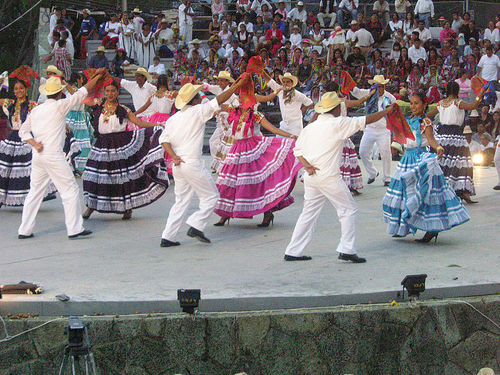
Popular Guelaguetza (free), Governor’s Guelaguetza ($40US). The word Guelaguetza comes from the Zapotec language and is usually interpreted as the “reciprocal exchanges of gifts and service.” Communities from within the state of Oaxaca gather to present their regional culture in the form of dance, music, costumes and food.

Local indigenous groups traditionally perform these dances to fulfill their obligations to their Uses Y Costumbres organized communities which is called doing your “tequio.”

Oaxaca has a large indigenous population, 40 percent, compared to 15 percent for Mexico as a whole. Indigenous culture in the state remains strong in its own right, with over 300,000 people in the state who are monolingual in indigenous languages. The celebration dates back to before the arrival of the Spanish and remains a defining characteristic of Oaxacan culture. Its origins come from celebrations related to the worship of corn as Oaxaca is considered it’s birthplace.

As the festival became a bigger tourist attraction, there was an inevitable backlash from purists that saw the ancient traditions being used for commercial purposes. The 2005 decision by the PRI Governor to conduct two performances a day for each of the two Mondays, was perceived by many traditionalists as a blatant attempt accommodate more ticket purchasing tourists. So the “popular” Guelaguetza, or a return to the more spontaneous celebrations of the pre-Columbian era, was organized.

In Oaxaca, where there is conflict between some groups and the state, the festival can become a focal point of contention.

Due to protests in 2006 against the state government calling for the fraudulently elected Governor to step down, the state-sponsored Guelaguetza was not held up on the hill at the Cerro del Fortín as planned. The protests were led by the Asamblea Popular del Pueblo de Oaxaca, an umbrella organization of teachers, human rights groups, political organizations, unions and others, which were met with state violence. Instead a free, “Popular Guelaguetza” was held by APPO.

The 2007 Governor’s celebration was again boycotted by APPO, and attempts to hold a Popular Guelaguetza were thwarted by government police repression. APPO members had barricaded the entrance to the Governor’s outdoor auditorium which resulted in the police killing of at least one and the disappearance of many others.

This year, the Governor attempted to build a protective cover over the stage of the state sponsored outdoor auditorium but it was not completed in time due to another boycott but also probably more by poor planning. Instead it will be held in an old baseball stadium. The Popular Guelaguetza is being held at an outdoor venue at the Technological University.

Well, that’s probably all you want to know about the Guelaguetza. Of more interest to many is the the annual Mescal Fair in Llano Park. $1.50 entrance fee and free samples from about 50 vendors. Whew!

Futbol Around The World

Futbol, as Spanish speaking countries call it, is the national game in Mexico and all Latin American countries and Oaxaca is no exception.  Americans call it soccer, I think mostly to distinguish the game played with a round ball from the game played with an oblong pointy one that refuses to roll on the ground in a straight line. Apparently the word “soccer” was the original name for the game in England where it was invented but that’s another story you can find on the web.

My kids played soccer in grade school and my oldest banned me from the games for being too loud and embarrassing the heck out of him. So here in Oaxaca even I have found it difficult to avoid the mania.  But the audio of the vuvuzela I downloaded onto my iPhone was pretty sick.  I watched Serbia and Ghana…then expecting to see the Americans play (a game they won) SKY TV immediately replayed the Serbians!  What was that all about?!! I won’t even attempt to speculate.

The restaurants in the zocalo (plaza) have TV monitors facing the sidewalk cafes where mostly young people huddle together…those who don’t go to the bars to watch anyway or depending on the time of day or night the game occurs…and many of them are European language students.  Yesterday Uruguay played Germany. The Europeans were in the minority and rendered pretty mute by the locals urging on Uruguay…the underdog. A table of young French girls were oblivious…tentatively tasting the black mole with barely a drop on the tips of their knives.  It was fun watching the looks on their faces. Either they were famished or they loved it because afterward not a bit was left on the plates.

My son, the chef at the American Club in Hong Kong, is napping.  Tonight (or rather tomorrow) the final between Spain and Holland will air at 2am.  He will open the restaurant…featuring free hot dogs and hamburgers…for those intrepid souls who will stay up.  No fun watching by yourself on the couch in front of your home TV…side-line coaching with friends and a little testosterone thrown in adds much to the pleasure.

Read More

4th of July in Oaxaca

Ironically the 4th of July was also the day of Mexican state elections. Exit polls last night showed that the PRI, the corrupt party that has ruled Mexican politics for over 70 years, was voted out nearly all over Mexico and even in Oaxaca. Well. We’ll see if the actual vote counts are commensurate. If the PRI contests the vote results this will end up in the courts…if not also in the streets.

Death To Criollo Corn In Oaxaca

Criollo corn is under attack in Oaxaca.  Hand made criollo corn tortillas are the prize find for any foreign foodie and for all local Oaxacans.  Industrial corn tortillas taste like sandpaper.  This reads like a detective novel in which Monsanto’s Washington-based communications company uses “phantom” or fake sources to derail a biologist’s career because he was demonstrating that genetically modified corn has indeed infested criollo corn fields.  In other words, the industrialists are fighting natural corn from within in order to make farmers dependent upon their products.

Phantoms in the machine: GM corn spreads to Mexico
MARIE-MONIQUE ROBIN
July 3, 2010

I LANDED in Oaxaca, Mexico, in October 2006. Nestled in the heart of a lush landscape of green mountains, the city is considered one of the jewels of the country’s tourist industry. I was here, however, to investigate contaminated corn.

On November 29, 2001, the scientific journal Nature had published a study that created a stir and drew heavy fire from the St Louis headquarters of North American multinational agricultural corporation Monsanto – manufacturer of the world’s best-selling herbicide, Roundup, and the world’s leading producer of GMOs (genetically modified organisms). Signed by David Quist and Ignacio Chapela, two biologists at the University of California, Berkeley, it found that criollo (traditional) corn in Oaxaca had been contaminated by Roundup Ready and Bt genes. (Bacillus thuringiensis is a bacterium that produces a protein toxic to some insects. The gene inside the bacterium – the Bt gene – is added to seeds such as corn to create genetically modified crops.)

The news was particularly surprising because in 1998 Mexico had declared a moratorium on transgenic corn crops in order to preserve the extraordinary biodiversity of the plant, whose genetic cradle was Mexico. Grown since at least 5000BC, corn was the basic food for the Maya and Aztec peoples, who worshiped it as a sacred plant.

Travelling around the indigenous communities of Oaxaca, I encountered everywhere women drying magnificent ears of corn coloured pale yellow, white, red, violet, black, or an astonishing midnight blue. ”In the Oaxaca region alone, we have more than 150 local varieties,” said Secundino, a Zapotec Indian who was harvesting white corn by hand. ”This variety, for example, is excellent for making tortillas. Look at this ear: it has a very good size and fine kernels, so I’ll save it to plant next year.”

”You never buy seeds from outside?”

”No. When I have a problem, I exchange with a neighbour: I give him ears for him to eat and he gives me seeds. It’s old-fashioned barter.”

”Do you always make tortillas with local corn?”

”Yes, always,” he said with a smile. ”It’s more nourishing, because it’s of much better quality than industrial corn. Besides, it’s healthier, because we farm without chemical products.”

”Industrial corn” means the 6 million tonnes of corn that flood in every year from the United States, 40 per cent of which is transgenic (modified by the introduction of genetic material from another species).

”Look,” said Secundino, holding out in his hand like a gift a magnificent violet ear. ”This corn was my ancestors’ favourite.”

”It existed before the Spanish conquest?”

”Yes, and now there is another conquest.”

”What’s the new conquest?”

”The transgenic conquest, which wants to destroy our traditional corn so industrial corn can dominate. If that happens, we will become dependent on multinational corporations for our seeds. And we will be forced to buy their fertilisers and their insecticides, because otherwise their corn won’t grow. Unlike ours, which grows very well without chemical products.”

IGNACIO Chapela, one of the authors of the Nature study, agreed to meet me at Sproul Plaza on the Berkeley campus. ”Small Mexican farmers,” he said ”are very conscious of the stakes raised by transgenic contamination, because corn is not just their basic food but a cultural symbol.”

It was an October Sunday in 2006, and the huge campus was deserted. Only a police car drifted by like a damned soul. ”That’s for me,” said Chapela. ”I’ve been closely watched since this affair started, especially when there’s a camera.” When I looked incredulous, he went on: ”You want proof? Come with me.” We drove to the top of a hill overlooking San Francisco Bay. As we walked towards the lookout point, we saw the same police car, parked conspicuously at the side of the road.

”How did you find out that Mexican corn was contaminated?” I asked, rather disturbed. Read More

6.2 Earthquake in Oaxaca

About 20 minutes after 2am last night, my friend Paula and I felt a pretty strong but momentary earthquake that woke us both up.

Reuters already had an article posted by 5:30 this morning in the NY Times.

The U.S. Geological Survey said the quake struck near the town of Pinotepa Nacional around 80 miles (125 km) southwest of the colonial city of Oaxaca, but police patrols checking surrounding towns did not report problems.

The USGS reported the quake as strong as magnitude 6.5 but later revised the figure to 6.2, also moving the epicentre slightly.

I have felt several of these here before but so far so good.

When We Don’t Know That We Don’t Know

I have begun asking myself, why is it so hard to put aside our assumptions that we have the corner on the truth and the other guy is dead wrong. (besides ego of course.)

I just read an essay in the NY Times by Erroll Morris, the filmmaker who made “Fog of War” (interview of Robert McNamara after the war in Viet Nam) and “The Thin Blue Line” and some other great films.  His thoughts are precipitated by a ludicrously botched bank robbery where a thief was told by someone he believed that by rubbing lemon on his face it would be hidden by the video cameras. It leads to the question, “Can you be too incompetent to understand just how incompetent you are?”

From NY Times
By Erroll Morris
June 20, 2010, 9:00 pm

The Anosognosic’s Dilemma: Something’s Wrong but You’ll Never Know What It Is (Part 1)

Morris:

David Dunning, a Cornell professor of social psychology, was perusing the 1996 World Almanac.  In a section called Offbeat News Stories he found a tantalizingly brief account of a series of bank robberies committed in Pittsburgh the previous year.

As Dunning read through the article, a thought washed over him, an epiphany.  If Wheeler was too stupid to be a bank robber, perhaps he was also too stupid to know that he was too stupid to be a bank robber — that is, his stupidity protected him from an awareness of his own stupidity.

Dunning wondered whether it was possible to measure one’s self-assessed level of competence against something a little more objective — say, actual competence.  Within weeks, he and his graduate student, Justin Kruger, had organized a program of research.  Their paper, “Unskilled and Unaware of It: How Difficulties of Recognizing One’s Own Incompetence Lead to Inflated Self-assessments,” was published in 1999.[3]

Dunning and Kruger argued in their paper, “When people are incompetent in the strategies they adopt to achieve success and satisfaction, they suffer a dual burden: Not only do they reach erroneous conclusions and make unfortunate choices, but their incompetence robs them of the ability to realize it.  Instead, like Mr. Wheeler, they are left with the erroneous impression they are doing just fine.”

It doesn’t speak to the healthy optimism that we are all familiar with but blind optimism (magical thinking?) When people are incompetent they may not know that they are incompetent.

Read More

He he! Andy Rooney on Women Over 50

In case you missed it on 60 Minutes, this is what Andy Rooney thinks about women over 50

60 Minutes Correspondent Andy Rooney (CBS)

“As I grow in age, I value women over 50 most of all. Here are just a few reasons why:

A woman over 50 will never wake you in the middle of the night and ask, ‘What are you thinking?’ She doesn’t care what you think.

If a woman over 50 doesn’t want to watch the game, she doesn’t sit around whining about it. She does something she wants to do, and it’s usually more interesting.

Women over 50 are dignified. They seldom have a screaming match with you at the opera or in the middle of an expensive restaurant. Of course, if you deserve it, they won’t hesitate to shoot you, if they think they can get away with it.

Older women are generous with praise, often undeserved. They know what it’s like to be unappreciated.

Women get psychic as they age. You never have to confess your sins to a woman over 50.

Once you get past a wrinkle or two, a woman over 50 is far sexier than her younger counterpart.

Older women are forthright and honest.. They’ll tell you right off if you are a jerk or if you are acting like one. You don’t ever have to wonder where you stand with her.

Yes, we praise women over 50 for a multitude of reasons. Unfortunately, it’s not reciprocal. For every stunning, smart, well-coiffed, hot woman over 50, there is a bald, paunchy relic in yellow pants making a fool of himself with some 22-year old waitress. Ladies, I apologize.

For all those men who say, ‘Why buy the cow when you can get the milk for free?’ Here’s an update for you. Nowadays 80% of women are against marriage. Why? Because women realize it’s not worth buying an entire pig just to get a little sausage!”

Andy Rooney is a really smart guy!  But he should have also added that they make better lovers.

Comfort From Morning Tai Chi

Early each quiet Sunday morning, sitting on my veranda, I watch a small group of people practicing their Tai Chi in the park below. This morning I ponder my birthday tomorrow.  How did I get to be 66 already? Then I see the old blind homeless guy who sleeps in the park.