Poor Oaxaca

Update wed:
Well, I hope the governor is good and embarrased after overstating the damage in Oaxaca and drawing intense international media attention. He has now issued a statement saying that 11 people are missing, no confirmed dead and 3-4 houses buried. Shhiishh!

Oaxaca has been inundated with two feet of rain in the last two weeks with record rainfalls for a month before that. The New York Times carried this report this morning:

A hillside collapsed onto a village in the southern Mexican state of Oaxaca early Tuesday, burying houses in mud and stones and trapping hundreds of people as they slept, state authorities said.

As many as 300 houses in the village of Santa Maria Tlahuitoltepec may have been buried in the landslide, said the state governor, Ulises Ruiz.

Rescue workers trying to reach the village with earth-moving equipment have been hampered by blocked roads in the remote area, which has been pounded by incessant rains. “We hope to reach in time to rescue those families who were buried by the hill,” Mr. Ruiz told Mexican television.

This is about 50 miles from Oaxaca City where I live. And the latest news report on CBC says they couldn’t even land one helicopter there today (!!)
People in Oaxaca are forming help centers and are asking for donations. This appeared in the Oaxaca group on couchsurfing:

Up to us a lot more responsibility now with the tragedy that has befallen the people of Tlahuitoltepec, Mixe. They can overcome this sadness is in large part on all of us! Let’s help these people with great history, traditions and poverty.

In my facebook profile for me, Rodrigo Guzman, I have the account number to which they can make donations, so you can donate nonperishable food, bottled water, beans, rice, sugar, canned goods, can opener, antiviral drugs, clothes in good condition, covers and mattresses in any of the collection centers that are opening throughout the state.

The other tragedy of the moment has to do with the Trique indigenous communities in the Mixteca region north of Oaxaca City.

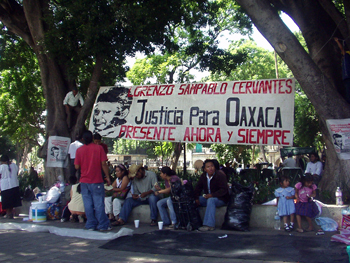
Three years ago, the indigenous Trique municipality of San Juan Copala, in the southern Mexican state of Oaxaca, declared itself autonomous from the government. Since that time they have faced severe repression, with community members being kidnapped, raped and assassinated by two state-backed paramilitary groups in an attempt to destroy the autonomous project. Two caravans bringing food and water to the town were driven back with several people murdered…one a Finnish human rights worker. The people have been driven out of their town and taken over by Oaxaca government allies.

Join Friends of Brad Will along with guests from Movement for Justice in El Barrio, to learn more about San Juan Copala, including a short documentary and video-message from residents of the autonomous municipality.

Friends of Brad Will is a national network working for justice for Brad Will, an American independent journalist murdered by state paramilitaries in Oaxaca in 2006.

As if all that wasn’t bad enough, a bridge to the Oaxaca airport has collapsed caused people to have to walk in and out.

Wish me luck driving down in mid-October.

El Grito 2010

EVERY 100 years, Mexico seems to have a rendezvous with violence as again the country gathered on Wednesday night for the ceremony of the “grito” — the anniversary of the Revolution…the call to arms that began the war for independence from Spain in 1910.

As they have on every Sept. 15 for 200 years, Mexicans gathered together in the central squares of our cities and towns, even in the smallest and most remote villages. At midnight, they heard a local governing official re-enact the grito uttered by Miguel Hidalgo, the “father of the fatherland.” They shouted, jubilantly, with genuine feeling: “Viva México!”

Euphoric cries were mixed with a flashy Mexico City military parade, a counter-bicentennial gathering, fresh outbreaks of narco-violence in different parts of the country and goads of symbolism that embodied the past, present and future of a nation of more than 100 million people. As the historic day faded, Hurricane Karl bore down on the state of Veracruz, already battered by this summer’s torrential rains.

At a ceremony in the town of Dolores Hidalgo, Guanajuato, the unassuming place where Father Miguel Hidalgo y Costilla launched the 1810 rebellion that resulted in Mexican independence 11 years later, President Felipe Calderon was greeted with a sprinkling of obscenities and unusual shouts. Some members of the audience reportedly yelled out “Viva El Chapo,” or “Long Live El Chapo,” in apparent reference to fugitive drug lord Joaquin Guzman Loera. “Death to the Bad Government!” also was heard.

Later, Calderon presided over a Mexico City military parade of about 23,000 Mexican army and navy personnel, including members of elite anti-narco units. While air force jets flew overhead, military delegations from 17 countries were on hand for the historic commemoration.

What’s that all about?!!!

The participation of a Federal Police contingent was an unusual feature of this year’s parade. As the emerging front-line force in the so-called drug war, the Federal Police headed by Genaro Garcia Luna is the institution favored by Mexico City and Washington to take over combat of organized crime from the army and the navy.

Meanwhile in Oaxaca more than 2,000 police and military personnel are guarding entry to the Zocalo as a security measure. Wed night was the Grito, and Thursday was the parade.

Against whom are they guarding? All we know is the ambulant vendors, the unions and protesters.

In Oaxaca El Grito belies a different kind of violence…one instigated by the PRI (the powerful party in control for the last 80 years) to pit one group of Trique indigenous people against another group seeking autonomy as the government had promised years ago. Read More

Why Are Americans Loud

A bit of information about the formation of the individual and national consciousness of people in the U.S.

Sorry for length, but this is mostly for people who are not “United Staters.” :))

We all know that the US was settled by people who had already rejected religious and political persecution. My own Polish great grandfather, when the Germans who had taken over the part of Poland they were in, toward the end of the 18th century, wanted to conscript the boys into the German army and only allow German to be used in the schools, said “hell no” and sent my grandfather and his older sister, 17 and 18 at the time, across the ocean in the middle of a harrowing storm, to find a home for their parents and the rest of their 10 siblings. Imagine that!

They worked in the mines in Illinois until they had enough money to rent farms. My husband’s German parents, fleeing the fury of Stalin in Ukraine, settled first in Canada and then lived in earth huts in North Dakota…carving out a life out of stone and mud. People were “bootstrappers.” They were “free thinkers” and were some of this countries first teachers. This is the stuff that this country was made of…and still is if only in the national consciousness.

Then came WWI and WWII. I don’t know if many people realize that “Americans” in the U.S. contributed a great deal of support to the war effort… especially by severe rationing. After the war, in the 50’s, there was a GI student loan program that enabled returning veterans to leave the farms and become educated and join the booming middle class…many donning suits to work hugely long hours in new businesses. (Man In The Grey Flannel Suit).

There was an economic rebound and people were able to enjoy all those material things they had never had before…buying washing machines, sewing machines, modern kitchens with sinks and refrigerators and all kinds of things produced by the industrial revolution. This was when the states became very materialistic. Families wanted to provide the things for their children they never had for themselves.

But the collateral damage was huge. The children of these families grew up feeling neglected by absentee fathers. Mothers and other women, largely uneducated, were kept out of the work force and except by a few brave vocal ones, became the “perfect” housewife. The culture became extremely conforming. A woman’s skirt, one inch above or below the norm was considered weird. By this time, in the late 50’s, with increased economic stability, children were entering college. They began to notice the materialism and lack of values. They began to feel stifled by the conformity and perceived hypocrisy. This spawned the Beat Generation:

From the “Free Wiki”:

The Beat Generation is a term used to describe a group of American writers who came to prominence in the 1950s, and the cultural phenomena that they wrote about and inspired (later sometimes called “beatniks”). Central elements of “Beat” culture included experimentation with drugs and alternative forms of sexuality, an interest in Eastern religion, and a rejection of materialism.

The major works of Beat writing are Allen Ginsberg’s Howl (1956), William S. Burroughs’s Naked Lunch (1959) and Jack Kerouac’s On the Road (1957). Both Howl and Naked Lunch were the focus of obscenity trials that ultimately helped to liberalize what could be published in the United States. On the Road transformed Kerouac’s friend Neal Cassady into a youth-culture hero. The members of the Beat Generation quickly developed a reputation as new bohemian hedonists, who celebrated non-conformity and spontaneous creativity.

The original “Beat Generation” writers met in New York. Later, the central figures (with the exception of Burroughs) ended up together in San Francisco in the mid-1950s where they met and became friends with figures associated with the San Francisco Renaissance.

This is what attracted kids later to the streets of San Francisco.

Meanwhile, “Old Leftists,” (largely Socialist and Communist) seeing the handwriting on the wall became vocal but were drummed out by a culture diametrically opposed to their political agendas. Union organizers were beaten by police at the bidding of robber barons.

In the late 50’s, Jerry Rubin lead the “Free Speech Movement” largely centered at the University of California at Berkeley. I have friends who were swept off the steps of Spraul Hall by water cannons during those demonstrations.

These were the spiritual predecessors of the next generation of “drop-outs” in the 60’s and 70’s…rebelling against conformity and lack of free expression. Kids left home to live on the streets or join “back to the earth” communes. (The Beatles “She’s Leaving Home” and songs by first Pete Seegar and then Bob Dylan). Conscientious Objectors fled to Canada rather than be drafted into the Viet Nam War. And they were “loud.”

Backpackers by the thousands hit the “Hippie Trail” that led from London to Kathmandu and found alternative cultures and values.

Those who initially objected to the involvement in Vietnam fell into three broad categories: people with left-wing political opinions who wanted an NLF victory; pacifists who opposed all wars; and liberals who believed that the best way of stopping the spread of communism was by encouraging democratic, rather than authoritarian governments.

The first march to Washington against the war took place in December, 1964. Only 25,000 people took part but it was still the largest anti-war demonstration in American history.

In 1967, a group of distinguished academics under the leadership of Bertrand Russell, set up the International War Crimes Tribunal.

In November, 1965, Norman Morrison, a Quaker from Baltimore, followed the example of the Buddhist monk, Thich Quang Due, and publically burnt himself to death. In the weeks that were to follow, two other pacifists, Roger La Porte and Alice Herz, also immolated themselves in protest against the war.

The draft increased the level of protest. Students protested at what they considered was an attack on people’s right to decide for themselves whether they wanted to fight for their country. Young men burnt their draft cards.

The Civil Rights Movement raged in the late 1960s. Anti-Vietnam War leaders began to claim that if the government did not withdraw from the war they might need the troops to stop a revolution taking place.
In New York, over a million people took part in one demonstration.

Eldridge Cleaver argued that blacks were being denied the right to vote in elections. Therefore, blacks were fighting in Vietnam “for something they don’t have for themselves.” As another black leader put it: “If a black man is going to fight anywhere, he ought to be fighting in Mississippi” and other parts of America.

The most dramatic opposition to the war came from the soldiers themselves. Between 1960 and 1973, 503,926 members of the US armed forces deserted. Many soldiers began to question the morality of the war once they began fighting in Vietnam.

In 1967, Vietnam Veterans Against the War was formed. They demonstrated all over America in wheelchairs or on crutches. People watched on television as Vietnam heroes threw away the medals they had won fighting in the war. (Senator John Kerry was one of these.)

Jerry Rubin and the Yippie movement had already begun planning a youth festival in Chicago to coincide with the Democratic National Convention in 1968. Students For a Democratic Society and the National Mobilization Committee to End the War in Vietnam, also made their presence known. In the end, 10,000 demonstrators gathered in Chicago for the convention where they were met by 23,000 police and National Guardsmen. And they were all very loud.

The Black Power and Brown Power movements threatened the “Establishment” “The Man.” They were loud. In 1968, at the Olympics in Mexico, the two Black medal winners held their black-gloved fists up during the national anthem.

The older generation and the conservatives by nature became confused and frightened. Society became divided. And is divided still. Libertarians have joined the New Leftists as if in two ends meeting in a circle in their demand for freedom for the individual. For the Libertarians and Constitutionalists, it means too much governmental power. With the world economic crisis, militias and the gun culture is growing…expecting a Mad Max world. Tea Partiers, on the margins, sick of “political correctness” and being made to feel guilty by the demands of the minorities are holding up misspelled signs. Glenn Beck is earning millions on Fox TV. The left has turned to blogs on the web. And they are all loud.

What has all this to do with the American personality? We are demanding freedom of expression and openness…politically and personally. There is a class war developing. Genteel behavior is just a reminder of the stifling 50’s and the superficiality and materialism it spawned. Gentility is also associated in many minds with the stifling cultures that “the Americans” fled in the last couple of centuries. Gentility is not considered very important in the scale of things. Backpacking leftists and tea partiers alike are extolling the “common man” against the monied oligarchy and abuse of governmental power. And they are loud.

Those on the sidelines, either have been greatly influenced by the continuum of popular and political culture eg some people in the south still fly the Confederate flag left over from the Civil War. Or are just not aware…busy making a living and/or raising kids. All these strands are immensely diverse depending on personal histories and the histories and cultures of the regions and states they live in, whether urban or rural, and anyone wanting to get a “feel” for the people would have to at least live there awhile but also travel extensively to see it. I would even go so far as to compare the states in the U.S. to the countries in the EU. Nearly impossible to make very many generalizations except for historical facts.

Whew!
Do You Follow Travel Warnings

I read travel warnings and take them into consideration. They are useful if detailed, recent and taken together with other sources of information. But in my opinion they are primarily a cover-your-ass thing. They are used by tour companies and exchange programs for the same reason…to mitigate against extreme criticism and lawsuits in case anything happens to a tourist both of which affects the bottom line as well as reputation.

The reason I don’t rely on them is because I have been in too many places that have received ridiculous travel warnings. In 2002 there was trouble in Kashmir, so the US state dept issued a warning for the entire country of India! We found out that even foreign businesses were ignoring it. We were, however, refused a visa extension in India…we think because of the warning.

There is a large amount of local and expat hostility in Oaxaca where I live because of travel warnings and expats who live here just roll their eyes and shake their heads when they are issued. In 2006-7 there was a popular uprising and yes people were killed…killed by government thugs trying to take down the leaders. An American Indymedia videographer was also killed…by a govt thug. The result was that hotels, guesthouses and other businesses were closed and hundreds if not thousands of people lost their jobs. Mexico depends largely on tourism so alarmist warnings can decimate the local economy.

I was in Thailand during the coup in 2006 If you didn’t know the coup was going on you wouldn’t know anything was happening. Same thing this April and May 2010 in Bangkok when tens of thousands of demonstrators occupied the two high-end hotel/shopping and business districts and upwards of 90 of them died including 4 journalists.

My guesthouse was only a couple sky train stops from the main staging area. But if I didn’t know what was going on I would never have known by just going out to the street. A friend and her husband were staying in their condo just a couple blocks away from the staging area and never saw anything. Most local violence is directed by locals against locals. My guesthouse workers were a great source of info. At least one of them joined the demonstrators every day after work.

I think the important thing is to take responsibility for your own safety by talking to locals, comb the internet travel forums for eye-witness information,  find out who is doing responsible tweeting, which political and personal blogs to pay attention to and read the local press…most countries have English-language news sources. Ask locals what they think of them. It didn’t take me long to know the score in a general way. Probably the most useful thing when you are in a country is to talk to long-term expats. They are probably better sources of information than the locals because they monitor the situation for themselves and usually know all sides of an issue.

And PAY ATTENTION! I was in the Saladaeng business district of BKK as late as 5pm just a few meters away from the military the day they entered it. They were all hunkered down in the overhead skytrain flyways. Everyone expected them to try to rout the demonstrators there but no one knew when. My pharmacist said, come back tomorrow and I will have your meds. I said, oh yeah???!! You could feel the tension in the air. I didn’t go back and sure enough that night and the next day locals and tourists alike were gravely injured in attacks that included tear gas and bullets with more than one local killed.

I follow Thai politics because my son lives there and I go there often so was reading and hearing rumors long before the trouble started. All you have to know is the political history of a country to know when there will be trouble. Most of us know beforehand when we are going to a country. Start researching as soon as you know.

Often an issue will quickly develop into a crisis WHILE you are there…not before, even if you are aware of the political environment as with the two events in Thailand.

I learned my lesson to research when I decided to move down to Oaxaca June 1 2006 although it wouldn’t have made a difference really. I got off the plane at night…got up in the morning in the hostel and went outside to explore. Much to my surprise I found 70,000 striking teachers camping in all the streets of the Centro. I moved into my pre-arranged apartment and 4am on the 14th woke up to gunshots, church bells and helicopters. The municipal police were trying to rout the teachers from their encampment in the Zocalo (central plaza).

This was to be my biggest education about corrupt governments with no rule of law, no economic development with money going into pockets instead, poverty, popular uprisings, history, US foreign policy, and bureaucrats in the pockets of foreign companies and a frightened middle class that I had ever had…first hand.

I spent the next 7 months reading, video taping, taking photos, documenting, witnessing and reporting until the President of Mexico finally sent in the federal riot control police in November who swept the Centro, picked up a couple thousand people off the streets, (not one foreigner) beat up a lot of them and hauled them to jail…raping some. This time, however, we saw it coming and I and some friends drove up to a mountain pueblo for the day even though if you are not participating tourists will be left alone.

No one wants an international run in. In Mexico this includes the narcos who will shoot the marijuana growers and runners if they make trouble with tourists. The locals wanted us out there because it made them feel safer and more difficult for the government to lie…although it did not stop it entirely.

It was amazing how similar the causes, uprising and government response was in Thailand. If you are already there develop local contacts and do some more research. One of the best immediate ways of gauging the environment is by following the tweets of the place you are going or are in.

Editorial comment: I tell people that if they find themselves in a country with upheavals going on for heaven’s sakes, don’t complain because it is “ruining your vacation.” You are in their country and they are in charge of making their history. They are not there to entertain the tourists unless their jobs depend on it.

Having said all that you will hear about the random tourist who will get into trouble.  But to provide some perspective I recommend reading “World’s Most Dangerous Places” by Robert Young Pelton. Here’s what he has to say:

“The United States has a very comprehensive system of travel warnings,” says Pelton, “but conveniently overlooks the dangers within its own borders. Danger cannot be measured, only prepared against. The most dangerous thing in the world,” he says, “is ignorance.” Welcome to Dangerous Places…”no walls, no barriers, no bull” it says in the preface. “With all the talk about survival and fascination with danger, why is it that people never admit that life is like watching a great movie and–pooof–the power goes off before we see the ending? It’s no big deal. Death doesn’t really wear a smelly cloak and carry a scythe…it’s more likely the attractive girl who makes you forget to look right before you cross that busy intersection in London…

It helps to look at the big picture when understanding just what might kill you and what won’t. It is the baby boomers’ slow descent into gray hair, brand-name drugs, reading glasses, and a general sense of not quite being as fast as they used to be that drives the survival thing. Relax: You’re gonna die. Enjoy life, don’t fear it.

To some, life is the single most precious thing they are given and it’s only natural that they would invest every ounce of their being into making sure that every moment is glorious, productive, and safe. So does “living” mean sitting strapped into our Barca Lounger, medic at hand, 911 autodialer at the ready, carefully watching for low-flying planes? Or should you live like those folks who are into extreme, mean, ultimate adventure stuff…sorry that stuff may be fun to talk about at cocktail parties, but not really dangerous…not even half as dangerous as riding in a cab on the graveyard shift in Karachi.

Living is (partly) about adventure and adventure is about elegantly surfing the tenuous space between lobotomized serenity and splattered-bug terror and still being in enough pieces to share the lessons learned with your grand kids. Adventure is about using your brain, body and intellect to weave a few bright colors in the world’s dull, gray fabric…

The purpose of “Dangerous Places” is to get your head screwed on straight, your sphincter unpuckered and your nose pointed in the right direction.”

Right on!!

BTW, in addition to an ice storm in the NW upon my arrival and the tsunami in Thailand while I was there (that almost took the lives of my son and his wife), I am developing a certain reputation and friends are jokingly warning me to stay away from them. 🙂

Window Closes…Another Opens

New York Times
The Summer That Ended All Summers
By JOSH WEIL
Published: August 21, 2010
Leverett, Mass.

No one — not the doctor in Cairo with his egret-feather hair and bad-news eyes; not the spinal surgeon, with his broad Egyptian shoulders and eagerness for the knife — knew how it happened. It might have started during Ramadan, out by the pyramids, on a spine-rattling, bareback gallop. It might have happened 13,000 feet up in the Alpine swamps between Uganda and Congo, as I leapt from tussock to tussock with 50 pounds of gear on my back.

But whatever caused the disc to burst and splatter against my spinal nerve, it brought the endless summer of heat and adventure that I had found while living in Northern Africa for a year suddenly, surely, to an end.

Ever since I was a kid, I’d lived for summer — and, until a few years ago, sharing it with my older brother was what brought summer to life. We used to crouch on the bank of the Deerfield River where it wound south of Vermont, taking turns blowing up our Kmart raft, bulge-cheeked and frog-eyed, our mouths on the inflation valves, dizzy and sputtering with laughter. We’d buckle on bike helmets, paddle into the rapids and spill.

If you’ve ever been hurled head-first into white water, you know the feeling: your world upturned, your hold on it spun loose, the current pitching you forward so fast you struggle to grasp what has happened to time. When you come up to breathe, the air is pure exhilaration.

Read More

Mexico Rethinks Drug Strategy

As death toll rises, Mexico rethinks drug war strategy

By TIM JOHNSON
McClatchy Newspapers

MEXICO CITY | The drug war in Mexico is at a crossroads.

As the death toll climbs above 28,000, President Felipe Calderon confronts growing pressure to try a different strategy — some are even suggesting legalizing narcotics — to quell the violence unleashed by major drug syndicates.

Many Mexicans don’t know whether their country is winning or losing the war against drug traffickers, but they know they are fatigued by the brutality sweeping parts of their nation. For example:

Eighteen people were killed at a July 18 birthday party in Torreon, the capital of the state of Coahuila. A prison warden freed the assailants and lent them vehicles and assault rifles to do the killing.

In Durango, eight severed heads were left strewn around the state one late July morning. Outside of Monterrey, soldiers discovered a mass dumping ground of victims of the drug wars containing 51 bodies.

During Calderon’s tenure, gangs have killed 915 municipal police officers, 698 state police, and 463 federal agents, said the Secretariat of Public Safety.

Beyond the drug trade’s public violence, its corrupting aspects have affected many aspects of Mexican society.

“There are powerful interests in Mexico who benefit from the drug trade and the $40 billion, or whatever it is, that is pumped into the Mexican economy,” said Scott Stewart, vice president for tactical intelligence at Stratfor, an Austin, Texas-based company that provides global analysis. “You’re talking bankers. You’re talking businesses that are laundering money, construction companies that are building resorts.”

When the huge drug trade boils into the public eye, it threatens another of Mexico’s major trade channels — tourism, the nation’s third-largest source of revenue, and generator of one out of every 7.7 jobs in Mexico.

Fighting the cartels
Read More

Why I Am An Expat In Oaxaca Mexico

As for me, the best kind of traveling for Pico Iyer, the travel writer, is when he is searching for something he never finds. “The physical aspect of travel is for me,” he says “the least interesting…what really draws me is the prospect of stepping out of the daylight of everything I know, into the shadows of what I don’t know and may never will. We travel, some of us, to slip through the curtain of the ordinary, and into the presence of whatever lies just outside our apprehension…” he goes on to say. “I fall through the gratings of the conscious mind and into a place that observes a different kind of logic.”

Being a wanderer, says Alain de Botton in “The Art of Travel”, crossing different lands among people who speak languages strange to one’s ear…meditating dreamily to the rhythm of train wheels, allowing the sounds of the world to be one’s mantra, enables one to grow…to transcend one’s known life. The silence of being alone (much like being on retreat in a monastery) without the ease of familiarity allows one to stand outside oneself… large sublime views and new smells revealing new thoughts and emotions…thrilling or disappointing aspects of oneself…here-to-for hidden from one’s awareness.

If we find poetry in tattered old men weaving home on bicycles, a grateful charm in smiling young country girls… and a shared intimacy in the look of recognition in the eyes of kindred travelers we have found “an alternative to the ease, habits and confinement of the ordinary rooted world.”

Introspective reflections revealed by  new places and people much different than us may reveal hidden thrilling or disappointing aspects of ourselves.  Thrilled by finally learning the geopolitics of another people and learning that there are many valid ways of living in the world other than ours.  Disappointed at discovering we have limits to our tolerance for what we judge as inefficient or unsanitary.  So as another travel writer says “it is not necessarily [only] at home that we encounter our true selves. “The furniture insists that we cannot change because it does not; the domestic setting keeps us tethered to the person we [think] we are in ordinary life…who may not be who we essentially are,” says the author.

I love to travel alone. Traveling companions can keep us tethered to our predefined idea of ourselves. They may expect certain reactions from us that obligates us…underneath our awareness…forces us to accommodate in a way that feels unnatural. Or in our companion’s desire to have their own experiences, they may not have the patience to reciprocate and share. In traveling alone we are free to connect with what and whom comes our way.  We are more approachable.

Robert Young Pelton nailed it for me though when he said in his “World’s Most Dangerous Places” “living is (partly) about adventure and adventure is about elegantly surfing the tenuous space between lobotomized serenity and splattered-bug terror and still being in enough pieces to share the lessons learned with your grandkids. Adventure is about using your brain, body and intellect to weave a few bright colors in the world’s dull, gray fabric…”

The purpose of his book, he says, “is to get your head screwed on straight, your sphincter unpuckered and your nose pointed in the right direction.”

I retired in 2002, rented out the house long term and “went on the road.” I traveled for the next four years but then got sick of piling on and off buses, trains, planes, taxis, boats and all other manner of transportation…and packing and unpacking.

I returned to the states and for 4 months went from the computer to the TV and back again. One day, I thought, I could just die in this chair. Go for a walk? Where? Around the neighborhood block? Have to get in your car…and then go where? A coffee shop? I was bored to death. Not that there are not a jillion activities I could have participated in. But why? I felt I had done all I wanted to do there. Bored by a country I had spent 60 years in and bored by a town I spent 40 years in. I am not attached to the place and the culture….although I do miss incredibly sweet raspberries and strawberries in the spring and cherries and peaches in the fall…picked by migrants from here and sold cheaply in the US due to their cheap labor.

One son is in Hong Kong, one in Thailand and one in Las Vegas. No grandchildren. My grandparents immigrated from Poland and Ireland but died before or just after I was born…no extended family to speak of and the ones I have are all ranchers in Montana…a physical and intellectual world away.

My friends and former co-workers are scattered from “hell to breakfast” as we say.   Generally speaking, with only one or two weeks of vacation a year,  Americans don’t frequently travel outside the country.  So, “Oh,” you say, “in Thailand…” And then the veil comes down over the eyes and that is the end of that!

Many of my friends that I have now, I met on the road and keep in frequent contact through skype, email and Facebook. I have learned that “community” doesn’t have to be a physical place. It can be virtual. Guess I have, as Pico Iyer puts it…a “global soul.”

No roots to speak of…in a physical sense. I HAVE learned, however, after witnessing incredible poverty and injustice in the world, to value much more all those things (my roots) we as Americans take for granted…but they are internalized and remain with me wherever I live…independence, self-sufficiency, efficiency, innovation, freedom of thought and speech, an appreciation for the rule of law and government with relative separation of powers and relative lack of collusion and corruption. I said “relative.”

So…long story short…what I realized I wanted now, was a daily life that was interesting and full of small enjoyments. And to search for an understanding of a culture I will never find. So I moved to Oaxaca. I chose Oaxaca because it is in the mountains which I love and the weather is temperate year round. I also chose Oaxaca because I had worked with many farmworkers in Oregon who were from here and I found the people to be real.

Music everywhere. Rockets, fireworks going off. Church bells to wake you up in the morning. Processions, Fiestas. Protest marches, daily walks around the Centro…(I have arthritis so I need to walk) always discovering new little cafes and other places of business. And am trying to understand that when my Mexican friend says “I will see you manana he may mean tomorrow, next week or next month or never! Ha!)

I am learning to cook “Oaxacan” so going to a different little market for specialty items…mole and rare chilis at the Merced, Friday market tienges in Llano Park for meat and vegetables is a joy. A hundred small vendors selling everything you can imagine…and great chivo (BBQ goat) with consumme or tacos with hand-made tortillas.  I love to feed my friends and couchsurfers and watch them delight over estofado or mole.

Five blocks to the tree-filled Zocalo (plaza) where I can sit for hours in one of the little sidewalk cafes surrounding it over coffee or beer with friends who wonder by…both local and expat. There are 16 different indigenous groups from small mountain villages that are easily accessible whether 1 hour or 7 hours away. Or I just sit on my veranda overlooking a lovely park to read. Or the news junkie that I am, peruse the internet for the latest via my WiFi…amid wafts of dance music coming from the nearby cultural center.  Or visit with a friend over Pechuga Mescal. On Saturday and Sunday mornings I watch people practicing Tai Chi in the park below. Or video-skype one of my sons.

And then there is learning and practicing the language…a challenge to keep the brain from totally disintegrating.

Of course my social security and pension goes farther here. But it’s not the reason I am here.  Friends in the U.S. say” but why do you want to live in Mexico?  It is so poor!”  You don’t know poor until you’ve gone to India or black Africa.  Or they worry that I will get kidnapped or shot.  The narcos leave the tourists alone…they only kill each other or people who get in the way. And that is mainly in the border areas.  I feel very safe here.

I don’t know how long I will be here.  Much of it depends on my health. A debilitating or chronic condition would require me to go back to the states in order to be covered by medicare.  But for now, I enjoy the daily small things.  I still do travel periodically…mostly to Asia. In fact I just returned from 8 months away….6 of it in Thailand and Hong Kong.  But I live in a culture I will probably never understand.  It’s rewarding and enlivening to push my boundaries and try.

Oaxaca: Who is Permitted to Earn Money, and Where?

Taken from NarcoNews:

The Real Battle for Oaxaca: Who is Permitted to Earn Money, and Where?
“The lesser officials manage the street scene, but also the professionals, vendor bosses, who run a crew of ten or a dozen”

By Nancy Davies
Commentary from Oaxaca

August 17, 2009

A plague of ambulatory vendors annoy the tourists sipping cappuccinos in the Oaxaca zócalo. Beneath the cafe umbrellas vacationers, often with their families, don’t want to be pestered. They have disposable money; smart vendors head for the “whities”. The peddlers, here called ambulantes, have changed. A decade ago I could greet the same few — a family who sells homemade candy, Jorge who sells rebozos, AltaGracia who sells place-mats and table runners—all “inherited” their peddler’s licenses from parents, or so they tell me. During 2006, they suffered —no tourists, no sales. AltaGracia, a vital woman with a nice smile, lost almost all her teeth in the past two years.

waiting-for-permissi.jpg
Vendors waiting for permission

D.R. 2009 – Photos Nancy Davies
Who are the new ambulantes? Women from Chiapas, recognizable in wool wrap skirts and braided hair, selling beads and Chinese rubber chickens. Children follow behind, or if they’re nursing, nuzzle a breast and lunch on the go, like busy business-people must. Children vend by themselves if they are over eight or nine, thin-legged, endlessly circling in their plastic shoes. Others Oaxaqueños sell handmade wooden toys, or canes, or plastic necklaces.

On the corners the sellers of raspas station their ice-carts, and the popsicle vendors and soda vendors criss-cross the square.

Stationary vendors descend for any and all fiestas, to set up on the sidewalks their blouses and “hand-made” tourist goods, tortillas and comals for cooking food, oil cloth covered tables and iron benches or stools -a carnival atmosphere. In the background the blaring music. The permanent puestos (the booths which might or might not be taken down at night) smothered Bustamante Street, supplemented by sidewalk vendors with lettuce and radishes and fruits in season. Las Casas Street has been jammed for so long that I think of it as my favorite street, for its “true to life” confusion. The shopkeepers complain, probably with good reason —there’s hardly space to enter.

Welcome to hard times. The slippage of the Oaxaca (and Mexican) economy can be calculated by the numbers of vendors multiplied by the number of fiestas. Read More

Police Kick Vendors Out of Oaxaca Zocalo

Wondering around in the Zocolo (plaza) Monday, my friend Paula, who has lived here before, was approached by some young girls with a questionaire for tourists and asked if she had been to the Guelaguetza…or if she had been to see the reenactment of the Princess Donaji legend or any other official  related event of which she had attended none.

But she announced that she HAD been in the Zocolo that morning when the Municipal Police ignominiously strutted in with their flak jackets, shields and rifles to throw the street vendors out, releasing tear gas,  injuring four, detaining eight (mostly local hippie looking jewelry-makers who were standing up for the rest of the vendors who are mostly indigenous people from the mountains)  and sending tourists and locals alike into a frightened flurry to get out of the way.

It is not clear whether the vendors had a permiso to be in the zocalo but this is not the first time they have been thrown out over the years.  Maybe they didn’t pay their mordida (bribe to the city)?  This happened at the same time that the out-going Governor was giving his welcoming speech at the Guelaguetza so I guess he figured most of the tourists wouldn’t witness what was happening in the zocalo.

Read More