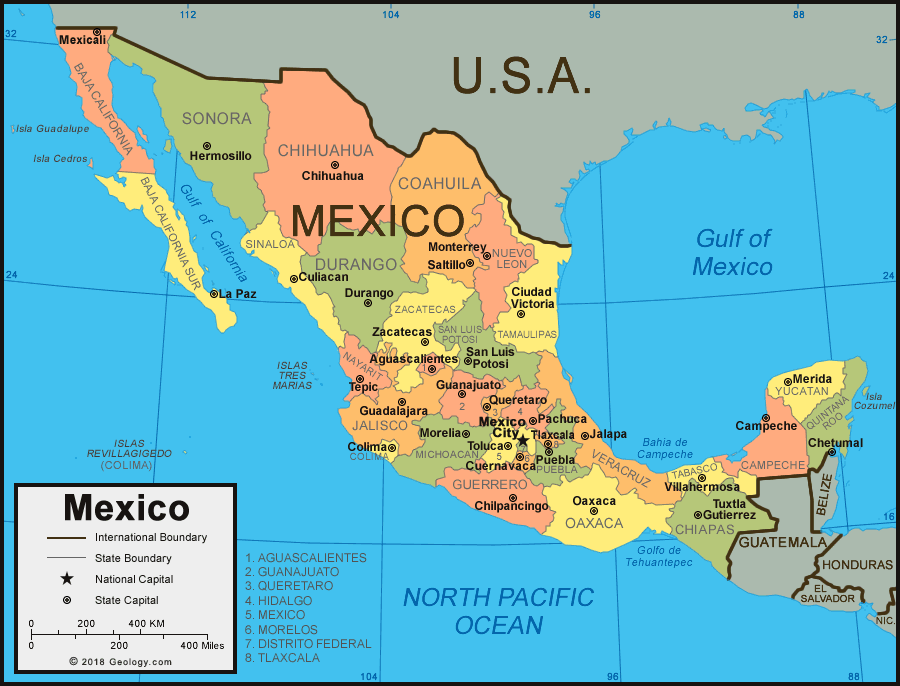
Where is Oaxaca
A lot has happened since my last blog entry in 2017!
After the September 1917 earthquake along the coast of Oaxaca, I asked a friend, David Venegas, to go with me to take some tarps for people left without shelter. When we returned, David’s mom was hospitalized and died. He had graduated from Chapingo University as an agronomist but had been working as a waiter. I fell and had a back injury earlier, so I offered to have him live with me to help me with lifting and translating since he was fluent in both Spanish and English.
Then I moved from my apartment to a big 3 bedroom house with a big back yard and little adobe casita with it’s own bathroom and shower for David to live in.
For the purposes of this blog I am ignoring that trump and the pandemic ever happened.
Since then we have acquired a little Mexican Hairless Puppy.

Josh was here 10 days and Polly the last 4 of that. Oh my gosh! Two cooking classes and a full day Mescal Tour. And shopping, walking, shopping, walking! Tasting menus at two restaurants, El Destilado and Pitiona and a third meal at Origen! And that doesn’t count the Tlacalula Market, Benito Juarez and November 20 Markets!
Someone posted on a Couchsurfing 50+ discussion site this question:
Were You A Hippie? It got me to thinking. Long and deep.
Educated in a Catholic college prep school, my first doubts about the oppressive aspects of both religion and popular culture were given expression by reading, in high school as a teenager, Catcher In The Rye by J.D. Salinger. And “Siddhartha”-Hermann Hesse (1922) and “Razor’s Edge”-Somerset Maugham.
In my view, all hippies were counterculture but often for various reasons. Much of it was not ideological but was just adolescent rebellion against authority. So young people grew their hair long and dressed sloppy and purposely often dirty and freely engaged in sex.
The worldview of hippies and political activists alike included a make the world better mindset based on a combination of Eastern philosophy and secular Humanism. For some this meant nebulous peace and antiwar and all-you-need-is-love. For others this meant an active attempt to do something practical. They didn’t think the Hippies had a program.
I did some browsing on the internet and found this on Wikipedia.
European Roots Of The Counter-Culture Movement
Between 1896 and 1908, a German youth movement arose as a countercultural reaction to the organized social and cultural clubs that centered around German folk music. Known as Der Wandervogel (“migratory bird”), the hippie movement opposed the formality of traditional German clubs, instead emphasizing amateur music and singing, creative dress, and communal outings involving hiking and camping.[16] Inspired by the works of Friedrich Nietzsche, Goethe, Hermann Hesse, and Eduard Baltzer, Wandervogel attracted thousands of young Germans who rejected the rapid trend toward urbanization and yearned for the pagan, back-to-nature spiritual life of their ancestors.[17] During the first several decades of the 20th century, Germans settled around the United States, bringing the values of the Wandervogel with them. Some opened the first health food stores, and many moved to southern California where they could practice an alternative lifestyle in a warm climate.
About the same time Henry David Thoreau, a Transcendentalist, wrote “Walden,” a reflection upon simple living in natural surroundings, and his essay “Civil Disobedience,” originally published as “Resistance to Civil Government,” in the mid 19th Century was an argument for disobedience to an unjust state.
Over time, young Americans adopted the beliefs and practices of the new immigrants. One group, called the “Nature Boys,” took to the California desert and raised organic food, espousing a back-to-nature lifestyle like the Wandervogel.[18] Songwriter Eden Ahbez wrote a hit song called Nature Boy inspired by Robert Bootzin (Gypsy Boots), who helped popularize health-consciousness, yoga, and organic food in the United States.”
The song has been recorded by David Bowie and others and was part of the Moulin Rouge movie soundtrack.
Historical Roots in the U.S.
“Birth of the Cool”
The World Wars and Great Depression spawned a ‘beat generation’ refusing to conform to mainstream American values which lead to the emergence of the Hippies and the counterculture.
The “Beat” writers had picked up the lingo of Black musicians in the 40’s who were using the terms “hip” and “hep” and “hep cat.” This was the birth of “cool” and they were called “Beatniks.”
In 1962-64 in college we were having beat parties where we wore black turtleneck sweaters and leotards, drank cheap red wine and listened to Miles Davis and beat poetry like “Howl” by Allen Ginsberg (written in 1955 BTW) with candles burning in old wine bottles. And reading Kerouac and Alan Watts.
So the proliferation of the counterculture movement actually started in the late 50’s way before you saw any “hippies.” Right after the end of WWII the GI bill enabled returning men to get an education and become successful businessmen and their wives could enjoy leisure time with newly acquired wash machines and nice kitchens. The social environment was excessively restrictive after the chaos of the war when adults wanted predictability and order. The middle class rose like a sphynx. Families were headed by “The Man In The Grey Flannel Suit,” a play of the same name, and dutiful wives played highly defined roles. To not be thought weird, dresses on women had to hit at exactly the right spot on the calf.
But their children rebelled against absentee fathers working long hours and restrictive roles for women and moral rules. They left home for freedom and the sexual revolution. The Beatles sang “She’s Leaving Home.”
Women began rebelling too. The Feminist Movement grew and women started meeting in “Consciousness Raising” groups. Women started wearing “granny” dresses and Mini skirts. The hell with dresses hitting that “right” spot on the calf. Guys grew their hair long in defiance of societal expectations of the male. Dress length on women and hair length on men became very symbolic making a political statement.
Psychedelics
The writer has some interesting comments on the book “Hillbilly Elegy.”
“The solution needs to be that the white poor and the white working class needs to get together with black and brown folks and figure out a way to fight for a better system.”
I remember working for the Peace and Freedom Party in LA in the 60’s. The party was a socialist reaction to the politics of the “Old Left.” The idea was that it was better to join a coalition of black and brown folks to fight the system from within. The old left would come to the meetings and start fist fights. The party elected our next door neighbor to go to Minnesota to nominate Eldridge Cleaver (“Soul On Ice”) at the party’s convention to run for president in the 1968 election. Then Robert Kennedy and King were taken out as was John Kennedy before.
It was a fantasy. You saw posters saying EVOLUTion instead of REVOLUTION. But the Old Left insisted on spouting party line to distinguishing themselves from the political system. And they still are but are marginalized now. But the P&F party still exists in CA and is going national now that Bernie is on the scene.
But the big mistake was that this was not a party that included the working class. It was a party of the Berkeley free speech intellectuals in tie dye t-shirts who the workers couldn’t relate to.
A lot has happened. In 1964 Mario Savio, the spokesperson for the Free Speech Movement, gave his “Rage Against The Machine” speech atop a police car on the Berkeley campus. Now Antifa (antifascists) who are insisting on political correct speech on college campuses, are fighting the Alt -Right in the streets who are insisting on “free speech!” Ironic!
Every morning my friend writes a fantasy perception of fascist life and posts it on Facebook. Today he writes:
“Salem. The Terrorism and Resistance Mitigation and Compliance people have been sweeping the city, picking up everyone in sight. Half the barista’s are in detention, and the streets are littered with propaganda leaflets. A man walks past the coffee house window, holding up a rear-view mirror to see who might be following him. A woman walks into the cafe with a license plate attached to her purse. Everyone’s ordering Xanax espressos.”


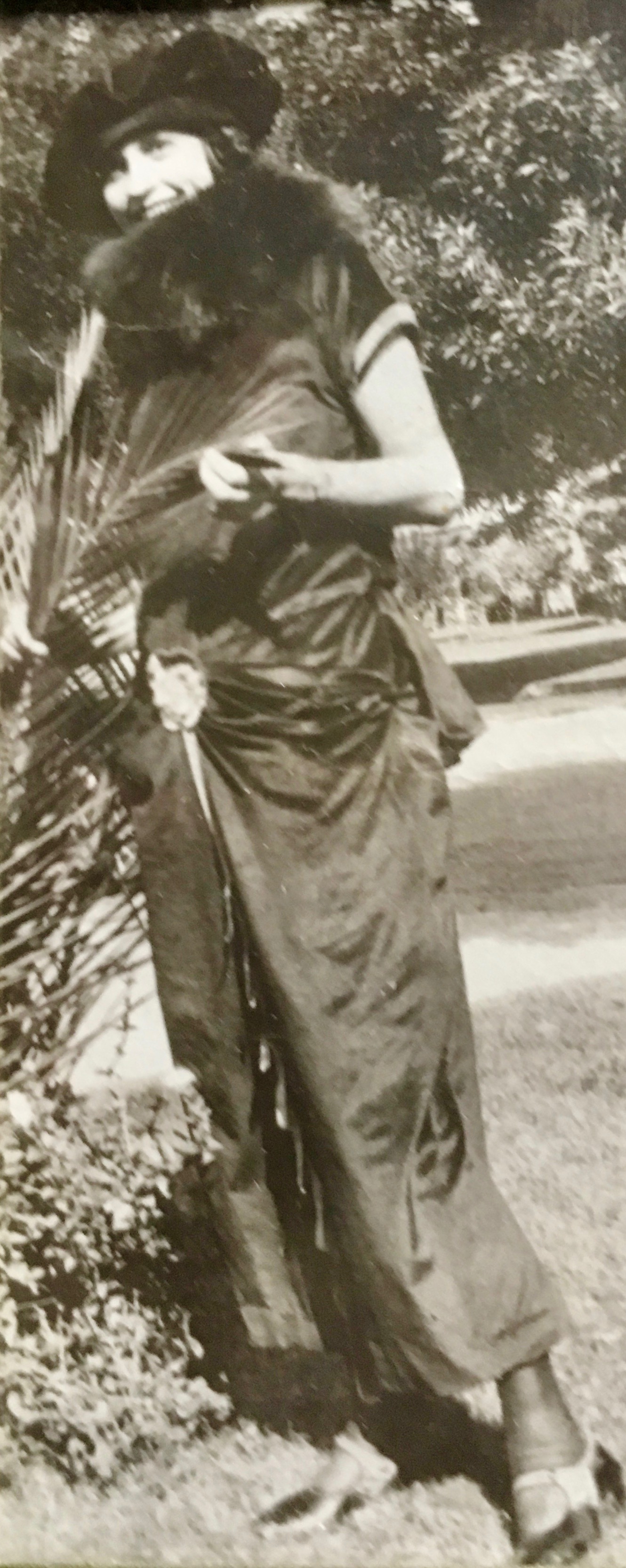
Born 1900 in Spring Valley, Illinois of first generation immigrant parents from Poland. She had no idea what was ahead of her.

Here in Oaxaca I think I know more local young ones than older ones. Of course it helps that the younger locals often speak English even if just a little and between my Spanish and their English we do fine. And they are happy to practice English. In fact yesterday 4 young art students came to study using my free wifi. I gave them some beer and put on some New Zealand reggaton. It made them happy. And we practiced speaking a bit.
It’s really interesting to be able to get young views of Mexican culture vis a vis the different generations here. And what they think about Mexico and the hopes and fears they have for themselves in the future. Being young they are more open to discussing the more controversial aspects of the culture and the politics here with someone they feel safe with. I try to be as explicitly unbiased as I can and just listen.
Most of the younger ones I know are really into self-sufficiency. There is a round table at the Universidad de la Tierra that was established by Gustavo Esteva each week. A few years ago, he took about 25 students to four countries for a year…to study local self sufficiency methods…Thailand, New Zealand, Tanzania and the last being Oaxaca. And to stand their patronizing do-good mind set on it’s head. One girl from Texas I hosted almost had a breakdown on the program because it confronted her whole do-good world view. We spent hours debriefing. A couple years later she returned to Oaxaca with her Caribbean boyfriend and they stayed with me. Another one on the program was Malaysian who had been going to school in Maine and I got to stay with her and her parents in Kuala Lumpur and even meet her Chinese grandparents who had been quarantined during the war by the Japanese. I didn’t even know about the Japanese in Malaysia during the war!!!
Meeting those kids, because I hosted some of them through Couchsurfing, was so enriching because I already had been reading about the work that Gustavo and Ivan Ilych did together on “unschooling” when Ivan was still alive. Gustavo is in his 80’s now and not well so you don’t see much of him around. He has written extensively.
Gustavo has had a most interesting trajectory. Grew up in a Zapotec family in the Etlas in Oaxaca. Got a good education. Studied at Harvard. Worked as an exec for Coca Cola, got a high up job in the Mex govt…then one day he went back to visit his Zapotec grandmother and saw clearly for the first time how integrated or not the culture was with their economic survival in a neoliberal world. He did a 180 and has been fighting neoliberalism ever since. And opened Universidad de la Tierra in Reforma focusing on self sufficiency.
As for why I am here and not somewhere else…I lived with a Mex-American family for 4 years of high school and then worked on behalf of the migrant community for 30 years…most of whom were from Oaxaca and for the last 10 years developed and administered a violence prevention/alternative ed program for Latino high school dropouts. I loved the families we were working with from Oaxaca and mentored several of the girls from the Mixteco. I wanted to come see the culture where they all were from and what made them who they are. 10 years later I am happily still here. But it is sad that we cannot find an authentic culture at home and have to “borrow” someone else’s.
 Laughingnomad