Climbing In Nepal

Bob climbs mountains in Nepal, including Everest base camp, on two different occasions…in 1998 and in 2000. I’m waiting for him to tell his own story. He likes
layovers in Bangkok especially.

The cultural heritage of the Kathmandu Valley is illustrated by seven groups of monuments and buildings which display the full range of historic and artistic achievements for which the Kathmandu Valley is world famous. The seven include the Durbar Squares of Hanuman Dhoka (Kathmandu), Patan and Bhaktapur, the Buddhist stupas of Swayambhu and Bauddhanath, and the Hindu temples of Pashupati and Changu Narayan. The valley is a UNESCO World Heritage Site.

Bob Climbs Kilomanjaro

HF0m0NezqDnitkljwNP8lg-2006188095850902.gif
Kilomajaro.jpg

Marengo Route.jpg
BobatKilomajaro.jpg

Bob’s Report:

Curious how one thing leads to another. It all started at the local fitness club. In the bravado of a post-workout discussion we proposed adventures that would be a goal to keep our workouts both frequent and intense. The suggestion that appealed to us was to climb Mt. Rainier in Washngton State. We decided to do it and six months later realized that the effort was similar to running a marathon with risk, thrill, and danger elements thrown in.

Subsequent to the climb, I found myself on the mailing list of a prominent climb leader. His brochures detailed the many climbs he had scheduled for the next year. I skimmed one pamphlet that described plans for a Mt. Kilomanjaro climb in Kenya and filed it in a corner of my desk pile as being impossible. But as I reread the brochure several times over the ensuing weeks I began to think, “why not?” “What am I waiting for?” Eventually I sent in a deposit and had another goal for which I needed to maintain regular workouts.

Istanbul Turkey

According to political geograpy Turkey is half in Europe and half in Asia. But since it is ethnically and culturally closer to the Middle East I have categorized as such. With its strategic location on the Bosphorus peninsula between the Balkans and Anatolia, the Black Sea and the Mediterranean, Istanbul has been associated with major political, religious and artistic events for more than 2,000 years. Its masterpieces include the ancient Hippodrome of Constantine, the 6th-century Hagia Sophia and the 16th-century Süleymaniye Mosque and other historical sites. It is a UNESCO World Heritage Site.

On the way back from the Kyrgyzstan trek we stayed over a week in Istanbul before taking the plane back to the states.

Staying in a little guesthouse in the Sultanahmet area, we were within walking distance to the Blue Mosque, Hagia Sophia and the Old Bazaar. I enjoyed a traditional Turkish Bath in a beautiful huge centuries old bath house with stained glass ceiling letting muted sun filter below. I was scrubbed clean by a lady…and then led to lie nude along with other women on a huge slab of marble that was heated from below. Lovely.

An older gentleman from the trek was laying over in Istanbul too and staying in the same guesthouse. We planned on meeting him for a breakfast out but when the time came and went we became concerned. The next day he told us of his “adventure.” He had woken early and decided to walk down to the wharf to watch the fishermen bring in their haul. Unfortunately he met up with a couple guys who decided he was good for a few dollars. They forced him into a car, drove around for a couple hours all the while demanding his wallet. But this old guy was indomitable and stubbornly refused to give it up. Finally, his captors let him out. But he had no idea where he was. It took the better part of the rest of the day for him to find his way back. At least he was left in one piece!

The underground cistern was particularly interesting. No longer used for water, a walkway led past a statue of a head of Medusa…turned upside down and placed under a supporting pillar. Quite the Turk comment on a historical dispute with Greece.

The food was glorious…complex flavors of aubergine, tomato and spices blended perfectly together. Ummmmmm.

But a week in Istanbul…let alone in Turkey…was far too short. I will return.

A Dacha In Samarkand

7Z3XBdt3hLmJjqkmk2I6k0-2006190121351559.gif

After coming off the Kyrgyzstan trek, Peter, our trip leader, had arranged for us to go to Samarkand in Uzbekistan before continuing on up to Tashkent for the flight home via a week in Istanbul Turkey.

Beautiful…magical Samarkand…with more history than you can imagine. The population (412,300 in 2005) is the third-largest city in Uzbekistan and the capital of Samarkand Province. The city is most noted for it’s central position on the Asian Silk Road between China and the west.

We stayed at an old Russian “dacha” (summer home) used by Communist party members before the break-up of the Soviet Union.

Everyone was excited about a real shower, a real sit-down toilet and real beds. You line up there for toilet paper…someone said…pointing to a heavy babushka (old woman) sitting officiously behind a small table in the entry way. “No! No! Not tonight,” she grumbled loudly. “Tomorrow morning…toilet paper!” We were incredulous! But the sit-down toilets have no paper….we groaned. “No, No, Not tonight” she repeated. Someone else’s room didn’t have electric lights so an old guy was sent off to investigate…never did find out if light was discovered. Some rooms had tv’s with snowy reception of Russian programs…we were hoping to get some news but there was nothing we could decipher.

So gratefully, we all sat down on real sit-down benches at a real table in the garden outside the dacha for a feast after 18 days and nights eating on the ground. There was a smattering of Russians who joined us that were not on the trek…police…Peter said. One, who had too much too drink, bragged menacingly about how much power he used to have and now he was nobody. “Don’t answer him,” Peter advises.

Despite its status as the second city of Uzbekistan, the majority of the city’s inhabitants are Tajik-speaking. In 2001, after several abortive attempts, UNESCO inscribed the 2700-year-old city on the World Heritage List as Samarkand – Crossroads of Cultures.

The Registan

7Z3XBdt3hLmJjqkmk2I6k0-2006190121351559.gif

samar6.jpg
It is said, the sand was strewn on the ground to soak up the blood from the public executions that were held there until early in the 20th century. The Registan is where Tamerlane stuck his victims’ heads on spikes, and is where people gathered to hear royal proclamations, heralded by blasts on enormous copper pipes called dzharchis. But it obviously could be only before the first of charming historical buildings had been constructed, because Tamerlane died in 1405.

The Registan is composed of three Madrasahs. A Madrasah is a medieval Moslem clergy academy.

Registan_2_b.jpg
One of the three madrasahs of the Registan is Ulugbek Madrasah (1417-1420), on the west, was finished in 1420 and contains mosaics with astronomical themes. The Ulugbek Madrasah has an imposing portal with lancet arch facing the square. The corners are flanked by the high well-proportioned minarets. Mosaic panel over the entrance arch is decorated by geometrical stylized ornaments. About 100 students were taught the sciences, astronomy, and philosophy in addition to theology.

Registan_3_b.jpg
The Sher-Dor Madrasah (1619-1636) on the east was completed in 1636 as a mirror image of Ulugh Beg Madrassa, except with decoration of roaring lions, in blatant violation of Islamic rules. The harmony of large and small rooms, exquisite mosaic decor, monumentality and efficient symmetry put the structure among the best architectural monuments of Samarkand.

Registan_5_b.jpg
The Tilya-Kori Madrasah (1646-1660) in between was completed in 1660, with a golden decoration and with a pleasant courtyard. It was not only the place of training students, but also it played the role of grand mosque. It has two-storied main facade, vast courtyard fringed by dormitory cells with four galleries along axes. Mosque building is situated in the western section of the courtyard. The main hall of the mosque is abundantly gilded.

samar3.jpg

Exotic History Of Samarkand

7Z3XBdt3hLmJjqkmk2I6k0-2006190121351559.gif

From Wikipedia:

At times Samarkand has been the greatest city of Central Asia, and for much of its history it has been under Persian rule. Founded circa 700 BCE it was already the capital of the Sogdian satrapy under the Achaemenid dynasty of Persia when Alexander the Great conquered it in 329 BCE. Under Sassanid Empire of Persia, Samarkand flourished and became one of the most important cities of the Persian empire.

From the 6th to 13th centuries it grew larger and more populous than modern Samarkand and was controlled by the Western Turks, Arabs (who converted the area to Islam), Persian Samanids, Karakhan Turks, Seljuk Turks, Karakitay, and Khorezmshah before being sacked by the Mongols in 1220. A small part of the population survived, but Samarkand suffered at least another Mongol sack by Khan Baraq to get treasure he needed to pay an army. The city took many decades to recover from these disasters.

In 1370, Timur the Lame (Tamerlane) decided to make Samarkand the capital of his projected world empire, which extended from India to Turkey. For the next 35 years, he built a new city, populating it with artisans and craftsmen from all of the places he had captured. Timur gained a reputation for wisdom and generosity, and Samarkand grew to become the center of the region of Transoxiana.

His grandson Ulugh Beg ruled the country for 40 years. In Samarkand, Ulugh Beg created a scientific school that united outstanding astronomers and mathematicians. He also ordered the construction of an observatory; it contained a gigantic but precision-made marble sextant with an arc length of 63 meters.

In the 16th century, the Uzbek Shaybanids moved their capital to Bukhara, and Samarkand went into decline. After an assault by the Persian warlord Nadir Shah, the city was abandoned in the 18th century. The Emir of Bukhara forcibly repopulated the town at the end of the 18th century.

In 1868, the city came under Russian rule, when the citadel was stormed by a force under Colonel A.K. Abramov (1836-1886). Shortly thereafter the small Russian garrison of 500 men were themselves besieged. The assault was led by Abdul Malik Tura, the rebellious elder son of the Bukharan Emir, together with the Bek of Shahrisabz, and the attack was beaten off with heavy losses. Abramov, now a general, became the first Governor of the Military Okrug which the Russians established along the course of the River Zeravshan, of which Samarkand was the administrative centre. It later became the capital of the Samarkand Oblast of Russian Turkestan, and grew in importance still further when the Trans-Caspian railway reached the city in 1888. It became the capital of the Uzbek SSR in 1925 before being replaced by Tashkent in 1930.

Serendipity In Tashkent

7Z3XBdt3hLmJjqkmk2I6k0-2006190121351559.gif

In September of 1995 we flew into Tashkent, Uzbekistan from New York City on Uzbekistan Airways on our way to join an REI trek into the mountains in Kyrgyzstan. The night before we left home, we ran into a friend who told us that a couple of his friends from Salem, Oregon were in Tashkent working for USAid. He emailed his friends ahead of our arrival and they welcomed us at our hotel.

On our return from the trek we met up with them again when they took us to a U.S. Embassy party where upon walking in we see a guy from Roseburg Oregon (two hours from our home) barbequing hamburgers….and baked beans and potato salad on the table….a most welcome sight after two weeks in the mountains eating lamb and cabbage!

This cosmopolitan city of 2.3 million people is Central Asia’s hub and the fourth biggest in the Commonwealth of Independent States after Moscow, St. Petersburg and Kiev. It is situated in the middle of the Eurasian landmass and is better connected by international flights than any other city in the region. Rebuilt after the 1966 earthquake, Tashkent is the very model of a modern Soviet city..concrete apartment blocks including great parade grounds around solemn monuments. The older part of the city is a sprawling Uzbek country town with fruit trees and in every courtyard hidden behind secure walls where in one our tour group enjoyed an open air Uzbek meal under meandering grape vines.

Tashkent is half Russian-speaking and as in the rest of the country includes Slavs, Koreans, Caucasians and Tatars. Traditions of the old Silk Road still linger as Uzbeks consider themselves good traders, hospitable hosts and tied to the land. 85% of the people claim they are Sunni Islamic but only about 3% are practicing.

A shabby hotel was home for the week in Tashkent. A Russian babushka was stationed on each floor…a hold-over from Soviet days…to miserly dispense toilet paper, see to laundering your clothes and direct desiring gentlemen to local brothels.

The Russian-built underground metro in Tashkent, filled with striking artwork, is the most beautiful we have seen anywhere in the world. The metro was designed as a nuclear shelter and photos are strictly forbidden. We used these smooth fast trains to visit some of the many colorful open air farmers markets or bazaars around the city.

Trekking in Kyrgyzstan

7Z3XBdt3hLmJjqkmk2I6k0-2006190120654814.gif

The fall of 1995 Bob and I joined an REI adventure tour company based in Seattle Washington on an 18 day trek in the highest and most dramatic part of the central Tian Shan mountain range of south Kyrgyzstan in Central Asia.

Uzbekistan Airways, flying in from New York, landed in Tashkent Uzbekistan where we visited a couple from our home town of Salem Oregon who happened to be there as volunteers for USAID. We had told our friends via email where we would be staying, but upon failure of the phone system, they simply slipped a note under our door, a local custom in lieu of telephones, letting us know where and when to meet them.

When we arrived at a restaurant parking lot to board the bus, to our dismay, we found several Uzbekis hovered over many and myriad motor parts lying on the ground. “Have some tea,” they said as they pointed toward a nearby tea house, “and we will be ready soon!” Riiight…we thought. To our relief, after watching them reassemble the inner workings of the motor for an hour, we were motioned back to the bus by Peter, our trip guide.

To reach the trekking area in Kyrgyzstan it was necessary to cross a small oddly carved out thumb of Tajikistan from Uzbekistan. However, the two countries don’t get along and when we arrived at the Tajik border the guard held up the bus…apparently wanting baksheesh to let us pass. Peter was adamant about not wanting to set a precedent of paying them off so there we sat in the hot sun, eating the best melon we have ever had in our lives to quench our thirst. Finally, Peter had the driver take a roundabout road across the Fergana Valley to reach our staging area in Kyrgyzstan where the driver had to pull some very crooked logs over a stream to get the bus across…we chose to wobble across on our feet.

Aksu.jpg

The trek included walks up breath-taking beautiful stream-filled and flowered valleys and over high ridges to more valleys. Shepherds from their permanent homes in the lowlands summer their sheep and horses on the grassy mountain-sides. Sheer glossy Ak-Suu peak, one of the world’s best extreme rock-climbing destinations that had just before opened up to climbers since the fall of the Soviet Union glinted at the head of the glacial valleys. The first sobering day saw a climb team carry out a dead British compatriot that had fallen off the peak.

nomads.jpg

As we leisurely meandered up the trails, children of the local nomads would come running, sometimes with a kettle of tea or chay in their hands, yelling “pen!” “pen!” Have pen? Pens and paper are the most prized gifts, although Peter discouraged us from giving the kids anything…preferring to have them see us as friends rather than a rich Western source of material goods.

Alaska.jpg

Peter’s favorite “gift” was to bring photos of the locals that he had taken on previous treks in the area. The amazed smiles and giggles of the nomads that had never seen themselves in a picture was tear-jerking.

twoincentralasia.jpg

Every couple days, locally hired shepherds carried our gear on horses over narrow mountain trails to succeeding camps…the trek trip just before ours losing a horse hundreds of yards to a river below. We would set up our own tents. The potty was a hole dug out behind some rocks. In the mornings chay (tea) was brought to our tents to get us awake. In the evenings, Victor, our Russian cook, would wok up a delicious dinner like stew of spicy laghman (noodles) with cabbage and lamb bought from the locals. Dumplings (chuchvara) fresh yogurt (ayran) and home-made bread with raspberry jam and butter (sary may) kept us filled up.

After dinner at night, Peter, in real life a young non-practicing attorney from Colorado, would regale us with his rock climbing and trekking stories. One day he stumbled across a friend on the trail, a professional climber from Idaho who was checking out the newly opened climb area. A motivational speaker in the states, he mezmerized us that evening with a story of an Annapurna climb in Nepal during which a Russian climbing partner became disoriented and insisted on going up the line instead of down during a storm. The Russian was never seen again. Right at the climax, before we could find out what happened to the poor climber, we saw a huge lingering flash of red hot color fill the western sky! Only later, reading an English language paper in Istanbul Turkey on our way home, did we find out that it was the Russian manned space flight returning to earth in Kyrgyzstan.

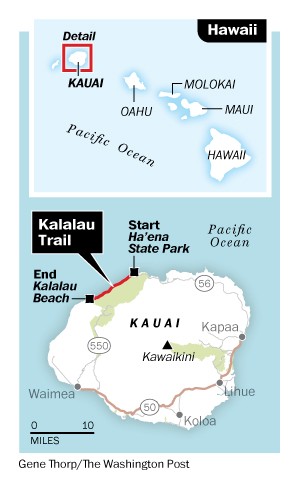
Na Pali Trail Kauai Hawaii

After our son Josh graduated from Whitman College, he joined his former roommate and friend, Phil, in Kauai where they were to spend a couple years working and repairing some cottages that belonged to Phil’s dad near Poipu Beach that were damaged in a hurricane September 1992.

Hurricane Iniki caused more damage than any other hurricane to affect Hawaiʻi since records began. It hit the island of Kauai as a Category 4 on September 11. Iniki caused almost $2 billion in damage, mainly to Kauai. It remains the second costliest East/Central Pacific hurricane on record, only behind Hurricane Paul in 1982. Six died as a result. Iniki brought winds of 140 miles per hour (230 km/hr).

Phil’s dad’s house, closer to the beach, was lifted clear off the concrete pad. For weeks afterward people were finding papers and objects they knew belonged to him because he was a well-known Methodist minister on the island.

Bob and I took the opportunity visit Josh while he lived on the island. We hiked the Na Pali Trail, which, in retrospect probably wasn’t a good idea. But what did we know was up ahead. Namely a trail along side the mountain…very very narrow trail…with a vertical drop of 300+ feet to the ocean rocks below. At times all we had to hang onto were branches of bushes and trees. Alas we turned back before we got to the hippie beach.

When the work on the cottages was done, Josh worked for a restaurant in the nearby Hyatt Hotel. He was offered a promotion but opted to quit and go to culinary school. Phil, who had been an art major is an artist and stay at home dad while married with two children in Seattle. For Josh the rest is history.