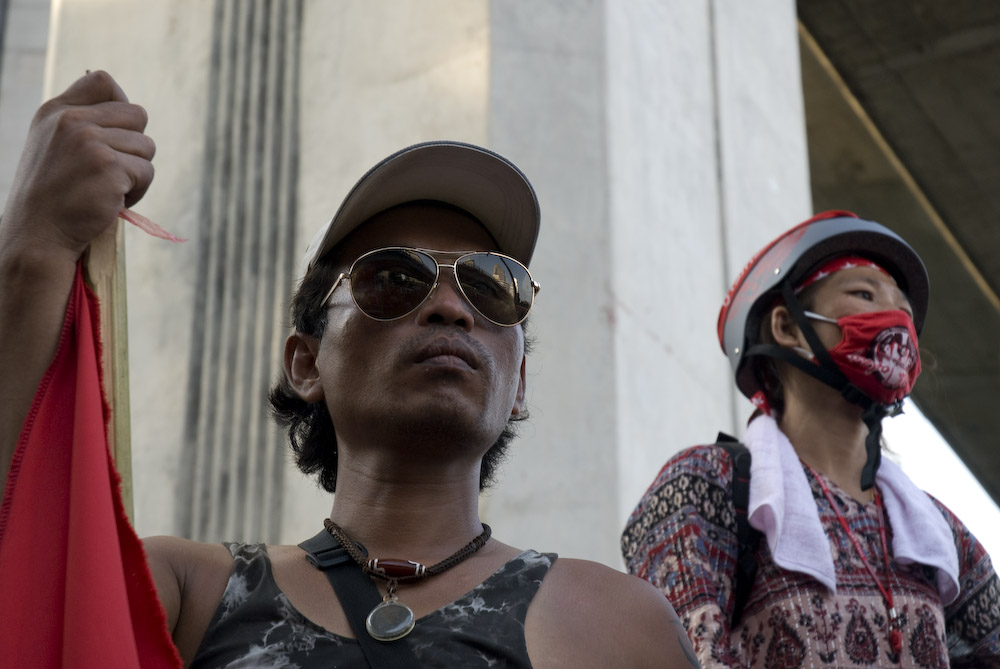
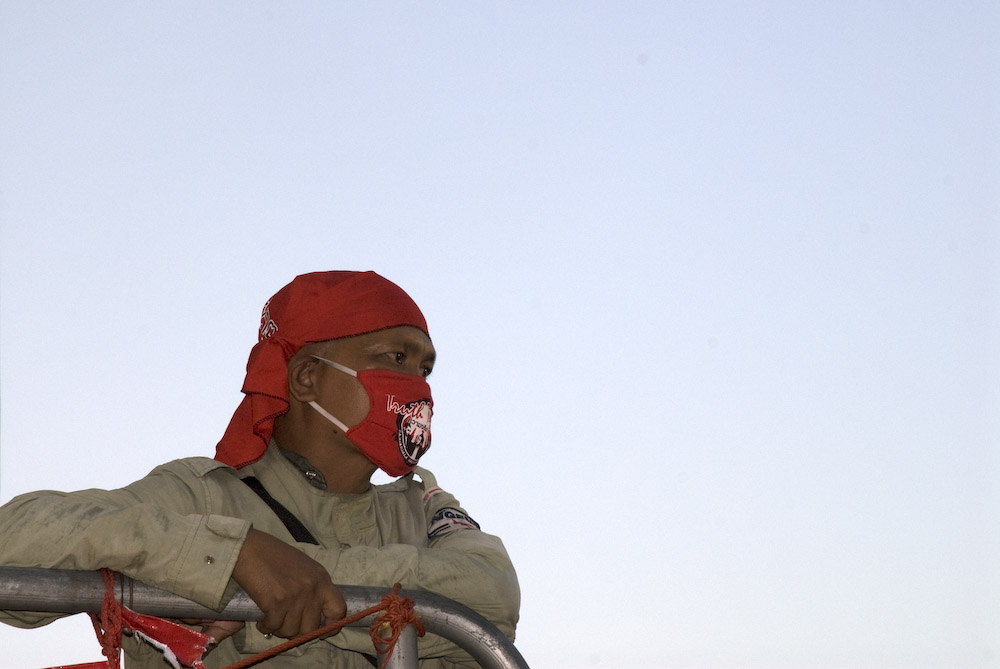
Panel Discussion On Thai Conflict At FCCT

Six weeks have passed since the mostly upcountry Reds launched protests in Bangkok and two since the occupation of Ratchaprasong intersection. Prime Minister Abhisit Vejjajiva has not wavered in his resolve to stay on as premier amidst calls for him to step down, and the country remains in an increasingly intractable crisis with no clear end in sight.

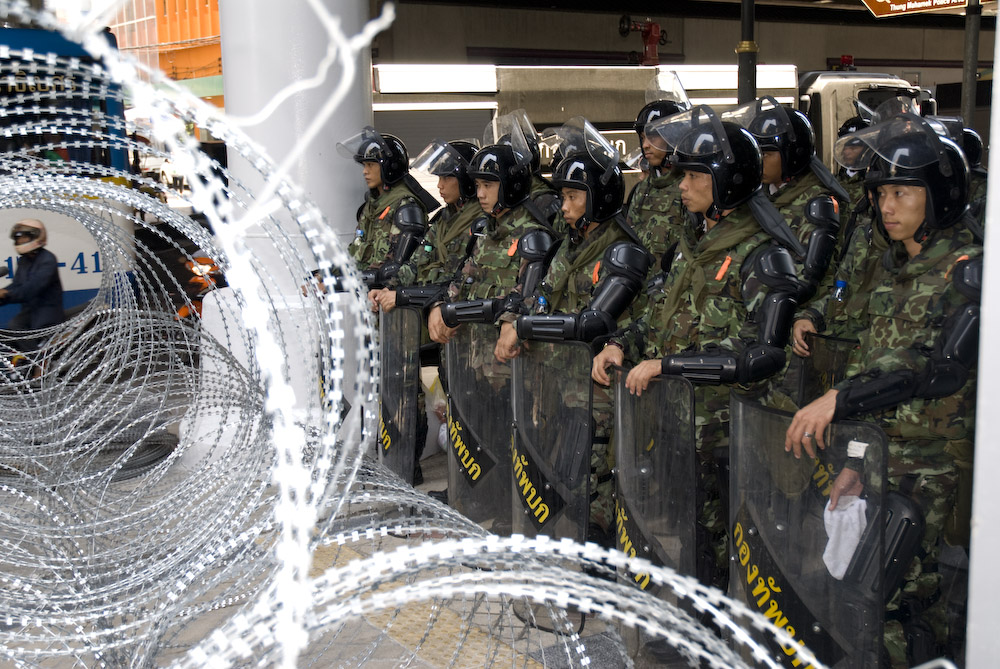
Thailand’s ongoing political impasse reached it’s most recent boiling point on Saturday April 10 when troops clashed with red shirt protesters leaving 25 dead and 840 injured.

Last night, Thursday April 22, at the very moment that the grenades were going off at the Sala Deang sky train station, the second Red rallying site, the Foreign Correspondents’ Club of Thailand was hosting a panel discussion on the conflict to speculate on what could possibly be done to end it with any lasting results.  The presenters, however, weren’t about to expose themselves politically by giving any clear answers even if they had any.

The panelists:
-His Excellency Lennart Linnér, Ambassador of Sweden to the Kingdom of Thailand since 2007 stressed the need for the international community to speak out and for responsibility of the press to not distort the facts which could possibly further divide the country and tip it into chaos and possibly civil war.

– Prof Thanet Aphornsuvan, former Dean of Liberal Arts at Thammasat University where he currently is the Associate Professor of Liberal Arts. He brought his perspective from his student days as an activist during the 1972 riots that left hundreds dead. He said that in spite of what you think about the Reds, the mainly agricultural and poorly educated people from upcountry, that that population has now become politicized which may be the point at which the people begin to stop looking up to the “caretakers” (or the elite if you want to call them that) for answers and instead become participatory members of Thailand’s democracy, such as it is, which has never happened before in the history of the country. He also spoke of Thailand’s need for it’s governmental structure to become “modernized,” whatever that means to him, and more participatory. To many of us, it implied a reference to the future of the Monarchy.

– Prof Gothom Arya, director of the Research Centre for Peace Building at Mahidol University. Professor Arya taught electrical engineering at Chulalongkorn University in 1997 and subsequently became an Election Commissioner until 2001. After that, he was Chairman of National Social and Economic Advisory Council. He spoke about the possibility (or not) of negotiation and peace-making at this point in the conflict where both sides have only become more entrenched in their positions due to the tactical errors of the government. For example, why was it necessary to issue an emergency decree which only served to place the government in the position it is in now wherein to follow the rule of law they would be required to unleash the military on thousands of it’s own citizens who are refusing the order to disband. They were a nuisance, he said, but were they really a threat?

My question: At what point does rhetoric cease to become free speech but instead a means of inflaming enough anger to send a country into anarchy. The Reds have been saying since the beginning that they intend to burn down the city. I don’t know Thailand’s position on free speech. I have been thinking about a similar issue a little closer to home…the fiery rhetoric of radio commentators like Rush Limbaugh and Glenn Beck and the others at Fox News that are continuing to distort the truth for millions of an uninformed electorate. To what extent is their rhetoric causing a meteoric rise in the number of extremist militias in the U.S.? To what extent will we follow what is happening in Thailand now and try to bring down a corrupt government through violence instead of the ballot box? But this discussion is for another day.

– Dr Pijaya Nagavajara, director of BMA General Hospital (Klang Hospital), the nearest hospital to the clash area that had a capacity of around 80 beds but had to triage and treat over 800 hundred injured and dead people the night of April 10. Definitely could put him into that arrogant attitudinal category of the “elite,” in my opinion! One amazing fact: “his hospital,” (he repeated this at least 30 times) the nearest to the site of the melee, is public, and injured Thais are required to go their first to be triaged before being shipped out again to other farther-flung and private hospitals. My physician husband who was with me just shook his head.

In a few minutes, at 4pm Friday April 23, the supposed pro-government “no coloreds” or “rainbows” will gather at the Royal Plaza… promising to bring in 100,000 people. Renaming this group of people doesn’t take away the fact that they are really led by the Royalist PAD, and you can be sure they and their Yellow Shirts, who held the Government House hostage for 193 days and took over the airport in 2008, will be among them. Their fiery leaders were impressive speakers at the meeting I attended with a Yellow Shirt friend last Saturday at Rangsit University. They decided at this meeting (or before) that if the government and the Reds didn’t resolve the conflict in 7 days they were “coming out.” Did we see them at the Sala Deang sky train station on Silom Rd last night? But hey, today is Friday, “and it is the 7th day!”

No one expects an end to this any time soon. But to end this on a lighter note, you should have seen my husband, who is here from his home in Jomptien Thailand to visit me in Bangkok before I leave, scamper past the Red’s encampment, down Sukhumvit from the Maneeya building, to the nearest Chid Lom sky train entrance last night after the FCCT meeting! LOL
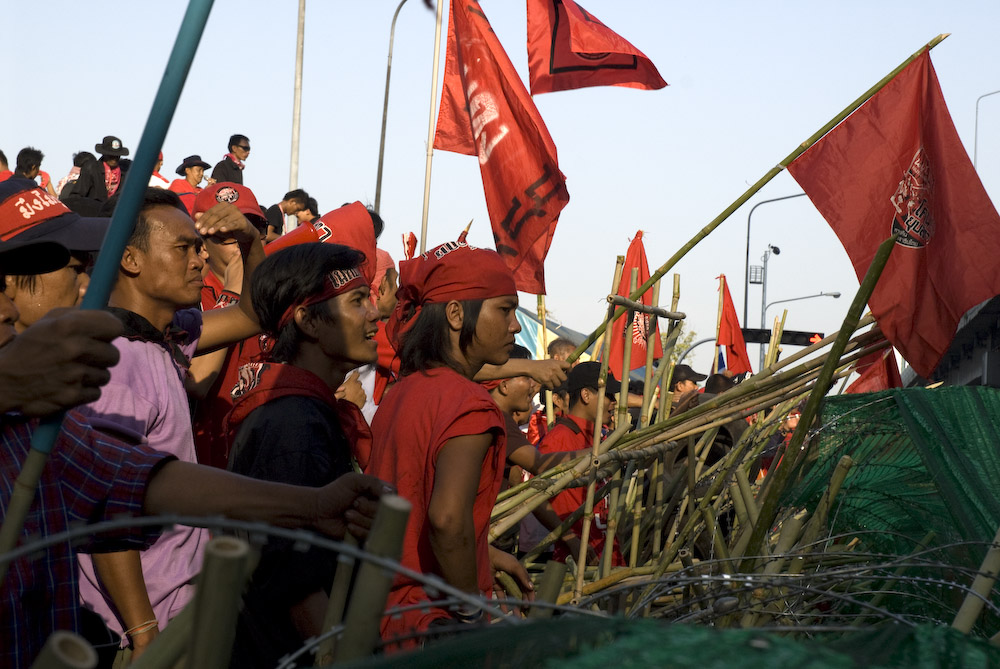
Thailand’s Colors…and Red Shirts and Watermelon Soldiers

Taken from an article in Time

In Thailand, people literally wear their politics on their sleeves. The nation has been locked for years in a paralyzing political showdown between two camps. There are the red shirts, who support former Prime Minister Thaksin Shinawatra, who was ousted in a 2006 military coup and later convicted in absentia of abuse of power. And there are the establishment yellow shirts, who back current Prime Minister Abhisit Vejjajiva. On March 12, around 100,000 red shirts, whose numbers are drawn largely from Thailand’s poor rural regions, began descending on Bangkok by bus, truck, boat and tractor for what they deemed their final stand: a massive march to force the yellow-backed government to hold elections, which the reds believe will favor them. “Relinquish power and return it to the people,” went the rally cry from protest leader Veera Musikapong. (See pictures from Thailand’s April 2009 protests.)

The protests are the latest in a years-running to-and-fro between the groups. In 2008, the yellows occupied Government House, the nation’s seat of power, for three months. Later they hijacked Bangkok’s two airports for a week, a disaster for a tourism-dependent economy. Last year, after a yellow-supported government took office, the reds swarmed an international summit at a seaside resort, forcing the emergency airlift of foreign leaders. That was followed by a scarlet siege of Government House, a takeover that culminated in Thailand’s worst political violence in nearly two decades.

Thailand’s color obsession extends beyond politics. Every day of the week has a shade. Born on a Wednesday? Your lucky color is green. Saturday is ruled by the color purple. Thailand’s beloved King Bhumibol Adulyadej entered the world on mellow-yellow Monday, which is why for years millions of his loyal subjects have voluntarily worn that hue to begin their week. But since the yellow shirts, who made support for the monarch a cornerstone of their activism, have chosen that color for political purposes, the number of Thais donning it on Mondays has declined dramatically.

So what’s safe to wear in Thailand these days? Pink — and the hue gets to the heart of a color conundrum. The Thai King may have been born on a Monday, but he was born in Massachusetts, which is half a day behind Thailand’s time zone. Technically, he was born on Tuesday, Bangkok time, which means he should be honored by the color pink. In late 2007, King Bhumibol wore a carnation-pink blazer and shirt following a hospital stay, apparently because an astrologer had judged the shade as auspicious for his health. The monarch’s fashion statement galvanized a run on all things pink, with tens of thousands of shirts selling in a matter of days. Last September, the 82-year old King, the world’s longest-reigning monarch, was readmitted to hospital. In late February, during a rare public appearance, he was again pictured wearing a pink shirt, prompting millions of Thais to pull similarly hued clothes out of their closets.

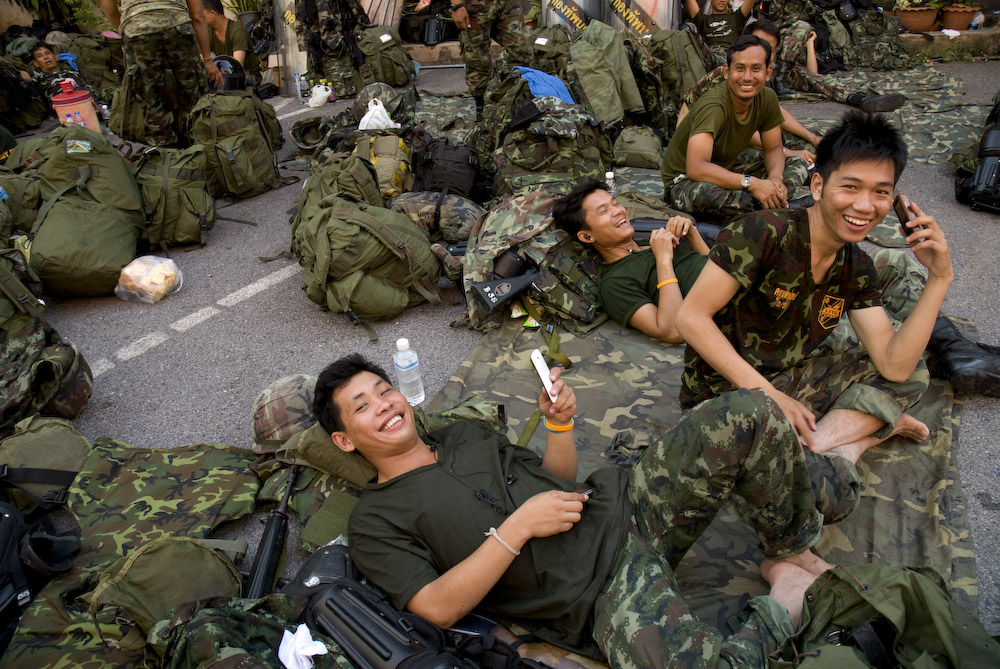
Now, with the current popular uprising in Bangkok, Thai soldiers sympathetic toward the anti-government “red shirts” are called Watermelon Soldiers.

Commenting on the continuing protests of Thailand’s red shirts, Wassana Nanuam wrote in The Bangkok Post:

Among the rapidly expanding glossary born of this prolonged political conflict, the term “watermelon army” or “watermelon soldier” is one of the most catchy. It means soldiers who may be wearing a green uniform but are actually rooting for the red shirts: green outside and red inside, just like a watermelon.

According to Nanuam, the red shirts have been keen to publicize the “watermelon factor,”  claiming it shows that only the army’s top commanders support the government.

[Thailand’s Army chief] Gen Anupong has admitted that there are indeed “watermelon soldiers” but he could not estimate their numbers. “No matter what colour your heart is or what doctrine you subscribe to, you do your duty as a soldier when you are deployed. Do not bring the colour in your heart into your duty. Bear in mind that a soldier must have no colour. We serve the country and the King,” Gen Anupong said.

Nanuam noted that some watermelon soldiers are suspected of having leaked information to the red shirts, something the top brass is keen to halt:

Even though the military has tried to emphasise the need for soldiers to be professional and colourless in their line of duty by coining a new term – “mango soldier,” which is green both within and without (the popular unripe variety, of course) – they have been unable to curtail the popularity of the watermelon trend. …

For now, the hunt for the watermelon is on at the army. Those who are found to have “red flesh” will be moved out of important positions. This includes those who happen to have a watermelon wife – whose spouse is supportive of the red shirts – as well.

The hunt for the red watermelon, however, is causing discomfort among professional soldiers who may truly be colourless but are being watched with suspicion anyway.

I came to Thailand this year with three tops…red, yellow…and grey.  No one has mentioned grey yet…somehow I doubt if grey will get me into trouble but I’m tired of wearing it.

Does The Government Do Anything Right?

I think the folks that argue that the the government can’t do anything right  should voluntarily give up all their tax supported services. I found this on a personal blog on the web:

This morning I was awoken by my alarm clock powered by electricity generated by the public power monopoly regulated by the U.S. Department of Energy.
I then took a shower in the clean water provided by The Municipal Water Utility.
After that, I turned on the TV to one of the FCC regulated channels to see what the National Weather Service of the National Oceanographic and Atmospheric Administration determined the weather was going to be like using satellites designed, built, and launched by the National Aeronautics and Space Administration. I watched this while eating my breakfast of U.S. Department of Agriculture inspected food and taking the drugs which have been determined as safe by the Food and Drug Administration.

At the appropriate time as regulated by the U.S. Congress and kept accurate by the National Institute of Standards and Technology and the U.S. Naval Observatory, I get into my National Highway Traffic Safety Administration approved automobile and set out to work on the roads built by the local, State, and Federal Departments of Transportation, possibly stopping to purchase additional fuel of a quality level determined by the Environmental Protection Agency. On the way out the door I deposit any mail I have to be sent out via the U.S. Postal Service and drop the kids off at the Public School.


After spending another day not being maimed or killed at work thanks to the workplace regulations imposed by the Department of Labor and the Occupational Safety and Health Administration, I enjoy another two meals which again do not kill me because of the USDA, and I am not electrocuted by my toaster thanks to the
Consumer Product Safety Commission. I drive my NHTSA car back home on the Dept of Transportation roads, through stop lights federally, state or municipally funded to my house which has not burned down in my absence because of the state and local Building Codes and Fire Marshal’s inspection, and which has not been plundered of all it’s valuables thanks to the local Police Department.


I then log on to the internet which was developed by the Defense Advanced Research Projects Administration and look up some information for my next summer vacation I am planning for my family in one of our National Parks. 

And I’d like to add that every time I nearly kill myself on sidewalks when I travel in foreign countries…or hang myself on straggling electrical wires…I think of the Accident and Preventive Division of federally mandated state government regulations in the U.S.

While connected to the internet, I read the latest grants by the U.S. National Laboratories, where any scientist in the world can have his experiment done on U.S. government equipment, some of the most advanced and unique in the world, by U.S. government employed scientists, FOR FREE, for only the promise that whatever he/she publishes out of that work be published openly for the sake of international science.

Then I read on freerepublic.com and fox news forums about how SOCIALISM is BAD because the government can’t do anything right.  So I look up SOCIALISM in Wikipedia to find out what it really means.   Hmmmm. 

The Merida Initiative and the Brad Will Case

After living here and watching events unfold since 2006, this is one (not small but easy) thing  that would not only protect the life of one unjustly incarcerated man, but the human rights of thousands of others in Mexico.

The case of JUAN MANUEL MARTINEZ MORENO, incarcerated for the murder of Indymedia journalist Brad Will in Oaxaca October 2006, is being railroaded by the Mexican government in Oaxaca.

Moreno’s next court hearing to have the case dismissed for lack of credible evidence will be held in Federal court in Oaxaca IN THE NEXT FEW DAYS.

Significantly, case of Brad Will’s murder was singled out by the U.S. Congress when they passed the 1.4 billion funding bill for the Merida Initiative in July 2008 (popularly called Plan Mexico to help Mexico fight the “drug war,”) calling in that bill for “progress in conducting a thorough, credible, and transparent investigation to identify the perpetrators of this crime and bring them to justice” as a condition for 15% of the funds. Read More

Honduran Refugees

July 4, 2009
Immigration News
Coup Tests Mexico’s Refugee Policy

The military coup in Honduras is providing an unexpected test of Mexico’s immigration and refugee policies. On Friday, July 3, dozens of Honduran nationals arrived at a church-run migrant shelter in the southern state of Oaxaca seeking refugee status because of the political situation in their
country.

Alejandro Solaline Guerra, spokesman for the Mexican Episcopal Conference, said a group of Hondurans sought assistance at the House of Mercy inCiudad Ixtepec on the Tehuantepec Peninsula. The migrant advocate said the bishops’ organization will contact the National Migration Institute to request refugee status for the Hondurans under international law.

“Migrants from a country in a state of war should not be denied refugee status,” Solaline declared.

The Honduran political crisis could aggravate an already-conflictive situation in Mexico’s southern border region. Despite the international economic crisis, thousands of Central Americans and other Latin migrants continue crossing the country’s southern border en route to the United States. Along the way, migrants remain a favorite target of corrupt Mexican officials and bands of organized criminals.

A report from Mexico’s National Human Rights Commission (CNDH) last month documented the kidnappings in Mexico of nearly 10,000 Latin American migrants, mainly from Central America, from September 2008 to February 2009. At least 157 women were among the victims; two women were murdered and others raped, according to the CNDH.

In the latest case to the hit the national press, the Mexican Army and law enforcement officials from Tabasco and Chiapas states detained 8 alleged kidnappers last week. A Honduran national, Francisco Handall Polanco, was among the group of alleged Zetas gang members arrested. Accused of holding 51 migrants against their will at a ranch in Tabasco, the group reportedly demanded ransoms reaching $5,000 from family members in return for releasing loved ones.

Once in the hands of authorities, migrants from Honduras and other nations are usually quickly deported. Emilio Chavez, director of the pro-migrant Sin Fronteras organization, charged that Mexico maintains a “double standard” when it comes to  migrant issues. While pressuring the United States to improve its treatment of Mexican migrants, Mexico fails to protect Central Americans within its own borders, Chavez contended.

If the Honduran crisis drags on, Mexico could see greater-than-expected numbers of migrants on its southern border. The Mexican Episcopal Conference’s Solaline said more Hondurans are reportedly on their way to Oaxaca. Identified only as “Janet,” an 18-year-old Honduran already in Ciudad Ixtepec described the situation in her country as grim.

“Schools are closed and the hospitals have no medicine,” she said, adding that electricity and propane gas shortages were also a problem.

Sources: La Jornada, July 4, 2009. Articles by Octavio Velez, Emir
Olivares and Angeles Mariscal. El Universal, July 4, 2009. Article by
Oscar Gutierrez. Cimacnoticias.com, July 3, 2009. Article by Alejandra
Gonzalez. CNDH.org.mx

Frontera NorteSur (FNS): on-line, U.S.-Mexico border news
Center for Latin American and Border Studies
New Mexico State University Las Cruces, New Mexico

And of course many of those Honduran immigrants who manage to get across the Mexican border will end up in the U.S.

What Mexico Needs From Obama

The LA Times has an opinion piece this morning entitled “What Mexico Really Needs From Obama” written by John M. Ackerman who is a professor at the Institute for Legal Research at the National Autonomous University of Mexico and a columnist for Proceso magazine and La Jornada newspaper.

From my observations of Mexico AND the U.S. he is right on on all accounts. In other words Obama should focus on helping Mexico reform it’s institutions and rule of law instead of supplying weapons to fight the drug cartels. “Only 15% of the funds in the $1.4-billion Merida Initiative signed by President Bush last year,” says Ackerman, “is earmarked for “institution building and rule of law.” If Obama hopes to contribute to long-term solutions, he should dramatically increase this percentage in future aid packages.”

“The Obama administration seems to be unaware of these deeper institutional issues. During her recent trip to Mexico, Secretary of State Hillary Rodham Clinton didn’t push Calderon on corruption control, human rights, freedom of the press, institutional reform or political reconciliation. She also went out of her way to cater to conservative constituencies. Her visit to Mexico’s principal basilica implied a nod to Calderon’s efforts to narrow the traditional separation between church and state. Her choice to travel to the city of Monterrey, home to the most powerful members of Mexico’s corporate oligarchy, also sent a clear signal about the priorities of the U.S. government.”

President Obama should not focus exclusively on short-term military goals during his visit to Mexico this week. The violence there, which has taken the lives of 10,000 Mexicans over the last two years, must be stopped. But the helicopters, weapons scanners and listening devices that have been the cornerstone of promised U.S. support will only go so far. The real solution lies in effective institution-building.

It does no good to capture drug kingpins if they don’t go to jail. During 2008, only one out of every 10 suspects arrested in Mexico for drug offenses was convicted, according to official statistics. In Chihuahua, one of the bloodiest states in the country, only 1,621 out of the 5,674 suspects arrested over the last 12 months have even had to stand trial, because of the weakness of the prosecutors’ cases.

RealTruth.org/Corruption_at_the_Top
Almost a decade ago, the U.N. special rapporteur on the independence of judges and lawyers, Param Cumaraswamy, discovered fundamental problems of inequality and inefficiency with Mexico’s system of criminal justice. Today, the grim picture he painted has changed little. Mexico’s jails remain full of petty thieves while serious criminals with money and connections roam the streets.

Last year, Mexico passed a major constitutional reform that would introduce oral trials — to replace trials conducted only through written documents — and transform the role of government prosecutors. The goals are to reduce case backlogs by speeding up trials, to prevent corruption by increasing transparency and to improve criminal investigations by dropping the requirement that prosecutors issue a preliminary judgment on the culpability of suspects. With this latter change, prosecutors would be able to dedicate themselves exclusively to investigating cases and avoid conflicts of interests. But the authorities have dragged their feet on implementation. Congress has delayed passing all of the necessary follow-up legislation, and the commission created by the reform, with representatives from the executive, judiciary and legislative branches, has not convened.

Corruption at the top all the way to the bottom.  Nothing will change until the institutions and rule of law are reformed. The problem is they are all on the take and no one wants to give that up.

State of Emergency in Thailand

Update April 14, 2009
Shopping malls are open and the train station has resumed service. Protestors have been bused home.  Arrest warrants have been issued for Thaksin and 13 other pro-Thaksin United Front for Democracy against Dictatorship (UDD) leaders for violating the state of emergency, which forbids gatherings of more than five people for political reasons.  It is worthy to note that that many of the “yellow shirts” that shut down 3 airports a few weeks ago have yet to be charged.  Unequal treatment under the law may be what is dividing the country to the extent that it has. Read More

Ten Terms Not to Use With Muslims

 My favorite paper media for years has was the Christian Science Monitor which sadly from here on out is only going to be a weekly. Since I started traveling I have been subscribing to the online edition which will continue. This article appears in their last daily edition.

 There’s a big difference between what we say and what they hear.

By Chris Seiple

from the March 28, 2009 edition

“In the course of my travels – from the Middle East to Central Asia to Southeast Asia – it has been my great privilege to meet and become friends with many devout Muslims. These friendships are defined by frank respect as we listen to each other; understand and agree on the what, why, and how of our disagreements, political and theological; and, most of all, deepen our points of commonality as a result.

I have learned much from my Muslim friends, foremost this: Political disagreements come and go, but genuine respect for each other, rooted in our respective faith traditions, does not. If there is no respect, there is no relationship, merely a transactional encounter that serves no one in the long term.

As President Obama considers his first speech in a Muslim majority country (he visits Turkey April 6-7), and as the US national security establishment reviews its foreign policy and public diplomacy, I want to share the advice given to me from dear Muslim friends worldwide regarding words and concepts that are not useful in building relationships with them. Obviously, we are not going to throw out all of these terms, nor should we. But we do need to be very careful about how we use them, and in what context.

1. “The Clash of Civilizations.” Invariably, this kind of discussion ends up with us as the good guy and them as the bad guy. There is no clash of civilizations, only a clash between those who are for civilization, and those who are against it. Civilization has many characteristics but two are foundational: 1) It has no place for those who encourage, invite, and/or commit the murder of innocent civilians; and 2) It is defined by institutions that protect and promote both the minority and the transparent rule of law.

2. “Secular.” The Muslim ear tends to hear “godless” with the pronunciation of this word. And a godless society is simply inconceivable to the vast majority of Muslims worldwide. Pluralism – which encourages those with (and those without) a God-based worldview to have a welcomed and equal place in the public square – is a much better word.

3. “Assimilation.” This word suggests that the minority Muslim groups in North America and Europe need to look like the majority, Christian culture. Integration, on the other hand, suggests that all views, majority and minority, deserve equal respect as long as each is willing to be civil with one another amid the public square of a shared society.

4. “Reformation.” Muslims know quite well, and have an opinion about, the battle taking place within Islam and what it means to be an orthodox and devout Muslim. They don’t need to be insulted by suggesting they follow the Christian example of Martin Luther. Instead, ask how Muslims understand ijtihad, or reinterpretation, within their faith traditions and cultural communities.

5. “Jihadi.” The jihad is an internal struggle first, a process of improving one’s spiritual self-discipline and getting closer to God. The lesser jihad is external, validating “just war” when necessary. By calling the groups we are fighting “jihadis,” we confirm their own – and the worldwide Muslim public’s – perception that they are religious. They are not. They are terrorists, hirabists, who consistently violate the most fundamental teachings of the Holy Koran and mainstream Islamic scholars and imams.

6. “Moderate.” This ubiquitous term is meant politically but can be received theologically. If someone called me a “moderate Christian,” I would be deeply offended. I believe in an Absolute who also commands me to love my neighbor. Similarly, it is not an oxymoron to be a mainstream Muslim who believes in an Absolute. A robust and civil pluralism must make room for the devout of all faiths, and none.

7. “Interfaith.” This term conjures up images of watered-down, lowest common denominator statements that avoid the tough issues and are consequently irrelevant. “Multifaith” suggests that we name our deep and irreconcilable theological differences in order to work across them for practical effect – according to the very best of our faith traditions, much of which are values we share.

8. “Freedom.” Unfortunately, “freedom,” as expressed in American foreign policy, does not always seek to engage how the local community and culture understands it. Absent such an understanding, freedom can imply an unbound licentiousness. The balance between the freedom to something (liberty) and the freedom from something (security) is best understood in a conversation with the local context and, in particular, with the Muslims who live there. “Freedom” is best framed in the context of how they understand such things as peace, justice, honor, mercy, and compassion.

9. “Religious Freedom.” Sadly, this term too often conveys the perception that American foreign policy is only worried about the freedom of Protestant evangelicals to proselytize and convert, disrupting the local culture and indigenous Christians. Although not true, I have found it better to define religious freedom as the promotion of respect and reconciliation with the other at the intersection of culture and the rule of law – sensitive to the former and consistent with the latter.

10. “Tolerance.” Tolerance is not enough. Allowing for someone’s existence, or behavior, doesn’t build the necessary relationships of trust – across faiths and cultures – needed to tackle the complex and global challenges that our civilization faces. We need to be honest with and respect one another enough to name our differences and commonalities, according to the inherent dignity we each have as fellow creations of God called to walk together in peace and justice, mercy and compassion.

The above words and phrases will differ and change over the years, according to the cultural and ethnic context, and the (mis)perceptions that Muslims and non-Muslims have of one another. While that is to be expected, what counts most is the idea that we are earnestly trying to listen to and understand each other better; demonstrating respect as a result.”

Chris Seiple is the president of the Institute for Global Engagement, a “think tank with legs” that promotes sustainable environments for religious freedom worldwide.

“Gang-Rape of the American Dream”

Best article yet on the financial crisis.  Tells it like it all came down…in great detail.  I can see it all now.

Rollingstone.com

The Big Takeover

The global economic crisis isn’t about money – it’s about power. How Wall Street insiders are using the bailout to stage a revolution

MATT TAIBBI

Posted Mar 19, 2009 12:49 PM

“As complex as all the finances are, the politics aren’t hard to follow. By creating an urgent crisis that can only be solved by those fluent in a language too complex for ordinary people to understand, the Wall Street crowd has turned the vast majority of Americans into non-participants in their own political future.

There is a reason it used to be a crime in the Confederate states to teach a slave to read: Literacy is power. [Italics mine]

In the age of the CDS and CDO, most of us are financial illiterates. By making an already too-complex economy even more complex, Wall Street has used the crisis to effect a historic, revolutionary change in our political system — transforming a democracy into a two-tiered state, one with plugged-in financial bureaucrats above and clueless customers below.”

Read the rest of the article here.