Far East Youth Hostel

East China.gif

The last time I was in China it was freezing cold in January 2003. The weather is fantastic this October day in 2004.

After slogging it out across Russia and Mongolia, we soak up creature comforts at the friendly Far East Youth Hostel located among the back alleyways of one of Beijing’s ancient hutongs where young backpackers pick the cheap dorm rooms next to the self-catering kitchen and laundry room in the basement and we, of course, choose a double room upstairs with all the Chinese tourists for about $25.

Downstairs is a “coffee bar” featuring a wide screen TV for viewing one of scores of dvd movies, three high speed internet terminals and a book case full of tattered novels and old travel guides.

Several tables of travelers share experiences and information…one with an Israeli guy trying to explain his country’s posture regarding Palestine to a couple of doubting Norwegians (Europe is generally pro-Palestine which is one reason the Europeans have trouble with the U.S.)

The compound includes a courtyard across the alley with a budget restaurant where I tried to order soy sauce in Mandarin (chiang yo) and got rice instead because of the tone I used.

On the back end of the courtyard are even cheaper dorms housing mostly young male West Europeans. After setting up the tiny computer speakers and coffee pot we step outside the doors of the cozy hostel and find ourselves dodging old men on bicycles between humming dumpling shops and cheap clothing stores blasting Chinese hip-hop and techno. At dinner we laugh at the English menu…among the choices are “Hot Pot of Old Duck With Chinese Medicine” and “Soup Of The Ox Reproductive Organs.” This is as good as it gets. If home is where the soul likes to be…I am there…at least for now.

And then…Bob packed up…and left.

Last Leg Through Mongolia

GyTjn0QZP9l6Qu21TubskM-2006198062551304.gif

Out of the train window, just before departure from Ulaan Bataar to Beijing on the last leg of our trans-siberian train trip, we watch about 30 Mongolians…brothers, sisters, aunts, uncles, grandparents, parents and who knows who else on the platform wave a tearful goodbye to three girls waving back at them. Bob and I chuckle and agree that we would be lucky if we could muster up just one person to see us off anywhere these days. Nearby, an older woman is waving goodbye to…husband…father…uncle? She takes a spoon and throws what I later find out is milk-tea at the train that just ends up staining the platform white…finally throwing what was left of the empty bottle and then tossing it over the fence behind her…for “safety and good travels.”.

Our companions in our cabin for our day and a half train ride through the moon-faced Gobi desert are a slim good-lucking Mongolian guy, Khurelsukh, (“I am 23 years”) and a Chinese man fluent in Mongolian. Khurelsukh has a sweet girlfriend (Saraa) in another cabin, however, who ends up joining us for most of the trip…snuggling together for the night on one of the bottom bunks we give up to them. He was born in Russia when his parents were engineering students there. He is still a student in the university in Ulaan Bataar but says he is going to Beijing on business to see about “lingua techna” machines to use for teaching languages. Saraa’s mother is a teacher and is advising him, I think I understand. I also think, however, that this trip to Beijing over the weekend is going to be much more…”you will go to discos, I ask.” He grins broadly and says “yes!”

“Mongolians don’t like Chinese,” he says later out of earshot of the still-unnamed Chinese guy.

When the train nears Beijing we all pile out to get our first glimpses of the remnants of the Great Wall and take pictures. Back on board Khurelsukh asks us why we think the wall was built…”to keep out the Mongolians,” we exclaim…watching for his reaction. “Yes, to keep out the Mongolians,” he says with a glint in his eye…probably wondering if we get the irony.

Reflections on the Steppe

GyTjn0QZP9l6Qu21TubskM-2006198062551304.gif

We are lucky…days are brisk but sunny…the sun glints off bare hills covered in golden fall grass. This feels like fall in southeast Oregon where I grew up. I soak it all in while Bob goes on a 4 hour hike through birch groves and box canyons full of grazing mustangs. How do you know they were mustangs I ask Bob…he says” they had labels on each side.” Places were steeper than he anticipated…had to run from one tree to another to keep from falling down the hill.

The next afternoon we paid three dollars to an elder Mongolian in traditional clothing to take us riding horses through the hills with him. Give him his head, I said to Bob who was trying to make his horse gallop! But there was no saddle horn on the tiny saddle to hang onto and it was difficult to post in the ornate metal stirrups. Mongolian saddles are definitely different than Western saddles I was used to as a girl in cowboy country USA. Still, the same freedom I used to feel…while riding…in the wind…in the hills…where I grew up… This is as close to heaven as it gets I thought…connected…connected to the earth.

Message from Ulaan Bataar

GyTjn0QZP9l6Qu21TubskM-2006198062551304.gif

Greetings-
Have been in Mongolia for the past week–initial few days in a ger bordering on a national park–lazy, relaxing days with hiking and Mongolian pony riding (when on the horse my feet nearly reach the ground). Then had only 2 days for Ulaan Bataar, the capital. Weather was so pleasant and culture such a change of pace following Russia that we decided to stay longer. However train only passes through town once a week, more time here than what we need but that’s ok.

First couple of days we did the home-stay thing but the hostess spoke no English and was a bit shy to interact so moved to a hotel. Lodging too expensive but all else cheaper–can take a taxi from one end of town to the other for less than a buck.

Yesterday went to a huge local market. Guidebooks said to take care re thievery (advice in the realm of one’s mother saying to wear a coat). But while there my packback received a gash and a similar long slash across my pant leg in the general area where someone saw me depositing change. I was aware of the contacts so nothing lost but do have a superficial cut on my thigh. That sort of action leaves an uncomfortable feeling. I was told that the local Mongolians are equally at risk but for some reason I stick out in a crowd (boyish good looks perhaps).

This city (Ulaan Bataar) has a bit of a cowboy feel–most roads not paved and well pot-holed, horse carts compete for space with autos who obey some sense of order only peripherally, older folks still wear their long brightly colored coats (deels) with and an orange sash, everyone under 40 in jeans, black leather jackets and constantly fiddling with their cell phones (same-same at all latitudes and longitudes). Tiz too bad as all interesting ethnic features/diversities will soon be lost–well on our way to a homogenized worldwide culture.

The Mongolians have features that are different than other Asians. They seem to universally dislike the Chinese but respond favorably when asked about Russians–surprising as the country was part of the Soviet Union until 1990. All that I have talked to however are much happier with independence. Too many soviet style buildings remain in the city and many of the people within the city still live in gers (50% by one guide book estimate).

Our next move is to Beijing; then no agenda. Probably will work our way down the east coast of China to Shanghai, then either inland or to Hainan Island in So. China Sea off the coast of Vietnam. Our fixed and booked trans-siberian itinerary ends in Beijing so then the fun begins with winging it again, buying train tickets in Mandarin, etc.-Chinese characters even harder for these poor foreigners than Cyrillic. Many Chinese find it difficult to believe that someone does not speak their language. And therein is the adventure.

Hope all are well. Please send money.
RLG

Lingering Images of Russia

7yBXvp82X2gVlMeZe25DiM-2006198051115673.gif

Siberian countryside with endless kilometers of grassland and golden pine and white birch trees… small wooden, weathered, unpainted, picturesque, single story bungalows throughout Sibera with blue painted shutters-the banya (toilet and shower) in a small building nearby…Outside the cities groups of small two-story dachas (2nd homes with three-sided pitched roofs with garden in front providing relief from tiny flats and a chance to grow their own vegetables for those who can afford it…intensely flavored wine-red berry jam on Olkhon Island.

Drab, dilapidated Stalin-era block style apartment buildings that make maximum use of space but with absolutely no aesthetic value… there’s definitely a market niche in this country, Bob laments, for brooms, scrub brushes, soap and paint…. black leather jackets, Lenin-style hats (never saw any baseball style hats) and shoes with pointed curled up toes on men and women with spike heels—click click click)…. Especially in evenings, but any time of day, people strolling or standing around with an open bottle of beer in hand… Occasionally someone toppling over from inebriation to be caught by a comrade before falling…people with an aloof veneer-not an air of superiority-just reserved as in “I’m minding my own business…you mind yours”-sometimes seemingly shy but when the exterior is cracked they smile readily and extend themselves with varying degrees of warmth and good humor-especially on the train where we have an opportunity to interact……deep underground metros-monumental works of art in themselves (no photos allowed)…wonderful rich soups and more soup, each a little different than the next…

Experiencing daily life in cozy cluttered apartment homestays with friendly middle-aged to elderly single women who get 30% of what we paid. The provided breakfasts range anywhere from here’s the eggs-cook your own to elaborate spreads in tiny rooms… tiny bathrooms (literally wc’s) with sit down toilets that took three times to flush clean…overheard conversations that sound like arguments in a tone of voice you and I would take offense at but then we think it’s all just bluster…people walking in-between and in front of us with no regard for personal boundaries but not intending to be rude…urban store windows full of fashionable clothing and products that only about l% of the people can afford and then only because they operate on the black market (one woman who works for the central bank whispered “yes, we take white money and black money.”

Grueling Border Wait

The wait at the Russian-Mongolian border is a grueling 5-6 hour wait for customs to go through each carriage and take our passports, return to the office to fill out forms and then return with our passports. Olga takes a six inch wad of $20 bills out of her hand bag and counts it three times.

We are desperate to get off the hot claustrophobic train and get some cold fresh air. We find a very small market a hundred yards from the train where we buy dried apricots, apples and dried noodle soup.

To relieve the bordom a young guy from Chicago (they have put most of the foreigners on this carriage) pulls out his frisbee and plays with an older guy from Australia out on the platform and when one toss ends up on top of the carriage, the guy from Chicago climbs up to get it but can’t resist the urge to pose playfully for all the cameras that appear down below…but not for long. Officials appear and grab all our cameras removing batteries, film & digital chips and tapes. They spend an hour filling out forms and waiting…for what…an offer of money? No one wants to pay money but we shuffle and wait nervously. Finally just before the train pulls away the cameras etc. are returned to their relieved owners.

The Mongol border is a good 2-3 hour wait too… Mongolian sellers and money changers come on board. Olga takes an offer from a guy wanting to exchange our Russian money but then slams the cabin door in his face as she lets in a Mongolian woman who gives us a better offer. Olga has obviously done this before.

After crossing six time zones out of a total of 9 or 10 in Russia, the train thankfully rolls into Ulaan Baatar at 7 the next morning.

The Tajik and Olga

7yBXvp82X2gVlMeZe25DiM-2006198051115673.gif

The Tajik and Olga
In Irkutsk, when we find our seats on the train to Ulaan Baatar, we find a good-looking 40 year old Muslim man from Tajikistan in our cabin. He has studied English in school when he was a boy by showing us how tall he was, and remembers a few words. He shows us pictures of his wife and four kids back at home in Tajikistan. We show him pictures on the computer of our trek in 1996 in Kyrgzstan although aware that the Kyrgeez and Tajiks don’t really like each other very much.

We are able to figure out that he is returning to Ulaan Baatar to operate a “caterpillar” at a gold mine after a three-month summer break with his family. We soon put our sausage and cheese and bread on the little table and he pulls out his bottle of Vodka. He is charming and has a wonderful smile and a quick laugh…I like this man.

The next day Olga, an energetic middle-aged blond, begs to move from her assigned seat near the toilet at the end of the carriage so she joins us…immediately kicking the mellow Tajik up to the top bunk and spreading her belongings from one end of the cabin to the other. Fluent in English, she says she gave up her doctoral studies in Chemistry in 1993 because there was no work in her field, to become an entrepreneur and she makes the trip to Mongolia and China every few months to buy merchandise…”everything for health” she says. She instructs us where to get a cheap hotel in Beijing and gives me an empty bottle to have the Chinese traditional pharmacist fill for my psoriasis.

Soon she and the Tajik are really going at it in Russian…the bluster again…and I ask her what they are talking about. Olga is incensed: “He leaves his wife in Tajikistan to work in another country but when I ask him if she works he says no she has to stay at home and only leave when she is with him!” This goes on for awhile and is actually quite entertaining to watch…then she non-plusses Bob by showing him a picture of man (XY) and woman (XX) and showing him that with an unfinished “X” (referring to the “Y” that “there is a mistake!” When he objects she says “well maybe women are more clever. He just looks at her.

Queuing In Russia

Urr0g6ZfQ7ttYL19duYJfg-2006170133924757.gif

Back in Irkutsk we watch women walking swiftly always carrying a plastic shopping sack or two (ovoiska from the Russian ‘ovois’ meaning ‘just in case’) of varying brands that have to be purchased)…a hold-over from Soviet-era shopping methods that, according to the British journalist Fiona Fleck who described in the ‘Guardian’ how Soviet era panic buying of bread, rice, cereal and flour affected the ordinary Russian even in late 1990’s: “whenever they go out they are constantly dropping into shops when passing by just in case something had arrived, sometimes joining queues in the hope that something will eventually arrive that day.

Queuing has always been a life-principle for the Soviet shopper and is enshrined in what must be the most roundabout way of buying in the world.” Even now at one consignment shop Bob had to stand in line to choose an item at which time the clerk wrote out a voucher that he was supposed to take this way and that way and then this way and that and then to stand in line to pay a cashier stamped the voucher indicating the item had been paid for and then stand in the first line again to show the stamped voucher to the original clerk and obtain the item. In Soviet times people would buy in bulk and shop in teams, often paying someone a little to stand in line for them.

Today, the queuing of cars is a machiavellian event . We are amazed at the ability of cars to “crowd” their way into a queuing line for example lanes merging into each other. When our driver to Olkhon Island arrived at the Ferry we were second “in line.” In the course of an hour there were about five lines across all waiting to crowd, inch by inch, into the two lanes that would lead onto the ferry. Apparently this is the accepted modus operandi…however we did see one car full of women get out of their car and take on the driver of another…yelling and gesturing and taking down the license number. The scene made me vow to never get into an argument with a Russian woman!

People have no trouble crowding to get onto a bus…in fact it sometimes becomes a matter of who can push harder. If you stand back and wait “your turn” like the nice people we learned how to be from our first grade teacher your reward will be to end up standing on the street with no ride.

Hiking Olkhon Island

Urr0g6ZfQ7ttYL19duYJfg-2006170133924757.gif

Back at Nikita’s “resort” I spend half a day taking care of monkey business while Bob goes hiking around the island. It is the end of September but Siberia lives up to it’s reputation. It is cold. On the trip to the island it snowed and now each day hovers below zero with chilling winds and puddles that don’t thaw. In another six weeks the lake will begin to freeze and the island will be cut off until the ice is thick enough for vehicular driving. The thaw will not arrive until May. We did not bring appropriate clothing and each dash from the cabin to the squat toilet is a determined gritting.

Tomorrow at 6pm we leave on the train for Ulaan Baator Mongolia.

Hanging Out On Olkhon Island

Urr0g6ZfQ7ttYL19duYJfg-2006170133924757.gif
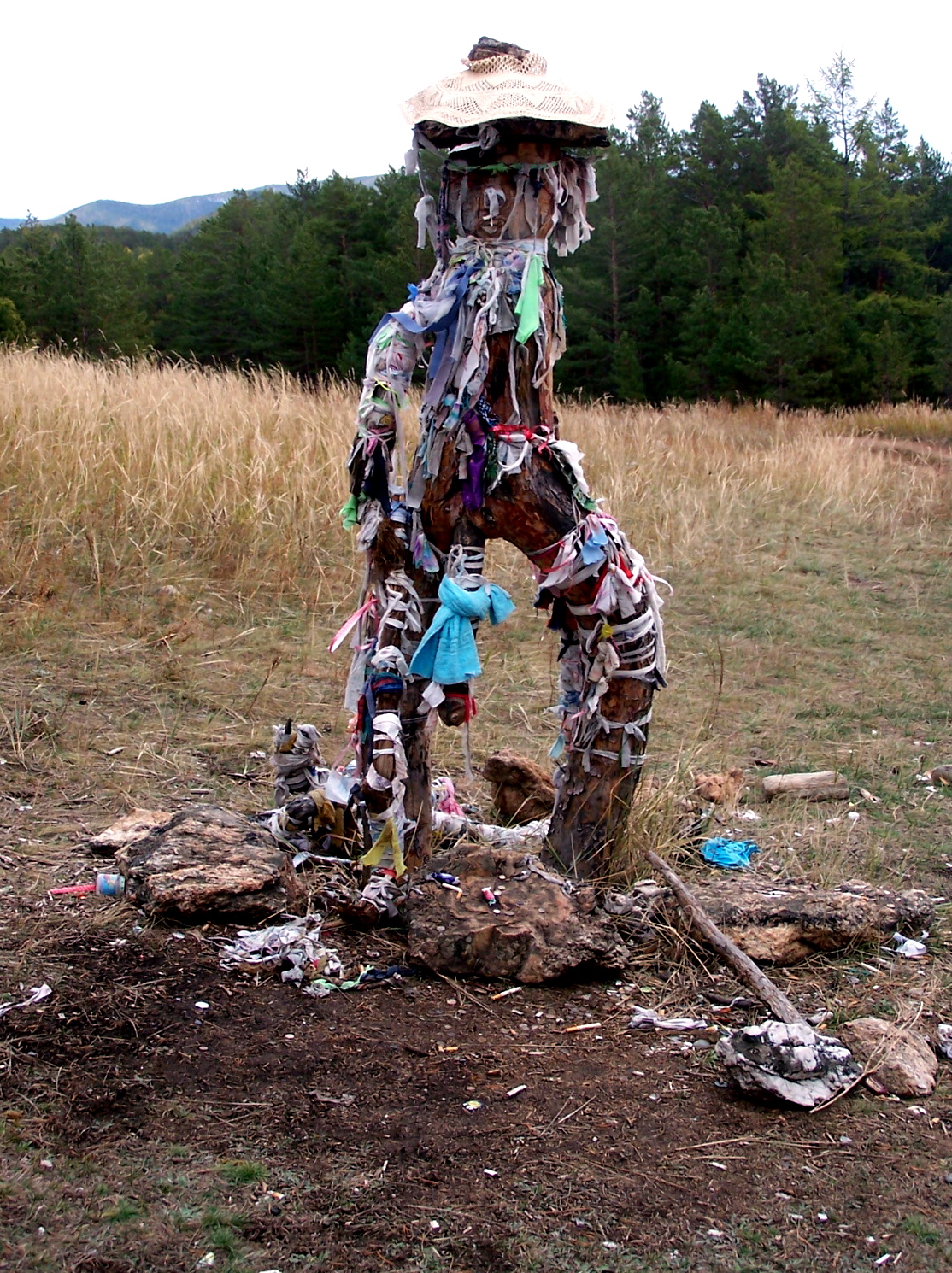
After hanging out a couple days…glad to be off the train…Gregory, a former University teacher of German, drove Bob and I, three Germans and a Pole on a half-day excursion to the north of the 70km long island to visit various geological sites and views of the lake but most especially to see a world renowned Shaman ceremonial circle called Three Brothers that is sacred to two faiths practiced here, Buddhism and Shamanism. Two years ago almost 300 Shamans from the world-over came together here. We lay a one rouble coin at the foot of the prayer flag pole while the “Sarma” or east wind blows fiercely over us.

The Buryats are of Mongolian descent…nomads who spent time herding their flocks between the southern shores of the lake and what is now northern Mongolia. They lived in felt-covered yurts and practised a mixture of Buddhism and Shamanism.

Gregory is driving Nikita’s four wheel drive van…a Russian vehicle designed 30 years ago and that was so successful they used it as an ambulance. “There is only one reason Russians sent the first man into space,” says Gregory the Kamikazi driver thumping over mud hole roads at least 90km per hour…”is because of the roads!” Later he says “we at the moment are using two wheels…if it gets really complicated we will use four!” “Normally we sacrifice two persons…usually 50% survive this trip!” Any of our U.S. vehicles would have rolled over at the first turn but this one mysteriously keeps it’s four wheels on the ground.

We pass through beautiful valleys with sheep and cattle farms…two of which are rich and have beautiful houses “because they don’t drink,” Gregory says. We pass by one small house of an old woman who lives alone with her cow…the rest of the houses in the area appear empty. We are shown an area that was a gulag during the Stalin era and whose inmates produced cans of caviar from the lake sturgeon that was then sent to the Kremlin for the enjoyment of the party bigwigs). I see a straggly triangular three wooden stick affair on the top of a hill and ask Gregory what it used to be. “Local KGB headquarters,” he says throwing his head back in laughter. I ask if the Russians and Buryats intermarry. “Seldom,” he says.