Thailand
Burning Of Bangkok
Just about eight minutes after the Red Shirt leaders gave their last speech on the main rally stage to jeers and tears, just before they gave themselves up to police who were closing in, flames and black smoke from burning tires has nearly covered 20 sites of the city for the last three days. In the clash, protestors used everything from rocket propelled hand grenades, petrol bombs, and molotov cocktails to slingshots and rocks and the military used hi-powered rifles, tear gas and tanks, although the BBC took video of the Reds using rifles too. On wednesday, several people were killed…including both Red Shirts and at least one soldier. Anger at what was perceived as a biased media resulted in reporters being targeted and an Italian photographer dead. Hundreds were wounded including 3 other reporters.
Central World, the second largest shopping mall in Asia was burned out, the old Siam Theater, a cultural icon, was burned among about 3 dozen buildings, people being harbored in a wat were attacked, a TV station was attacked with staff having to be airlifted out by helicoptors, soldiers wounded, almost the entire country came under Emergency Rule and the government is enforcing a 9pm to 5am curfew…much to the consternation of young backpackers. The MRT subway and BTS skytrain has stopped until further notice. The battle has spread to the provinces with at least two provincial halls being burned. So much for peaceful Thai farmers. The following Washington Post story with links to photos depict the disaster.
Thai military breaks up red-shirt protests in Bangkok


Story: Thai soldiers assault ‘red shirt’ encampment in Bangkok
The military launched an offensive to evict anti-government protesters from central Bangkok, a move that left parts of the city near anarchy.

Unrest in ThailandThailand has a long history of political unrest and protests. View a graphic showing the relationship between pro- and anti-government demonstrators over the last four years. Graphic
Protest in BangkokView a graphic that chronicles the protest in Bangkok, Thailand. |

Red Shirt Leaders Surrender
Washington Post Foreign Service
Wednesday, May 19, 2010; 2:06 PM
BANGKOK — Thai soldiers launched an assault Wednesday against “red shirt” protesters in a military operation that forced anti-government protest leaders to surrender but left parts of Bangkok in the grip of near-anarchy.
This Story
- Thai soldiers overrun protesters’ camp; ‘red shirt’ leaders surrender
- Four protest leaders flee Thai army crackdown
- Bangkok burns after protest chiefs arrested
- Bangkok video: Thai troops open fire at protestors’ encampment
- Thai soldiers assault ‘red shirt’ encampment in Bangkok
- Thai army clashes with protesters
View Only Top Items in This Story
Enraged by the offensive, protesters set fire to Thailand’s stock exchange and Southeast Asia’s second-biggest shopping mall, looted luxury boutiques and fired grenades and guns in areas previously untouched by the mayhem. Disorder spread to at least seven provinces, and protesters set fire to town halls in three northern cities.
In an effort to contain the violence, the government imposed an overnight curfew on Bangkok and extended it to 21 provinces. It also banned coverage of the unrest on local television channels, which limited themselves to government announcements.
At least five protesters and an Italian freelance news photographer were reported killed in Wednesday’s clashes, and about 60 other people were wounded. But there were indications that the death toll could rise. The Associated Press quoted witnesses as saying at least six more bodies were recovered in the capital’s protest zone after the military assault.
Speaking on television, embattled Thai Prime Minister Abhisit Vejjajiva said he was “confident and determined to end the problems and return the country to peace and order once again.”
But exiled former prime minister Thaksin Shinawatra, whose followers formed the red shirt movement, warned that military attacks on the protesters could spawn mass discontent and lead to guerrilla warfare, Reuters news agency reported. “There is a theory saying a military crackdown can spread resentment, and these resentful people will become guerrillas,” the agency quoted Thaksin as saying.
In an offensive launched at daybreak after days of escalating confrontation, armored vehicles smashed through barricades made of sharpened bamboo poles and rubber tires while heavily armed troops raced deep into territory occupied for more than a month by protesters.
As the military advanced toward the center of the fortified encampment, protest leader Jatuporn Prompan announced that he and other “core leaders” would turn themselves in to police. He pleaded with followers to leave the area to avoid further bloodshed.
“We have no more words to speak because all your hearts are already far beyond death,” Jatuporn said. “Today we will stop the death but we will not stop fighting. People keep dying; let’s stop the death together.”
An angry mob ignored the appeal for an orderly retreat and set fire to parts of Central World Plaza, an upscale nearby shopping mall, under the gaze of fashion models pictured on billboards advertising luxury clothing. Thick smoke billowed from the shopping center and also from Siam Theatre — a popular movie house — a government-owned bank and other buildings. Rioters set fire to the Thai stock exchange, which had closed early because of the violence. Some protesters began setting up new barricades and fought running battles with soldiers.
The government said it had the situation under control but also declared that a curfew would go into effect at 8 p.m. and continue until 6 a.m. Dazed tourists struggled to get back to their hotels through military checkpoints amid sporadic rounds of gunfire. Electricity went off in residential areas far from the protest zone.
There also were reports of unrest elsewhere in Thailand, a close military ally of the United States and popular tourist destination that touts itself as the “land of smiles.”
An angry mob ignored the appeal for an orderly retreat and set fire to parts of Central World, an upscale nearby shopping mall, under the gaze of fashion models pictured on billboards advertising luxury clothing. Thick smoke billowed from the shopping center and from the Siam Theatre — a popular movie house — as well as a government-owned bank and other buildings. Rioters set fire to the Thai stock exchange, which had closed early because of the violence. Some protesters began setting up new barricades and fought running battles with soldiers.
This Story
- After day of violent frenzy, relative calm returns in Thailand
- Military assault breaks up Thai protesters
- Interactive: Protest timeline
- Four protest leaders flee Thai army crackdown
- Bangkok burns after protest chiefs arrested
- Bangkok video: Thai troops open fire at protestors’ encampment
- Thai government says Bangkok protests mostly under control
View Only Top Items in This Story
The military eventually halted its advance on the center of the protest zone, saying it wanted to let people leave. The government said it had the situation under control but also declared that a curfew would go into effect Thursday. Dazed tourists struggled to get back to their hotels through military checkpoints amid sporadic rounds of gunfire. Electricity went off in residential areas far from the protest zone.
There also were reports of unrest elsewhere in Thailand, a popular tourist destination that touts itself as the “land of smiles.”
Most of the trouble outside Bangkok occurred in northern regions, the main base of support for Thaksin, a billionaire former police officer who wants to return to Thailand and to power. In Khon Kaen, a major city, protesters torched the town hall. In another big northern city, Ubon Ratchathani, about 1,000 red-shirt sympathizers set fire to city hall, gutting it, a resident said.
Such incidents show that far from settling Thailand’s deep political divisions, Wednesday’s assault threatened to polarize the country further. The protesters first gathered in central Bangkok to try to force early elections to replace the government, which was chosen by parliament, not a popular vote. It took power from a government loyal to Thaksin, who was overthrown in a military coup in 2006. What began as a peaceful movement for change, however, became increasingly unruly as hard-line militants took up arms and protest leaders lost control of their own cause.
Although the government clearly won the battle this week, it now faces the more difficult task of winning what will probably be a long campaign to restore enduring calm and to prevent pockets of resistance coalescing into a threat that could jeopardize the entire country’s stability.
In Bangkok on Wednesday, trouble spread beyond the “red zone” into Sukhumvit, a main thoroughfare usually clogged with foreign tourists. At Asoke, a major hub, red-shirt sympathizers set fire to tires outside a police station and blocked the street with buses. A crowd of bystanders cheered. A fire truck was chased away, leaving the fires to rage unchecked. They were later put out, and the crowd dispersed.
Jeremy King, a private fund manager and longtime British resident of Bangkok, said the onlookers’ cheers signaled a surprising degree of “grass-roots support for the red shirts.” But he was also surprised, he said, by “how quickly the crowd evaporated . . . and the fires were put out when the order came to stand down.”
Special correspondent Nate Thayer in Bangkok and staff writer John Pomfret in Washington contributed to this report.
Two Faces Of The Thai Uprising
Thaksin’s vendetta is wrecking the country
By Sopon Onkgara
The Nation
BANGKOK: — After a few days of armed skirmishes between rioters, terrorists and government troops in areas around Rajprasong, an end to the trouble remains elusive, despite the deadline given for the red shirts to disperse by 3pm yesterday afternoon.
Some more military action could ensue now that the crowd in front of the stage is thinning out. Only a few thousand are left to serve as shields for the red-shirt ringleaders, who have vowed to fight to the end.
But that sounds like empty bravado. Several have already left the stage for safety, especially the key leader Veera Musigapong, who opted out as if knowing that further persistence would lead to an unpleasant end.
It has been proven beyond any doubt that the red shirts, who serve as the political wing for the campaign to oust the government by Thaksin Shinawatra, have comrades in arms in the true sense of the word. They periodically fire grenades at troops and other targets during the running battles.
The number of grenades at their disposal has been amazing. The M-79 grenade launchers have become a key weapon of the unidentified, hooded men who look mean and lethal. The troops have not been able to capture any of them, either dead or alive. Only video clips of their actions have been shown.
The red-shirt leaders have not denied that they are allies of those forces. Since the beginning of the rally, they have elevated their campaign from a claim of peaceful protest and ahimsa to harassment and terror for Bangkok residents.
Now, they have realised that the punishment they deserve for their crimes is too serious for them to surrender to the authorities. Their options remain the same – flee, go to jail, or be killed if they resist the final crackdown.
Thaksin Shinawatra no longer remains silent, though he does not show himself for public view. Through messages and tapes, he tries to drag international organisations, including the UN, into participating in truce talks despite his status as a fugitive criminal fleeing a two-year jail term.
His whereabouts and the condition of his health remain vague, despite reports that he has been battling prostate cancer. Always on the move to avoid being tracked by the Thai authorities, Thaksin has become an international fugitive and is always causing trouble to the Abhisit government through his cronies in and outside the House.
The riots at various spots in Bangkok have claimed more than 30 lives. They include thugs, rioters and innocent by-standers. Among the casualties are foreigners and a medic who were shot by unidentified gunmen.
It is not a civil war, but the government is trying to suppress rioting, store looting, armed attacks and terrorism. Sporadic gunfire and grenade explosions are heard around the battle zones. Bangkok is virtually at war with Thaksin, who is at the core of the crisis.
His vendetta, financed by billions of baht paid to red-shirt protesters and armed men, is taking a heavy toll on the country’s political, economic and social structure.
No matter how the crisis ends, the country will not be the same. It will be ridden with deep-seated division and conflict, even with or without Thaksin being around.
After two months of tolerating illegal rallies and terror, the government only began to take real action in the past few days with the blockade of Rajprasong to deprive the crowd of sufficient food and support. Persuasion will cut down the size of the crowd to just a few thousand before a further crackdown, if the government decides that such action becomes inevitable.
A bold move was taken on Sunday when the government prevented financial transactions by 106 corporate entities and individuals with Thaksin connections. Starting right from Thaksin’s ex-wife and his siblings, the list includes all sorts of business and political cronies, as well as classmates from his days in the pre-cadet school.
The big names will not be allowed to engage in financial activities, and the measures are designed to cut funding for the rallies and mobilisation of supporters from upcountry.
The final death toll and number of injuries will depend on what actions are taken to flush out red shirts from their rally sites. The ultimate cost will be high in financial terms as well as human tragedy.
By now, Thailand and the world knows that Thaksin has unlimited potential to destabilise his homeland, from which his family has amassed wealth through political power and corruption.
One man like Thaksin is more than enough in the long history of this country.
And then there are the Red Shirts themselves. Supporting Thaksin because he handed out bits of help that no other Prime Minister had before him…small high-interest loans and a health program. But the up-country folk couldn’t see past that to the man who bilked the country of a couple of billion dollars in taxes, was convicted of corruption and who fled the country rather than serve a 3 year sentence. They just turned their heads like many Thais do. And now they are faced with the consequences of what the man who many call “Toxin” wrought. But it seems out of his control now.
Pongpat’s Tear-jerking Speech at Thai TV-Radio Awards
Hong Kong! Relief from Heat And Chaos of Bangkok
So the Reds are keeping up the pressure in Bangkok. My yellow shirt friend didn’t want me to take a taxi to the airport yesterday for a flight to Hong Kong (taxis being almost all Red because most of them are up-country folks too) so he picked me up at my hotel at 4am. Heading down Asoke to the expressway, we passed a dozen military trucks with army soldiers so the Reds apparently weren’t able to detain ALL the troops trying to get to the city at checkpoints they had set up in four provinces.
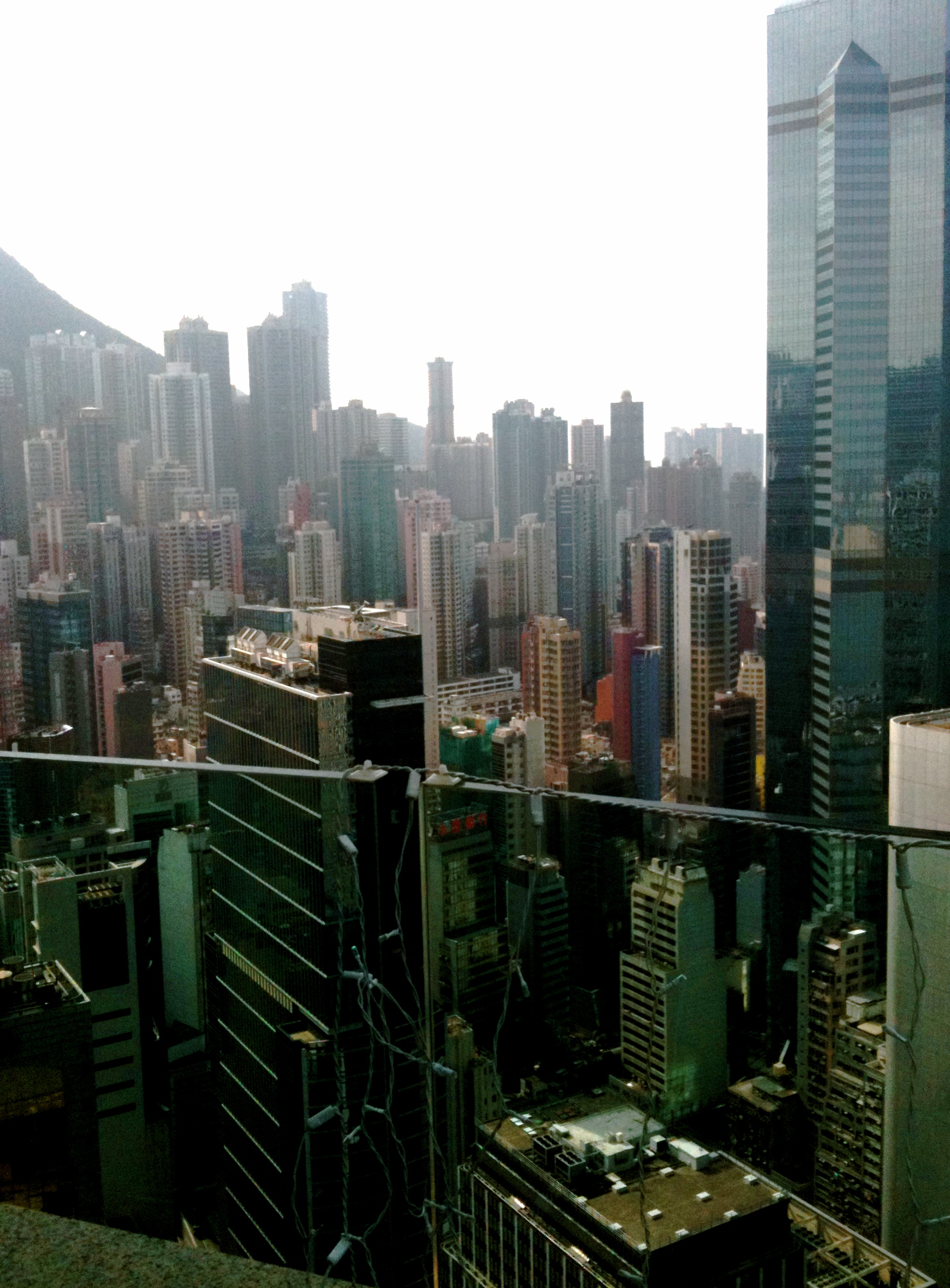
Boy, was I one happy camper yesterday when I stepped off the plane to spend a week with my son! It’s overcast and coolish and I said to Josh that the weather was just fine when he lamented no sun. So I’m out on the veranda of his tiny hi-rise apartment, in a jungle of hi-rise apartments overlooking the bay, with morning coffee and my computer on his WiFi reading the latest on the Red Shirt rally in Bangkok and of course keeping up with my adventuring Couchsurfing friends on the internet.
As before, I took the hi-speed train from the airport to the island but this time I wasn’t paying attention and got off at Kowloon…silly me! So had to wait for the next train to get back on for the final stop to the Hong Kong station. You’d think after all this time traveling I’d finally get it right! While waiting I get a call on my Thai phone…surprised that the Thai sim card was still working in Hong Kong… from Luk, son Doug’s Thai wife on the island of Koh Samui in Thailand…mom, you ok?
After a little nappy we made a grocery stop…of course my son being a chef there wasn’t a thing in his refrigerator except two small containers of expired milk…and then met Cantonese girlfriend Polly for some off the beaten track sushi. “Now we go for pizza,” Polly says with a sly smile…parroting an inside joke between her and Josh when when they overeat as usual. Hmmm. Wonder where we will eat tonight…eating of course is what I mostly do with my main man while in Hong Kong. 🙂
View of Hong Kong from Josh’s penthouse restaurant
The Yellow (now Multi-Color) Side
The “Royalists” (PAD Party), also called the “Yellow Shirts,” supports the King of Thailand and is in opposition to the mostly up-country “Red Shirt” farmers who support ex-prime minister Thaksin who has been indicted for corruption and is in exile. The “Reds” charge “the Bangkok elites” with being condescending and derisive and too fond of old money and privilege.
But ironically no one is more representative of the elites than Thaksin’s mafia which has a virtual stranglehold of Bangkok’s poor where the vendors have to pay tribute even to get a business started. But of course Thaksin, when he was in power, bought off the upcountry Reds with small loans that saved their rice crops and building clinics many of which stand empty because of the lack of equipment and trained staff. So now Thaksin has a nice constituency that sent over 300,000 farmers to camp out in the business district of Bangkok. Divide and conquer through class division, I say. Americans should recognize it.
The militant arm of the Yellow Shirts held the Government House hostage for 193 days in 2008 when it fled the military grenades and tear gas to hide out at the airport. It resulted, of course, in the airport being shut down by the government…devastating to tourism and disrupting air travel all over the world. Eighty-three protestors were convicted of treason which carries a death penalty but as usual no sentences have been handed out. But it also led to a coup against the then Democrat Party Prime Minister Abhisit. Confusing at the best.
The battle against corruption is occurring these days on the internet social sites like Facebook and blogs instead of on the streets. Except for a big strategy meeting in April at Rangsit University, sponsored by the University President, the “Yellow Shirts have been strangely quiet during the Red Rally but one Yellow Shirt friend told me: “they are just finishing what we started.”
Thaksin is part of the new monied class and is funding the Red protest, most people think, to position a return to Thailand to recover the money that was confiscated by the government after he was convicted for fraud and sentenced for 3 years in jail and also to possibly run for Prime Minister again. A megalomaniac, IMO. The Yellows support the current Prime Minister (Phua Thai Party) that came into power as a result of the Yellow protest. So you could easily say it’s old money and power against new money and power and class warfare that is driving the political division.
YouTube is full of propaganda videos against the Reds and the corrupt Thaksin and I am getting them in emails from Bangkok Thai friends. But they reflect the feeling of a lot of middle class Thai people…a fact.
Police Confront Reds Near Don Muang Airport
About 2000 protestors in trucks and on motorcycles from the Saladaeng rally site were led by Red leader Kwanchai Phraiphana on a march to Talad Thai Market near Don Muang Airport to urge people to join the rally site. Hundreds of police fire rubber and live bullets in air but protestors sat on the highway and refused to budge until they were told by a Red leader to desist and return to the rally site.
Traffic is chaotic and Don Muang urged passengers to expect 3 hrs to 4 hrs for traveling to airport.
Local media reports police shooting rubber bullets and live ammunition in the air to stop protestors but CNN reports “gun battles” at more than one point which implies shooting on both sides. I’ll wait for local reports.
Kwanchai Phraiphana, the red-shirt leader, was arrested near the clash site at Don Muang (when Red Shirts ran into a gas station,) Thai Rath Online reported.
The paper said Kwanchai was arrested at 2:41 pm while was trying to flee back to Rajprasong.
The BBC is reporting that one soldier was killed by a shot to the head and 10 people injured.
The Matter of the Thai Monarchy
Unspoken until now, in the background, is the matter of the Thai Monarchy. The beloved king is old and sick and on his way out. Many are wondering what will happen when he dies. His son is unsuitable to replace him to say the least. The daughter is much loved…but it is questionable whether the people will accept a Queen.
The Yellows (Royalists) and current government support the Monarchy. Those behind the Reds (and some academics) speak of “modernizing” governance in Thailand. Traditionally, the King is the Head of State and is supposed to stay out of politics and the Prime Minister is the head of the government.
There are a myriad of rumors pointing to the self-exiled Thaksin who fled the country rather than accept a three year jail sentence for corruption and who is financing the Reds…ironically mostly made up of up-country farmers who Thaksin gave “nitnoy” help (little help) to while Prime Minister.
The government has now said they have uncovered a wide conspiracy to overthrow the King. The Reds deny it. Deputy PM Suthep says this morning that an arrest warrant for ex-General Chavalit (also rumored to be behind the “third hand” mercenaries who appeared with hi powered rifles and grenades on April 10 where 25 people were killed including 5 soldiers) will be issued if he refuses to testify in his involvement in an alleged plot to overthrow the Monarchy. The investigation of the alleged plot may be a way of getting him out of the way.
Prime Minister Abhisit said today at noon that the Puea Thai Party filed a police complaint against the PM and CRES on defamation charges for accusing it of involvement in a movement to topple the Monarchy.
Seems the Monarchy has become politicized and the Red farmers and Red sympathizers from Bangkok rallying in the streets are being manipulated and used by all sides.
A journalist for TIME, an expat who has lived in Bangkok for 15 years, has this to say:
On may 19, I watched my adopted city burn. Plumes of thick black smoke rose amid deserted office buildings about 1.5 km from my Bangkok home as troops stormed the Red Shirt camp. There, chaos reigned: protesters set buildings ablaze, soldiers exchanged fire with black-clad gunmen, ambulances raced off with the dead and wounded. But farther south, near my home, there was no bloodshed, just shuttered shops and deserted roads. This unsettled me almost as much. I have lived in Bangkok for 15 years. What terrible force could empty the streets of this once vibrant city?
Fear, of course. The fighting and standoff of the past two months have claimed the lives of at least 70 people — mostly civilians, including foreigners — and injured hundreds. Thais pride themselves on unity. Now they are at one another’s throats, and the institutions that have always claimed to represent their best interests are too outdated and mired in crises to pull them apart. All countries weave myths about themselves, and here is Thailand’s: its people live in harmony, regardless of class, creed or ethnicity, their stability and prosperity assured by unblinking loyalty to King, country and religion — the so-called three pillars of Thai-ness. (See a TIME video on the violence in Thailand.)
The battle of Bangkok has shattered the myth of national harmony. Many Thais welcomed the crackdown. They regarded moderate Reds as dupes and militant Reds as terrorists and both as funded by fugitive former Prime Minister Thaksin Shinawatra, who was overthrown in a 2006 military coup. But others, including those who were sick of the protests, shuddered to see soldiers firing live rounds at people armed with rocks and slingshots, if armed at all. The last time that happened was a generation ago, in 1992, when at least 48 people were killed. Now Thais watch with horror as their fast-modernizing nation slips back into a darker era.
In 1992 it was Bhumibol Adulyadej, Thailand’s widely revered King, who intervened to halt the violence. But this time the ailing monarch, now 82, has remained silent. Other key institutions that might play a mitigating role are too busy wrestling with their own dysfunctions. The parliament barely functions; mobs have twice burst through its gates in recent years. The judiciary, which in 2008 toppled a government that Red Shirts helped elect, is widely viewed as partisan and unreliable. So are the media: free-to-air television channels effectively skew to the official line. The police are corrupt and incompetent, and in recent days they were conspicuously absent on Bangkok’s lawless streets. Thailand even has a crisis of faith: Buddhism is reeling from repeated scandals that Pope Benedict XVI might recognize. (See pictures of the showdown in Bangkok.)
These institutions need reform. But they are shielded from scrutiny and even well-meaning criticism by custom, taboo and — in the monarchy’s case — draconian lèse majesté laws. How can a country progress when its people cannot safely debate the very institutions that are central to their lives?
Read more: http://www.time.com/time/magazine/article/0,9171,1990640,00.html#ixzz0ogOJhzVm
U.S. Consulate Info Meeting In Bangkok
Before I left Bangkok, this last Monday Bob, who was in BKK for the weekend, and I attended a meeting in the Merriott Hotel Ballroom called by the U.S. Consulate for U.S. passport holders to update us on the current crisis in Thailand. They didn’t reveal or explain much that we already didn’t know about the political aspects. (Most of it is so complicated and there is such a lack of transparency that even the ordinary Thai doesn’t understand it).
The emphasis was on safety in case we found ourselves near a flair-up. No predictions. As most others have iterated, they said the only way to resolve this is political negotiation. They (as well as about 40 other countries) have been talking to the government and the Reds urging non-violence. Lot of good that is going to do! They said any negotiation needs trust and at the moment there is zero trust on either side. They warned that the conflict could very possibly be a very protracted one. If bombs go off near you, they said to get away from windows. When bombs went off in front of the embassy in Nairobi everyone ran to the windows and were taken out by the next bomb. That was about it.
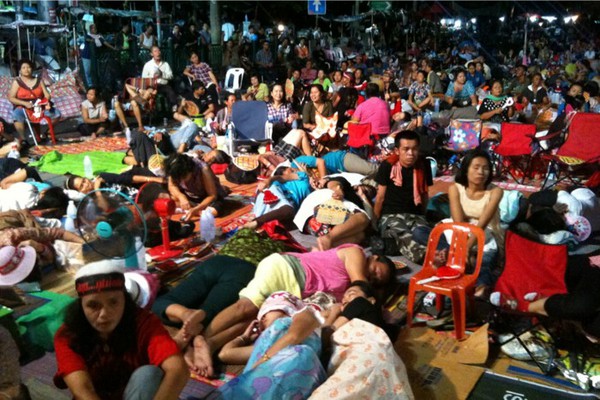
I thought they grossly under-estimated the number of protestors…said 20,000. The Friday before the meeting, on my walk from Silom to Siam Center and then to the main rally site at Ratchaprasong, it was a veritable tent city on both sides of streets all the way. Every 50 yards, huge screens were relaying the events on the main rally stage. People were lined up for food at make-shift commissaries; tents and sleeping mats, personal effects everywhere. Basically they have set up house-keeping. Walled barricades composed of tires and sharpened bamboo poles lined the streets. Reminded me of the 70,000 striking teachers in Oaxaca in 2006. The Red Guards dressed in black with red bandanas and flash-lights have set up check-points and are issuing red identification cards because, to become less identifiable by the police and army in case of an attack, they now they are wearing no colors.
In the last three or four days, three police and 8 people have been injured in a grenade blast in front of an ex-Prime Minister’s house; an M-79 grenade hit Chiang Mai police HQ. UDD (Red) protests have flaired in four province capitals where they are blocking police from entering Bangkok…where there apparently is not enough police to disperse the protestors. But that’s not the only problem. (A gross understatement!) At the same time that Prime Minister Abhasit is saying there will still be a crackdown if no agreement is reached, the Army General is saying that no blood will be spilled by the government troops. However, now this morning, the Centre for the Resolution of the Emergency Situation is saying they have given the police permission to use live ammunition. A bomb went off in front of Bangkok Bank this morning…the bank chosen because one of the political backers has close ties with it.
Any compromise must balance between the mounting public pressure to hold elections and resistance by Abhisit’s government and its military backers to a potentially unfavorable vote. One way forward could be a delayed election timetable that gives red-shirt leaders a reason to end their rally with a promise to return if the government doesn’t deliver. Fat chance.
Simon Westlake of the Christian Science Monitor, in his report April 26 shows how complicated the conflict on the ground is:
Government officials accuse the red shirts of harboring “terrorists” armed with military firearms and explosives. Red shirt leaders have denied the charges and disowned the shadowy paramilitaries.
The red shirts’ antigovernment movement is supported from exile by former premier Thaksin Shinawatra, whom Foreign Minister Kasit Piromya recently compared to Hitler and Mussolini.
Mr. Piromya berated foreign governments for not apprehending. “He is a bloody terrorist,” he told a seminar at Johns Hopkins University in Washington.
For all the hyperbole, there is growing evidence of an armed red-shirt wing, abetted by sympathizers in military headquarters who have leaked confidential plans.
Thai media identified one combatant caught on film during the April 10 clashes as a paramilitary border guard. Security sources say mercenaries with military or police backgrounds are also involved and that training camps have sprung up outside Bangkok.
A shared background
This doesn’t mean that rogue officers like Gen. Khattiya Sawasdipol, an ally of Mr. Thaksin who was suspended this year from duty, are taking control of government troops, say analysts and Western diplomats. General Khattiya is a celebrity among red shirts and is known for issuing threats against his enemies.
Divided loyalties among the rank-and-file, most of whom share similar rural backgrounds as the protesters, remain a concern for commanders in the event of a crackdown.
Red shirts can also probably count on the sympathies of Thailand’s police, who have been reluctant to confront them.
“There isn’t a breakdown of the Army command structure,” says Paul Quaglia, director of PSA Asia, a security consultancy in Bangkok. “But it’s hard for them to keep a secret.”
 Laughingnomad