Inconsistent Thai Values

After nearly a dozen visits and about six months time in the city, over the last several years, we have gotten to know Bangkok a little. In this city with a population of over 9 million people we can get anywhere we want to go…as long as our destination is near the Skytrain, subway line and boat ramps or as long as we can communicate with the taxi driver. Haven’t braved the buses yet but we do take the motorcycle taxis back and forth down Sukhumvit 22 to our dentist at the end of the street…surely risking our lives in the process!

It’s interesting to watch the people embarking public transportation in Bangkok. They stand politely aside as they wait for debarking travelers to get off before they step into the trains. (In China it’s an all out battle of people coming off against the people trying to get on!) Once on, people are usually very respectful…if they are Thai…careful not to bump each other.

One jaw-dropping gesture, for an American, is that anytime a small child embarks a crowded Skytrain or subway car with packed adults standing cheek to jowel, the nearest adult of any age will quickly jump up and invite the child to take his/her seat…leaving the beaming child to look up at it’s parent as if to say, I am really special today aren’t I?

We have never experienced a culture that has such implicit respect for their little ones. You never see adults scowling at children or admonishing them…in public at least. Children always get an admiring glance and an enthusiastic accommodation from adults around them. The interesting result is that you never see an unruly child. This is very humbling to observe. At home we often see parents humilating their children in public by yelling, shaking and even slapping or spanking them.

On the other hand, it is common for young women in small villages to leave their children in the care of others while they exchange sexual favors in Bangkok. A pretty young woman who was perming my hair, works in an upscale hotel beauty salon during the day and as a bar girl at night…her parents left to care for her two children in her northern Isaan village. It has been said that as many as one out of thirty very poor young women, who do not consider themselves prostitutes, will trade sex for money, dinner and shopping from the nearest Western or Japanese or Korean “ATM man.”

This activity often has more than the usual side effects however. Sadly, Thai women are often overcome with depression. It has been said that once Thai women consort sexually with a Westerner, the local Thai men will not have anything to do with them and they often remain single and without any way of supporting themselves. The Bangkok Post this week reported on a 23 year old young woman who had jumped from the Skytrain to her death on the pavement below because, her friend reported, her Western “boyfriend” had just broken up with her. From the point of view of the Western male, the gratitude and soft sensuous, accommodation of the Thai woman is a welcome relief.

I asked my friend, Jiraporn, a university professor here, who lived ten years in the States, what she thinks about this. “They are young and don’t know what they are doing. “Village families are poor and need the money the girls send home so everyone just turns their heads, she whispered kindly.

A Talk By Shirin Ebadi

Bob has been in the north for the last week so I joined the Foreign Correspondents Club the other day as a way of meeting other English speaking people in Bangkok.

Membership is reciprocal with Foreign Correspondents Clubs around the world; I first discovered the club in Phnom Penh, Cambodia a couple years ago. The club provides journalists with a venue and equipment for media activities but also provides memberships for other expats who live abroad or visit often…my category being “retired.” The club, in the penthouse of the Mayeena Building, sponsors activities like talks by visiting personalities like the Dalai Lama, has a bar and restaurant and a collection of English language papers, books and magazines.

So my first visit was to a talk given by Shirin Ebadi, the Muslim activist who was awarded the Nobel Peace Prize in 2003. The talk was very short…the questions by many of the media seemed designed for making their own statements about other governments like Burma, North Korea, the U.S. and Iraq.

Ms Ebidi is a self declared human rights activist (having once been jailed for her activities) and one of the many attorneys who are working together with many of the nearly 200 journalists who are currently incarcerated in Iran. She said that it is impossible to determine the exact number of people jailed for their human rights work because the statistics are not released by the government and families do not want to tell why their members are in jail for fear of reprisal.

Her most adamant point was that violence and war solves nothing but instead intensifies conflict. She added that Iran is not in a position to pose any danger to any of it’s neighbors. Then she continued by saying that it is left up to various Non-Governmental Organizations in Iran to go into neighboring countries with any messages, eg. human rights workers in Iran “are in agreement with Iraq’s Muslim leader, Sistani, who is adamantly advocating separation of church and state in Iraq.”

In describing her work, Ms Ebidi stressed that “the power of the pen is much stronger than the power of arms…the work of the pen can do more than an entire army,” she said. (Most of the people in attendance clapped in agreement when she commented that now that Saddam Hussein is going to be put on trial, the country must put western governments on trial too for collaborating with Hussein when he gassed the Iranians during the seven-year Iran/Iraq war!)

“So human rights activists are fighting for the freedom of the pen,” she said. “All societies need freedom of expression…the first stepping stone of democracy.” Regarding Burma, she said that the role of mass media is critical and the media should demand that the democratically elected leader and Nobel Prize winner, Aung San Suu Kyi, be given her freedom from house arrest.

When asked for her reaction to the Muslim woman in New York City who led a group of Muslim women in prayer over the objections of male Muslim leaders, she said she was not a religious person so she couldn’t comment on religion…but then went on to say that all women should be able to practice their religion the way they want. Islam, like all other religions, can be interpreted differently but any interpretation must be consistent with today’s societies. “What is the true Islam,” she asked? She answered herself by saying that “we all have a small piece of the truth. We must believe in what we are doing and believe in our path and allow the others to follow their own paths.” But then she added that “many use Islam to impose their political will on others.”

The most interesting question was asked by a woman from the BBC. She wanted to know how Ms. Ebidi was able to be critical of Iran, a country, like Thailand, that considers criticism as unpatriotic, without incurring reprisal. Her answer was that sometimes activists are accused of plotting against national security, but that it is impossible for one person to make a complete change in a country and any change must take place through the people. “The world is a mirror that reflects the good and bad in us eventually,” she concluded.

A man at my table was a professor of engineering at a local university. After introducing myself (retired and a traveler) he wondered why I was interested in “this.” I thought it was an interesting question. I was kind of speechless for a moment since the answer seemed so obvious to me. Then I remembered that my son Doug told me that when they got married his Thai wife, Luk, didn’t know who Prime Minister Thaksin was…an example of the lack of general knowledge of and interest in civic affairs. The other person at my table was a woman who worked in the human resources department of an oil company who was going to be doing business with Iran. The man at the table had a slight Indian accent but side-stepped the where are you from question from the woman. I mentioned that I thought the speaker was very “cagey” in her answers…and the guy was delighted with the use of the word “cagey” but I admitted I had no idea how the word came to be used this way! I love this stuff.

Trekking Northern Thailand

gatQye8keZlS3vpnwrOvxg-2006186163905868.gif
As soon as we returned to Bangkok from Bali Bob took a train to Chiang Mai for a trek in northern Thailand near Mae Son Hong. I stayed in Bangkok to have some dental work done. This entry was written by Bob.

Chiang Mai is Thailand’s second city and the jump-off point for experiencing the northern hill tribes.
100_3454.JPG

Mae Hong Son is in the trekking area–but quite a ways from Chiang Mai–drove there with several treks en route and spent one night in the town. There are many ethnic tribes–most renowned being the long necked ladies. When I was there not many tourists as it is hard to get to. We subsequently flew back to Chiang Mai–but that was included in the package. Did this on one of my early trips. On that trek we would walk for a day or two, spend nights in tribal villages and the van would pick us up at a designated site. Then onto the next trek–also did a little rafting but no rapids.

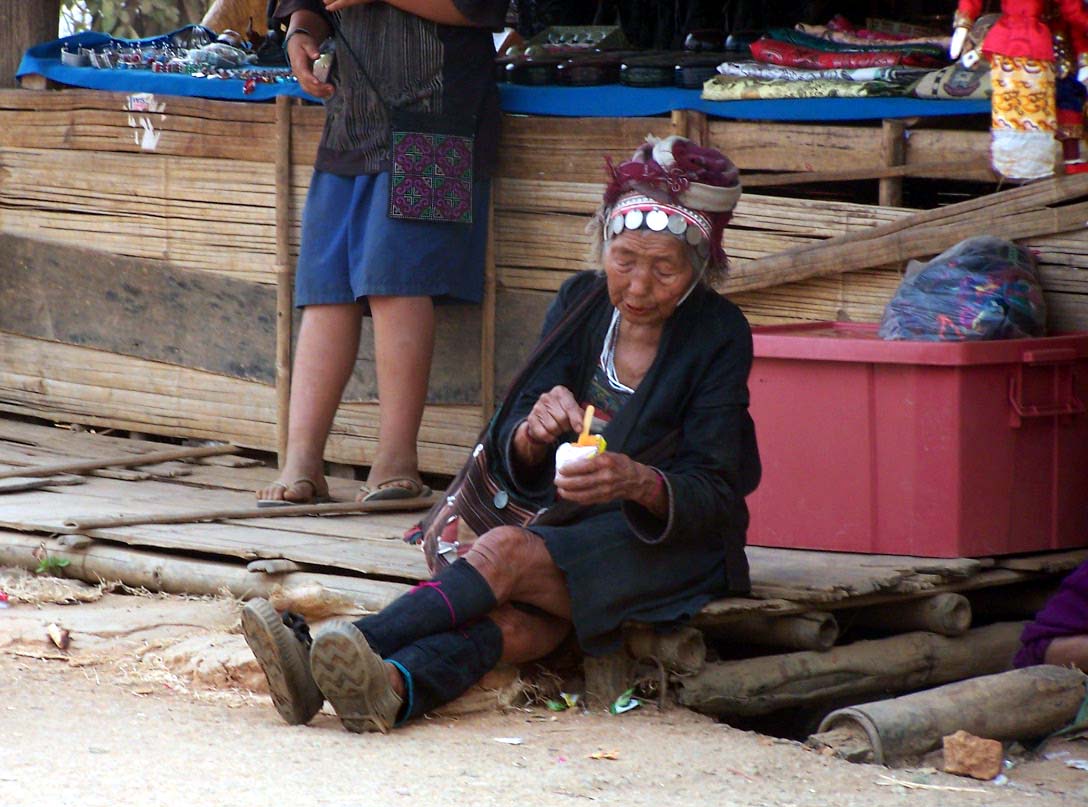
These peoples owe allegience to their ethnic group and national boundries are of no signifigance. They originally migrated from China and Tibet and now reside in southern China and in a geographic band across the north of Burma, Thailand, Laos and Vietnam.
100_3585.JPG

These tribes have taken taken advantage of the tourist influx and now offer their villages and homes as overnight lodging for trekkers. As they live in the hills there are no roads, autos and access is strictly by foot. So after a couple of days re-exploring Chiang Mai (its growing big time) I joined 5 other farangs (European and half my age) and a Thai guide for a 4-5 hr ride in the back of a pickup to the trailhead for a 3 day trek.

The walking is relatively easy but the heat/humidity combo is a killer. In 5 hrs we reach a Karen village, are given lodging in a bamboo slat hut and offered a “shower” from a barrel of cold water using a laddle to pour water on whichever body part is selected. A simple meal is offered–tasty but usually best not to ask what it is. Market comes to us as the local ladies show up with their handicrafts. The children run about and giggle at/with the strangers. During the night a pig was the victim of a noisy slaughter as the next day was a festival (new years).

On the previous trek along the Burmese border we had been invited to a wake for a child who had died that day (probably from congenital heart disease). But alcohol became the focus of the event and we made a hasty departure out a side door as belligerence unfortunately replaced festivity.

The next day of this trip offered many stream crossings over narrow logs and I was made suddenly aware that balance is one of the skills that diminishes with advancing youth. Oh well! But we made it to the waterfall for a rewarding swim and that night barbequed a suckling pig.

The last day offered a ride on a bamboo raft through several small rapids and the obligatory elephant ride (once is enough). My less than friendly elephant was named Toby with her cute baby following along behind. I kept thinking that I should have a seat belt. Toby, however, was sure footed, enjoyed the sugar cane and bananas that were sold at intervals along the route.

Mae Sai is just a border town in the far north I went to on another trip. Across the bridge is Burma. It is not a primary trekking destination. Used more for visa stamp-outs and Thais purchase stuff (primarily pornography I think that they cannot get in Thailand–or at any rate saw much of it being confiscated by Thai immigration.) From Chiang Mai it is part of a day trip –in a van–that also includes the Golden Triangle (people stand and have their picture taken under a Golden Triangle sign) and Mekong River/Laos border area. A boring trip.

Tip: The trips out of ChiangMai have become a bit too packaged and westernized–now include the obligatory elephant ride and a raft trip which is a token overcrowded experience. Ok if one has never done it but better if you are able to get off the beaten track like the trip to Mae Hong Son.

Keeping Body and Soul Together

In Bangkok we got a good deal for a month in a beautiful completely furnished apartment on a dead-end street in the upscale Saladaeng area…close to the Skytrain and the new subway that is running again after a recent accident.

Many delicious food vendors just outside the front door were well-placed for the two towers of business offices at the end of the street. After a week Bob took off for northern Thailand and I stayed in Bangkok…taxiing back and forth to my Tufts university-trained dentist who employs a group of specialists…all women…on Sukhumvit 24. With two new porcelain caps and a root planing, I will return in a month for prep work on two implants that will be completed in another 4 months…all for about a 7th of what it would cost with no dental insurance at home.

Doug and Luk took an overnight train from Krabi and stayed with me for a few days while a friend babysat their dog Ting-Tong at their house. They eat very small meals many times during the day…Thai food being what it is…so it seemed like we were eating constantly. One evening Doug took us up to the top of one of the tallest towers in Bangkok where we looked down from an outdoor bar/restaurant sitting on the very edge of the building…refreshing cool breezes blowing our hair…jaw-dropping night lights of the city down below. But mostly Doug and Luk just hung out in the air-con apartment with me…dreading the return to their “fan-cooled” (a uphemism if ever there was one) house in Krabi.

Bought a 20 hour wireless card I use with my Mac computer in any of the many Starbucks around town…handy for uploading blog notes and updating software…visiting with other computer users like the young guy from London who just moved here for a two-year tour with his company…paying as much for the freight on his furniture as it all cost in the first place. Our visit ended when a Thai-boy sat down at the Brit’s table…shooting me a look that could kill. Apparently I was interfering with their date.

Visited the six floors of Panthip Computer Shopping Mall several times where you can buy any high-tech item you could ever want. There are hundreds of stalls selling CD’s and DVD’s and at one I spoke to a rough-looking character standing next to me. “I come here often for R&R,” he says looking at the Thai girl standing next to him. (One in 30 Thai women have said to be working as prostitutes although they don’t call themselves that…they just want an ATM guy to exchange sex with.) “Most things are cheaper if you order over the net,” he says, apparently except for the handfulls of games and software he is buying for his employees in his computer center in Iraq.

Checked out the Foreign Correspondents Club, one of many around the world (I used the one in Phnom Penh Cambodia) that honor each other’s members. In the penthouse of a Bangkok tower you will find the club with a bar/restaurant that hosts speakers from around the world…recently the Dalai Lama spoke there…has a state of the art media center for journalists, jazz on Friday nights…and expats to speak English to! The night we were there ASEAN was hosting an open conference regarding Burma.

Vibrant Bangkok

Bangkok Air From Koh Samui to Bangkok again. Not a pretty city but it’s vibrant. The populace, as with much of Asia, lives outdoors-almost all 10 million of them. It is increasingly cosmopolitan and this year seems to have more farangs (Westerners) than I can recall in my several former visits here.

It is a paradox of a city. Some big money and big establishments with big prices but the vast majority is poor and the cost of living (by most western standards) is inexpensive. Traffic predictably chaotic with frequent gridlock. Travel by sky train and new subway system redeeming (and air-conditioned).

Walking is an adventure with uneven and poorly constructed sidewalks, often with holes, open pits, and unstable underfoot tiles– exposed haphazard electrical wiring and the mangiest dogs anywhere –all of them breeding exponentially. Hard to tell if they have any owners. Half of the dogs have orthopedic disability either from vehicle vs dog and/or intracanine squabbles. They sleep on the sidewalks during the day and roam at night occasionally in packs that cause a pause and change of direction for us pedestrians.

Shops, vendors, food stalls on wheels, open front restaurants, open sewers, tuk-tuks; all contribute to a cacophany of sound and smell that paradoxically continue to be both enticing and repelling. Bangkok is not renowned for it’s aesthetics. It is visited for it’s populace…the Thai people.

Smiles and accomodation prevail—but who knows what is lurking beneath…best to accept the presentation at face value and not analyze. The attitude, dictums of the Budda prevail. Mei pen rai (“whatever”).  As a passenger on a motorcycle taxi the driver, without looking, pulls out and speeds into the flow of traffic. “Slowly, slowly”, says I. “Mai pen rai, Budda will take care of us,” is the nonchalant response. The concept of liability has not reached these shores. Persons or events are either lucky or not lucky. Inevitable comparison of societies is fraught with subjectivity and tilted by one’s biases. Perhaps it is best (and more just) to live and let live. Enough. RLG

Stamp-Out to Burma

1wXSp3CkNsDoJl3s0SgHmw-2006171164904627.gif

“Stamping out” consists of leaving Krabi Thailand at a border crossing…in the case of Ranong the border is with Burma…and then “stamping” back into Thailand. To do this they went to the Thai immigration office at the port in Ranong to officially exit the country called “stamping out.” Then they hired a boat ($12) for a 40 minutes ride across the estuary to Burma. They paid $5 US (had to be a US bill) at the Burmese immigration office for a stamp in their passports to enter Burma. They walked around the little dumpy Burmese border town trying to avoid the sellers (the big sales item was Viagra…probably from India) for 30 minutes and then took the boat back across to Thailand where they returned to the Thai immigration office to get stamped back into the country for another 30 days.

In my case I had purchased a 60 day Thai tourist visa in Kunming China so I had another couple weeks in my passport. While Bob and Doug were monkeying around with this, Luk and I found a nice air-con hotel that would accept their little Shimizu “Ting Tong” (the name means “crazy”) for the night…having take-out dinner purchased from the local night market and eating it in our room … one of the best meals we had in Thailand…all of us feasting for about $3.

The next day we drove east to Surat Thani on the east coast of the Thai peninsula …visiting a famous Buddhist meditation teaching center (in English) on the way. Had strong thoughts of being dropped off here for a month but there was no air-con or even fans in the rooms and that even I was not ready for. I just settled for my good old TM mantra in my comfortable air-con room in Krabi.

Tsunami In Khao Lak

1wXSp3CkNsDoJl3s0SgHmw-2006171164904627.gif

Before we left Krabi, Bob and Doug both had to “stamp out” of the country at Ranong (on border of Burma) so they could get another 30 days in Thailand. We rented an SUV and drove over to Patong Beach on the west side of the island of Phuket where so many people lost their lives in the tsunami. You would never know anything horrible happened here…businesses up and running and tourists lying on the beach although in minimal numbers compared to before the disaster…but a lot of bare areas where store-houses once stood facing the beach.
DSC00032.JPG
Driving up the coast north to Ranong we passed through Khao Lak…a 50 mile stretch of beach that took the worst beating in Thailand. For miles there was nothing but bare bulldozed land…bulldozed in order to remove bodies that were trapped among the roots of Mangrove trees and under rubble. Much of the land here is flat from the beaches to the foothills inland so in places the devestation extended across the road and into the countryside for more than two kilometers. Halfway up a hillside we saw a wrecked coast guard ship sitting at a crazy angle that we understand will be preserved as part of a memorial to all who died here.

We passed a volunteer center that is accepting volunteers for a month at a time and for as long as a year…many of them young people who scrambled down from the backpacker streets in Bangkok…others flying in from the U.S. and Europe…many of them professionals in their fields. At the web site at http://www.tsunamivolunteer.net you can read heart-rending and life-changing message boards…many in English.

Luk’s Family In Trang

1wXSp3CkNsDoJl3s0SgHmw-2006171170004499.gif

100_2898.JPG

We rented an SUV and drove to Trang, about 150 kilometers south of Krabi, to meet Luk’s immediate and extended family. We were greeted with the traditional Thai wai greeting with head bowed and hands folded…a greeting that feels so incredibly respectful. Grandfather is 81 and lives at home with Luk’s graceful grandmother who is 72.

Before a visit to the market with Luk’s mother we stopped by a fish farm to buy fresh fish for dinner. Luk’s mother, a professional cook, prepared a half a dozen dishes for us and for various cousins and uncles who appeared on the scene throughout the evening.

Luk’s mom lives out in the countryside with a woman friend. Luk’s brother is 19 and works in a grocery store. One of Luk’s cousins has been a surgical nurse for four years in the Trang Hospital…her boyfriend works for the police department. Another cousin is in the army and works as a dive master on the side. We struggled to communicate…but we all laughed together at Luk’s mom’s tiny Laborador puppy who was terrorizing Luk’s 8 month old Shimazu! On the way to the car after dinner Luk’s mother and I walk hand in hand. We are family now.

Ao Nang Beach Krabi Thailand

1wXSp3CkNsDoJl3s0SgHmw-2006171164904627.gif

Bob and I have been here in Krabi Province of Thailand with Doug and Luk for three weeks now…a welcome respite after a month in smoggy noisy Bangkok where I had some dental work done and a 6 month routine check-up at Bumrungrad Hospital.

Bob left a couple days ago to do some hiking in Khao Sok National Park up north. I stayed here in my little 2nd story bungalow on lazy Ao Nang Beach watching the dark wiry young boat guys guide their long tailed boats to various karst islands and isolated beaches out in the deceivingly placid blue and green ocean and return again. Bob and I will either meet up in Bangkok or he will return here first…who knows what he will do. The breeze cools down at night until about noon…then air conditioning goes back on again.

Doug and Luk come over every morning (my place is 10 minutes up the road from their house) and we breakfast together. Then we all pile on the motorbike for a ride through the karsts and banana tree forests looking for a little fantasy house for me to rent…can get a house with tile floors, bathroom, hot water, kitchen facilities and bedroom and main room for about $200 a month if you are not on the water. A bottom floor bungalow on the water like Doug had before the tsunami is about $450 a month.

Weird to see inaugural celebrations on Fox News and then to drive by the Krabi Wat with hundreds of pictures of victims and piles of burial boxes.

An internet friend of mine who just married a Thai girl is staying on Patang Beach on Phuket Island where most of the damage was done. He said the beaches have been cleaned up…chairs and umbrellas are back up and the local businesses are begging for tourists. Reconstruction has already begun on some of the lost and damaged hotels. The second worst place in Thailand to get hit was Khoa Lak…just up north from here. They are still finding bodies in the Mangrove Forests and the village water well ended up with a car and 92 bodies in it. Several thousand bodies have not been found yet, many of them illegal immigrants from Burma. We hear they will not even try to rebuild at Khao Lak.

Post Christmas in Bangkok & Escaping The Tsunami 2004

1wXSp3CkNsDoJl3s0SgHmw-2006171170004499.gif

A month in Bangkok

On the morning of December 26, 2004, after a bowl of spicy Thai soup on the street outside my Bangkok hotel, I returned to my room and flipped on the satellite TV to find both CNN and BBC running astounding commentary and amateur video of the tsunami wave that had hit the Krabi coast earlier that morning. Son Doug and his wife Luk had been living on Khlong Muang beach 15 feet from the water in Krabi Province just SE of Phuket. The telephone circuits were all busy but after four tries and 30 minutes trying to reach them with my heart in my throat, Luk finally answered. What sweet voices that day!

About 10:30 that morning Doug and Luk had been in bed when they heard what they thought was a bomb. When he opened the curtains to the sliding glass doors, he instead found that it was the first wave of the tsunami that hit their glass doors facing the beach leaving the bungalow under water. They were lucky the doors were closed. Many lives were lost when water entered open doors and windows leaving people with no way to escape.

Doug said he immediately threw a bottle against the door of a sleeping couple behind their bungalow to wake them while Luk climbed screaming to the roof. Then when the first wave went back out, he and Luk scrambled to safety up the hill behind them.

When the 2nd wave washed detritus and some of their belongings back up on the beach, they made a little pile of stuff on the country road above the house. Doug had just sunk a lot of money into a cozy cafe/bar in front of his beachfront rental unit only to lose the whole investment…but not his life. He also luckily didn’t lose his new motorbike, that he retrieved as it was out swirling crazily in the 2nd wave.

They were able to quickly arrange for a friend with a pickup to take them and what was left of their belongings to a rental house farther inland on the road between Krabi Town and Ao Nang Beach and later to the island of Koh Samui.

About a week later, Bob appeared in Bangkok from wherever he was and he and I flew from Bangkok to Krabi Town…all of 6 people flying with us…not a good sign for the tourist industry here, I thought, as I stepped off into the humid tropical air. It felt very strange to be flying into the tsunami ravaged area on a colorful holiday plane. Son Doug and Luk, met us in the terminal…Luk, smiling, handed me a nicely wrapped gift. A friend that was in the Peace Corps in Thailand says the name “Luk” is an endearing name in Thai. She is a dear.

Krabi Province has about 500 people known to be lost so far to the tsunami. After spending a night in Krabi Town, a busy dusty town of about 18,000, Bob rented a motorbike and we moved about 30 kilometers up the coast to the beach town of Ao Nang.

On the way out of town we passed the Buddhist Wat that is providing space for a Krabi assistance and communication center under wide green awnings by the side of the road. Volunteers assist families looking for the missing on computer terminals. Color photos of the dead, disfigured and unrecognizable, and pictures of the missing cover rows of standing sheets of plywood. I was shocked and revolted by the appearance of drowned bodies. I had no idea they would swell like they do. Most of the photos of the dead attempt to show anything that may be identifiable by an intimate family member…a ring, a bracelet, a tatoo, a logo on a t-shirt…flowered undergarments…

Workers are still building several hundred wooden boxes that will be lowered with their contents into a mass grave in the cemetery beside the Wat. Driving along the roads in Krabi, here and there can be seen covered memorial areas with casket and flowers for funerals by some family members who have been able to identify their dead. We had been told that Krabi Province’s worst hit area is Khao Lak, farther north up the coast where the wave penetrated three kilomaters into the Mangrove forests and where people are still being found as debris is cleared. There are no plans to rebuild the area we are told.

The immediate crisis is over here in Krabi province. Smiling Thai people are some of the most positive people in the world and they are trying to make the best of a bad situation. They are not waiting for the wheels of international aid. Here in Ao Nang beaches are quickly being cleaned up…an attempt to salvage the devastated tourist high season. The local boat school is donating student workers and materials to repair about 50 damaged long-tail boats. A local company is donating time to desalinate long-tail motors. Boatmen are again taking what few tourists are left here out on diving expeditions and trips to outlying islands. Window glass is being replaced.

Patang Beach on Phuket Island had the most deaths and got the most publicity, but many beaches have been cleaned up already. It is indeed strange how one area could be hit hard and how the next area 10 feet away would not be damaged at all. Destroyed businesses and homeless families will get help.

But unfortunately, international coverage by CNN and BBC filmed the devastation to the exclusion of all the other areas which frightened away prospective tourists. On top of that, both Sweden and Denmark issued travel warnings so the tour companies have rescinded their travel insurance for those people…prompting travelers on two and three week holidays to return home. Restaurants and guesthouses here are empty. One restaurant owner told me that they have heard that some business owners will get some money to pay their rent but that still leaves them with little source of livlihood.

Koh Samui on the other side of the Thai peninsula, not hit by the wave, is packed at 100% capacity…only families getting hotel rooms and tents being set up on the beaches for backpackers. But here on the west side of Thailand, local expats and long term tourists are writing home and telling people if they really want to help now, to buy a plane ticket and come visit. If taking a vacation in SE Asia right now seems repugnant to you…as it did for us…think of the living here instead. The opposite side of the coin is the economic struggle of the survivors as they lose their source of income…60% of which comes from tourism. We are going to Phuket in a few days. Maybe the hospital there could use some help.