International Driving

Don’t know if it’s just Oaxaca or maybe it’s the whole of Mexico. However, my dentist says that drivers in Oaxaca are worse than in Mexico City! But in Xalapa they were ever so polite…big fines meted out if they are not.

But you are taking your life in your hands in Oaxaca. The taxis and buses are the worst…speeding, honoring no lanes…forcing you over. No stop signs, lights, when there are lights and when they are working, are suggestions only. And then there are the “topes” or speed bumps everywhere. Never know when one is coming up unless you watch the cars ahead and hope they slow down…however, one, with drivers from Veracruz, didn’t slow down until they got to the tope. Then they stopped. Bam. Their little car could do it. My big Toyota Land Cruiser couldn’t. So I slammed right into the back of their car. Good thing no one was hurt. Good thing for insurance.

Actually I expected this…but thought I’d get side-swiped by a bus. Now I know why Mexican immigrants in the north get into so much trouble! A couple years ago in my home town in Oregon I was T-boned by an immigrant going through a red light at about 60 miles an hour…she had no insurance. No one has insurance here except the expats.

There are rules here…just not the posted ones. And heaven help you if you don’t obey them! Boils down to buses and taxis and very small cars do what they want…and that includes just about everyone. Except the gringa with the Toyota with a US license plate. Yes, I know I should have put more space between me and car in front. You get conditioned to keep close…cars, buses and taxis will try to edge into even a sliver of space forcing you over. If you leave a lot of room…say a couple car lengths you never get to where you are going because the whole city will move in front of you.

DSC00006.JPG

Thailand is no better. Was rear-ended by a motorcycle there once. Today got an email from Bob who is living in Thailand: “Now if I could only learn to control my mini-rage reactions at Thai drivers,” he says.

“Earlier this week I was driving in a line of autos and a bus tried to pass the whole line of 5-6 cars. He encountered oncoming traffic and cut in front of me–not really in front more like forced me onto the shoulder.

I offered selected auditory and visual feedback. (Had to laugh because the same thing happens here in Mexico!)

But the curious cultural phenomena is that I was the heavy in that I lost my cool. But driving is very unsafe here–most trips (even to the market) produce an anxiety or at least an edge of apprehension. And the Thais cannot park. It is humerous to watch them attempt a parallel park, most often most of the car is left somewhere out on the street. And I have two significant dings being clipped me while I was parked. Oh well…..” 

I think I detect a note of Thai-speak in that syntax.

Faithful Tuk Tuk Driver

eWCBF9KYWi73omUCUHRffw-2006185115650300.gif

Nice to have someone faithful to me. I trust Supoat, in his 50’s, with soft face and warm bright eyes. I call him when I need him to drive me somewhere in his Tuk Tuk.

Most of the people living outside of the moat that surrounds the center of town are illegal Shan refugees from the border between Thailand and Burma. Today, he took me to the Chiang Mai Shan temple where very young Shan boy- children are being initiated into monkhood. They are carried in a musical procession through the streets and around the temple on the shoulders of young men. They are dressed in sparkling tribal ceremonial dress and their faces are made up like girls with lipstick and rouge. Nearby drummers are making rhythmic music. I am the only farang in the crowd and draw curious looks.

My masseuse suggested today I eat a northern Thai soup called Kang Cae for my health, a soup with many different vegetables including two different kinds of eggplant and 15 different herbs. Supoat joined me tonight at the “Huenphen,” a lovely upscale restaurant specializing in northern Thai cuisine. Learning spoken and written English in school as a small boy he got the best grades in his class he says proudly. A Chinese couple next to our table says not a word to one another during their dinner…listening to our conversation in English…seeming to be deeply disturbed at seeing us together. I do not have a good feeling about them. They leave in a huff.

Supoat suggests taking me two hours north to his home town, Fang, early tomorrow in his new (used) Peugeot car purchased with money down given him by his niece’s husband who is a mechanic in Texas. We will visit his mother and father in Fang. He will drive me another hour on up to Tha Tan, a tiny village at the Burma border, drop me off and return to Fang to spend the night with his parents and rake the leaves in their yard. As the youngest of his siblings he is responsible for taking care of his mother, he says. He will return to Tha Tan at noon the next day and pick me up to go further on to visit tribal villages before returning to Chiang Mai. I am looking forward to being out of the hot noisy city and getting into the cool mountains.

Miao Village In Guizhou

1wXSp3CkNsDoJl3s0SgHmw-2006171171225701.gif

In Shanghai, exploring the Lonely Planet Thorn Tree web site, I noticed a query from a young woman from Kaili in Guizhou Province who was offering to arrange a homestay in a Miao minority village in the mountains. We exchanged emails and I was excited to meet her. But then I received an email saying she was in Shanghai and could we meet for the train ride to Guizhou in a couple days. I returned that I couldn’t leave that soon but I could meet her in Kaili…then I never heard from her again. A mystery…or maybe she got an offer from someone to pay her fare back to Kaili…who knows. But I knew where I was going next! From Shanghai I flew to Guiyang, capital of Guizhou Province and stored my baggage at a hotel there before boarding a bus for the three hour ride to the city of Kaili.

When I got off the bus there, I was directed to another station around the corner with several rickety old buses waiting for passengers to various villages. I had no idea which bus would take me to Xiuang, the village I had been told by the English-speaking receptionist in Guiyang that would be celebrating their New Year’s holiday. Then I saw a smiling family waiting near one half-full bus. “Xiuang,” I asked. Yes, they nodded. But while we were waiting to board, a couple of men outside a nearby fence a few feet from us motioned us to approach them. It gradually became clear they were taxi drivers that wanted to take us to Xiuang. Between my motions and their language we all agreed to share the cost of the taxi so we piled in and were off…on a harrowing short-cut along steep mountain dirt roads with thousand foot drop-offs…to our village!

The people in the mountains in this southeastern Chinese province are not Han Chinese. Eighteen different minorities live within Guizou province and I was here to visit the Miao people in this gulley-like valley with identical hand-hewn wooden houses climbing the hills on all sides.

209915718_a429a4e0bb.jpg

209926509_dec6fd2f3f.jpg

The wooden houses are built on foundations of stone and constructed with wooden pegs…no nails or cement. Steep paths meander among the houses.

After some initial quandry as to where a hotel might be, if there was one, I came across a woman who led me to a small building…who would have thunk it was a hotel…for about $2.00 for the night. I was invited to join the family around their hotpot dinner downstairs…had no idea what I was eating but I was starved and it tasted delicious with smiling faces all around. No extra charge! There was no heat in the freezing room that night so I took the bedding off the other twin bed and added it to mine.

There are at least 130 different types of Miao people living in villages among the mountains and they have different dialects, headdress, and traditions. Yet, they all belong to one Miao minority. Their language is endangered as it has no written form and is used less and less among the younger generation who is often eager to learn English.

The next morning, walking along the main cobblestone path through the village I came across a young French couple…the only Westerners in the town…who were delighted to speak English with someone after hiking all over the mountains from village to village without a guidebook. “Just knock on a door” they said, and show the sign for sleep and eat and show money and you will be invited in,” they said. They were in their second year of travel before returning home to start a family. They had been traveling in the province two months and it was they who took me to Mr. Hou. Mr. Hou was the English teacher in the middle school there that drew students from villages all over the mountains. “By foot,” he said.

210633704_1745d7eb1b.jpg

210633628_6db0e86236.jpg

Mr. Hou invited me to stay for two days for $4 a day in his home, generously sharing three banquet meals a day around “hotpot” and dozens of small dishes of whatevers with him and his extended family of which there were many coming and going during each meal! While the men and women prepared the food, the guests all sang a local folk song. Then they asked me to sing a song…and I’ll be darned if my mind didn’t go panicky blank…all I could think of was Row Row Your Boat and I think that is really a French song! So I told them we had rock music and I couldn’t sing rock. They all nodded in agreement…to my relief I was off the hook!

The family and I joined round on 8 inch high stools and watched Mr. Hue chop the meat up on a thick round wood cutting block on the floor. Then slowly bowls of food appeared from another cooking room that the women had prepared and were set out on the floor around a “hotpot”or wok full of boiling broth sitting on a foot high round stand full of lit charcoal. Mr. Hue would chopstick some of the food he considered the best onto my small bowl of rice. The bones and small rejected bits were spit onto the floor. After every few bites the local hooch was poured round and after a song and a whoop everyone would gulp down the fiery fruit-flavored alcohol made by the grandmothers. It didn’t take long for the whoops and songs to exceed the eating. Humorously, I was given “just a small amount” each time..the villagers having experienced past catastrophes with drunk foreigners!

Finally the day came when the New Year’s biggest day would be celebrated…music, dancing…the women in wonderful traditional dress.

210851901_ed09870d37.jpg

210885497_88f1e95a8d-2.jpg

211284526_99c82f9754.jpg

During the daytimes I wandered through the small cobbled lanes leading through the houses and shops…trying my best to avoid the firecrackers thrown at the visitors by the small boys.

Although the New Years ethnic dances in costumes were delightful and the people warm-hearted and friendly, I was happy to leave the village. The small boys thought it was great fun to make the “foreigner” jump when they threw firecrackers at her feet…one landing on top of my backpack…nearly scaring me out of my wits. And on top of that Mr. Hou felt he had to direct my every move in the home…was terribly worried I would fall off the narrow log ladder to the upper level where he had cleared out a cozy room with a rock-hard bed. After all, I was “old.” 62! So by the third day I had had enough fireworks and directing!

While I was waiting for the bus back to Kaili, (there was no schedule…you just waited for the bus to show up) a newly-arrived young man from Amsterdam and I made friends with some Chinese English-speaking students from Hunan province who were there with their photography teacher and we nearly went to Langde village with them if there had been room in their van. I was sorry not to be able to go with these cheery young people who were so anxious to try out their English…some of the words inappropriately big and ostentatious…and some I didn’t even know the meaning of! Be sure to correct our English, they said! Well, we don’t use that word in normal conversation I would say and they would look so disappointed. We exchanged email “to practice English.”

“Kaili, Kaili, bystanders yelled at me as a small bus appeared…barely missing the food-vendors on either side of the dirt road leading up to the village. Then just as I was waiting to board, a Russian-American in his 80’s from NYC with a false leg nearly toppled off the bus with his bag into the street. We quickly traded some travel stories…he had been backpacking for years all over the world…refusing to give it up…very inspiring…and touching…

I headed back to Kaili, a comfortable and colorful Miao urban city with great food down small alleys, and was pleasantly surprised to find that my hotel room harbored a broadband high speed internet connection! This was not only Asia, but it was China after all and the appetite here for technology and communication devices is insatiable.

213543317_e1daf65c6e_m.jpg

213492238_197f89aa47.jpg

213563973_0e7b423433_m.jpg

213492164_3ac8d92d2e.jpg

After another bus back to Guiyang I spent the evening walking along the river than runs through the city, meandering up and down streets…getting lost and finding my way again…checking email at a large internet cafe with at least a hundred young kids all noisily playing video games. And eating wonderful street food!

The next night I headed off to Kunming on an overnight train…middle bed in a 6-bed compartment this time…but not without exploring the new Wal-Mart around the corner from the train station to replenish my battery supply!

Hanging Out On Olkhon Island

Urr0g6ZfQ7ttYL19duYJfg-2006170133924757.gif
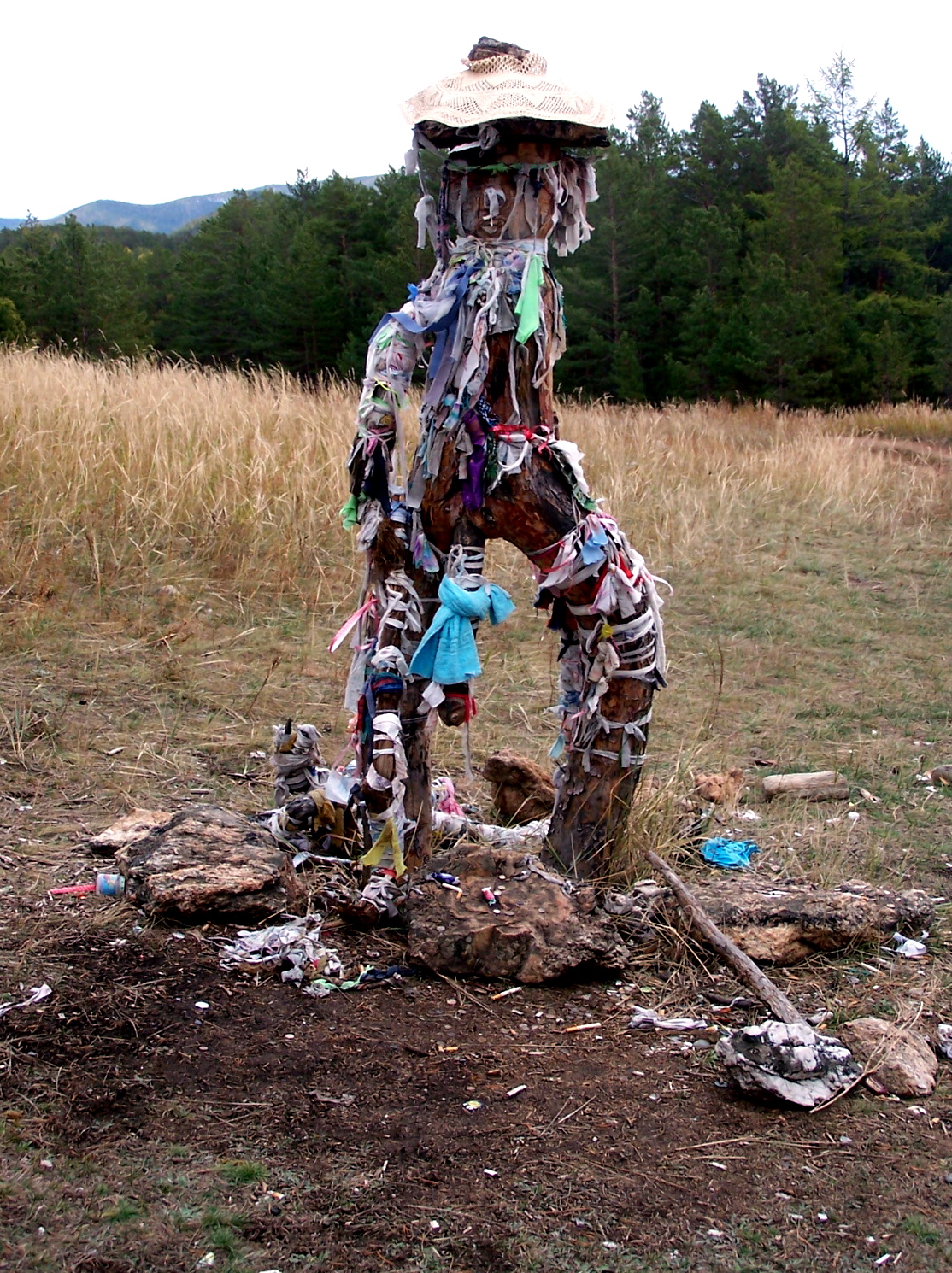
After hanging out a couple days…glad to be off the train…Gregory, a former University teacher of German, drove Bob and I, three Germans and a Pole on a half-day excursion to the north of the 70km long island to visit various geological sites and views of the lake but most especially to see a world renowned Shaman ceremonial circle called Three Brothers that is sacred to two faiths practiced here, Buddhism and Shamanism. Two years ago almost 300 Shamans from the world-over came together here. We lay a one rouble coin at the foot of the prayer flag pole while the “Sarma” or east wind blows fiercely over us.

The Buryats are of Mongolian descent…nomads who spent time herding their flocks between the southern shores of the lake and what is now northern Mongolia. They lived in felt-covered yurts and practised a mixture of Buddhism and Shamanism.

Gregory is driving Nikita’s four wheel drive van…a Russian vehicle designed 30 years ago and that was so successful they used it as an ambulance. “There is only one reason Russians sent the first man into space,” says Gregory the Kamikazi driver thumping over mud hole roads at least 90km per hour…”is because of the roads!” Later he says “we at the moment are using two wheels…if it gets really complicated we will use four!” “Normally we sacrifice two persons…usually 50% survive this trip!” Any of our U.S. vehicles would have rolled over at the first turn but this one mysteriously keeps it’s four wheels on the ground.

We pass through beautiful valleys with sheep and cattle farms…two of which are rich and have beautiful houses “because they don’t drink,” Gregory says. We pass by one small house of an old woman who lives alone with her cow…the rest of the houses in the area appear empty. We are shown an area that was a gulag during the Stalin era and whose inmates produced cans of caviar from the lake sturgeon that was then sent to the Kremlin for the enjoyment of the party bigwigs). I see a straggly triangular three wooden stick affair on the top of a hill and ask Gregory what it used to be. “Local KGB headquarters,” he says throwing his head back in laughter. I ask if the Russians and Buryats intermarry. “Seldom,” he says.

Free-Wheeling Moscow

7yBXvp82X2gVlMeZe25DiM-2006198051115673.gif

Video

2004-09
Like in the big Central European cities we visited, there are cranes everywhere… old soviet buildings built during the Stalin era are scheduled to be razed and new one modern ones put up. Foundations for Stalin’s “Seven Sisters, called “Wedding Cakes” by foreigners, were laid in 1947 to mark Moscow’s 800th anniversay when Stalin decided that Moscow suffered from a ‘skyscraper gap’ compared to the USA.

Inextricably linked to all the most important historical and political events in Russia since the 13th century, the Kremlin (built between the 14th and 17th centuries by outstanding Russian and foreign architects) was the residence of the Great Prince and also a religious centre. At the foot of its ramparts, on Red Square, St Basil’s Basilica is one of the most beautiful Russian Orthodox monuments. It is a UNESCO World Heritage Site.

Moscow is a free-wheeling city. To the ambitious there are no limits…the streets around the hotels outside Red Square are lined with black Mercedes and BMW’s with black glass windows guarded by black leather clad “goon” drivers…looking like the mafia. I find a fancy hotel where there is free WIFI in the lobby while participants in a European Union meeting saunter back and forth and high-heeled jeans-wearing translators wait around having lively conversation with pipe-smoking goons.

While I sit here uploading text on our blog, Bob wheels off to find the American Medical Clinic where he has a smoldering tooth extracted by a Russian-speaking dentist before we get on the trans-siberian train for Yekaterinburg (birthplace of Yeltsin) Lake Baikal and Mongolia beyond. We miss each other at the end of the day and it costs me 600 roubles to get back to the flat in a taxi because I’m too chicken to hazard the buses and metros.

The night we saw “Spartacus” at the Bolshoi Theater, our bags were searched by monstrously big “security,” one at least seven feet tall. Tanya says, “I never see them there before…” I ask if it is because of terrorism and she says yes, terrorism. By the way, the suicide bomber that killed several of the people in front of the metro entrance was only about 5 minutes from her flat…she says she was at that metro only a few minutes before the bomb went off. People in Moscow worry she says, but what can you do? Yes, I said, I know, thinking of our Josh who works at a restaurant in lower Manhattan.

We are in the ozone at the Bolshoi, the first ballet for Bob who now says he is ready to take ballet lessons if you can picture that and we enjoy conversations with people around us during the intermissions…one older woman from Berkely and a young woman who is here for a few months to volunteer with an AIDS education Non Profit Organization. Come to find out, over a glass of champaign and caviar-filled pastry, her boyfriend, having graduated from Harvard, is working in Chicago as a chef and they are moving to Manhattan…so of course I take her email address to give to Josh.

We leave on a midnight train for Yekaterinburg.

Four Taxis to Dinner In Mumbai

In Mumbai one night it was so ludicrous we just had to laugh…afterward.

Taxi number one only got us to the end of our street before Bob, realizing the driver didn’t know where the hell to go, jumped out of the car.

Taxi number two was an old old man that had to stop three times to get directions to Tamarind St. (Less than two kilometers away.) Each time he would say oh yes-like finally he knew just where to go-just enough reaction to be encouraging. He really had no idea where he was going but knew we wanted to eat so he took us right to a good restaurant across from Victoria Station…McDonalds! Oh my god, look where he brought us, I groaned. We paid him and got out.

Then Bob went from taxi to taxi on the street asking if any of the drivers knew where Tamarind St. or Meadows House or if they knew of the restaurant named Ankur. Taxi driver number three insisted he knew where he was going and drove around until we realized we were right back where we started-exactly one-half block from our hotel! In frustration we got out and left the taxi driver sitting there. “I don’t know what he was thinking,” Bob said in exasperation…”what did he think was going to eventually happen?” Maybe a miracle,” I suggested?

Then another driver said he could get us there…ok…one more time. The fourth time worked. I counted 11 people attending 8-10 tables. Tells you something about wages in India.