Back To Snake Park

The next morning, on the road back to the Snake Park there are small villages and shops; give me pen; give me something; what do you have to give me…the kids yell out to us as we drive past them. The little ones will fight over an empty plastic water bottle.

We are half way to camp when we come upon a huge bog half a mile long and 50 yards wide with several stuck vehicles. Everyone in the village is standing watching the goings on. We have to double back to find another road through some corn fields when we hit another huge bog with 3 feet of water and mud. We are well into the bog when a Land Cruiser, towing a mini-bus, comes into view. There is much yelling back and forth and then Francis realizes it is up to us to back out of the bog to let the Land Cruiser through. I am absolutely astounded at the ability of these vehicles to maneuver through the red slippery clay. Like I said, Hillary really missed some good 4- wheeling!

Drove past the Tanzania Military Defence Association. Reminds me that there has been very little police presence in Kenya or Tanzania. The compound has the only uniform wooden houses we have seen-apparently it is a military installation. all the other houses we have seen so far in Africa are made of sticks and mud.

Meserani Snake Park-Again
East African parks are great; toilets, and showers-some with hot water. Although on this night the water was cold. Found out in the bar later that the meter reader had offered to fix the meter so it would run half as fast if the owners of the park would kick back a monthly fee to him.

While our electronics recharged again I talked with the Brit still at the park who was motorcycling overland. His wife was in their tent recovering from the removal of a molar tooth that day in Arusha. They had lived in Guyana for two years (remember Jonestown?) with the British Volunteer Service and said it had an interesting mix of people and had a waterfall that has the longest free fall in the world but gets no publicity. He had been married 10 years with apparently no children. They rented their house out in London. Said if he could keep his expenses down to 600 pounds a month he could travel indefinitely. ($900) His father was a Cambridge graduate, he said, who still climbs mountains in Nepal. I think we are finding the one percent of the world’s population who have figured out how not to work.

Ngorongora Crater

Firstviewofcrater.JPG

The Ngorongora Crater is a conservation area and National Heritage Site. After breaking camp in the Sarangeti, we drive another two hours up to the Crater rim where we set up camp so we can be ready for the drive down into the Crater the next morning. The crater is 16-17 km across; the difference between a park and a conservation area is that people can live in a park; so many Maasai life in the Sarangeti but none in the crater. The crater sides are covered in a dense rain forest; Black Rhino only here; no giraffes here because it is too steep for them to walk down; no Topi or Impala here; the alkalai lake is filled with pink Flamingos; Corey Bastards are mating; hyenas with their lowered backsides slither along…

The Land Rover dodges huge elephant poop on the roads meandering along the crater bed.

Maasai and Samali Ostriches: incubation 48 days; female watches the eggs during the day and the male at night. Biggest enemies are man and lions; Red Billed Duck; Black Winged Stilt; Black Headed Heron; White Heron; Sacred Ibis; Crowned Crane; Wida Bird; European Stock: coming from Europe with no passport and flies back in December-he is not ours, Francis says.

Common and Golden Jackal; Flamingos by the million who eat algae and salt that makes them pink; Spotted Hyenalives 35 years; noctural;4- 5 months gestation; he was walking the whole night that is why he is sleeping. No one else eats the Hyena except other Hyenas when they die. Lions may kill them but they don’t eat them. Male Lion eats first-big boss-then the mother and the cubs; 40 lions in the crater; sometimes you see no lion because they don’t know you are coming to see them and they just lie anywhere in the tall grass where you can’t see them, Francis says.

Wart Hog; monkey sitting on top of an Acacia Tree-the king of the world. A mini bus drives up. Ladies in nice clean white blouses sit in the back with their suitcases with wheels on them; probably staying at the expnsive Ngorongoro wildlife Lodge on the rim. “My god they are not even camping; not getting the full-on experience!” the kids yell out to each other laughing hysterically. By the way, at a potty stop, one of the kids spotted a tourist all dressed up like Safari Guy just stepping out of Magellan Catalogue. All the crew and kids laughed themselves silly.

Francis says that the animals in the crater are very polite because they haven’t been in the hunting block outside the crater where they learn to be scared of the human.

Black Headed Heron eating baby Black Mama snake; male elephant with biggest penus ever…swinging between his legs as he walks. Weighs 3 kg, Francis says. How does he know, Bob retorts.

We stop at Tak Tak spring for a rest and watch a school of Hippos.

When the zebras walk or run away from the car, their heads bob up and down telling the lions “I have seen you, I have seen you, I have seen you,” Francis says.

We drive around a bend to find five Forest Elephants all in a row. They are waiting for pictures, Francis says smiling. Then we drive up and out of the crater and head back to camp.

Animal Spotting The Big 5 In The Sarengeti

I love the remnants of the Swahili cadence in Victor’s English.

Giraffe: “It is raining and he is very happy there-he is getting a shower.”

Bob watching elephants: “This makes you feel badly there are zoos.

Topi: lives up to 20 years, gestation 7 months, smell and sight are bad so they stand on termite mounds to see the lions-so no Topi in the crater because there are no termite mounds in the crater.

Bob: “My everlasting memory of Africa will be the Acacia Tree.”

Sarengeti means endless in Swahili…endless horizons, endless silence, endless pleasure for us.

Grand Gazelle: male has long horns and female has short ones; Lilac Breasted Brawler: Black Jackal-scavenger-only kills rats or grasshoppers; Impala has one mate-the male has to fight to get the female.

Best 4-wheeling ever! Hillary really missed a good time when she took the helicopter in!

The park’s vultures: White Headed Vulture; Hyena; Jackal

This is pleasure-we are finally out of the chaos of the city. Writing helps assimilate our experiences so we can move on…

Glossy Starling: Marshall Eagle; Dove; Bee Eater; Francis: I have to study and put it all in my mind. Guinnie Fowl; “Monkeys are not afraid of you they just like to be by their friends.” Velvet Monkey; Water Buck: males have horns, stay close to the water and need green grass. His enemy is the lion.

The Hippos are grazing all night and in the morning they come back and are sleeping in the day, Francis says. They are mating in the water, delivering babies in the water. They kill many people because they know man is not a good animal. They stay in the water 10 minutes without his breathing. Gestation is 8 months and life span is 40 years. Many Hippos together is called a school: Just like children-they must be together. Now is midnight for them. They roam 5 km at night and return to the pond in the morning. The Park has to arrange for keeping the ponds filled with water because otherwise we can get a problem and Hippos have to die when their skin dries out.

Then Bob says to Francis: “There are humans that eat 25kg a day, the gestation is 9 months they eat animals and leave a big mess.” Francis is delighted “very good, very good” he says. Bob and Francis are friends.

Black Smith; Embrella Acacia-big old one; Maasai Giraffe: gestation 15 months; lives 35 years. When they are walking or when they are ambling their legs are together and when they are running their legs are asymetrical. It is illegal to kill this animal, Francis says. Leopard: a loner-if you see two leopards together either they are mating or it is a mother with her cub. After the baby is born the male is takes off. They are afraid of the dew, like a housecat, so they stay in the tree. At night they are coming down and hunting for their food. When they are killing they put the food in the tree and they are there eating for three days. For hunting they have to use their cunning because they run so slow-they have to hide somewhere and wait-like the lion. Cheetah runs 110 km per hour and is fastest land animal. He cannot climb-just walks. Don’t know if we’ll see him today because of the tall grass…

Much sighing-becoming more and more relaxed…like the animals….

Many Ostriches; Francis says the best animal viewing is July-Sept when the grass is brown and everything is dry and animals are gathered around the water holes. However, Bob saw more animals this trip than he did six years ago in August.

Saw part of a pride of male lions out in a field. Francis spotted a lioness on a rock sleeping-she is waiting for the sun; completely relaxed with one foreleg wrapped down around her rock. There are only 3000 lions in the park. Lives 16-20 years; gestation 5 months. Sometimes their teeth break and they can’t eat food and they have to die. They eat 40 kg of meat-can go one week without eating; nocturanl-very active at night. Later we drive up to a vehicle and two lionesses are lying in the shade against the back wheel. Several vehicles arrive and park in a semi-circle around the lions so we can all take pictures.

We are triumphant! We have seen the “Big Five,” Buffalo, Elephant, Leopard, Lion, Rhino.

Sarangeti Spoof: a person says they have spotted an animal and everyone tries to see it. It is not funny.

We stop at a Maasai Village on the way out of the Sarangeti. “They are people-not monkeys,” I say, and refuse to get out of the car. Most everyone else goes inside the village, made of sticks and bushes, to watch the males do their jumping dance and make the Wilderbeast sound while the females try to sell their necklaces. It costs $5 to go into the village-this is not a cultural exchange or an I-Thou experience either one.

Egyptian Geese; The elephants kill and they pile branches on top and wait for three days to make sure he isn’t going anywhere; Toni Eagle; Wilderbeast: they are very stupid, Francis says, if one crosses the river they all have to cross…like sheep. If they have been in the hunting block, when you stop the car they are not sure of their life. They remember those bad people there. If they have always lived outside the hunting block you can go right up to them and they are not afraid of you.

Sarangeti Safari

There are about 5 people to a car besides the driver. The tops of the vehicles pop up so you can stand up and view the animals and take pictures.

DSC00077.JPG
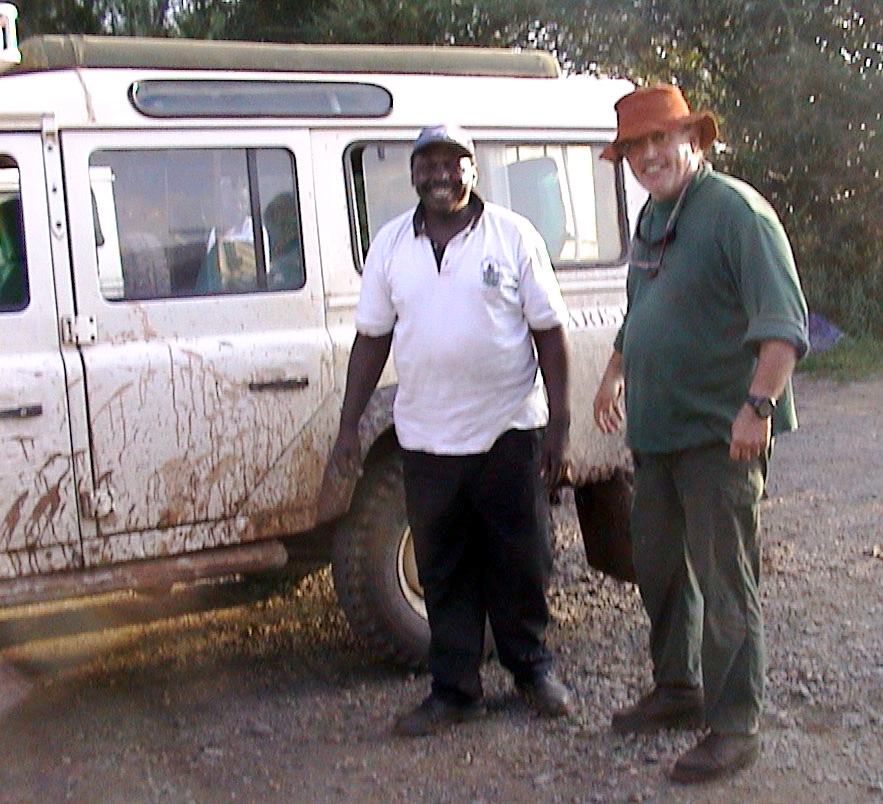
Our driver is Francis, about 55, who lost his wife 6 years ago. “I have four boys-I beat you,” he says laughing. There are about 5 people to a car besides the driver. The tops of the vehicles pop up so you can stand up and view the animals and take pictures. The 4-wheelers have radios and the drivers let each other know of animal sightings. We leave the two young Tanzanian cooking crew chattering and bantering in Swahili and take off across the Sarangeti with our drivers.

Merani Snake Park

The second night we stayed at the Merani Snake Park near Arusha Tanzania. We showered and headed to the park bar for a drink and to plug in the electronic equipment for recharging.
ArushaBar.JPG

Our tour company has contracted with a safari company in Arusha to take us in 4-wheel drive Land Rovers to the Sarangeti National Park and the Ngorongoro Crater. (www.roysafaris.com) We leave behind George and James to watch over the truck and to putter with necessary maintenances.

Land Rovers and Land Cruisers in Africa are a necessity on the mud roads-in American cities they are just expensive status symbols. It took four hours to travel the 200 miles to the Sarangeti. Tanzania has begun paving the road all the way to the Crater which will dramatically increase the tourist influx. The Maasai walking by the side of the road try in vain to get the Rovers to slow down; there are virtually no other cars on the African highways-only trucks and buses.

On the way we pass by a weekend market…charcoal fires filling the air…cooking food for the festivity. “Young people come here to see each other,” our driver says.
TanzMarkt.JPG
We set up camp and ate dinner around a lantern. I drop, exhausted from the jouncing, into bed only to wake up a few minutes later by the sound of elephants playing although it didn’t sound much like playing at the time. Woke again when I heard Bob outside the tent-zipping and unzipping the flaps again and again and juggling the bottle of water we left outside. Finally I reached over to find Bob sound asleep. It was a Bush Pig, I am told later by the cooks. Woke again when I heard grunting, which at the time I thought was snoring coming from one of the other tents; a lion, we are told the next morning-not more than 10 yards from camp.

Maasai Warrior Tribe

Jumping3.JPG

Masaaiposing3.JPG

Beautiful tall Masaii men and women still maintain their tribal lifestyle and religion-wearing red to keep the lions away from their cows. They live in southern Kenya and northern Tanzania. The cow is the practical and spiritual focus of their lives. The religion is animistic-they see God in everything.

The women build the houses, gather the firewood, cook and take care of the children. Every day the woman walks five miles for water and firewood.
WoodWomen.JPG

The man tends the cattle and keeps the lions away. The man eats alone and she hides while he is eating. The Maasai only eat meat, milk and drink hot blood-but they do not eat any wild game.

A boy is cirumsized at about age 16. If he cries out he cannot get married because it means he is not a man. Women used to be circumcised (clitorectomy) also but Francis says that has stopped in the Maasai tribe.

The man can have more than one wife. Some believe if the live in a house they will get sick so they live in the bush and make fire with sticks. They use no medicine or hospitals. If they die they just throw them in the bush, Francis says.

They make a beer called Hadsa out of honey. They sleep on the skin of an animal. They eat birds and baboons. The Chief wears the skin of a baboon,. Children go to school from age 7 through 7th grade by law in Tanzania. If they are not in school there is trouble, Francis says. The 122 tribes in Tanzania are allowed to intermarry and that is why we are not fighting each other, Francis says. Tribes are Christian, Muslim and Animist. They can marry Whites, Francis says.

To the Sarangeti

HF0m0NezqDnitkljwNP8lg-2006188104829364.gif

A week before picking Bob and me and another 3 people up in Nairobi, the WorldWide Adventure Company had taken about 15 others across the Masi Mara into Rwanda to see the Gorillas. Their stories made us sorry we didn’t go…”we were 2 meters away from them…they were so relaxed…and peaceful. The gorillas were completely comfortable with us being there…”

Our first day out the kids were hyper as hell from being stuck in the mud for two days after seeing the gorillas. I threatened to abandon the truck as soon as we got to Dar es Salaam but earplugs got me through. The second day was better…our good natured trip leader talked the kids out of the Michael Jackson tape. Our guide, Rod is South African; the crew-Kenyans. George is a great cook and James-a good driver. The truck is a great way to see Africa because you sit up high and can see all over.The luggage and kitchen stuff is underneath the seats…accessible from outside.

As the truck was moving through the Kenyan/Tanzanian border a young kid wanted $100 American for his little hand-carved giraffes; we all laughed and he yelled up at us “I want to be the Bill Gates of Africa!” then quickly added, “I am just joking!”

Stayed the first night at Namanga Camp where Bob discovered a small pretty Maasai woman named Eunice tending the small camp store. Eunice gave me my Maasai name-Milanoi. We exchanged addresses and she promised to make me a necklace with my Maasai name and send it to my home. (I never got it of course.) She refused to take money for the necklace or the postage so I gave her a silver ring. But in the morning she didn’t give me my 20 shilling change for a Fanta I drank the night before and then the other shoe dropped. She asked me to send her clothes, shoes (size 4) earrings and nail polish and clothes for her 9 year old son. Our expectations of cultural exchanges so different…we hate feeling “used” under the pretenses of friendship. Extend that to our Aid programs world-wide. Who is used by whom?

Arusha

In Arusha the truck parked for an hour outside an internet cafe so we all climbed down the five-step vertical ladder to a hundred outstretched hands.

Saw a westerner (Brit) sitting by himself at a sidewalk table so I joined him. He had been in the country eight years trying to make a go of a business but had given up and was going back to the UK. He said you can’t make it if you are honest….hands out all over Africa, he said, all the way from the little kid in the street to the top.

Remembered a taxi driver in Nairobi: “80% of the businesses are owned by the Indian minority and they are very very rich,” he spat! I told him what the taxi driver had said and he said, oh, that’s the way it is all over Africa. Fills an economic need for the country but the Africans never get an opportunity to learn the skills they need for self-sufficiency.

Nairobi to Cape Town Overland

HF0m0NezqDnitkljwNP8lg-2006188104829364.gif

May 5, 2002
We left for the 4000 mile seven week trip in a Mercedes Benz truck overland from Nairobi to Capetown. As Bob suspected there would be, there are 17 kids all under the age of 30 on this truck-very cheeky Aussies and Kiwis and half a dozen ball-busting Britains. Overland trucks are the cheapest way to travel Africa so the trucks are always full of kids-guess we will be content with being the token elders.

PottyStop.JPG

The master of African roads is the truck driver-cars cannot manage the ruts and potholes. The truck can go almost anywhere with its powerful engine and wide tires. James understands the power under his control. We are dumbfounded by his ability to wedge the truck into the smallest path, narrowest driveway, around the sharpest corner! Drivers are extraverted and have tremendous confidence-an almost regal bearing. I read this on my blog to James and he whooped and hollered and jumped up and down…Yes! Yes! That’s me! That’s me! First instruction from Rod: it’s a TRUCK and not a bus! Every time someone calls it a bus we are supposed to buy Rod a drink-I’m the biggest offender. I just laugh.

We are all divided into four groups that rotate daily-cooks helper, dish washing, security and “dog’s-body.” Security has to stay with the truck when are parked in the towns. Dogs-bodies are the go-fers. They fill up the water jugs at the camps and set up the folding seats. They set up the folding table for food preparation and put up George’s tent. (George is the Kenyan cook.) They also periodically sweep out all the dust and mud out from under the seats and the aisle of the truck. Dish washers make up three tubs of water-one soapy, one with disinfectant and one rinse. They set up two plastic pans for hand washing-one with soap and one with disinfectant for rinse. They dry the dishes by swinging them in the air.

George makes a fire on the ground with the charcoal he has purchased along the road and sets a big grate over the top.

George.JPG

The charcoals much softer than ours…coals are red and coffee-water hot in just a couple minutes. Cooks helpers peel veges and generally do whatever George wants them to do while they try and keep out of his way. George has pretty fixed and definite ideas about how he wants things to go.

George2.JPG

For breakfast we have had eggs all different ways, French Toast, pancakes, dry cereal made with reconstituted dried milk, toast, wieners, bacon, canned spaghetti, beans. Lunch is grated carrots, sliced tomatoes, grated cheese, green or red peppers, sliced meat and bread for sandwiches. I ask Claire if this is always going to be lunch and she says yes, but to shut up and don’t complain because it’s the only fresh veges we get! So I don’t say a word! George usually puts out the leftovers from the night before too. Pineapple or bananas or dessert.

Dinner usually is served with creamed soup first and then African stew with mashed potatoes or rice, steak and baked potatoes, chicken and rice with good spices, spaghetti with interesting sauces…and many more good things like that. We sit on little camp stools to eat. A couple times George has fixed the African staple, maize, for us-a kind of fine white corn meal. You dip your fingers into it and form a little ball with which you then dip into a spicy meat stew and eat. When it is dark and getting colder and we want to sit awhile around the campfire we put a few coals on the ground underneath each folding canvas seat…works nicely.

The truck has padlocked compartments all the way around with doors that fold down. George has the keys on a shoelace that he wears around his neck. I get tired trying 14 keys to find the one that unlocks the compartment where our baggage is so I paint the key with someone’s nail polish. George just laughs.

The truck periodically pulls over for “toilet stops.” We scatter…boys on one side of the truck and girls on the other. On one stop I was one of the last to get off and after walking down a small bank I looked to the left and saw 6-7 shiny white butts all in a row. I yelled to the girls that I wished I had my camera-you can imagine the hullabaloo! Our hands get sprayed with disinfectant before we get back on the truck.

There are two heavy plastic drops on each side in place of windows that are rolled up during the day so we get lots of fresh air and can see out. It also gives us accessibility to people standing around the truck when we are parked at border crossings and supply stops for those who choose to stay on the truck. If everyone gets out we put the drops down because local kids are known to jump up and grab things off the seats. If we are in a camp the drops come down to keep the monkeys and baboons out of the truck.

The other riders on the truck ranging from early twenties to early thirties are bright and sassy. Besides Bob and I there are two other couples, Damian and Melissa from Melbourne Australia and Tim and Belinda from New Zealand-the rest are single-Heather and Fiona are sisters from New Zealand, Nikki from New Zealand but had been working as a nanny in London, Michelle, Claire, Sarah and Lorelle traveling together from England. Adrian is from Australia with a Canadian passport who lives and works in London and Pete is a New Zealander. In Victoria we will pick up Michael from Johannesburg South Africa and lose everyone else except Nikki, Fiona, Heather, Sarah, Michelle, Adrian and us. Heather, who was working as a nanny in London had a friend who knew Mick Jagger”s nanny (hope this is right, Heather!)

Most are already well-traveled-the four girls from England spent a year traveling together after “uni” (university) and Michelle and Nikki have done overland trips before-Nikki amazingly did a 6 month overland trip in the year 2000 on the old “hippie trail” from England to Kathmandu via Iran, Pakistan and the Karakoram highway. Both Michelle and Nikki are gunning for a job in the overland business and will remain in Africa at the end of the trip.

It’s fun listening to the British, Aussie and Kiwi accents but they insist Bob and I are the ones with the accent! I am starved for conversation and want to discuss the linguistic, cultural and political differences among the English speakers but I sense they don’t like it…that maybe they assume I am being critical of them…the arrogant American…little do they know how critical I am of my own popular culture and the foreign policies of my government.

There is a library (big box of tattered paperbacks) ranging from slut novels to the Autobiography of Nelson Mandela on the truck for long travel days. There is a cassette deck with speakers at the front and the back. The smokers have to sit in the back-always Michelle in her funky little hat under which you can barely see her sparkly eyes and Rod the tour leader. At the very front of the truck there are two steps up to a section of four seats on each side where the Brits usually sit facing each other so they can chatter. The rest of the seats face forward. There is a cooler for drinks.

We have lucked out with a really nice group that is very compatible and everyone enjoys each other. Tim from New Zealand says he couldn’t imagine his mom doing an overland trip-makes me feel good. Rod has confiscated the Michael Jackson tape but the rest of the music blaring all day on the truck stereo is ungodly as you might imagine. We would prefer to remain steeped in images of Africa…the sounds of the local dialects in soft voices…he sound of children’s laughter…the look of the bright wide smiles…the sounds of the daily village activity and of the animals in the parks, the sight of the incredible red clay soil reflected in the morning and evening light, the mind blowing brightness of the stars at night…the breathtaking red sun while it is setting down on the Zambezi…we have left home partly in an effort to get away from the abrasiveness of western popular culture…but James says the other riders are young-this is their time to enjoy…

Bob and I don’t sit together…24 hours a day since February is more than enough togetherness. The truck is not full and many of us get two seats to ourselves. In July and August we are told the truck will be filled to capacity-36 people! I can’t even imagine it! It is good to be traveling now.

Bob Climbs Kilomanjaro

HF0m0NezqDnitkljwNP8lg-2006188095850902.gif
Kilomajaro.jpg

Marengo Route.jpg
BobatKilomajaro.jpg

Bob’s Report:

Curious how one thing leads to another. It all started at the local fitness club. In the bravado of a post-workout discussion we proposed adventures that would be a goal to keep our workouts both frequent and intense. The suggestion that appealed to us was to climb Mt. Rainier in Washngton State. We decided to do it and six months later realized that the effort was similar to running a marathon with risk, thrill, and danger elements thrown in.

Subsequent to the climb, I found myself on the mailing list of a prominent climb leader. His brochures detailed the many climbs he had scheduled for the next year. I skimmed one pamphlet that described plans for a Mt. Kilomanjaro climb in Kenya and filed it in a corner of my desk pile as being impossible. But as I reread the brochure several times over the ensuing weeks I began to think, “why not?” “What am I waiting for?” Eventually I sent in a deposit and had another goal for which I needed to maintain regular workouts.