End of a Disastrous Experiment

7yBXvp82X2gVlMeZe25DiM-2006198051115673.gif

I want to emphatically state (and I think Bob would concur) that I have nothing but admiration for this proud and resilient people who have survived 70 years of this “ideological tidal wave that affected virtually the entire globe,” according to Robert Harvey in his “Comrades…The Rise and Fall of World Communism,” “that left maybe 100 million dead in its wake, as well as twice that number homeless and suffering, and more than 30 million as slave labor of one kind or another and that shaped the lives of billions.”

Robert Conquest in “Reflections on a Ravaged Century,” argues that a group of sub-intellectuals fastened upon Marx’s convoluted and half-baked theories because of the new turn-of-the-century faith in science as the answer to every problem, including human ones” which was one response to a bewildering new world of social upheavel and unseen forces as lost men sought to gain control over the destiny of their lives.

I mention to three of our homestay hosts that I see T-shirts with CCCP (USSR or Union of Soviet Socialist Republics) and hammer and sickle on the backs…black humor born of a young generation that did not have to live through the bloodbaths…and when I see the responses on the faces of these women, I know I will not wear this T-shirt. It is not funny.

Are not some Muslim men today, full of shame because they are jobless and without family also reaching from out of a medieval creed with a leveling response in a desperate attempt to gain control over their lives? From communism to this?

Lingering Images of Russia

7yBXvp82X2gVlMeZe25DiM-2006198051115673.gif

Siberian countryside with endless kilometers of grassland and golden pine and white birch trees… small wooden, weathered, unpainted, picturesque, single story bungalows throughout Sibera with blue painted shutters-the banya (toilet and shower) in a small building nearby…Outside the cities groups of small two-story dachas (2nd homes with three-sided pitched roofs with garden in front providing relief from tiny flats and a chance to grow their own vegetables for those who can afford it…intensely flavored wine-red berry jam on Olkhon Island.

Drab, dilapidated Stalin-era block style apartment buildings that make maximum use of space but with absolutely no aesthetic value… there’s definitely a market niche in this country, Bob laments, for brooms, scrub brushes, soap and paint…. black leather jackets, Lenin-style hats (never saw any baseball style hats) and shoes with pointed curled up toes on men and women with spike heels—click click click)…. Especially in evenings, but any time of day, people strolling or standing around with an open bottle of beer in hand… Occasionally someone toppling over from inebriation to be caught by a comrade before falling…people with an aloof veneer-not an air of superiority-just reserved as in “I’m minding my own business…you mind yours”-sometimes seemingly shy but when the exterior is cracked they smile readily and extend themselves with varying degrees of warmth and good humor-especially on the train where we have an opportunity to interact……deep underground metros-monumental works of art in themselves (no photos allowed)…wonderful rich soups and more soup, each a little different than the next…

Experiencing daily life in cozy cluttered apartment homestays with friendly middle-aged to elderly single women who get 30% of what we paid. The provided breakfasts range anywhere from here’s the eggs-cook your own to elaborate spreads in tiny rooms… tiny bathrooms (literally wc’s) with sit down toilets that took three times to flush clean…overheard conversations that sound like arguments in a tone of voice you and I would take offense at but then we think it’s all just bluster…people walking in-between and in front of us with no regard for personal boundaries but not intending to be rude…urban store windows full of fashionable clothing and products that only about l% of the people can afford and then only because they operate on the black market (one woman who works for the central bank whispered “yes, we take white money and black money.”

Grueling Border Wait

The wait at the Russian-Mongolian border is a grueling 5-6 hour wait for customs to go through each carriage and take our passports, return to the office to fill out forms and then return with our passports. Olga takes a six inch wad of $20 bills out of her hand bag and counts it three times.

We are desperate to get off the hot claustrophobic train and get some cold fresh air. We find a very small market a hundred yards from the train where we buy dried apricots, apples and dried noodle soup.

To relieve the bordom a young guy from Chicago (they have put most of the foreigners on this carriage) pulls out his frisbee and plays with an older guy from Australia out on the platform and when one toss ends up on top of the carriage, the guy from Chicago climbs up to get it but can’t resist the urge to pose playfully for all the cameras that appear down below…but not for long. Officials appear and grab all our cameras removing batteries, film & digital chips and tapes. They spend an hour filling out forms and waiting…for what…an offer of money? No one wants to pay money but we shuffle and wait nervously. Finally just before the train pulls away the cameras etc. are returned to their relieved owners.

The Mongol border is a good 2-3 hour wait too… Mongolian sellers and money changers come on board. Olga takes an offer from a guy wanting to exchange our Russian money but then slams the cabin door in his face as she lets in a Mongolian woman who gives us a better offer. Olga has obviously done this before.

After crossing six time zones out of a total of 9 or 10 in Russia, the train thankfully rolls into Ulaan Baatar at 7 the next morning.

The Tajik and Olga

7yBXvp82X2gVlMeZe25DiM-2006198051115673.gif

The Tajik and Olga
In Irkutsk, when we find our seats on the train to Ulaan Baatar, we find a good-looking 40 year old Muslim man from Tajikistan in our cabin. He has studied English in school when he was a boy by showing us how tall he was, and remembers a few words. He shows us pictures of his wife and four kids back at home in Tajikistan. We show him pictures on the computer of our trek in 1996 in Kyrgzstan although aware that the Kyrgeez and Tajiks don’t really like each other very much.

We are able to figure out that he is returning to Ulaan Baatar to operate a “caterpillar” at a gold mine after a three-month summer break with his family. We soon put our sausage and cheese and bread on the little table and he pulls out his bottle of Vodka. He is charming and has a wonderful smile and a quick laugh…I like this man.

The next day Olga, an energetic middle-aged blond, begs to move from her assigned seat near the toilet at the end of the carriage so she joins us…immediately kicking the mellow Tajik up to the top bunk and spreading her belongings from one end of the cabin to the other. Fluent in English, she says she gave up her doctoral studies in Chemistry in 1993 because there was no work in her field, to become an entrepreneur and she makes the trip to Mongolia and China every few months to buy merchandise…”everything for health” she says. She instructs us where to get a cheap hotel in Beijing and gives me an empty bottle to have the Chinese traditional pharmacist fill for my psoriasis.

Soon she and the Tajik are really going at it in Russian…the bluster again…and I ask her what they are talking about. Olga is incensed: “He leaves his wife in Tajikistan to work in another country but when I ask him if she works he says no she has to stay at home and only leave when she is with him!” This goes on for awhile and is actually quite entertaining to watch…then she non-plusses Bob by showing him a picture of man (XY) and woman (XX) and showing him that with an unfinished “X” (referring to the “Y” that “there is a mistake!” When he objects she says “well maybe women are more clever. He just looks at her.

Queuing In Russia

Urr0g6ZfQ7ttYL19duYJfg-2006170133924757.gif

Back in Irkutsk we watch women walking swiftly always carrying a plastic shopping sack or two (ovoiska from the Russian ‘ovois’ meaning ‘just in case’) of varying brands that have to be purchased)…a hold-over from Soviet-era shopping methods that, according to the British journalist Fiona Fleck who described in the ‘Guardian’ how Soviet era panic buying of bread, rice, cereal and flour affected the ordinary Russian even in late 1990’s: “whenever they go out they are constantly dropping into shops when passing by just in case something had arrived, sometimes joining queues in the hope that something will eventually arrive that day.

Queuing has always been a life-principle for the Soviet shopper and is enshrined in what must be the most roundabout way of buying in the world.” Even now at one consignment shop Bob had to stand in line to choose an item at which time the clerk wrote out a voucher that he was supposed to take this way and that way and then this way and that and then to stand in line to pay a cashier stamped the voucher indicating the item had been paid for and then stand in the first line again to show the stamped voucher to the original clerk and obtain the item. In Soviet times people would buy in bulk and shop in teams, often paying someone a little to stand in line for them.

Today, the queuing of cars is a machiavellian event . We are amazed at the ability of cars to “crowd” their way into a queuing line for example lanes merging into each other. When our driver to Olkhon Island arrived at the Ferry we were second “in line.” In the course of an hour there were about five lines across all waiting to crowd, inch by inch, into the two lanes that would lead onto the ferry. Apparently this is the accepted modus operandi…however we did see one car full of women get out of their car and take on the driver of another…yelling and gesturing and taking down the license number. The scene made me vow to never get into an argument with a Russian woman!

People have no trouble crowding to get onto a bus…in fact it sometimes becomes a matter of who can push harder. If you stand back and wait “your turn” like the nice people we learned how to be from our first grade teacher your reward will be to end up standing on the street with no ride.

Hiking Olkhon Island

Urr0g6ZfQ7ttYL19duYJfg-2006170133924757.gif

Back at Nikita’s “resort” I spend half a day taking care of monkey business while Bob goes hiking around the island. It is the end of September but Siberia lives up to it’s reputation. It is cold. On the trip to the island it snowed and now each day hovers below zero with chilling winds and puddles that don’t thaw. In another six weeks the lake will begin to freeze and the island will be cut off until the ice is thick enough for vehicular driving. The thaw will not arrive until May. We did not bring appropriate clothing and each dash from the cabin to the squat toilet is a determined gritting.

Tomorrow at 6pm we leave on the train for Ulaan Baator Mongolia.

Hanging Out On Olkhon Island

Urr0g6ZfQ7ttYL19duYJfg-2006170133924757.gif
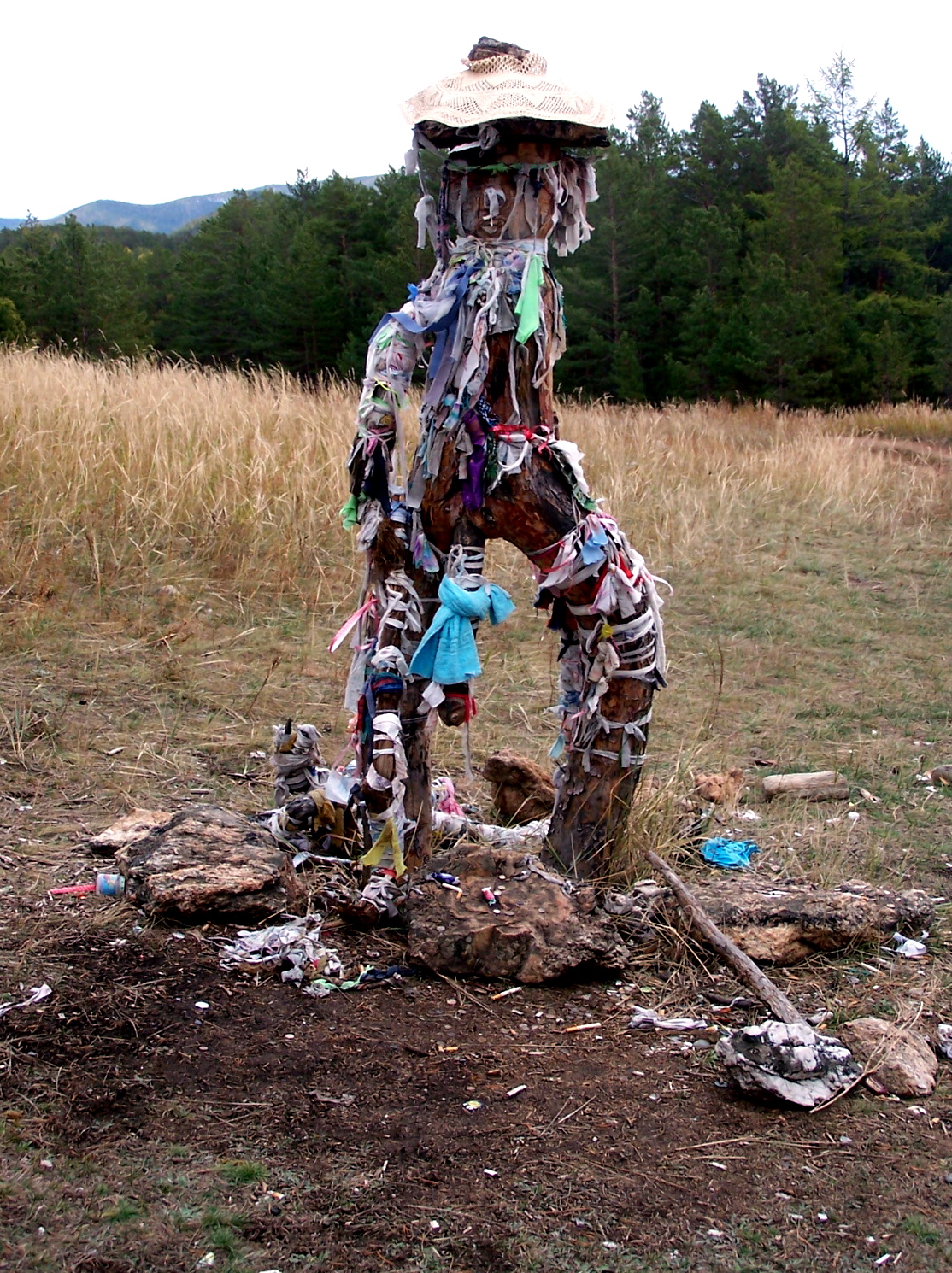
After hanging out a couple days…glad to be off the train…Gregory, a former University teacher of German, drove Bob and I, three Germans and a Pole on a half-day excursion to the north of the 70km long island to visit various geological sites and views of the lake but most especially to see a world renowned Shaman ceremonial circle called Three Brothers that is sacred to two faiths practiced here, Buddhism and Shamanism. Two years ago almost 300 Shamans from the world-over came together here. We lay a one rouble coin at the foot of the prayer flag pole while the “Sarma” or east wind blows fiercely over us.

The Buryats are of Mongolian descent…nomads who spent time herding their flocks between the southern shores of the lake and what is now northern Mongolia. They lived in felt-covered yurts and practised a mixture of Buddhism and Shamanism.

Gregory is driving Nikita’s four wheel drive van…a Russian vehicle designed 30 years ago and that was so successful they used it as an ambulance. “There is only one reason Russians sent the first man into space,” says Gregory the Kamikazi driver thumping over mud hole roads at least 90km per hour…”is because of the roads!” Later he says “we at the moment are using two wheels…if it gets really complicated we will use four!” “Normally we sacrifice two persons…usually 50% survive this trip!” Any of our U.S. vehicles would have rolled over at the first turn but this one mysteriously keeps it’s four wheels on the ground.

We pass through beautiful valleys with sheep and cattle farms…two of which are rich and have beautiful houses “because they don’t drink,” Gregory says. We pass by one small house of an old woman who lives alone with her cow…the rest of the houses in the area appear empty. We are shown an area that was a gulag during the Stalin era and whose inmates produced cans of caviar from the lake sturgeon that was then sent to the Kremlin for the enjoyment of the party bigwigs). I see a straggly triangular three wooden stick affair on the top of a hill and ask Gregory what it used to be. “Local KGB headquarters,” he says throwing his head back in laughter. I ask if the Russians and Buryats intermarry. “Seldom,” he says.

Five Hours to Olkhon Island

7yBXvp82X2gVlMeZe25DiM-2006198051115673.gif

The next morning we are picked up at our homestay in Irkutsk by a sullen driver who drives us five hours over pot-holes, through the taiga and across a bay of the beautiful blue Lake Baikal to the small Buryat fishing village of Khuzhir on Olkholn Island with a population of 1500 (half are Buryat). Urr0g6ZfQ7ttYL19duYJfg-2006170133924757.gif

We stay at Nikita’s Guest House (Siberia’s only real traveler’s hangout) for five days. Nikita, we are told by some of the guests, was at one time Russia’s table tennis champion. Two multi-lingual Russian girls seem to keep things hanging together and they serve us great garlic-charged meals in a communal dining area. The guests are all European…no Americans…and the conversation is spirited…two Swedes quickly challenge a comment I made that they interpreted as being critical of Socialism.

We enjoy the banya (bathhouse) with wood-heated hot water we can pour over ourselves…although the first time we signed up we were the first on the list and the water was still cold.

Irkutsk…”Paris of the East”

7yBXvp82X2gVlMeZe25DiM-2006198051115673.gif

Off the train again, we dump our luggage at Nadia’s, our homestay and look for a cafe where there just might be an English menu. We find one…not too expensive…that looks full of the city’s hoi paloi. A tall man in a 3/4 length leather coat and fairly long hair by Russian standards, slowly enters the cafe. He moves almost majestically and sits at the coffee bar drinking a single espresso..jeweled ring on each pinky finger…while he waits for a table…whispering solemnly in the ear of the pretty, attentive waitress. He takes off his jacket and carefully hangs it before sitting down. He has a blue shirt on with pink stripes. I want to cast him in a movie.

Later, behind me on our way to the internet cafe, click, click. I move my smooth slow stroll to the side. Click click, she quickly passes on a mission to some unknown destiny.

Goodbye to Vladamir

Vladamir makes crying motions with his fingers running down his cheeks as we prepare to leave him on the train. Astrakhan in 2–5 he writes on a piece of paper…Astrakhan in 2005 we say to him as he helps us to get off the train with our baggage…carrying his address and phone number carefully in my backpack.