The Unseen During The Olympics

Watching the Olympics in Beijing has got me to thinking about China again.  I’d like to make a point about the legacy of the damage done in the last 50 years.

You might like to read “The Corpse Walker: Real-Life Stories, China from the Bottom Up” by Liao Yiwu.

Master Deng Kuan, abbot of the Gu Temple, established in the Sui Dynasty sometime around the turn of the sixth century, was 103 when the writer Liao Yiwu met him while mountain climbing in Sichuan Province, in 2003, and Yiwu’s oral histories begin with him.

This is from a review of the book by Howard W. French, a former career foreign correspondent for the New York Times, who covered China from 2003 to 2008 and who teaches at the Columbia University Graduate School of Journalism:

We know the Anti-Rightist Campaign of the late 1950s, the party went on a nationwide witch hunt for supposed liberals, reactionaries and capitalist roaders. Relating the Chinese experience amounts to a way of averting one’s eyes from something that may seem too hard to comprehend. It also encourages a kind of blurry forgetting, a storing away of things on a high, musty shelf that has been officially encouraged by China’s leaders, who are most keen to manage this story because they have the most to lose from a more vigorous and thorough telling. Thus the famous posthumous verdict by Deng Xiaoping, who judged that Mao had been 70 percent “correct” and 30 percent wrong. Yes, Mao’s errors, like the 30 million or more deaths from starvation caused by the crash industrialization of the Great Leap Forward, were doozies, but by and large he kept the country on the right path, avers Deng Xiaoping. Deng’s past has also benefited from studious airbrushing to avoid mussing up the standard portrait of him as a kindly, strong and nearly infallible second father to the nation. His enthusiastic role in violently suppressing “rightists” in the late 1950s has been placed out of bounds by the gatekeepers who determine which subjects can be researched and which cannot.

Master Deng’s life, and almost every other oral history in Liao Yiwu’s new book, appropriately subtitled Real-Life Stories, China From the Bottom Up , gives the lie to this entire vision, making this a deeply subversive book. I do not mean the reader should expect a tract or treatise on Chinese politics. Instead, Liao casts aside the official “facts” of events and replaces them with “memories”–with the resulting contrast between the censored record and interior consciousness revealing a post-1949 China that has never stopped being a traumatic place. At their root, all of Liao’s “real-life” stories share something fundamental: a fantastic, dreamy and nightmarish quality. Each story provokes a moment’s thought about its relationship to the truth.
Read More

Another View Of The Torch Runs

This is an interesting post in response to the Australian who described his experience in Canberra with the passing of the torch (read below.) This writer was born in China and has lived in China, Mexico and now France. She is well educated and speaks several languages.

After our discussion, I checked several big forums and found that almost all internet surfers are proud and encouraged by the passage [of the torch] in Australia. And Chinese who had taken part in the passage in Canberra (includes some of my friends who live in Aus) felt honorable. Today I read also some news about the torch in Korea. I just have no words and am really worry about the nationalist state [of mind] of many Chinese!

To explain the difference of Chinese value to the west is a bit long and complicated I think. I try to give you some examples. Chinese [were] educated by Confucion thoughts since more than 2500 years which [are] totally different from the west thought – freedom, equality, personally value, etc. For example, [the word] “Country” in Chinese is “Guo (state) Jia (family). Chinese also used to compare country as mother. That means for Chinese there first have country then family, the country’s (mother’s) interest is much more important than self interest. People could even forget or modify their own interest to adapt [to] the group or the country. For Chinese, though mother (country) has many faults, this has to be keeping [kept] inside. That means this is a family case, the others should better not criticize on.

Since last later of the 19’s century, china invaded by west countries and had been in a chaos. That’s the reason why when PRC was founded; china stopped almost all communications with the world. Later 70’s, Chinese understood that they have to reopen the country to make up for lost time, then Chinese try to learn as much as possible on other developed (democracy) countries. So there is a kind of complex feeling on Chinese, as I said in my last posting when we talked about the Tibet issue, which confused by pride, inferiority, curiosity and fear.

I have awareness about the problems, but I don’t think it works to simply complain and support one side. That’s why I suggested “less critical” and tried to explain about China and Chinese. Personally I feel there have big inner difference between two values. There are a lot problems in China, some can be treated and changed by exterior influence, some have to be changed from inside. Such as Tibet issue or any other human rights, culture reserve etc. This is just like a person who has many problems, people around him can give him suggestions but finally it’s himself who have to recognize and to change. If we criticize too much on him and forced him to follow our ideas, he would never listen and accept at all. Things would turn contrary as we would like to see. This just identifies the recent reactions from Chinese, no? Combined [with] the bad experience in the past, Chinese people feel one more time the “west control” on China and then the nationalism comes back more than ever this time. This is very dangerous and worries me a lot.

member of couchsurfing.com

On To Jinghong

Too cold to do anything in Kunming so am flying out today to Jinghong in the south of China where it is reportedly warm. Was in Jinghong in the tropical Xishuangbanna Region in December 2004 when it was much warmer than this year.  Lonely Planet says there are over 800,000 people  in Jinghong, the capitol, and the many surrounding minority villages. It will be fun to go there again. It is unusually cold in Kunming and nothing is heated…I mean nothing…not hotels…not restaurants…nothing… including my hotel room. During this unusually cold winter there is an energy crisis in China and President Hu has called on the people to conserve. But the heat pad under my bottom sheet is toasty and I can lie in bed and watch Channel TV Asia with information provided by Reuters out of Singapore…but am not sure.

Big deal on TV the last couple days is Spielberg’s resignation as artistic director of the Olympic games. President Hu (who?) says politics shouldn’t be mixed with the Olympics. But he doesn’t mention the fact that China is the biggest provider of arms to the Sudan, of course. Or that China is blocking a UN Security Council resolution against Sudan because China gets most of Sudan’s oil. Guess Spielberg et al figured it doesn’t do any good to talk nice to China and this was the only way to get it’s attention. A Chinese official says it is not China’s foreign policy to react to criticism.  BTW, China is very worried about the possibility that demonstrations will mar the games.

And then there is the case of the two spies for China that were arrested by the U.S. President Who says the accusations against China’s spying is a bunch of hooey. He didn’t say it that way of course. He says the U.S. is trying to start up the cold war again.

So it goes…

I plan on uploading pictures of Josh’s menu items when I get to a place where I can use my own computer.  He says that small groups of the Olympic committee have been meeting at the Hilton for the last four years, that during the Olympics the hotel will be 95% full with the entire Committee and that he is bracing for the walloping restaurant business.

2008 Olympic Venues

The two most impressive Olympic venues are the National Aquatics Center or simply the “Water Cube” and the “Bird’s Nest.”

The “Water Cube,” a palatial structure with an area of 80,000 sq meters that is white in the daytime and blue at night, was completed January 28, 2008. Underneath a pure and simple facade, this translucent building embodies a complex and unrestricted framework as well as environmentally advanced technology that has become a landmark structure.
Img214242716.jpg
Img214242533.jpg

According to the Official Olympic web site, the shapes woven within the steel framework of the “Water Cube” symbolize a membrane of water molecules…a “pure and natural beauty.” Josh says the membrane structure ‘cloth’ is made of translucent teflon. But the welding of the irregular steel framework was the most difficult part of the design and construction.

The web site goes on to say that the “designers created the steel structure of the “Water Cube” based on the so-called “bubble theory,” a somewhat controversial theory because of its many unsolvable problems. When the designers of the National Aquatics Center decided to practice the bubble theory, it drew great attention in the international architecture field. Almost all of the architects that have studied the bubble theory have come to visit the venue construction site.”

“It took only 10 months for workers to build the large-scale, irregular steel structure of the Olympic venue, which is considered a miracle in the history of world architecture.”

“The design and construction of the ‘Water Cube’ steel structure stunned the whole world,” the web site goes on to say. “The Guardian, a British newspaper, published an article calling it a masterpiece of theoretical physics.”

Leave it to the Chinese to wax ecstatic. But it IS impressive! But nowhere do the Chinese say that the architects were all from out of the country.

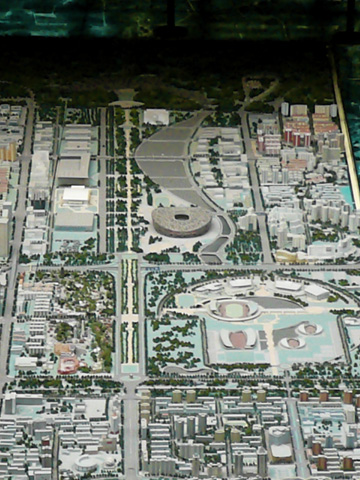
The “Bird’s Nest” lies adjacent to the the “Water Cube” and creates a nice design foil. At night the inside of the shell is lit up of course and the structure of the actual venue inside is beautifully illuminated. A man made “lake” in the shape of a dragon frames the building as seen blow in the model at the Beijing Exposition.

.p1040157.JPG
20080127114905357.jpg