Sukhothai Historical Park

We stayed in the Ban Thai Guesthouse in New Sukhothai on an old road full of backpacker guesthouses bordering the Yoh River that runs through “new town.” Unfortunately during the floods of 2011 the city was inundated with water and you can still see sand bags lying around in front of the buildings. Subsequently they built up the concrete barrier to the river at such a height you can’t see over it. So the river is hidden from the guesthouses. However it didn’t stop the sound of Zumba coming from the other side! 😉

In north central Thailand, the Kingdom existed from 1238 until 1438. The old capital, now 12 km outside of New Sukhothai in Tambon Mueang Kao, is in ruins and has been designated as a UNESCO World Heritage historical park.

The history of Sukhothai is the history of the oldest known beginning of Thailand.

Prior to the 13th century, Tai kingdoms had existed on the northern highlands including the Ngoenyang (centered on Chiang Saen; predecessor of Lanna) kingdom and the Heokam (centered on Chiang Hung, modern Jinghong in China) kingdom of Tai Lue people. Sukhothai had been a trade center and part of Lavo, which was under the domination of the Khmer Empire. The migration of Tai people into upper Chao Phraya valley was somewhat gradual.

Modern historians stated that the secession of Sukhothai from the Khmer empire began as early as 1180 during the reign of Po Khun Sri Naw Namthom who was the ruler of Sukhothai and the peripheral city of Sri Satchanalai (now a part of Sukhothai Province as Amphoe). Sukhothai had enjoyed a substantial autonomy until it was re-conquered around 1180 by the Mons of Lavo under Khomsabad Khlonlampong.

Traditional Thai historians considered the foundation of the Sukhothai kingdom as the beginning of their nation because little was known about the kingdoms prior to Sukhothai. Modern historical studies demonstrate that Thai history began before Sukhothai. Yet the foundation of Sukhothai is still a celebrated event.

With regard to culture, the monks from Sri Thamnakorn propagated the Theravada religion in Sukhothai. In 1283, the Thai script was invented by Ramkamhaeng, formulating into the controversial Ramkamhaeng Stele discovered by Mongkut 600 years later.

The Sukhothai domination was, however, short. Meanwhile, Ayutthaya rose in strength, and finally in 1378 King Thammaracha II had to submit to this new power. (Wikipedia)

Ao Nang Beach Krabi Thailand

1wXSp3CkNsDoJl3s0SgHmw-2006171164904627.gif

Bob and I have been here in Krabi Province of Thailand with Doug and Luk for three weeks now…a welcome respite after a month in smoggy noisy Bangkok where I had some dental work done and a 6 month routine check-up at Bumrungrad Hospital.

Bob left a couple days ago to do some hiking in Khao Sok National Park up north. I stayed here in my little 2nd story bungalow on lazy Ao Nang Beach watching the dark wiry young boat guys guide their long tailed boats to various karst islands and isolated beaches out in the deceivingly placid blue and green ocean and return again. Bob and I will either meet up in Bangkok or he will return here first…who knows what he will do. The breeze cools down at night until about noon…then air conditioning goes back on again.

Doug and Luk come over every morning (my place is 10 minutes up the road from their house) and we breakfast together. Then we all pile on the motorbike for a ride through the karsts and banana tree forests looking for a little fantasy house for me to rent…can get a house with tile floors, bathroom, hot water, kitchen facilities and bedroom and main room for about $200 a month if you are not on the water. A bottom floor bungalow on the water like Doug had before the tsunami is about $450 a month.

Weird to see inaugural celebrations on Fox News and then to drive by the Krabi Wat with hundreds of pictures of victims and piles of burial boxes.

An internet friend of mine who just married a Thai girl is staying on Patang Beach on Phuket Island where most of the damage was done. He said the beaches have been cleaned up…chairs and umbrellas are back up and the local businesses are begging for tourists. Reconstruction has already begun on some of the lost and damaged hotels. The second worst place in Thailand to get hit was Khoa Lak…just up north from here. They are still finding bodies in the Mangrove Forests and the village water well ended up with a car and 92 bodies in it. Several thousand bodies have not been found yet, many of them illegal immigrants from Burma. We hear they will not even try to rebuild at Khao Lak.

Reflections on the Steppe

GyTjn0QZP9l6Qu21TubskM-2006198062551304.gif

We are lucky…days are brisk but sunny…the sun glints off bare hills covered in golden fall grass. This feels like fall in southeast Oregon where I grew up. I soak it all in while Bob goes on a 4 hour hike through birch groves and box canyons full of grazing mustangs. How do you know they were mustangs I ask Bob…he says” they had labels on each side.” Places were steeper than he anticipated…had to run from one tree to another to keep from falling down the hill.

The next afternoon we paid three dollars to an elder Mongolian in traditional clothing to take us riding horses through the hills with him. Give him his head, I said to Bob who was trying to make his horse gallop! But there was no saddle horn on the tiny saddle to hang onto and it was difficult to post in the ornate metal stirrups. Mongolian saddles are definitely different than Western saddles I was used to as a girl in cowboy country USA. Still, the same freedom I used to feel…while riding…in the wind…in the hills…where I grew up… This is as close to heaven as it gets I thought…connected…connected to the earth.

Life in a Mongolian Ger

GyTjn0QZP9l6Qu21TubskM-2006198062551304.gif

Video
Terelgj National Park, an hour by car outside of Ulaan Baatar, is a spectacular valley surrounded by high eroded rock formations, pine covered mountains and steppes carpeted with sheep, Mongolian horses and perennial wild flowers. We are immediately taken by the tour company van to the ger (the word “yurt” is of Turkic origin that the Russians use) of an older Mongolian man who welcomes us with delicious yak butter on thin hard bread, two kinds of dried cheese and milk tea. We are told his wife is in Ulaan Baatar visiting a daughter who works for a mining company.

We walk behind a yak pulling a cart with our luggage up the side of a small valley to our ger which will be our home for three days. A ger is a round structure with a wooden lattice framework with long poles extending up toward the apex of the ceiling…all covered with layers of felt. Our ger sits on a cement platform covered with linoleum and carpeting. At the center is a hearth where the fire is considered sacred. The door faces south, men traditionally enter and walk to the west of the fire and the women to the east. At the north, opposite the door is the Khoima where valued objects like an altar for the Buddah and family pictures are kept. We have two beds with regular mattresses, one on each side of the hearth, a candle and small table. The mattresses and camel cloth blankets…”Gold Sheep Brand Wool En Bl Anket” all made in China.

It has snowed the day before and a young woman lights our fire in the evening and again, silently, about five in the morning. Our meals, are beautifully served in a large nearby ger.

Zhangziajie

YUqE3FCf1Hd9CjfG1qqmt0-2006171132705308.gif

Bob and I said goodbye to Jana who would leave later in the day on a train to Shanghai and then home from Hong Kong. The next day we took a train to Zhangjiajie in Hunan Province.

Zhangjiajie
At the Dragon International Hotel Coffee shop…Little Santas and Christmas trees hanging everywhere…like Cinco de Mayo at home…no one knows what the day really celebrates but it is an excuse for a party…Kenny G on the stereo as usual…Old Lang Syne and Winter Wonderland. Our waitress, Liu Wen Qin, is a smiling friendly 19 year old…”excuse me, can I ask you some questions?”…absolutely we say…where are you from…where is your tour group…you are by yourselves? And we quickly become friends. She is from Hubei Province near Yichang…has two sisters one of whom she lives with in a room costing 120 yuan a month ($15) with the husband of her sister and five year old child…the child having a heart condition, she said. When she gets off work at 11am she leads us to the bus that will take us to Zhangjiajie Village in the Wulingjuan Scenic Park about 40 minutes away…by ourselves we never would have found the bus, one of many that all look alike.

Zhangjiajie Village

w020060814618397491283.jpg
The Park is truly stunning with craggy cliffs and columns rising out of sub-tropical growth…the winter fog sitting low in the narrow canyons-a place that would be wonderful for hiking in the summer. Lonely Planet said the best hotel in the village was Minzu Shanzhuang, a thatched, Tujia-run (a Chinese minority group) hotel…but this was winter and it had snowed the night before. We buried ourselves under blankets and hot water bottles because the heater was lousy…and quit altogether during the night…

Back in Zhangjiajie City early the next morning we stumbled off the bus to the welcome-warm smile of Liu Wen Qin at the Dragon International Hotel Coffee Shop…glad for a place to park ourselves for the day until the train for Guangzhou at 6pm. We walked the streets awhile…a bookstore…Diary of Johann D. Rockefeller sitting right next to a book about Mao Tse Tung….in the window Bill Gates” Theories of Management and “How To Win Friends And Influence People.”

Since it was winter and hardly anyone was in the hotel, we spent most of the afternoon speaking English with Liu Wen Qin…Bob teasing her and loving it when, laughing delightedly, she finally catches on. He’s good at flirting with Asian girls 😉 When it was time to leave we paid the bill and by the time we had our backpacks on she had disappeared…the rumor that the Chinese hate to say goodbye apparently true…my throat getting a catch as I write this.

We settled in for what Lonely Planet said was a 24 hour train ride south back toward Hong Kong in a hard sleeper. But 6am the next morning, after only 12 hrs, we were awakened by the train attendant…we are here, she said…Guangzhou…Guangzhou!

After a night in Hong Kong we flew to the Philippines to warm up on a beach. Then we flew back to Hong Kong to catch our flight back to the States.

This is the end of our first year of travel around the world.

Chobe National Park

t5vdleC6v9bjElbi1QdXwg-2006193161808725.gif

The border crossing from Zambia into Botswana is at the border post of Kazungula. The truck ride on the Kazungula Ferry across the Zambezi River is not much of a hassle. Rod tells us that one year the ferry sank and about 40 people died; we sit silently during the crossing.

The topography becomes almost perfectly flat and we see thousands of acres of sunflower fields and scrub brush far as the eye can see in all directions. To the little town of Kasane to fill up with gas, go to the Bureau de Change, buy camera batteries, and blankets because it is winter here now and the nights will be cold the rest of the way. Stocked up on junk food again in the small market; Botswana has a good trade relationship with South Africa so we see things in the stores here that we haven’t seen since we got to the continent.

Kasane sits amid a shady, riverine woodland at the meeting point of Botswana, Zambia, Namibia and Zimbabwe and the confluence of the Chobe and Zambezi Rivers. It is the administrative center and the gateweay to Chobe National Park so the small town is full of activity. Then we drove down the road to Chobe Resort for the afternoon where we had cold drinks in the bar and some of the girls swam in the ice cold swimming pool.

Chobe National Park
Rod contracted with a Safari company to take us in raised-seat land rovers through the Park about an hour before dark when all the animals will be feeding and watering around the Chobe River. On the way, the driver calls the elephant dung on the highway “chocolate cake.” The driver talks about elephants…eats 250 kg of food a day so he has huge dung. They have 7 sets of teeth so when he has used all his teeth you can tell he is older because you see bark and sticks in the dung.

Elephants are so bad at destroying trees-just because they can, the driver says-and overgrazing-so that the elephant herds have to be culled. Sometimes a couple hundred at a time. They have to make sure they kill all the members of a family, however, or any remaining members will return to get retribution.

Hippos run 40 km an hour and can swim 30 km an hour to find grass…the water monitor (snake) didn’t have a shower because he didn’t know you were coming for a picture, the driver says. About 20 female elephants and their babies are in the water-males always off alone…Southland Giraffe…Impala society-only one male to a herd so these young males will soon have to fight to stay or be kicked out of the herd…Bob says Homo Sapiens are known for not getting along either…everyone laughs. Kudu Antelope have huge antlers on the male…when giraffes drink they spread their front legs which really looks funny…Impalas make a noise like a pig…we see a lioness with large teats so she must have cubs near…we follow her…the African light on the red clay landscape is breathtaking….water buffalo…but the hilarious part of the trip is the driver…look, there is a rare Red Sable, he says as he roars by…we finally get him to stop at the Kudo but when he stops so all we see are bushes…!

Camp at Thebe River Lodge near Kasane
As we drove in we wave to the woman from New York that used to live in Walla Walla and the guy from Seoul that were on the Booze Cruise with us at Victoria Falls-their tour group on the same route. James the camp dog happily greeted us; the camps all have watch dogs that will warn us if strange two or four legged animals enter the camp at night. When I went into the bar for a Fanta (think the whole third world has a monopoly on Fanta), I noticed a black board advertising Bone Marrow Soup so I ordered a small bowl before dinner; was good but was so spicy couldn’t really taste the marrow.

By this time Bob had joined me and while we were there the woman from Walla Walla came in. She had been a school teacher (I had guessed it). Now she has decided she wants to work for a Methodist Aid group in Nairobi-I want to do something in Africa she says-I really like “The Blacks.” The way she said it made me feel very uncomfortable. She kept making references to Bob about finding what he was looking for…finally Bob told her he wasn’t looking for a thing. Maybe she knew more than he did…or maybe it was she that was looking…

Ngorongora Crater

Firstviewofcrater.JPG

The Ngorongora Crater is a conservation area and National Heritage Site. After breaking camp in the Sarangeti, we drive another two hours up to the Crater rim where we set up camp so we can be ready for the drive down into the Crater the next morning. The crater is 16-17 km across; the difference between a park and a conservation area is that people can live in a park; so many Maasai life in the Sarangeti but none in the crater. The crater sides are covered in a dense rain forest; Black Rhino only here; no giraffes here because it is too steep for them to walk down; no Topi or Impala here; the alkalai lake is filled with pink Flamingos; Corey Bastards are mating; hyenas with their lowered backsides slither along…

The Land Rover dodges huge elephant poop on the roads meandering along the crater bed.

Maasai and Samali Ostriches: incubation 48 days; female watches the eggs during the day and the male at night. Biggest enemies are man and lions; Red Billed Duck; Black Winged Stilt; Black Headed Heron; White Heron; Sacred Ibis; Crowned Crane; Wida Bird; European Stock: coming from Europe with no passport and flies back in December-he is not ours, Francis says.

Common and Golden Jackal; Flamingos by the million who eat algae and salt that makes them pink; Spotted Hyenalives 35 years; noctural;4- 5 months gestation; he was walking the whole night that is why he is sleeping. No one else eats the Hyena except other Hyenas when they die. Lions may kill them but they don’t eat them. Male Lion eats first-big boss-then the mother and the cubs; 40 lions in the crater; sometimes you see no lion because they don’t know you are coming to see them and they just lie anywhere in the tall grass where you can’t see them, Francis says.

Wart Hog; monkey sitting on top of an Acacia Tree-the king of the world. A mini bus drives up. Ladies in nice clean white blouses sit in the back with their suitcases with wheels on them; probably staying at the expnsive Ngorongoro wildlife Lodge on the rim. “My god they are not even camping; not getting the full-on experience!” the kids yell out to each other laughing hysterically. By the way, at a potty stop, one of the kids spotted a tourist all dressed up like Safari Guy just stepping out of Magellan Catalogue. All the crew and kids laughed themselves silly.

Francis says that the animals in the crater are very polite because they haven’t been in the hunting block outside the crater where they learn to be scared of the human.

Black Headed Heron eating baby Black Mama snake; male elephant with biggest penus ever…swinging between his legs as he walks. Weighs 3 kg, Francis says. How does he know, Bob retorts.

We stop at Tak Tak spring for a rest and watch a school of Hippos.

When the zebras walk or run away from the car, their heads bob up and down telling the lions “I have seen you, I have seen you, I have seen you,” Francis says.

We drive around a bend to find five Forest Elephants all in a row. They are waiting for pictures, Francis says smiling. Then we drive up and out of the crater and head back to camp.

Sarangeti Safari

There are about 5 people to a car besides the driver. The tops of the vehicles pop up so you can stand up and view the animals and take pictures.

DSC00077.JPG
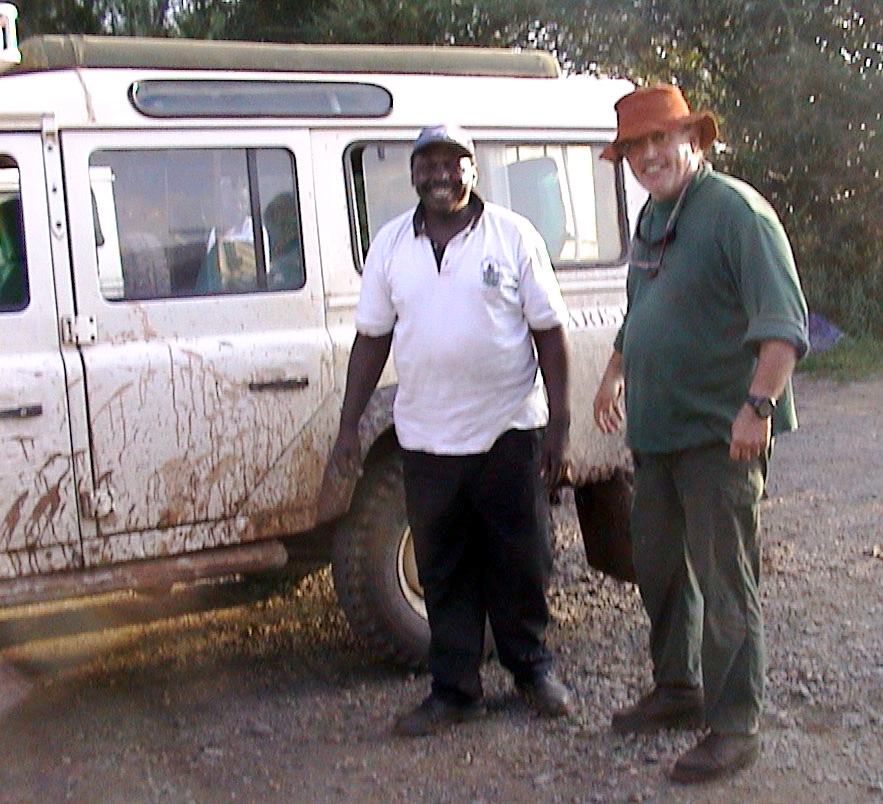
Our driver is Francis, about 55, who lost his wife 6 years ago. “I have four boys-I beat you,” he says laughing. There are about 5 people to a car besides the driver. The tops of the vehicles pop up so you can stand up and view the animals and take pictures. The 4-wheelers have radios and the drivers let each other know of animal sightings. We leave the two young Tanzanian cooking crew chattering and bantering in Swahili and take off across the Sarangeti with our drivers.