No Political Freedom

Today Burmese citizens are forbidden to talk to foreigners about politics and of course this makes the Burmese afraid to talk to you about anything. Government workers from mail carriers to university professors, must sign a pledge not to discuss the government among themselves, at risk of losing their jobs. Red and white signboards posted in public areas of all major cities carry slogans such as “Only when there is discipline will there be progress,” and “The strength of the nation lies only within.”

News Publications including the only English language newspaper called “The New Light” carry the following under the heading “People’s Desire: Oppose those trying to jaopardise stability of the State and progress of the nation” and “Crush all internal and external destructive elements as the common enemy.”

Myranmar TV is a hoot! TV Myranmar operates nightly and regular features include military songs and marching performances. A segment of national songs is performed by women dressed in ethnic costumes; when the songs are over the national flag is hoisted by the singer wearing Bamar dress.

Educated Burmese listen to shortwave BBC and VOA and the Burmese service of Radio Free Asia (RFA); state controlled Radio Myanmar broadcasts news three times a day.

Sr. Christine’s Orphanage

Burma.gif

While Bob was trekking I decided to walk a couple kilometers up the hill in Kalaw to Christ the King Church. Sr. Christine, a Burmese nun who was walking behind me caught up with me and introduced herself.

Sister.jpg

When we got to the church compound about 20 little girls in raggedy clothes came running out to greet us. These are our children, Sister says. They have no parents so they live with us. (The boys live with Father Paul in the rectory.) Then the children all lined up to sing some touching little songs about friendship for us…obviously having done this before.

How do you get money to support yourself, I asked…giving her an opening. By donations from tourists, she said honestly. Then she asked me to sit and have juice and little butter and bread sandwiches while we talked softly and quickly about the oppression of the military government which had confiscated most of the buildings belonging to the church. They lost their school and dormitories…everything except the rectory and one small building the four nuns share; the children sleep on cotton mats on the sidewalk out in front of the building at night.

I asked Sister if she had seen the BBC (British Broadcasting Corp) special on TV a few nights before about the war going on between the government and the ethnic groups. Oh no, she said, they didn’t get satellite TV. (About a year before she had visually seen the Pope for the first time in her life on a video.) When I described some of the atrocities that the BBC special showed, including a Karen village burned to the ground on Nov 11, 2001, she began to cry…remembering, she said…her father who had been tortured and killed by the army.

When the missionaries, mostly Catholic, arrived in the country, she explained, they immediately went into the outlying areas of the country where most of the ethnic minorities were located. So now, the people in central Burma are nearly all Buddhist and the minority areas are mostly Catholic and some Baptist. The ethnic groups therefore are not only culturally and linguistically different than the ethnic Berman people in central Burma but religiously different as well.

In the BBC special an American doctor from Louisiana said that burning the villages to the ground causes much more suffering for the people who are then forced to run into the jungle with whatever possessions they can carry…stopping to cook some food on little fires on the ground… than if they just shot the people. The most effective weapons, he said, are fear, poverty, hunger and disease. In addition, the army kidnaps young teenage boys from their families and forces them to be porters in the jungle. One who was interviewed by BBC said that they know if they run they will be shot and killed like others they have seen.

Though the doctor was in an area off-limits to foreigners, he said: “There are times when you have to take a stand and fight the evil…when we see people, their homes destroyed putting their belongings on their backs and slowly walking into the jungle to find someplace to hide, we know we have every right to be here because no one else will come to help.” By the time the world wakes up to the plight of the minorities it will be too late, he says, in spite of all the UN resolutions and efforts of governments who have put pressure on the country.

But our tour driver in Pagan (Bagan ) had denied that there was any fighting going on in Burma…

The highlight of the visit to mass at Christ The King Church the next day, Sunday, was the singing by the children. The entire back half of the church was filled with children singing with strong raised voices…singing with exhaltation if ever I heard it.

Trek to Pa-O Villages

Burma.gif

Bob was happy to get out and stretch his legs on a two day trek in the hills above Kalaw. His guide used to be a chemistry teacher and school principal who only made about $8.00 a month teaching school. So now he makes $15 for a two day trek in the hills.

teacherturnedguide.jpg

They visit several villages…the people know and love him and welcome the people he brings to their homes for a meal and overnight stay in exchange for the tips they receive.

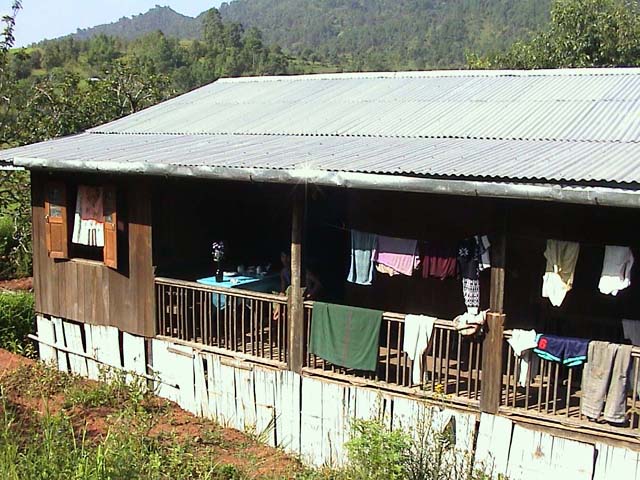
longhouselaundry.jpg

Bob was introduced to a young woman who had been his guide’s chemistry student. She quit studying chemistry in the local high school because she could make 10 times more money raising garlic. If the progress of the country depends on education, it is going to be a very long time before these humble people dig themselves out from under their oppressive military regime. Makes one wonder if this is by design.

Extended families live in a large building, usually on stilts, called a Longhouse. Over dinner in the longhouse that night, Bob, in his way, made one three month old baby giggle which delighted and impressed the family. When Bob offered to buy the baby they all laughed and said no….but the mother then offered to sell him the rambunctious 18 month old sitting next to her!

A UNICEF Advisor

Burma.gif

In Kalaw, at an outdoor tea house, I called out to a Western looking couple walking by…look…somebody from the West! The couple, from Israel, laughed and joined us at our low table for tea…all of us sitting on little stools with our knees around our ears again.

The woman had been in Rangoon for six months as a UNICEF advisor to the local education authorities. Families have about 10 children because about half die by the time they are teenagers she said. When the ethnic children go to school, she explained, they are confronted with both English and Bamar languages layered over their ethnic dialects and they have a very hard time learning. Old story I thought to myself thinking of the indiginous Indian children from Mexico who come with their migrant parents to the States.

Coincidentally, when I told her we were from Salem Oregon, she said a woman friend from Israel went to our city a couple years ago to live with a man friend but after six months of boredom she went back to Israel. What did she miss especially, I asked. Having fun, she said, dancing, having fun and street life. Yes, I know the feeling, I said!

Kalaw…British Hill Station

Burma.gif

In a monsoon rainstorm we climbed off the train in this cool wooded hill station built during the British occupation. The locals laughed (with me) at my little paper sun umbrella I carried that I had bought at the umbrella shop in Inle. Only transpo available was in a partially covered horse cart driven by a kind old man. Off went the horse clip-clopping with us along to the ironically named Dream Villa Hotel a few blocks away in the center of town. It was off season and we and a French couple were the only tenants in the second floor room in the very friendly hotel painted white with verandas and windows open on two sides.

I looked down into the street to see a common occurrence in Asia that we hardly see in the West…males touching each other…often holding hands while walking down the street. On this day three boys stood one behind the other looking out toward the street, each with hand and arms around the boy in front and finally the one in the back reaching to the boy in front, lovingly cradling the boy in the middle…it was done spontaneously and naturally and lasted only a few seconds. Refreshing I thought.

We explored the rotating market that happened to be in town the following Saturday…we have wonderful pictures of the goods that the colorful tribal hill people bring to town to sell; flowers, fish including eels, perfect looking leafy green vegetables of all kinds, cigars, prepared food of all unidentifiable kinds. Everyone wears flip flops; heels cracked and calloused. Babies in Burma are not diapered…the child is just held out in the air at the right time and whatever wants to come out comes out. One mother in the seat in front of us on the moving train to Kalaw held her baby with bare bottom out the window for this event.

We stop by a tea shop (patrons are almost always men and they all stare at me; women stay at home as they did in Morocco, Egypt, Africa, India, Greece and Thailand) to rest and watch the street scene. There was cheap clothing brought in from China…some of the tables piled with used plaid shirts, levi jackets and 501’s. So this is where the young Burmese university students get their levis I thought…you know those levi trucks you see in the supermarket parking lots at home?

Schwenguan

Burma.gif

We took a taxi back over the mountain from Tounggye to Schwenguan where we were to catch a train for the three hour ride through beautiful terraced rice fields and vegetable patches to Kalaw-a mountain hill station used by the British. But as with practically every government runvenue they wanted to be paid in dollars. I had a $20 on me but the fair was only $4 for the both of us (foreigner rate-foreigners pay many times more than the locals for everything). Bob refused to pay the $20 so there we stood. I gave some kyets to some teenagers to take me to find a money changer but no luck. By the time I got back Bob had dug $5 out of his backpack. We’re on the train!

At HeHo for lunch we reach through the train window and pick out boiled peanuts and deep fried mashed potato balls from the big round shallow basket a pretty woman holds on her head. We took a great picture of the small girl with arms crossed in disappointment who had only small raw potatoes to sell which no one was buying of course.

Repression & The People

Burma.gif

Next door to the restaurant in Taunggyi I struck up a conversation with a young university student who was tending a a small bookstore. “Can everyone speak (out) in America,” he asked. “Yes, we can,” I said, thinking I will not tell him about “politically correct” speech that I consider just as fascist as the rules perpetrated by his government.

A few people, forbidden to talk about politics with foreigners, tried oblique approaches to the subject. One man with delicious donuts on a platter came up to me at the market and said to me in perfect English that he used to be a teacher. Then he disappeared and returned a few minutes later with his wife who wanted to meet me. “She wants to go to America-so bad,” he said. I made several attempts to ask him to have tea and then dinner with us but was disappointed when he looked furtively around him and told me he couldn’t do that. The government has forbidden the people to talk to foreigners about politics but they are afraid to be seen talking to you at all as it could mean trouble for them.

However, in Bagan our hired tour guide for a day to view the pagodas, told me that some Americans once told him that that there was a lot of fighting in Burma but that he reassured them there was no fighting in his country. I bit my tongue thinking of the BBC special the night before that described the fighting between the ethnic minorities and the military near the Thai border where camps harbored thousands of refugees. American and European doctors regularly cross the border under cover of fire to care for the Karen tribal people who are suffering from a government policy of ethnic cleansing by burning their villages and killing the people outright or overworking them to death in forced labor groups. “I’ll bet he is a government informer,” I said to Bob. “I think so too,” Bob said.

The next morning as I am waiting for my breakfast in the top floor restaurant I watch as two monks enter the alley below on their early morning rounds. They stand outside the gate of a house and wait for the owner to come out. After a few minutes a woman does and immediately drops to her knees and bows with her head down to the ground. The older monk appears to give her a blessing and a few words. She stays on her knees as they walk to the next house where a man comes out with some food but he doesn’t get on his knees.

The People
Everyone assumes you are well intentioned. If you give them a smile you will immediately get one back-without guile or expectation. Waiters in restaurants wait on you with respect like altar boys at mass-putting the plate down slowly and respectfully in front of you.

Taunggyi…Last Frontier of Burma

JTOL4njiflVtj5kLlwVbAM-2006175061519331.gif

Taunggyi is the official end of the line for east-bound foreigners in Burma–at least if you are travelling by road. Beyond Taunggyi lies a world of black-marketeers, ruby miners, insurgent armies and opium and methamphetamine warlords. Because it functions as a conduit for smuggled goods from Thailand, China and India, this is one of Burma’s most colorful towns. Long-haired smugglers in army fatigues down the street alongside turbaned hill tribe people and sleek-suited Chinese businesspeople. An abundance of black-market consumer goods is displayed in the Taunggyi market.

In the market we see two Buddhist nuns asking for donations from the vegetable vendors followed by a young girl in a white T-shirt with Jesus (Heart) You on the front. I particularly liked the military green combat hat with a pirated Nike label which was very popular. An Indian in a military hard hat explained to us that we could get “free” pastry at the tea shop. Guys with camoflage jackets and military green Chinese issue tennis shoes are everywhere. On a second floor alley I was carrying some chicken and rice in a sack when two small raggedy boys came up to me so I gave them my chicken. They ran off tickled to death. A few minutes later they appeared again and handed me my 1000 kyat bill that I had forgotten that I had dropped into the bag. So we took the bill and gave them back 500 kyat (about 40 cents) and you would have thought they were just handed a fortune.

On our way out an old man came up to me and spoke in excellent English. He used to be a teacher he said and just wanted to talk. San Francisco, San Francisco he laughed. (People always seem to mention San Francisco for some reason when we tell them we are from America.) Good city! Then he cautioned me against buying any of the rubies two traders were trying to offer me. “Glass,” he said, “glass!”

Mothers make a big deal out of having their babies see us. They beam if we pay any attention at all to the small ones or take their pictures-almost like it is good luck for the child. We are a symbol offreedom-freedom they long for and hope to have sometime in their lifetime.

On the way back to our Chinese owned hotel called New Paradise that night we stopped at the Coca Cola Restaurant with pigs ears and pig brains on the menu and spent 20 minutes trying to get the waiter togive us some sugar for Bob’s ice tea. Think about it. How do you explain “sugar” to someone who doesn’t understand a word of your language nor you theirs?

Continuing along the street that evening, I asked a young guy at a betelnut cart to make me some betel chews that are made with small chunks of dried areca nut wrapped in a betel leaf smeared with lime paste. Some may contain flavoured tobacco (Indian snuff) peppermint and other spices. Experienced chewers can hold betel cud in their mouths for hours without spitting. An alkaloid in the nut produces mild stimulation and a sense of well being. The chewed nut stains the teeth dark red and leaves the streets everywhere running with blood-red spit.

He Ho & Inle Lake

Burma.gif

August 26 2002
It is possible to take a ferry up the Irrawady to Mandalay but we chose not to do this because we heard the ferry was government-run and we tried very hard not to support government-run operations and second because we heard that Mandalay is a big, noisy, tout-filled beggar-filled city that we have had enough of over the course of this journey. So we took the one hour flight from Bagan east to HeHo and from there a taxi through Shwenyaung to Inle Lake.

inlefishing.jpg

Inle Lake is 22 km long and 11 km wide and outrageously beautiful.
inlewomanboater.jpg

After exploring the town of Inle and it�s markets for a couple days we took an all day boat trip around the shallow lake. Our Intha boat paddler stood in his longyi (length of cotton loom-woven cloth wrapped around and tucked in at the waist) on the stern of the flat-bottomed boat onone leg and wrapping the other leg around the oar slowly plied the calm black water dotted with floating islands and water hyacinth.

Hills rim the lake on all sides; the lakeshore and lake islands harbor nearly 20 villages on stilts mostly by the Intha people that are culturally and linguistically separate from their neighbors in the rest of the Shan state around them. The people use the same long flat boats to navigate to and from their homes and small lakeside businesses. Our paddler predictably stopped at a silk weaving factory and an umbrella cottage business. I bought a piece of silk the design of which was developed by the grandmother of the owner so it felt very special.
inleweavers.jpg
I bought a piece of plastic to cover myself for 50 kyats (pronounced chat; there are about 980 kyats to the US dollar which everyone trades on the black market-about 10 times the official rate at the bank).

Burma�s incredible ethnic diversity means a wide range of handicrafts and we came away with several beautiful Shan shoulder bags, some pictures of the beautiful Pa-O and Palaung ethnic people in their colorful clothes. and some wonderful Shan food in our bellies. The Pa-O�s wear black with red trim and colored towel swrapped around their heads.
reticentwomen.jpg

Nyaung U

Burma.gif

The largest village in the area is Nyaung U about 5 km up the Irriwaddy River from the Pagan Archeological Site and you can visit the market and food stalls there by taking a horsecart, a pickup or by renting a bike.

We took a horsecart with a friendly driver.