What Mexico Needs From Obama

The LA Times has an opinion piece this morning entitled “What Mexico Really Needs From Obama” written by John M. Ackerman who is a professor at the Institute for Legal Research at the National Autonomous University of Mexico and a columnist for Proceso magazine and La Jornada newspaper.

From my observations of Mexico AND the U.S. he is right on on all accounts. In other words Obama should focus on helping Mexico reform it’s institutions and rule of law instead of supplying weapons to fight the drug cartels. “Only 15% of the funds in the $1.4-billion Merida Initiative signed by President Bush last year,” says Ackerman, “is earmarked for “institution building and rule of law.” If Obama hopes to contribute to long-term solutions, he should dramatically increase this percentage in future aid packages.”

“The Obama administration seems to be unaware of these deeper institutional issues. During her recent trip to Mexico, Secretary of State Hillary Rodham Clinton didn’t push Calderon on corruption control, human rights, freedom of the press, institutional reform or political reconciliation. She also went out of her way to cater to conservative constituencies. Her visit to Mexico’s principal basilica implied a nod to Calderon’s efforts to narrow the traditional separation between church and state. Her choice to travel to the city of Monterrey, home to the most powerful members of Mexico’s corporate oligarchy, also sent a clear signal about the priorities of the U.S. government.”

President Obama should not focus exclusively on short-term military goals during his visit to Mexico this week. The violence there, which has taken the lives of 10,000 Mexicans over the last two years, must be stopped. But the helicopters, weapons scanners and listening devices that have been the cornerstone of promised U.S. support will only go so far. The real solution lies in effective institution-building.

It does no good to capture drug kingpins if they don’t go to jail. During 2008, only one out of every 10 suspects arrested in Mexico for drug offenses was convicted, according to official statistics. In Chihuahua, one of the bloodiest states in the country, only 1,621 out of the 5,674 suspects arrested over the last 12 months have even had to stand trial, because of the weakness of the prosecutors’ cases.

RealTruth.org/Corruption_at_the_Top
Almost a decade ago, the U.N. special rapporteur on the independence of judges and lawyers, Param Cumaraswamy, discovered fundamental problems of inequality and inefficiency with Mexico’s system of criminal justice. Today, the grim picture he painted has changed little. Mexico’s jails remain full of petty thieves while serious criminals with money and connections roam the streets.

Last year, Mexico passed a major constitutional reform that would introduce oral trials — to replace trials conducted only through written documents — and transform the role of government prosecutors. The goals are to reduce case backlogs by speeding up trials, to prevent corruption by increasing transparency and to improve criminal investigations by dropping the requirement that prosecutors issue a preliminary judgment on the culpability of suspects. With this latter change, prosecutors would be able to dedicate themselves exclusively to investigating cases and avoid conflicts of interests. But the authorities have dragged their feet on implementation. Congress has delayed passing all of the necessary follow-up legislation, and the commission created by the reform, with representatives from the executive, judiciary and legislative branches, has not convened.

Corruption at the top all the way to the bottom.  Nothing will change until the institutions and rule of law are reformed. The problem is they are all on the take and no one wants to give that up.

U.S. Arms Flow Into Mexico

Homeland Security Secretary Janet Napolitano and Attorney General Eric Holder visit Mexico Thursday to meet with their counterparts.

The Christian Science Monitor has this story blaming gun shows and subsequent smuggling into Mexico for the proliferation of guns in Mexico…which are illegal and hard  to get for the ordinary citizen. I am sure illegal guns are coming across the border. But Narco News Bulletin has this disturbing story indicating:

“To be sure, some criminal actors in the U.S. are smuggling small arms across the border. But the drug war in Mexico is not being fought with Saturday night specials, hobby rifles and hunting shotguns. The drug trafficking organizations are now in possession of high-powered munitions in vast quantities that can’t be explained by the gun-show loophole.

At least one report in a mainstream media outlet deserves credit for recognizing that trend.

“[Mexican] traffickers have escalated their arms race, acquiring military-grade weapons, including hand grenades, grenade launchers, armor-piercing munitions and antitank rockets with firepower far beyond the assault rifles and pistols that have dominated their arsenals,” states a recent story in the Los Angeles Times. “The proliferation of heavier armaments points to a menacing new stage in the Mexican government’s 2-year-old war against drug organizations. …”

The Narco News report goes on to say:

“The deadliest of the weapons now in the hands of criminal groups in Mexico, particularly along the U.S. border, by any reasonable standard of an analysis of the facts, appear to be getting into that nation through perfectly legal private-sector arms exports, measured in the billions of dollars, and sanctioned by our own State Department. These deadly trade commodities — grenade launchers, explosives and “assault” weapons —are then, in quantities that can fill warehouses, being corruptly transferred to drug trafficking organizations via their reach into the Mexican military and law enforcement agencies, the evidence indicates.

“As in other criminal enterprises in Mexico, such as drug smuggling or kidnapping, it is not unusual to find police officers and military personnel involved in the illegal arms trade,” states an October 2007 report by the for-profit global intelligence group Stratfor, which Barron’s magazine once dubbed the Shadow CIA. “… Over the past few years, several Mexican government officials have been arrested on both sides of the border for participating in the arms trade.”

The U.S. State Department oversees a program that requires private companies in the United States to obtain an export license in order to sell defense hardware or services to foreign purchasers — which include both government units and private buyers in other countries. These arms deals are known as Direct Commercial Sales [DCS]. Each year, the State Department issues a report tallying the volume and dollar amount of DCS items approved for export.

The reports do not provide details on who the weapons or defense services were exported to specifically, but do provide an accounting of the destination countries. Although it is possible that some of the deals authorized under the DCS program were altered or even canceled after the export licenses were issued, the data compiled by State does provide a broad snapshot of the extensive volume of U.S. private-sector arms shipments to both Mexico and Latin America in general.

According to an analysis of the DCS reports, some $1 billion in defense hardware was approved for export to Mexico via private U.S. companies between fiscal year 2004 and fiscal year 2007 — the most recent year for which data was available. Overall, during the same period, a total of some $3.7 billion in weapons and other military hardware was approved for export under the DCS program to all of Latin America and the Caribbean.

In addition to the military hardware exports approved for Mexico, some $3.8 billion in defense-related “services” [technical assistance and training via private U.S. contractors] also were approved for “export” to Mexico over the same four-year period, according to the DCS reports.

That means the total value of defense-related hardware and service exports by private U.S. companies to Mexico tallied nearly $5 billion over the four-year window. And that figure doesn’t even count the $ 700 million in assistance already authorized under the Merida Initiative [Plan Mexico] or any new DCS exports approved for fiscal years 2008 and 2009 [which ends Sept. 30].”

Maybe that’s why the tear gas canisters used against the demonstrators in 2006-7 in Oaxaca had “Made in the USA.” on them. [sarcasm]

100_0203.JPG

Couchsurfing Zoe

I joined Couchsurfing.com with a million members last year while I was traveling in Asia.  Couchsurfing is a world-wide social and cultural program run mostly by volunteers to foster cultural understanding…much like Hospitality Club (which I also belong to) or Servas.

For CS you are asked to set up a personal profile with your picture and fill in the answers to questions that explain your interests, personal philosophy of life, experiences with CS, travel experiences etc. You describe your guest facilities and whatever preferences you have such as preferred age groups or male, female or either etc. You are asked to verify your identity by giving a small donation by credit card and then they send a code number to your address which you then return to your profile and fill in. This verifies that you are who you say you are and that you live where you say you live. Then you can do a search for a particular city or country you want to visit and send a message through the secure CS messaging service to request a stay…or even just a request for a coffee or drink. At this time you can give your phone number and/or email address and discuss prospective visits. In addition, there are hundreds of forum discussion groups (I am a member of some of these like “International Politics”) and you end up getting to know and make friends with people there. Often these people will meet for a social evening in whatever city and country they are in and make their “couches” available to others from other cities/countries wanting to attend.

Then after being a guest or hosting or just “surfing” with (exchanging messages) you can leave a reference and/or a request to be a “friend” which will show up on the profiles of each party.

So when I returned to my home for a few months in Salem Oregon, I made my “couch” available but ended up not hosting anyone. However, now that I am living in Oaxaca I am getting requests almost daily…mostly from young women, although I did host a young French guy who has been living in Mexico City for three years. He is setting up a web-based Spanish-language radio program and is on the look-out for interesting stories. My first CSer was a young Iranian-American woman who had grown up in Berkeley. She was lovely and we had a great time together!  A couple nights ago I couldn’t host a woman from Oakland but she came to my apartment for a mescal…bringing a hand-full of lovely roses for me.  She appreciates that I make my “couch” available, she says.  A young Zoologist and his significant other from the Oregon State University faculty came one evening for fresh-squeezed orange juice and good conversation. In April I have two women from Estonia who are ecologists coming for a few days. And there are others.

In the meantime, I am hosting Belle and her young daughter, Yoli, from Austin Texas, who lived in my other apartment house with me in 2006-7. Belle has been to and lived in Oaxaca many times and tomorrow a Oaxaquena friend of hers is coming to my apartment to teach us how to make Chili Coloradito and get me back into learning Spanish.

Hillary Is Coming To Mexico Today

Articles about Mexico appeared at least twice in the LA Times this morning.

On her first official trip to Mexico beginning today, Secretary of State Hillary Rodham Clinton will confront a range of bilateral issues.  The LA Times this morning asked experts on both sides of the border to discuss issues that are likely to come up. Comments I found interesting:

Mayor of Rosarito, Mexico, and owner of the Rosarito Beach Hotel:

“People in Mexico love President Obama, even if he doesn’t know anything about Mexico. He’s never been in Mexico, even as a tourist. We also like Hillary, but she doesn’t really understand either. Mexico is going to be disappointed.

Certain elements in the U.S. government have reacted very quickly in telling people not to come to Mexico, talking only about the problems we have and that we have a lot of narcos. We do, but you have more over there. Our criminals sell the drugs wholesale, you distribute them retail, and the amount of money handled by U.S. distributors is probably 10 times as much.

For our city in particular, the travel warning is a big problem. We have had lots of killings. But 96% of the killings in our area were between traffickers. That also happens in New Orleans and Baltimore and other cities with high crime rates. But all of a sudden, there is a campaign to stay away from Mexico. We haven’t had any tourist or visitor caught in a crossfire in 20 years. We have 20 million visitors a year in Baja California, so really the risk is not there for a tourist. Yet in Rosarito, we have lost about 70% of tourists since the middle of last year”

Jose Reyes Ferriz Mayor of Ciudad Juarez, Mexico

“The problem right now is organized crime. The major problem we have is the sale of guns in the United States without regard to the fact that those guns are going to be illegally smuggled into Mexico. This needs to be investigated by the United States.

The second point that needs to be addressed is money. The activities by organized crime in Mexico are financed with drug money coming in from the United States. Money-laundering investigations need to be stepped up so the flow of money into those illegal activities stops”

These statements are all true but it is hilarious that they are coming from persons most probably on the cartel payroll! That or they would be dead by now!

“Gang-Rape of the American Dream”

Best article yet on the financial crisis.  Tells it like it all came down…in great detail.  I can see it all now.

Rollingstone.com

The Big Takeover

The global economic crisis isn’t about money – it’s about power. How Wall Street insiders are using the bailout to stage a revolution

MATT TAIBBI

Posted Mar 19, 2009 12:49 PM

“As complex as all the finances are, the politics aren’t hard to follow. By creating an urgent crisis that can only be solved by those fluent in a language too complex for ordinary people to understand, the Wall Street crowd has turned the vast majority of Americans into non-participants in their own political future.

There is a reason it used to be a crime in the Confederate states to teach a slave to read: Literacy is power. [Italics mine]

In the age of the CDS and CDO, most of us are financial illiterates. By making an already too-complex economy even more complex, Wall Street has used the crisis to effect a historic, revolutionary change in our political system — transforming a democracy into a two-tiered state, one with plugged-in financial bureaucrats above and clueless customers below.”

Read the rest of the article here.

I Used To Make Fun Of Rick Steves

 I used to make fun of Rick Steves.  No more!

Here are a few gems from a Salon.com interview just in case you don’t want to read to the end:

Salon: “Steves wants Americans to get over themselves. He wants us to please shed our geographic ego. Everybody should travel before they vote,” he has written.”

So if McCain and Palin had won, what would we have seen abroad?”

Steves: “More and more Americans wearing Canadian flags”

LOL.  During 7 years of near constant travel, I used to say I was from Canada.  My husband used to say he was from Iceland.  I always said I wanted a T-shirt that said in 6 languages: “I didn’t vote for Bush.”  Election night there were parties all over Mexico. Now they are watching us.

Steves: “As a travel writer, I get to be the provocateur, the medieval jester. I go out there and learn what it’s like and come home and tell people truth to their face. Sometimes they don’t like it. But it’s healthy and good for our country to have a better appreciation of what motivates other people. The flip side of fear is understanding. And you gain that through travel.”

What’s the most important thing people can learn from traveling?

Steves: “A broader perspective. They can see themselves as part of a family of humankind. It’s just quite an adjustment to find out that the people who sit on toilets on this planet are the odd ones. Most people squat. You’re raised thinking this is the civilized way to go to the bathroom. But it’s not. It’s the Western way to go to the bathroom. But it’s not more civilized than somebody who squats. A man in Afghanistan once told me that a third of this planet eats with spoons and forks, and a third of the planet eats with chopsticks, and a third eats with their fingers. And they’re all just as civilized as one another.”

The “ugly American” thing is associated with how big your country is. There are not just ugly Americans, there are ugly Germans, ugly Japanese, ugly Russians. Big countries tend to be ethnocentric. Americans say the British drive on the “wrong” side of the road. No, they just drive on the other side of the road. That’s indicative of somebody who’s ethnocentric. But it doesn’t stop with Americans. Certain people, if they don’t have the opportunity to travel, always think they’re the norm. I mean, you can’t be Bulgarian and think you’re the norm.

It’s interesting: A lot of Americans comfort themselves thinking, “Well, everybody wants to be in America because we’re the best.” But you find that’s not true in countries like Norway, Belgium or Bulgaria. I remember a long time ago, I was impressed that my friends in Bulgaria, who lived a bleak existence, wanted to stay there. They wanted their life to be better but they didn’t want to abandon their country. That’s a very powerful Eureka! moment when you’re traveling: to realize that people don’t have the American dream. They’ve got their own dream. And that’s not a bad thing. That’s a good thing.

That is certainly true of many people I have talked to around the world and most people I talk to in Mexico who have migrated to the north. The fruit seller speaks a little English. I ask if he has ever worked in the north. Yes, he and others say. Three years. Six years. Ten years, the guy in the tiny mountain village 7 hours from the nearest town in Guatemala says. The guy on the corner of my block whose wife sells tamales worked in the U.S. 30 years. But eventually they usually come back. If given an economic choice they would choose to stay in their own country where they can enjoy their own language, their own culture…and their families. One of my eureka moments. Read More

Every Day In Oaxaca A Different Day

My friends at home in the U.S. ask me “What do you do every day?” We expats find that a difficult question to answer.

Well, last week I walked all over town to find a rice cooker. I know, I’m spoiled. Wish I had the one that is packed away in my house in Salem…along with all the other stuff. I picked up my art pieces that I had framed and hung them. The apartment is really coming along. Everything is so nice…especially in the evening with Buddah Bar music coming from my iPod powered by the living room speakers and dimmers turned down on the recessed lights that provide a soft glow against the orange and yellow walls.  (Recessed lights are a luxury in Mexico…not to even mention dimmers! Most lights are just bare light bulbs hanging from the ceiling.)  Bright blue and purple pillows made from hand-woven Guatemalan huipiles (women’s tops) fill my white suede leather soiree couch. White woven Italian lawn chairs and a Mexican Rustica coffee table sit on big hand-woven earth-colored Guatemalan rugs in the middle of the living room facing the couch.  Against the opposite wall is my rustica brown leather covered round table for telephone with big comfy Mexican Rustica reading chair and light next to it.  On the end wall is a huge Rustica shelf unit with my metal Buddah head on the top shelf wisely overlooking all. Huge floor to ceiling windows face the veranda and park.  Found a huge ceramic flower vase with a big wide mouth for all the lovely flowers found in local markets. Being in a globalized world, it is made in Viet Nam. It is sitting in the middle of a beautiful dining room table that I found in a local woodworking cooperative waiting for flowers that I will buy in the Friday Market in Llano Park. Now I just have to find a small funky table for my long covered veranda overlooking Conzati Park. Conzati was an Italian botanist and teacher who contributed greatly to the city.  He catalogued the flora in the park that used to be much more forested than it is now and there is a monument to him there.

My friend Max is giving me, today, a rose bush and some other plants…and I will plant a local vegetable (the Chayote)  that will sprout into huge long vines and by the end of the summer will block the sun from the southern exposure.  And provide me with mucho chayotes that are good in soup.  So I will have to take a bus out to this gigantic earthen pot factory and bring home pots in a taxi. Max’s roommates, Budd and Sandy are back from the states and it will be fun to see them again. Budd worked on a documentary of the fall of the Soviet Union for the BBC and was the photographer who took the famous picture of Yeltsen on the tank in Russia during the coup. He has circled the globe on a motorcyle and they are in the business now of buying motorcyles instead of a car to get around on in Oaxaca. She is 70ish and he is in his 80’s…with 9 marriages between them! Expats can be an interesting lot.

One of the five “neighbors” in my apartment building, Carlos, showed me his new purchase yesterday. He is the curator of the Oaxaca Contemporary Art Museum so I was interested in seeing what he had…maybe something from one of the world-famous Oaxacan painters? No. To my surprise he showed me what looked like a huge antique Chinese urn…made by a Mexican artist up north…and found in an antique shop in Mexico City! I laughed! Serves the Chinese right, I said! In China today, I told him, you can see a pleasure park with all manner of copied Mayan, Zapotec and Aztec ruins and pyramids all jumbled up in one big mess! He sighed in dismay. Actually, I like it (the urn), I told him. It’s kind of funky…made by a Mexican and displayed in a art aficionado’s apartment in Oaxaca. “I like funky too,” he said as he smiled ironically. Then I trotted him over to my apartment where I showed him my big purchase that morning. A beautifully matted black and white lithograph made by a relatively unknown Zapotec artist that lives a block up from me…up a tiny cobbled alley-way. His stark but tasteful adobe one-room home/studio leads out the back to a huge garden with trees, plants and flowers. But he is very poor and I wanted to support his work. You know…the starving artist. The galleries take about half the money of an artist’s sale and makes the pieces unaffordable for me.  Now I will enjoy many hours trying to figure out the meaning of this really interesting  piece! Actually, there is a story to how I met him. When I was in Kunming several years ago, I met a lovely 35 year old British woman in an internet cafe at the Camellia Hotel and have kept in touch with her since. After leaving China she traveled up South and Central America and stopped in Oaxaca for a month. She is an artist and wanted to soak up the huge local art scene. She hung out here with a local guy, she said, and there on her web page was this gorgeous Zapotec guy…not too tall…about 50 plus…with the typical big Zapotec nose, long flowing black hair and dressed all in white. OMG, I told her…he is beautiful! Then a couple years later I was walking down a street in Oaxaca and passed by this guy. I stopped him and asked if he was Heather’s friend. Yes, he said. Small world, as they say. Sigh…if I were only 20 years younger…

Incidentally, my other apartment neighbors are: a high-priced prostitute who works in the Oaxaca judiciary,  keeps her co-workers happy and travels a lot. (This chisme… gossip… is from my funny gay apartment manager from NYC who lives downstairs with his young Mexican consort in a gorgeous apartment he remodeled at his own expense). She is very nice, he says. Then there is a young couple on one  side of me…a Mexican woman and her British boyfriend, and a divorced Mexican woman who lives with her daughter downstairs and whose ex-husband uses my unused parking spot with out telling me…much to the consternation of the manager.

I won’t even try describing the trip to the mountain Mescal factory with Max, my friend Paula who is here teaching English, and Francisco and his new consort…Joan.  Max, an old sot, got more than slightly inebriated, along with the driver, and Paula, Joan and I threatened to get out of the pick-up and hail down a collectivo taxi.  Anyway, Paula and I ended up leaving Max in Tlacalula with Francisco and Joan. It’s sad to see this very intelligent articulate witty man this way.  He is very ill and shouldn’t drink but he doesn’t care since he’s really on his way out anyway. Incidentally, the driver picked up a young Mexican along the way.  He had been going to high school in the states…illegally of course.  His English was perfect so he obviously had been living there most of his life.  The police picked him up off the street and threw him in jail for 6 months without charging him and then deported him.  I asked him how many others were there like him in jail in the states.  “Thousands,” he said.  I am furious that tax-payers are paying for jail time for immigrants who instead should just be deported.

All last week I hosted, through couchsurfing.com, a beautiful and gracious young Iranian-American woman who was born in Austria but raised in Berkeley. She speaks Farsi and Spanish (she majored in Spanish/linguistics) and and is now traveling after teaching Spanish in Guadalajara for the last 6 months. Her love is salsa dance and danzon…a beautiful dance from Cuba with choreographed steps…which she had a chance to enjoy in the lit-up zocalo the other night. Afterward, we ran into Willy…my Swiss friend…in a zocalo outdoor cafe and who I treated to beer and mescal…much to his dismay. Willy is such a gentleman and never lets me buy drinks…which he can ill-afford…living on the local economy. Nearby, the nightly marimba band accompanied a few dancers who just couldn’t keep still. One night we joined my friend Judie, who teaches English here in the Lending Library,  to listen to her Mexican boyfriend play a wailing sax with his great 3 piece band in a tiny smoke-filled venue. But we wished the rude Chilangos (from Mexico City) would have kept quiet. There is no love lost between the Oaxacans and the slumming Chilangos who are generally considered by the Oaxacan Indios to be rude, demanding and arrogant. But I had a great time with Sepi and miss her…but alas she is not mine to keep.

Yesterday I was supposed to host a French journalist who has lived in Spain many years and is now in Mexico City developing a Spanish language radio web site. But guess he found more interesting ground to till. And the two German girls didn’t show. Ended up in a hostel with other young travelers. Next wednesday my friend Belle, who lived in the last apartment with me in 2006-7 will visit me with her husband and adopted Guatemalan daughter. She recently found her daughter’s birth family by traveling in two buses and on a donkey up to a Guatemalan mountain village. It will be interesting to hear about the visit…her daughter is about eight now. Next month two women ecologists from Estonia will stay with me several days.

Week before last, on Ash Wednesday, found me with my Mexican friends, Mica and Bardo, in Huayapam at the annual Ash Wednesday Fair. Celebrants leaving church were greeted with miniature plastic cups of Mescal. Only in Mexico we often say. The whole town participates. The crowded food stands were great. Mica sold her roasted coffee beans and her mother served up the traditional frothy Zapotec Tajate drink.  I enjoyed three chili roja (red sauce) tomales…and the banda music and fireworks.

This is the Lenten season. Every day there have been processions and music all over town. Here is the best to come:

Friday, March 20th – Good Samaritan Day – businesses and homes set up booths and give free drinks to passers-by, thereby, becoming Good Samaritans. Question is…are these soft drinks or Mescal? My bet is on Mescal. 🙂

Thursday, April 9th – Day of Our Lady of the Sorrows – traditionally Oaxacans visit seven churches that day where altars are set up with chía seeds sprouting green out of clay animals (symbolizing the Resurrection) and flowers and Maguey plants. A beautiful one is constructed in the Privada de Alcalá on the Alcalá south of Niños Heroes de Chapultapec.

Good Friday, April 10th – Procession of Silence from the Church of the Sacred Blood of Christ up the Alcalá and returning to the church via García Vigil. Easter Week will find Oaxaca full of tourists enjoying the daily processions and music.

And that is not all…by a long shot. Yesterday my son, Greg, sent me, via UPS, a new iPod Touch for my birthday so now I have a new toy to play with.

Now you know…sort of…what I do every day in Oaxaca…when I am not reading, on my computer, sitting on the veranda…or taking a siesta.
Casa Raab Zapoteco Mescal Distillery

My friend Charlie and I visited Tony this week at his Casa Raab estate, about 30 minutes north of Oaxaca City, where he has built a traditional Zapoteco mescal distillery.

57bab57a7bb8a5a6f20a95eaf7110bed31ecdc4b9e1f9c0ea4cb789ccb243e01.jpg

From the Casa Raab website:

“Mezcal is the traditional local distilled liquor. It is made, like tequilla, from cooked agave hearts. Mezcal making in Oaxaca is still a rather primitive process, and the excellent quality illustrates the difference between a careful hand made product and an industrial one. Drinking mezcal in Oaxaca is a bit like drinking wine in France; the varieties are amazing, and the quality can’t be found anywhere else.”

Casa Raab has been collecting hand made mezcal directly from the remote stills in the mountains for over ten years. We also grow maguey (agave) plants by the thousands. We have a medium size pottery still on the property where we process hand picked “pinas” that come from our fields. Once or twice a year we do a “run”, and try to produce some of the best mezcal in the world. Visiting during a distilling period is great fun, and really educational.”

Tony is also growing the rare Tovala agave which makes a more flavorful mescal. I bought 1.5 liters which I will age in glass bottles. Charlie, however, loaded up with about 5 gallons of regular 2008 mescal which he will leave in Oaxaca to age until he returns from Canada next year…providing no one gets into it first! 🙂

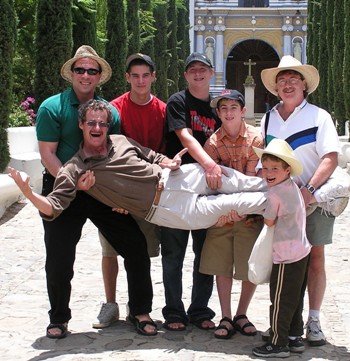
On the Casa Raab web site you will also see lovely pictures of Tony’s estate where they provide beautiful Zapoteco style lodging, tours and other activities. I guarantee Tony, levitating with help below, would show you a good time!
dab2b259c08b05fc1882db2d0b335e22e4b9821496a79d2a6e93b3cb9dfbda8f.jpg

Resilience

A man sleeps every night on a wrought iron bench in the park across the street from my apartment in Oaxaca Mexico.  At 6 o’clock,  he wakes and prepares for the day. He is dressed in slacks and a sweater over a white shirt. From my veranda I watch as he meticulously folds up a big black sheet of plastic that he sleeps under…carefully shaking it out after each fold…matching the corners perfectly.  He has two small backpacks that carefully hold his belongings.  He washes his face and hands from a bottle of water and then picks up several pieces of cardboard that he sleeps on and puts them under one arm.  He puts on a pair of glasses. Then he picks up a short white “stick” and unfolds it into full length.  The tip of the walking stick is red. He walks down the street toward LLano Park.   I wonder, what does a blind man do for work in Mexico…”

These stories, as Obama has said, “tell us that even in the most trying times, amid the most difficult circumstances, there is a generosity, a resilience, a decency, and a determination that perseveres…”

Their resolve is our inspiration.