Police Kick Vendors Out of Oaxaca Zocalo

Wondering around in the Zocolo (plaza) Monday, my friend Paula, who has lived here before, was approached by some young girls with a questionaire for tourists and asked if she had been to the Guelaguetza…or if she had been to see the reenactment of the Princess Donaji legend or any other official  related event of which she had attended none.

But she announced that she HAD been in the Zocolo that morning when the Municipal Police ignominiously strutted in with their flak jackets, shields and rifles to throw the street vendors out, releasing tear gas,  injuring four, detaining eight (mostly local hippie looking jewelry-makers who were standing up for the rest of the vendors who are mostly indigenous people from the mountains)  and sending tourists and locals alike into a frightened flurry to get out of the way.

It is not clear whether the vendors had a permiso to be in the zocalo but this is not the first time they have been thrown out over the years.  Maybe they didn’t pay their mordida (bribe to the city)?  This happened at the same time that the out-going Governor was giving his welcoming speech at the Guelaguetza so I guess he figured most of the tourists wouldn’t witness what was happening in the zocalo.

Read More

Guelaguetza Time Again

oaxacaoaxacaguelaguetza1.jpg

OMG narrow colonial streets are overrun with buses bringing dancers down from the mountains and by cars full of Mexican tourists. Calendas plug up what the cars don’t. Calendas are processions with a band with huge dancing 20 foot tall dressed figures with boys on stilts hidden inside leading a parade of costumed people. Got to be careful not to get hit by the flapping arms.

A bus ripped a hole in it’s fiberglass bumper turning the corner by my apartment the other day…and the night before a car hit another car and flipped over and slid down the sidewalk in front of the Arabia Cafe on the same corner…waking my house guest in the bedroom on that side of the apartment at 1am. A party of about 20 young men in the park from midnight until 5am kept her awake a few nights before that. I think she might be glad to leave next week. :))

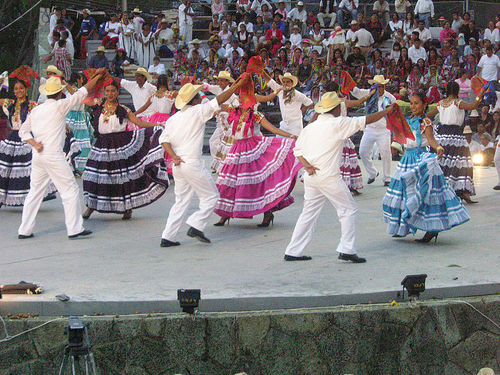
Popular Guelaguetza (free), Governor’s Guelaguetza ($40US). The word Guelaguetza comes from the Zapotec language and is usually interpreted as the “reciprocal exchanges of gifts and service.” Communities from within the state of Oaxaca gather to present their regional culture in the form of dance, music, costumes and food.

Local indigenous groups traditionally perform these dances to fulfill their obligations to their Uses Y Costumbres organized communities which is called doing your “tequio.”

Oaxaca has a large indigenous population, 40 percent, compared to 15 percent for Mexico as a whole. Indigenous culture in the state remains strong in its own right, with over 300,000 people in the state who are monolingual in indigenous languages. The celebration dates back to before the arrival of the Spanish and remains a defining characteristic of Oaxacan culture. Its origins come from celebrations related to the worship of corn as Oaxaca is considered it’s birthplace.

As the festival became a bigger tourist attraction, there was an inevitable backlash from purists that saw the ancient traditions being used for commercial purposes. The 2005 decision by the PRI Governor to conduct two performances a day for each of the two Mondays, was perceived by many traditionalists as a blatant attempt accommodate more ticket purchasing tourists. So the “popular” Guelaguetza, or a return to the more spontaneous celebrations of the pre-Columbian era, was organized.

In Oaxaca, where there is conflict between some groups and the state, the festival can become a focal point of contention.

Due to protests in 2006 against the state government calling for the fraudulently elected Governor to step down, the state-sponsored Guelaguetza was not held up on the hill at the Cerro del Fortín as planned. The protests were led by the Asamblea Popular del Pueblo de Oaxaca, an umbrella organization of teachers, human rights groups, political organizations, unions and others, which were met with state violence. Instead a free, “Popular Guelaguetza” was held by APPO.

The 2007 Governor’s celebration was again boycotted by APPO, and attempts to hold a Popular Guelaguetza were thwarted by government police repression. APPO members had barricaded the entrance to the Governor’s outdoor auditorium which resulted in the police killing of at least one and the disappearance of many others.

This year, the Governor attempted to build a protective cover over the stage of the state sponsored outdoor auditorium but it was not completed in time due to another boycott but also probably more by poor planning. Instead it will be held in an old baseball stadium. The Popular Guelaguetza is being held at an outdoor venue at the Technological University.

Well, that’s probably all you want to know about the Guelaguetza. Of more interest to many is the the annual Mescal Fair in Llano Park. $1.50 entrance fee and free samples from about 50 vendors. Whew!

Futbol Around The World

Futbol, as Spanish speaking countries call it, is the national game in Mexico and all Latin American countries and Oaxaca is no exception.  Americans call it soccer, I think mostly to distinguish the game played with a round ball from the game played with an oblong pointy one that refuses to roll on the ground in a straight line. Apparently the word “soccer” was the original name for the game in England where it was invented but that’s another story you can find on the web.

My kids played soccer in grade school and my oldest banned me from the games for being too loud and embarrassing the heck out of him. So here in Oaxaca even I have found it difficult to avoid the mania.  But the audio of the vuvuzela I downloaded onto my iPhone was pretty sick.  I watched Serbia and Ghana…then expecting to see the Americans play (a game they won) SKY TV immediately replayed the Serbians!  What was that all about?!! I won’t even attempt to speculate.

The restaurants in the zocalo (plaza) have TV monitors facing the sidewalk cafes where mostly young people huddle together…those who don’t go to the bars to watch anyway or depending on the time of day or night the game occurs…and many of them are European language students.  Yesterday Uruguay played Germany. The Europeans were in the minority and rendered pretty mute by the locals urging on Uruguay…the underdog. A table of young French girls were oblivious…tentatively tasting the black mole with barely a drop on the tips of their knives.  It was fun watching the looks on their faces. Either they were famished or they loved it because afterward not a bit was left on the plates.

My son, the chef at the American Club in Hong Kong, is napping.  Tonight (or rather tomorrow) the final between Spain and Holland will air at 2am.  He will open the restaurant…featuring free hot dogs and hamburgers…for those intrepid souls who will stay up.  No fun watching by yourself on the couch in front of your home TV…side-line coaching with friends and a little testosterone thrown in adds much to the pleasure.

Read More

4th of July in Oaxaca

Ironically the 4th of July was also the day of Mexican state elections. Exit polls last night showed that the PRI, the corrupt party that has ruled Mexican politics for over 70 years, was voted out nearly all over Mexico and even in Oaxaca. Well. We’ll see if the actual vote counts are commensurate. If the PRI contests the vote results this will end up in the courts…if not also in the streets.

Death To Criollo Corn In Oaxaca

Criollo corn is under attack in Oaxaca.  Hand made criollo corn tortillas are the prize find for any foreign foodie and for all local Oaxacans.  Industrial corn tortillas taste like sandpaper.  This reads like a detective novel in which Monsanto’s Washington-based communications company uses “phantom” or fake sources to derail a biologist’s career because he was demonstrating that genetically modified corn has indeed infested criollo corn fields.  In other words, the industrialists are fighting natural corn from within in order to make farmers dependent upon their products.

Phantoms in the machine: GM corn spreads to Mexico
MARIE-MONIQUE ROBIN
July 3, 2010

I LANDED in Oaxaca, Mexico, in October 2006. Nestled in the heart of a lush landscape of green mountains, the city is considered one of the jewels of the country’s tourist industry. I was here, however, to investigate contaminated corn.

On November 29, 2001, the scientific journal Nature had published a study that created a stir and drew heavy fire from the St Louis headquarters of North American multinational agricultural corporation Monsanto – manufacturer of the world’s best-selling herbicide, Roundup, and the world’s leading producer of GMOs (genetically modified organisms). Signed by David Quist and Ignacio Chapela, two biologists at the University of California, Berkeley, it found that criollo (traditional) corn in Oaxaca had been contaminated by Roundup Ready and Bt genes. (Bacillus thuringiensis is a bacterium that produces a protein toxic to some insects. The gene inside the bacterium – the Bt gene – is added to seeds such as corn to create genetically modified crops.)

The news was particularly surprising because in 1998 Mexico had declared a moratorium on transgenic corn crops in order to preserve the extraordinary biodiversity of the plant, whose genetic cradle was Mexico. Grown since at least 5000BC, corn was the basic food for the Maya and Aztec peoples, who worshiped it as a sacred plant.

Travelling around the indigenous communities of Oaxaca, I encountered everywhere women drying magnificent ears of corn coloured pale yellow, white, red, violet, black, or an astonishing midnight blue. ”In the Oaxaca region alone, we have more than 150 local varieties,” said Secundino, a Zapotec Indian who was harvesting white corn by hand. ”This variety, for example, is excellent for making tortillas. Look at this ear: it has a very good size and fine kernels, so I’ll save it to plant next year.”

”You never buy seeds from outside?”

”No. When I have a problem, I exchange with a neighbour: I give him ears for him to eat and he gives me seeds. It’s old-fashioned barter.”

”Do you always make tortillas with local corn?”

”Yes, always,” he said with a smile. ”It’s more nourishing, because it’s of much better quality than industrial corn. Besides, it’s healthier, because we farm without chemical products.”

”Industrial corn” means the 6 million tonnes of corn that flood in every year from the United States, 40 per cent of which is transgenic (modified by the introduction of genetic material from another species).

”Look,” said Secundino, holding out in his hand like a gift a magnificent violet ear. ”This corn was my ancestors’ favourite.”

”It existed before the Spanish conquest?”

”Yes, and now there is another conquest.”

”What’s the new conquest?”

”The transgenic conquest, which wants to destroy our traditional corn so industrial corn can dominate. If that happens, we will become dependent on multinational corporations for our seeds. And we will be forced to buy their fertilisers and their insecticides, because otherwise their corn won’t grow. Unlike ours, which grows very well without chemical products.”

IGNACIO Chapela, one of the authors of the Nature study, agreed to meet me at Sproul Plaza on the Berkeley campus. ”Small Mexican farmers,” he said ”are very conscious of the stakes raised by transgenic contamination, because corn is not just their basic food but a cultural symbol.”

It was an October Sunday in 2006, and the huge campus was deserted. Only a police car drifted by like a damned soul. ”That’s for me,” said Chapela. ”I’ve been closely watched since this affair started, especially when there’s a camera.” When I looked incredulous, he went on: ”You want proof? Come with me.” We drove to the top of a hill overlooking San Francisco Bay. As we walked towards the lookout point, we saw the same police car, parked conspicuously at the side of the road.

”How did you find out that Mexican corn was contaminated?” I asked, rather disturbed. Read More
6.2 Earthquake in Oaxaca

About 20 minutes after 2am last night, my friend Paula and I felt a pretty strong but momentary earthquake that woke us both up.

Reuters already had an article posted by 5:30 this morning in the NY Times.

The U.S. Geological Survey said the quake struck near the town of Pinotepa Nacional around 80 miles (125 km) southwest of the colonial city of Oaxaca, but police patrols checking surrounding towns did not report problems.

The USGS reported the quake as strong as magnitude 6.5 but later revised the figure to 6.2, also moving the epicentre slightly.

I have felt several of these here before but so far so good.

Comfort From Morning Tai Chi

Early each quiet Sunday morning, sitting on my veranda, I watch a small group of people practicing their Tai Chi in the park below. This morning I ponder my birthday tomorrow.  How did I get to be 66 already? Then I see the old blind homeless guy who sleeps in the park.

Back Home in Oaxaca

Whew!  What a ride! A week in Vegas, a month in Salem Oregon, a week in Hong Kong, 5 months in Thailand (4 in Bangkok and a month on Koh Samui) a week in Hong Kong again, 2 weeks in Salem, 10 days in Vegas and now back home in Oaxaca. Right now, I don’t care if I see another airport again!

Oaxaca is in the middle of an historical heat wave. Am I still in Thailand? Three fans on in my bedroom at night. Oh where is that Thai A/C?! Too hot to go grocery shopping!  (Maybe I’ll lose some weight.) Tomorrow I’ll just water my plants and drink what’s left of my Arizona Iced Green Tea.  And then take a nap.

Mexican Independence Day In Oaxaca

A friend who saw the parade into the Oaxaca City zocalo this A.M. said it was similar to all  military parades he has seen in the US and elsewhere, and by that standard, quite good. I didn’t go, so have no photos. I did however, watch the fireworks through my open sliding glass living room doors.  Noticias will not publish on Thursday because national law “compels” vacation days” for newspapers, so since Noticias came out today it will honor its no-print day tomorrow.

No one shot, wounded or jailed! That makes headlines, although I heard that some APPO people who wanted to protest were knocked around by the police, and so were the photographers taking their pictures.

URO, the Governor, had on hand 1500 cops, some in uniform and some plain clothes. He delivered the Grito dressed in a  New York-Miami suit, standing on the balcony of the former government palace now a museum, waving the Mexican flag.

A friend reports that in Zaachila, a nearby pueblo, one of the strongest movement towns, there were two Gritos delivered, one official by the municipal president Noe Perez, and the second alternative-popular. Azael Santiago Chepi, Sec General of Section 22 gave the alternative Grito speech. He is quoted as calling on the people to prepare themselves for the coming revolution  “which does not necessarily  have to be armed, but is a transformative consciousness raising force of the people to achieve a better level of life in all areas”.

Chepi was backed by the Zaachila Education Front which consists of 19 education institutions in the municipality , which chose girl students  to perform the national anthem  and one of them shouted the Vivas, which after the historic figures ended ¡Viva Mexico! ¡Viva Zaachila! ¡Viva el Frente Educativo Zaachilense!

In his speech Chepi added that people have to prepare themselves for the great revolution awaiting us. “it is the struggle that we teachers have to wage in every community: awaken the consciousness of our students, find solidarity with the parents, contact the true governors of the peoples such as the great grandfathers or councilors of elders, because the movement is in the phase of gathering force…. diversity makes us stronger, ideological concurrence makes us stronger too, to find points of agreement in this battle against the repressive governor; we have to prepare ourselves  because more complex situations are approaching where surely we will know how to reply to whatever aggression.”

He commented on the police presence in the Oaxaca capital zocalo which was “to gurad an attempt at a festivity which is not of the Oaxaqueños, but to the contrary, is put in play by all the repressive forces that reside in the state; likewise public plazas in the entire country because of the Mexican government´s fear of social dissent which day by day becomes generalized in the face of evident failure of neoliberal policy.”

The Merida Initiative and the Brad Will Case

After living here and watching events unfold since 2006, this is one (not small but easy) thing  that would not only protect the life of one unjustly incarcerated man, but the human rights of thousands of others in Mexico.

The case of JUAN MANUEL MARTINEZ MORENO, incarcerated for the murder of Indymedia journalist Brad Will in Oaxaca October 2006, is being railroaded by the Mexican government in Oaxaca.

Moreno’s next court hearing to have the case dismissed for lack of credible evidence will be held in Federal court in Oaxaca IN THE NEXT FEW DAYS.

Significantly, case of Brad Will’s murder was singled out by the U.S. Congress when they passed the 1.4 billion funding bill for the Merida Initiative in July 2008 (popularly called Plan Mexico to help Mexico fight the “drug war,”) calling in that bill for “progress in conducting a thorough, credible, and transparent investigation to identify the perpetrators of this crime and bring them to justice” as a condition for 15% of the funds. Read More