Christmas In Oaxaca 2010

I will be spending this Christmas with four lovely couchsurfers who are staying with me and we will all be christmas orphans together. One, a part Lao guy born in Paris who has recently been living in Canada, who will be going to Lao for three years to work on a development project and who has invited me to visit him on my next trip to SEA. He met his travel companion, Fanny, in Canada and who is from Switzerland. Another guy is from Michoacan Mexico and his travel companion, Inge, is Dutch. He is selling his photographs as a way of paying for his travel.

I wrote up this description of Christmas in Oaxaca for them:

Little kids dress up like Jesus and Joseph and march in a procession…usually with their respective church members. These are called Posadas. They stop by various homes asking for posada (shelter) in a ritual song, but are refused by those within who also answer in song. The group is finally received at a home previously agreed upon, where the padrinos ( God-parents ) of the particular posada will receive the pilgrims with song and prayer. Then, coffee and tamales are served for the adults and a piñata filled with fruits and nuts for the children.

Beginning with the ‘calenda’ (the procession in which people march in a procession at night with candles and sing songs…often with an accompanying band…and sometimes on the backs of decorated trucks ) on the 6th of December, the party continues with another calenda on the 10th, announcing the upcoming celebrations of the Virgin of Guadalupe. On the 12th, a festive breakfast is served to all in front of the Guadalupe church.

On the 16th, the nine days of ‘posadas’ begin, as well as the calenda of Oaxaca’s patron saint la Virgin de Soledád (Virgin of Solitude) around the zócalo. This calenda is filled with cultural and religious expressions of the indigenous people from the seven regions of Oaxaca. There is a solemn procession and then the famous and colorful Danza de la Pluma is performed outside the basilica of Soledad.

From the 16th through the 31st, is the ‘breaking of the plates’; eating buñuelos (a classic Christmas dessert) and drinking hot chocolate and then smashing the ceramic plates to the ground. (They are made just for this.) Beside the Cathedral, restaurant, stands serve chocolate and “bunuelos” out of bowls which are then thrown against the sidewalk and smashed. It is said that this has something to do with the ancient Indian custom of destroying all of one’s belongings every 52 years, at the end of a cycle proscribed by the Gods. It is also suggested that this comes from Moctezuma’s habit of never eating from the same plate twice.

The people from the mountains bring down the moss and orchids called “San Miguelitos” for the manger scenes on people’s home altars.

On the 17th, there are fireworks in front of the Soledad Basilica. On the 18th, in the morning, people can have breakfast in the patio of the basilica and listen to indigenous music from around the state.

The Noche de Rabanos (Night of the radishes) is on the evening of December 23rd, when the zocalo becomes the scene of a huge exhibition of figures sculpted from radishes.

The fourth and biggest posada is on December 24th, when groups from all over Oaxaca meet in the zócalo to celebrate the arrival of Christmas night. Prior to arriving at the zócalo, each posada will proceed to the home of the madrina (god-mother) who will provide a statue of the child Jesus for the local parish’s nativity scene. After a joyfully festive parade around the zócalo and through Oaxaca, the community returns to its parish church and prepares to celebrate the ‘Misa de Gallo’ (mass of the rooster), the first worship celebration of the Christmas feast.

The fiesta in Oaxaca, of course, is not limited to the days leading up to the 25th. The twelfth day of Christmas (Jan. 6th) is still celebrated here as the ‘feast of the three kings’. Small gifts (hand-made toys or sweets) are given to children on this day. Families, sharing a meal on this day with compadres, are served a special ring-shaped loaf of bread called a ‘rosca’. Inside the loaf are hidden a few tiny images of the child Jesus. If a person finds one in his slice of rosca he/she is obliged to host yet another fiesta for the final celebration of the Christmas season on February 2nd. Most people just laugh but they don’t really host another fiesta! But on this day, families are supposed to bring an image of Jesus from their home altar along with candles to be blessed at church which they do. This feast has come to be known as calendaria.

The Night of the Petition, “Noche del Pedimento” is an indigenous celebration on Dec. 31st. On a hill near Mitla, near Oaxaca City, this ceremony is acted out at a tiny chapel where a cave represented the entrance to the other world, symbolized by the mouth of the jaguar god. Country people, and many from the city come with small models to petition favors from the gods.

Of course the majority of the people are Catholic, in custom if not always in faith, so people of other faiths or no faith just join in the “cultural” activities.

There are things like this going on constantly all throughout the year (anything for a party) and sometimes I wonder how anybody gets anything done! :))
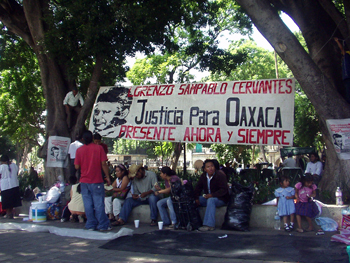
End Of The PRI in Oaxaca

Upside Down World has an article by a local writer summarizing the end of the PRI (Institutional Revolutionary Party that ruled Mexico for 70 years) in Oaxaca and the inauguration of the new governor.

The writer describes the ceremony on December 1…the beginning of the new administration:

In the afternoon ceremony in the former government palace, Cue introduced his cabinet; indigenous groups offered a symbolic cleansing (which might apply to the building as well, since Cue has declared he will re-open it for Executive business); conch shells called fifteen ethnic groups of Oaxaca to give and receive symbolic batons of office; marches and street parties enlivened Oaxaca City. Rigoberto Menchú attended the event to sign an agreement between Oaxaca and Menchú’s environmental foundation. The Teachers Social Movement and the APPO (Asamblea Popular Pueblo de Oaxaca) mobilized 60,000 teachers who jammed the zócalo. Azael Santiago Chepi, Secretary General of the Education Workers union Section 22 stated: “Ruiz practiced the politics of terror and persecution and will go down in history as an incompetent who refused to hear the people…the teachers union is prepared to work with the new administration on all issues….” Punishment of Ulises Ruiz Ortiz (URO) was demanded, again.

A friend who watched the march arrive in the Zocalo described a crowd that was impossible to walk through. Then by the middle of the afternoon the crowd emptied leaving the Zocalo nearly empty.

However by 5pm, when I arrived, a humongous stage had been erected in front of the cathedral and another different crowd was entertained by a famous Mexican singer and a Columbian (??) band. The Zocalo had been cordoned off on the north side in front of the stage so access was limited to the south end…unless you wanted to maneuver through thousands of people in front of the stage. I sat at one of the few remaining restaurant tables at the end nearest the rear of the stage. I was the only gringo in the zocalo that I could see.

The new Governor spoke about an hour…of course I couldn’t understand much of it. I hope there weren’t too many promises. The fireworks were good. I left about 11pm for the walk back to my apartment…with the music still playing.

This time it was the middle middle class. Not the fancy dressed upper-middle and upper classes…who I assume would have probably been aligned with the PRI. The people have cautious hope in a governor reputed to be honest and with the best intentions. I felt cautious too. We in the north were once excited about a new president too.

To Oaxaca! Whew! Done!

I waited until the day we left for Queretaro to call and tell my friend Patsy (we go waaayyy back) that we had changed our itinerary and would be seeing her that evening. What fun! It had been three years since I had seen her and Jose…in fact since June 13, 2006 when they drove into Oaxaca the night the municipal police tried to tear gas the striking teachers out of the zocalo. Haven’t seen her in Oaxaca since!

After she and Jose married in Oregon five years ago, they moved to Mexico so they could be near Jose’s aging mother after so many years working up north. A trained ESL teacher, they survive on what she makes teaching English in her home (cracker boxes are thanks to low-income housing by ex President Vicente Fox) and Jose’s meager computerized and complex mechanic work. Even though born of Mexican parents in San Francisco CA, Patsy feels isolated and lonely in this new country, she says. Interesting…

Parked the car in her fenced yard…in the care of her dog…and got a nice hotel in downtown San Juan del Rio. Drinks and dinner on me. My great pleasure. And I unloaded a few treasured magazines and books for Patsy.

The next morning after breakfast and coffee, Patty and Jose led us out to the toll road toward Mexico City so we wouldn’t have to use my GPS like we did during a Saturday fiesta day on the way in. Grrrrr. A brand new toll road cuts off after a few miles, however, toward Pueblo where we could then go on to Oaxaca. Open about a year. So we didn’t have to traverse Mexico City which can be crazy even on a Sunday. Cars are only allowed in the city on alternate days with licenses that end with even/odd numbers and we didn’t know which day was which…so the new Puebla toll road…as expensive as it was…about $30…was worth every penny.

Incidently, drivers are completely covered by Mexican insurance on the divided toll roads. Just keep your pay stub. Some are federally owned and some are owned by private corporations which are fenced to keep the animals out. A solar powered phone can be accessed every few meters from which a call to the Green Angels will bring out an ambulance and trained medical personnel. Or a mechanic. Repairs and replacement parts are free. A totaled car is replaced. A medical facility at the end of the toll will provide intermediate emergency care until transport to a nearby hospital. Now, why can’t the U.S. do this if Mexico can!?

A Damn Long Drive

From Oregon to Oaxaca Mexico! And all that worry for nothing! We’ve been reading too many newspaper articles up north. Flew through the Nogales border and down highway 15…no stops…no searches…no dogs…no federales to bribe…or narcos dressed like federales…no banditos!

No cars pulled off the toll road and set afire by narcos trying to block the police like happened at Loredo a few months ago. 18 of them! I made the mistake of telling my son about it…which disappointingly resulted in his reneging on a promise to give me his VW Taureg!

At the 22km mark got my $36 car permit good for the duration of my FM3 visa (one year) with no trouble. It renews automatically when I renew my visa. Good thing for plastic. Cash would have required a $400 deposit for a new Nissan Xterra to ensure no resale in Mexico and it’s return back across the border. (Some day) Sure wouldn’t want to take a sale from a Mexican auto dealer.

Nearly three weeks in Las Vegas with my oldest son Greg and his sweet Yellow Lab was a joy. He has to be kissing you and in your lap constantly…the Lab…not Greg! My early rising habit came in handy…I made coffee every morning for Greg before he joined another doctor and some others for a 7am workout with an ex Navy Seal. Then it was my job to rub on the Icy Hot and Peppermint Oil. I made Pork with Green Salsa and lasagna for his freezer. Maybe he’ll let me come back some time! Weather was great! Sat out by the pool with my computer every day. “You’re darker,” my friends here are saying. Good. Need that vitamin D!

I had picked up a friend near Palm Springs to ride down with me and as we approached Mazatlan we made a last minute decision to drive over to Lake Chapala. Expat City. Don’t even have to meet any Mexicans…

Spent the night in a very clean luxurious “love motel” in Guadalajara for $20…a “hot pillow” motel my friend called it. We confused the heck out of the maids when we asked for two rooms! Pulled the car through a narrow curving driveway and maneuvered under the room behind a metal door. Then up the stairs…never to be seen by anyone who might tell…

One wall full of mirrors. Vibrating king-sized bed. Porn on the TV. Bathroom two steps up…condoms and lubricants at the ready. Glass-walled shower allowed a view from the room below. You could order all sorts of toys, more condoms?? and viagra…that would be whirled around through the wall in a metal contraption that kept the maid from seeing anything. What a waste on me, I thought!

The next day we managed to make our way into the old silver mining town of Guanajuato without getting lost among all the canyon tunnels. Here is a video of one such tunnel.

The city is much bigger than I remembered from a visit many years ago. There are several colleges here and on a week day the streets were crammed with “kids.” Our beautiful old colonial hotel was also crammed with kids who kept us awake all night. Arghhh.

There are tunnel “raves” with electronic music held every year here. Incidentally, these are common in New York City and all over Europe. One of my couchsurfers from Berlin recently told me about A Love Parade rave in a tunnel in Duisberg Germany in July 2010 that ended in tragedy when the crowd stampeded and 21 were left dead and hundreds injured. That annual Love Parade, which started in Berlin, was permanently canceled. Below is a video of one in Guanajuato.

Visited Diego Rivera’s home which is now a museum…and of course the Mummies of Guanajuato. About a hundred naturally mummified bodies were found interred during a cholera outbreak in 1833. Horribly, you can tell some of them were accidentally buried alive. They were disinterred between 1865 and 1958, when few relatives could pay a tax in order to keep the bodies in the cemetery. They are so popular with tourists that the city has built a beautiful new museum to hold them…open about a year.

Well, that’s Guanajuato. It was my second city of choice when I moved to Mexico in 2006. Next stop, San Juan del Rio…just south of Queretaro.

Self Censuring

I moved to Oaxaca City in 2006 to find 70,000 of the state’s teachers striking in the Centro. They had been striking every year for more than 20 years to gain a minimum of educational standards for a state with 16 indigenous groups living in the mountains…all with their own languages.

The strike gained scores of supporters, including human rights activists and civil organizations and this time it lasted 7 months before it was put down by thousands of federal riot control troops. It left more than 20 dead, including an American independent journalist and hundreds more beaten and/or incarcerated or disappeared. No one has been convicted of any of it.

I reported on much of this in this blog, thinking, like many other expats living there, that helping shine the light internationally on unlawful acts by the authorities, would help protect the innocent. I am not so sure any more because the impunity of the authorities has been escalating. The most recent incident is the killing of a Finnish human rights worker along with two Trique leaders as he accompanied a caravan bringing food and water from Mexico City to a barricaded Trique community. Repeated inquiries by the Finnish parents, the European Union and even the UN has not resulted in justice.

However, it is also unlawful in Mexico for foreigners to “interfere” in Mexican national politics and the authorities are free at any time to define what constitutes “interference.” The authorities can arrest or deport (or more) any foreigner on the spot and it has been done.

So when I return to Oaxaca, I will not be reporting on my blog on activities that I feel could be interpreted as “interference.”

However there are reputable blogs reporting breaking events in Latin America, including Oaxaca. Two of these are Upside Down World and Narco News.com with 450 co-publishers reporting.

Poor Oaxaca

Update wed:
Well, I hope the governor is good and embarrased after overstating the damage in Oaxaca and drawing intense international media attention. He has now issued a statement saying that 11 people are missing, no confirmed dead and 3-4 houses buried. Shhiishh!

Oaxaca has been inundated with two feet of rain in the last two weeks with record rainfalls for a month before that. The New York Times carried this report this morning:

A hillside collapsed onto a village in the southern Mexican state of Oaxaca early Tuesday, burying houses in mud and stones and trapping hundreds of people as they slept, state authorities said.

As many as 300 houses in the village of Santa Maria Tlahuitoltepec may have been buried in the landslide, said the state governor, Ulises Ruiz.

Rescue workers trying to reach the village with earth-moving equipment have been hampered by blocked roads in the remote area, which has been pounded by incessant rains. “We hope to reach in time to rescue those families who were buried by the hill,” Mr. Ruiz told Mexican television.

This is about 50 miles from Oaxaca City where I live. And the latest news report on CBC says they couldn’t even land one helicopter there today (!!)
People in Oaxaca are forming help centers and are asking for donations. This appeared in the Oaxaca group on couchsurfing:

Up to us a lot more responsibility now with the tragedy that has befallen the people of Tlahuitoltepec, Mixe. They can overcome this sadness is in large part on all of us! Let’s help these people with great history, traditions and poverty.

In my facebook profile for me, Rodrigo Guzman, I have the account number to which they can make donations, so you can donate nonperishable food, bottled water, beans, rice, sugar, canned goods, can opener, antiviral drugs, clothes in good condition, covers and mattresses in any of the collection centers that are opening throughout the state.

The other tragedy of the moment has to do with the Trique indigenous communities in the Mixteca region north of Oaxaca City.

Three years ago, the indigenous Trique municipality of San Juan Copala, in the southern Mexican state of Oaxaca, declared itself autonomous from the government. Since that time they have faced severe repression, with community members being kidnapped, raped and assassinated by two state-backed paramilitary groups in an attempt to destroy the autonomous project. Two caravans bringing food and water to the town were driven back with several people murdered…one a Finnish human rights worker. The people have been driven out of their town and taken over by Oaxaca government allies.

Join Friends of Brad Will along with guests from Movement for Justice in El Barrio, to learn more about San Juan Copala, including a short documentary and video-message from residents of the autonomous municipality.

Friends of Brad Will is a national network working for justice for Brad Will, an American independent journalist murdered by state paramilitaries in Oaxaca in 2006.

As if all that wasn’t bad enough, a bridge to the Oaxaca airport has collapsed caused people to have to walk in and out.

Wish me luck driving down in mid-October.

El Grito 2010

EVERY 100 years, Mexico seems to have a rendezvous with violence as again the country gathered on Wednesday night for the ceremony of the “grito” — the anniversary of the Revolution…the call to arms that began the war for independence from Spain in 1910.

As they have on every Sept. 15 for 200 years, Mexicans gathered together in the central squares of our cities and towns, even in the smallest and most remote villages. At midnight, they heard a local governing official re-enact the grito uttered by Miguel Hidalgo, the “father of the fatherland.” They shouted, jubilantly, with genuine feeling: “Viva México!”

Euphoric cries were mixed with a flashy Mexico City military parade, a counter-bicentennial gathering, fresh outbreaks of narco-violence in different parts of the country and goads of symbolism that embodied the past, present and future of a nation of more than 100 million people. As the historic day faded, Hurricane Karl bore down on the state of Veracruz, already battered by this summer’s torrential rains.

At a ceremony in the town of Dolores Hidalgo, Guanajuato, the unassuming place where Father Miguel Hidalgo y Costilla launched the 1810 rebellion that resulted in Mexican independence 11 years later, President Felipe Calderon was greeted with a sprinkling of obscenities and unusual shouts. Some members of the audience reportedly yelled out “Viva El Chapo,” or “Long Live El Chapo,” in apparent reference to fugitive drug lord Joaquin Guzman Loera. “Death to the Bad Government!” also was heard.

Later, Calderon presided over a Mexico City military parade of about 23,000 Mexican army and navy personnel, including members of elite anti-narco units. While air force jets flew overhead, military delegations from 17 countries were on hand for the historic commemoration.

What’s that all about?!!!

The participation of a Federal Police contingent was an unusual feature of this year’s parade. As the emerging front-line force in the so-called drug war, the Federal Police headed by Genaro Garcia Luna is the institution favored by Mexico City and Washington to take over combat of organized crime from the army and the navy.

Meanwhile in Oaxaca more than 2,000 police and military personnel are guarding entry to the Zocalo as a security measure. Wed night was the Grito, and Thursday was the parade.

Against whom are they guarding? All we know is the ambulant vendors, the unions and protesters.

In Oaxaca El Grito belies a different kind of violence…one instigated by the PRI (the powerful party in control for the last 80 years) to pit one group of Trique indigenous people against another group seeking autonomy as the government had promised years ago. Read More

Mexico Rethinks Drug Strategy

As death toll rises, Mexico rethinks drug war strategy

By TIM JOHNSON
McClatchy Newspapers

MEXICO CITY | The drug war in Mexico is at a crossroads.

As the death toll climbs above 28,000, President Felipe Calderon confronts growing pressure to try a different strategy — some are even suggesting legalizing narcotics — to quell the violence unleashed by major drug syndicates.

Many Mexicans don’t know whether their country is winning or losing the war against drug traffickers, but they know they are fatigued by the brutality sweeping parts of their nation. For example:

Eighteen people were killed at a July 18 birthday party in Torreon, the capital of the state of Coahuila. A prison warden freed the assailants and lent them vehicles and assault rifles to do the killing.

In Durango, eight severed heads were left strewn around the state one late July morning. Outside of Monterrey, soldiers discovered a mass dumping ground of victims of the drug wars containing 51 bodies.

During Calderon’s tenure, gangs have killed 915 municipal police officers, 698 state police, and 463 federal agents, said the Secretariat of Public Safety.

Beyond the drug trade’s public violence, its corrupting aspects have affected many aspects of Mexican society.

“There are powerful interests in Mexico who benefit from the drug trade and the $40 billion, or whatever it is, that is pumped into the Mexican economy,” said Scott Stewart, vice president for tactical intelligence at Stratfor, an Austin, Texas-based company that provides global analysis. “You’re talking bankers. You’re talking businesses that are laundering money, construction companies that are building resorts.”

When the huge drug trade boils into the public eye, it threatens another of Mexico’s major trade channels — tourism, the nation’s third-largest source of revenue, and generator of one out of every 7.7 jobs in Mexico.

Fighting the cartels
Read More

Why I Am An Expat In Oaxaca Mexico

As for me, the best kind of traveling for Pico Iyer, the travel writer, is when he is searching for something he never finds. “The physical aspect of travel is for me,” he says “the least interesting…what really draws me is the prospect of stepping out of the daylight of everything I know, into the shadows of what I don’t know and may never will. We travel, some of us, to slip through the curtain of the ordinary, and into the presence of whatever lies just outside our apprehension…” he goes on to say. “I fall through the gratings of the conscious mind and into a place that observes a different kind of logic.”

Being a wanderer, says Alain de Botton in “The Art of Travel”, crossing different lands among people who speak languages strange to one’s ear…meditating dreamily to the rhythm of train wheels, allowing the sounds of the world to be one’s mantra, enables one to grow…to transcend one’s known life. The silence of being alone (much like being on retreat in a monastery) without the ease of familiarity allows one to stand outside oneself… large sublime views and new smells revealing new thoughts and emotions…thrilling or disappointing aspects of oneself…here-to-for hidden from one’s awareness.

If we find poetry in tattered old men weaving home on bicycles, a grateful charm in smiling young country girls… and a shared intimacy in the look of recognition in the eyes of kindred travelers we have found “an alternative to the ease, habits and confinement of the ordinary rooted world.”

Introspective reflections revealed by  new places and people much different than us may reveal hidden thrilling or disappointing aspects of ourselves.  Thrilled by finally learning the geopolitics of another people and learning that there are many valid ways of living in the world other than ours.  Disappointed at discovering we have limits to our tolerance for what we judge as inefficient or unsanitary.  So as another travel writer says “it is not necessarily [only] at home that we encounter our true selves. “The furniture insists that we cannot change because it does not; the domestic setting keeps us tethered to the person we [think] we are in ordinary life…who may not be who we essentially are,” says the author.

I love to travel alone. Traveling companions can keep us tethered to our predefined idea of ourselves. They may expect certain reactions from us that obligates us…underneath our awareness…forces us to accommodate in a way that feels unnatural. Or in our companion’s desire to have their own experiences, they may not have the patience to reciprocate and share. In traveling alone we are free to connect with what and whom comes our way.  We are more approachable.

Robert Young Pelton nailed it for me though when he said in his “World’s Most Dangerous Places” “living is (partly) about adventure and adventure is about elegantly surfing the tenuous space between lobotomized serenity and splattered-bug terror and still being in enough pieces to share the lessons learned with your grandkids. Adventure is about using your brain, body and intellect to weave a few bright colors in the world’s dull, gray fabric…”

The purpose of his book, he says, “is to get your head screwed on straight, your sphincter unpuckered and your nose pointed in the right direction.”

I retired in 2002, rented out the house long term and “went on the road.” I traveled for the next four years but then got sick of piling on and off buses, trains, planes, taxis, boats and all other manner of transportation…and packing and unpacking.

I returned to the states and for 4 months went from the computer to the TV and back again. One day, I thought, I could just die in this chair. Go for a walk? Where? Around the neighborhood block? Have to get in your car…and then go where? A coffee shop? I was bored to death. Not that there are not a jillion activities I could have participated in. But why? I felt I had done all I wanted to do there. Bored by a country I had spent 60 years in and bored by a town I spent 40 years in. I am not attached to the place and the culture….although I do miss incredibly sweet raspberries and strawberries in the spring and cherries and peaches in the fall…picked by migrants from here and sold cheaply in the US due to their cheap labor.

One son is in Hong Kong, one in Thailand and one in Las Vegas. No grandchildren. My grandparents immigrated from Poland and Ireland but died before or just after I was born…no extended family to speak of and the ones I have are all ranchers in Montana…a physical and intellectual world away.

My friends and former co-workers are scattered from “hell to breakfast” as we say.   Generally speaking, with only one or two weeks of vacation a year,  Americans don’t frequently travel outside the country.  So, “Oh,” you say, “in Thailand…” And then the veil comes down over the eyes and that is the end of that!

Many of my friends that I have now, I met on the road and keep in frequent contact through skype, email and Facebook. I have learned that “community” doesn’t have to be a physical place. It can be virtual. Guess I have, as Pico Iyer puts it…a “global soul.”

No roots to speak of…in a physical sense. I HAVE learned, however, after witnessing incredible poverty and injustice in the world, to value much more all those things (my roots) we as Americans take for granted…but they are internalized and remain with me wherever I live…independence, self-sufficiency, efficiency, innovation, freedom of thought and speech, an appreciation for the rule of law and government with relative separation of powers and relative lack of collusion and corruption. I said “relative.”

So…long story short…what I realized I wanted now, was a daily life that was interesting and full of small enjoyments. And to search for an understanding of a culture I will never find. So I moved to Oaxaca. I chose Oaxaca because it is in the mountains which I love and the weather is temperate year round. I also chose Oaxaca because I had worked with many farmworkers in Oregon who were from here and I found the people to be real.

Music everywhere. Rockets, fireworks going off. Church bells to wake you up in the morning. Processions, Fiestas. Protest marches, daily walks around the Centro…(I have arthritis so I need to walk) always discovering new little cafes and other places of business. And am trying to understand that when my Mexican friend says “I will see you manana he may mean tomorrow, next week or next month or never! Ha!)

I am learning to cook “Oaxacan” so going to a different little market for specialty items…mole and rare chilis at the Merced, Friday market tienges in Llano Park for meat and vegetables is a joy. A hundred small vendors selling everything you can imagine…and great chivo (BBQ goat) with consumme or tacos with hand-made tortillas.  I love to feed my friends and couchsurfers and watch them delight over estofado or mole.

Five blocks to the tree-filled Zocalo (plaza) where I can sit for hours in one of the little sidewalk cafes surrounding it over coffee or beer with friends who wonder by…both local and expat. There are 16 different indigenous groups from small mountain villages that are easily accessible whether 1 hour or 7 hours away. Or I just sit on my veranda overlooking a lovely park to read. Or the news junkie that I am, peruse the internet for the latest via my WiFi…amid wafts of dance music coming from the nearby cultural center.  Or visit with a friend over Pechuga Mescal. On Saturday and Sunday mornings I watch people practicing Tai Chi in the park below. Or video-skype one of my sons.

And then there is learning and practicing the language…a challenge to keep the brain from totally disintegrating.

Of course my social security and pension goes farther here. But it’s not the reason I am here.  Friends in the U.S. say” but why do you want to live in Mexico?  It is so poor!”  You don’t know poor until you’ve gone to India or black Africa.  Or they worry that I will get kidnapped or shot.  The narcos leave the tourists alone…they only kill each other or people who get in the way. And that is mainly in the border areas.  I feel very safe here.

I don’t know how long I will be here.  Much of it depends on my health. A debilitating or chronic condition would require me to go back to the states in order to be covered by medicare.  But for now, I enjoy the daily small things.  I still do travel periodically…mostly to Asia. In fact I just returned from 8 months away….6 of it in Thailand and Hong Kong.  But I live in a culture I will probably never understand.  It’s rewarding and enlivening to push my boundaries and try.

Oaxaca: Who is Permitted to Earn Money, and Where?

Taken from NarcoNews:

The Real Battle for Oaxaca: Who is Permitted to Earn Money, and Where?
“The lesser officials manage the street scene, but also the professionals, vendor bosses, who run a crew of ten or a dozen”

By Nancy Davies
Commentary from Oaxaca

August 17, 2009

A plague of ambulatory vendors annoy the tourists sipping cappuccinos in the Oaxaca zócalo. Beneath the cafe umbrellas vacationers, often with their families, don’t want to be pestered. They have disposable money; smart vendors head for the “whities”. The peddlers, here called ambulantes, have changed. A decade ago I could greet the same few — a family who sells homemade candy, Jorge who sells rebozos, AltaGracia who sells place-mats and table runners—all “inherited” their peddler’s licenses from parents, or so they tell me. During 2006, they suffered —no tourists, no sales. AltaGracia, a vital woman with a nice smile, lost almost all her teeth in the past two years.

waiting-for-permissi.jpg
Vendors waiting for permission

D.R. 2009 – Photos Nancy Davies
Who are the new ambulantes? Women from Chiapas, recognizable in wool wrap skirts and braided hair, selling beads and Chinese rubber chickens. Children follow behind, or if they’re nursing, nuzzle a breast and lunch on the go, like busy business-people must. Children vend by themselves if they are over eight or nine, thin-legged, endlessly circling in their plastic shoes. Others Oaxaqueños sell handmade wooden toys, or canes, or plastic necklaces.

On the corners the sellers of raspas station their ice-carts, and the popsicle vendors and soda vendors criss-cross the square.

Stationary vendors descend for any and all fiestas, to set up on the sidewalks their blouses and “hand-made” tourist goods, tortillas and comals for cooking food, oil cloth covered tables and iron benches or stools -a carnival atmosphere. In the background the blaring music. The permanent puestos (the booths which might or might not be taken down at night) smothered Bustamante Street, supplemented by sidewalk vendors with lettuce and radishes and fruits in season. Las Casas Street has been jammed for so long that I think of it as my favorite street, for its “true to life” confusion. The shopkeepers complain, probably with good reason —there’s hardly space to enter.

Welcome to hard times. The slippage of the Oaxaca (and Mexican) economy can be calculated by the numbers of vendors multiplied by the number of fiestas. Read More