Guelaguetza Time Again
oaxacaoaxacaguelaguetza1.jpg

OMG narrow colonial streets are overrun with buses bringing dancers down from the mountains and by cars full of Mexican tourists. Calendas plug up what the cars don’t. Calendas are processions with a band with huge dancing 20 foot tall dressed figures with boys on stilts hidden inside leading a parade of costumed people. Got to be careful not to get hit by the flapping arms.

A bus ripped a hole in it’s fiberglass bumper turning the corner by my apartment the other day…and the night before a car hit another car and flipped over and slid down the sidewalk in front of the Arabia Cafe on the same corner…waking my house guest in the bedroom on that side of the apartment at 1am. A party of about 20 young men in the park from midnight until 5am kept her awake a few nights before that. I think she might be glad to leave next week. :))

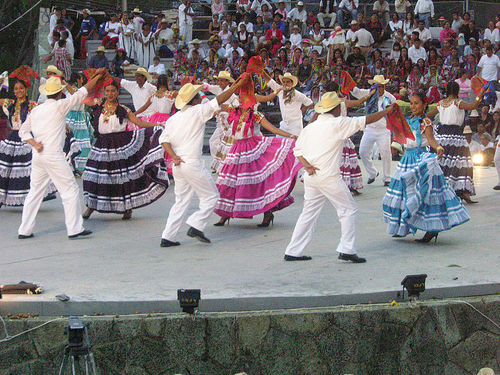
Popular Guelaguetza (free), Governor’s Guelaguetza ($40US). The word Guelaguetza comes from the Zapotec language and is usually interpreted as the “reciprocal exchanges of gifts and service.” Communities from within the state of Oaxaca gather to present their regional culture in the form of dance, music, costumes and food.

Local indigenous groups traditionally perform these dances to fulfill their obligations to their Uses Y Costumbres organized communities which is called doing your “tequio.”

Oaxaca has a large indigenous population, 40 percent, compared to 15 percent for Mexico as a whole. Indigenous culture in the state remains strong in its own right, with over 300,000 people in the state who are monolingual in indigenous languages. The celebration dates back to before the arrival of the Spanish and remains a defining characteristic of Oaxacan culture. Its origins come from celebrations related to the worship of corn as Oaxaca is considered it’s birthplace.

As the festival became a bigger tourist attraction, there was an inevitable backlash from purists that saw the ancient traditions being used for commercial purposes. The 2005 decision by the PRI Governor to conduct two performances a day for each of the two Mondays, was perceived by many traditionalists as a blatant attempt accommodate more ticket purchasing tourists. So the “popular” Guelaguetza, or a return to the more spontaneous celebrations of the pre-Columbian era, was organized.

In Oaxaca, where there is conflict between some groups and the state, the festival can become a focal point of contention.

Due to protests in 2006 against the state government calling for the fraudulently elected Governor to step down, the state-sponsored Guelaguetza was not held up on the hill at the Cerro del Fortín as planned. The protests were led by the Asamblea Popular del Pueblo de Oaxaca, an umbrella organization of teachers, human rights groups, political organizations, unions and others, which were met with state violence. Instead a free, “Popular Guelaguetza” was held by APPO.

The 2007 Governor’s celebration was again boycotted by APPO, and attempts to hold a Popular Guelaguetza were thwarted by government police repression. APPO members had barricaded the entrance to the Governor’s outdoor auditorium which resulted in the police killing of at least one and the disappearance of many others.

This year, the Governor attempted to build a protective cover over the stage of the state sponsored outdoor auditorium but it was not completed in time due to another boycott but also probably more by poor planning. Instead it will be held in an old baseball stadium. The Popular Guelaguetza is being held at an outdoor venue at the Technological University.

Well, that’s probably all you want to know about the Guelaguetza. Of more interest to many is the the annual Mescal Fair in Llano Park. $1.50 entrance fee and free samples from about 50 vendors. Whew!

Hierve El Agua

Last weekend I took Mica, Bardo and the kids from Hauyapam, and Charlie, who used to be a coffee bean roaster in Oaxaca in the 70’s but now is a roaster in Canada and here for a few weeks, in the car to Hierva El Agua about 50 miles into the mountains. There cold water mineral springs fall over steep cliffs and solidify into rock-hard deposits forming algae-painted slabs in level spots and accumulating into what appear to be grand frozen waterfalls…shining in the sun.

The governor is building a huge glassed-in pyramid-shaped restaurant within yards of the springs…giving diners (what diners?) a spectacular view of the Sierra Sur mountains where the indigenous Mixe live…but the place is accessed by pot-holed dirt roads. The only place to eat was an empty shack…interestingly named “Alice’s Restaurant” where we were the only patrons. The first evening a good-looking young woman gave us black beans, salsa and bread and coffee while she nursed her ten-month old little boy…her two year old by her side. She says it is common here for women to have ten children…but she has had her tubes tied, she says.

We stayed in the only bungalow…with “matrimonial” bed in a loft and two sets of bunk beds below. There was no gas for the stove or water heater. The gate-keeper in the same building had spent six years in LA and wanted to practice his English.

The next day we sat next to a smoke-filled wood fire in the corner of the dirt yard of the “restaurant” while an older woman made fresh corn tortillas on a huge comal. The tomatoes for the fresh salsa were roasted in the wood ashes…giving it a wonderful smoky flavor. She amazingly was able to grind the chilis on a window sill next to the fire. We devoured the avocados and cheese memelitas with the salsa and coffee…running for cover from the wood smoke whenever the woman stoked the fire. Best-tasting Oaxacan food yet!

On the way home, we stopped at a small family-run traditional mescal factory to buy jugs of Mescal. I will buy a small oak barrel with a spigot at the market to keep the mescal from drawing the taste of the plastic jug. The maguay plants are ground to a pulp in a round concrete “trough” under a huge marble “wheel” that is pulled round and round by a donkey. The mescal I chose had been stilled and aged with several different local fruits-and chicken breasts-in addition to the magay plant! Smooth, slightly sweet and full of flavor…40% alcohol…compared to the young 100% alcohol stuff that burns the gullet all the way to the stomach.

This week, Joe, a recently retired CPA from Chicago who is living in my apartment complex and teaching English, and I will have lunch together. Joe was married and has two grown children. Has also come here for a new life. Funny and gregarious…very nice guy. A young couple has just moved into the apartment (there are four apartments) from Canada. He is a writer …they have a 4 year old little boy who is squaring it off with the little girl in the manager’s apartment…neither of which knows the other’s language. They are driving the mothers nuts!

Can’t believe I’ve been here six months already. When my visa expires in August I will go to Asia to see my son and his wife, Josh and Amy, in Beijing China and son Doug and Luk, his wife, on the island of Koh Samui in Thailand…then probably back here if everything returns to normal politically. If not I’ll just stay in Asia.

Zapateca Mescal Distillery

Yesterday, Charlie and I visited an American and his wife, Tony & Rebecca Raab, who have a beautiful bed and breakfast called Casa Raab about 20 minutes outside the city. Tony has built a hand-made authentic Zapateco mescal still. Some of the best I’ve tasted. Certainly worth a personal tour.

casaraab@gmail.com

google Casa Raab

Monte Alban & Huayapam

Yesterday morning Mike and I drove 30 minutes to Monte Alban…a gigantic Zapotec ruins on top of one of the mountains surrounding Oaxaca City…passing early morning walkers along the way. We were the sole visitors this morning in this ancient ruins…meditating on the lives of this great indigenous people…looking sadly at the carvings of naked vanquished enemies. And we are surprised that the descendents of this proud people are standing up to their oppressors and shouting Basta!?

Around 500 BC ancestors of Oaxaca’s Zapotec people founded what many believe to be Americas’ earliest metropolis. They raised monumental platforms, pyramids, palaces and ceremonial courts. Encompasing 3 sq miles, Monte Alban flourished for centuries as a city with as many 40,000 at it’s height a thousand years later until an invasion of Mixtecs from the north who became the ruling class in a number of valley city-states. The blend of Mixtec and Zapotec art and architecture sometimes led to new forms especially visible at the sites of Yagul and Mitla.

Monte Alban is a UNESCO World Heritage site.

By 10 am we were drinking bad coffee with Mirella, my Australian friend and my friend Sharon in the Zocalo.

Then I walked across the Zocalo to visit Max at a sidewalk cafe. After awhile, I received a call from Gerardo. “Come to Bardo’s and bring some beer and cheap mescal,” says Gerardo. Just as I hung up, an old Mexican comes by our table selling a three-liter gas can full of mescal…smooth yellow mescal…”anejo” (aged) mescal. I bought a liter of water, dumped it out, gave Max a liter and took off for the apartment to get Mike who had collapsed in his room earlier for a nap. “Hey, Mike, get up, you want to party?” And off we went to Huayapam…of course getting lost in a small village but finding our way through dirt roads to Bardo’s house. I gave out my gifts I had brought for the family and Bardo sent out for great pastor tacos with those glorious sweet roasted onions while Gerardo regaled us with the story of his march, his hard life in Mexico and ten years in the US while poor Bardo, tired of listening to Gerardo’s untranslated (slurred by this time) English, finally retreated with his wife Mica to their bedroom to watch TV.

Dodging the burning tires and barricades through the Centro, we finally made our way home at 2am…eating left-over vegetable soup and guacamole before collapsing into our beds.