Sr. Christine’s Orphanage

Burma.gif

While Bob was trekking I decided to walk a couple kilometers up the hill in Kalaw to Christ the King Church. Sr. Christine, a Burmese nun who was walking behind me caught up with me and introduced herself.

Sister.jpg

When we got to the church compound about 20 little girls in raggedy clothes came running out to greet us. These are our children, Sister says. They have no parents so they live with us. (The boys live with Father Paul in the rectory.) Then the children all lined up to sing some touching little songs about friendship for us…obviously having done this before.

How do you get money to support yourself, I asked…giving her an opening. By donations from tourists, she said honestly. Then she asked me to sit and have juice and little butter and bread sandwiches while we talked softly and quickly about the oppression of the military government which had confiscated most of the buildings belonging to the church. They lost their school and dormitories…everything except the rectory and one small building the four nuns share; the children sleep on cotton mats on the sidewalk out in front of the building at night.

I asked Sister if she had seen the BBC (British Broadcasting Corp) special on TV a few nights before about the war going on between the government and the ethnic groups. Oh no, she said, they didn’t get satellite TV. (About a year before she had visually seen the Pope for the first time in her life on a video.) When I described some of the atrocities that the BBC special showed, including a Karen village burned to the ground on Nov 11, 2001, she began to cry…remembering, she said…her father who had been tortured and killed by the army.

When the missionaries, mostly Catholic, arrived in the country, she explained, they immediately went into the outlying areas of the country where most of the ethnic minorities were located. So now, the people in central Burma are nearly all Buddhist and the minority areas are mostly Catholic and some Baptist. The ethnic groups therefore are not only culturally and linguistically different than the ethnic Berman people in central Burma but religiously different as well.

In the BBC special an American doctor from Louisiana said that burning the villages to the ground causes much more suffering for the people who are then forced to run into the jungle with whatever possessions they can carry…stopping to cook some food on little fires on the ground… than if they just shot the people. The most effective weapons, he said, are fear, poverty, hunger and disease. In addition, the army kidnaps young teenage boys from their families and forces them to be porters in the jungle. One who was interviewed by BBC said that they know if they run they will be shot and killed like others they have seen.

Though the doctor was in an area off-limits to foreigners, he said: “There are times when you have to take a stand and fight the evil…when we see people, their homes destroyed putting their belongings on their backs and slowly walking into the jungle to find someplace to hide, we know we have every right to be here because no one else will come to help.” By the time the world wakes up to the plight of the minorities it will be too late, he says, in spite of all the UN resolutions and efforts of governments who have put pressure on the country.

But our tour driver in Pagan (Bagan ) had denied that there was any fighting going on in Burma…

The highlight of the visit to mass at Christ The King Church the next day, Sunday, was the singing by the children. The entire back half of the church was filled with children singing with strong raised voices…singing with exhaltation if ever I heard it.

Trek to Pa-O Villages

Burma.gif

Bob was happy to get out and stretch his legs on a two day trek in the hills above Kalaw. His guide used to be a chemistry teacher and school principal who only made about $8.00 a month teaching school. So now he makes $15 for a two day trek in the hills.

teacherturnedguide.jpg

They visit several villages…the people know and love him and welcome the people he brings to their homes for a meal and overnight stay in exchange for the tips they receive.

longhouselaundry.jpg

Bob was introduced to a young woman who had been his guide’s chemistry student. She quit studying chemistry in the local high school because she could make 10 times more money raising garlic. If the progress of the country depends on education, it is going to be a very long time before these humble people dig themselves out from under their oppressive military regime. Makes one wonder if this is by design.

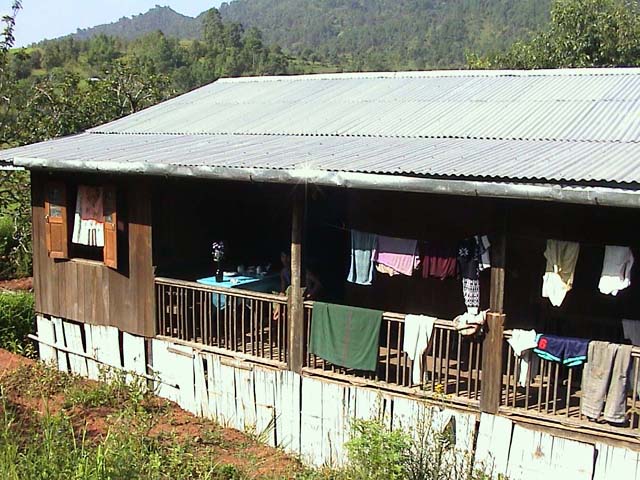
Extended families live in a large building, usually on stilts, called a Longhouse. Over dinner in the longhouse that night, Bob, in his way, made one three month old baby giggle which delighted and impressed the family. When Bob offered to buy the baby they all laughed and said no….but the mother then offered to sell him the rambunctious 18 month old sitting next to her!

A UNICEF Advisor

Burma.gif

In Kalaw, at an outdoor tea house, I called out to a Western looking couple walking by…look…somebody from the West! The couple, from Israel, laughed and joined us at our low table for tea…all of us sitting on little stools with our knees around our ears again.

The woman had been in Rangoon for six months as a UNICEF advisor to the local education authorities. Families have about 10 children because about half die by the time they are teenagers she said. When the ethnic children go to school, she explained, they are confronted with both English and Bamar languages layered over their ethnic dialects and they have a very hard time learning. Old story I thought to myself thinking of the indiginous Indian children from Mexico who come with their migrant parents to the States.

Coincidentally, when I told her we were from Salem Oregon, she said a woman friend from Israel went to our city a couple years ago to live with a man friend but after six months of boredom she went back to Israel. What did she miss especially, I asked. Having fun, she said, dancing, having fun and street life. Yes, I know the feeling, I said!

Kalaw…British Hill Station

Burma.gif

In a monsoon rainstorm we climbed off the train in this cool wooded hill station built during the British occupation. The locals laughed (with me) at my little paper sun umbrella I carried that I had bought at the umbrella shop in Inle. Only transpo available was in a partially covered horse cart driven by a kind old man. Off went the horse clip-clopping with us along to the ironically named Dream Villa Hotel a few blocks away in the center of town. It was off season and we and a French couple were the only tenants in the second floor room in the very friendly hotel painted white with verandas and windows open on two sides.

I looked down into the street to see a common occurrence in Asia that we hardly see in the West…males touching each other…often holding hands while walking down the street. On this day three boys stood one behind the other looking out toward the street, each with hand and arms around the boy in front and finally the one in the back reaching to the boy in front, lovingly cradling the boy in the middle…it was done spontaneously and naturally and lasted only a few seconds. Refreshing I thought.

We explored the rotating market that happened to be in town the following Saturday…we have wonderful pictures of the goods that the colorful tribal hill people bring to town to sell; flowers, fish including eels, perfect looking leafy green vegetables of all kinds, cigars, prepared food of all unidentifiable kinds. Everyone wears flip flops; heels cracked and calloused. Babies in Burma are not diapered…the child is just held out in the air at the right time and whatever wants to come out comes out. One mother in the seat in front of us on the moving train to Kalaw held her baby with bare bottom out the window for this event.

We stop by a tea shop (patrons are almost always men and they all stare at me; women stay at home as they did in Morocco, Egypt, Africa, India, Greece and Thailand) to rest and watch the street scene. There was cheap clothing brought in from China…some of the tables piled with used plaid shirts, levi jackets and 501’s. So this is where the young Burmese university students get their levis I thought…you know those levi trucks you see in the supermarket parking lots at home?

Schwenguan

Burma.gif

We took a taxi back over the mountain from Tounggye to Schwenguan where we were to catch a train for the three hour ride through beautiful terraced rice fields and vegetable patches to Kalaw-a mountain hill station used by the British. But as with practically every government runvenue they wanted to be paid in dollars. I had a $20 on me but the fair was only $4 for the both of us (foreigner rate-foreigners pay many times more than the locals for everything). Bob refused to pay the $20 so there we stood. I gave some kyets to some teenagers to take me to find a money changer but no luck. By the time I got back Bob had dug $5 out of his backpack. We’re on the train!

At HeHo for lunch we reach through the train window and pick out boiled peanuts and deep fried mashed potato balls from the big round shallow basket a pretty woman holds on her head. We took a great picture of the small girl with arms crossed in disappointment who had only small raw potatoes to sell which no one was buying of course.