Koor Yi…Ok Ok

YUqE3FCf1Hd9CjfG1qqmt0-2006171132705308.gif

Monday December 16
OK, OK, OK, (koor yi in Chinese) the woman taxi driver giggles as we pull out of Old Town Lijiang on the way to the bus station. Ni hao (hello)! xiexie pronounced shishi (thank you)! we said to each other Goodbye, How are you, she said. She taught us the words for banana (sansha) and apple (pepo), earthquake (juluna) or to that effect. And then that was the end of the Chinese discussion! She did, however, get through to us the fact that all the buildings we were passing were newly constructed as a result of the 1996 earthquake…it was hilarious watching her body language as she tried to communicate that many people were killed and injured! Her fee was twice as high as it should have been (12 yuan or about $1.25) but we figured the extra 6 yuan was for the entertainment! And we were grateful when she rushed into the bus station to find out that the next bus was leaving within the next 10 minutes.

We wonder from time to time how the Dutch couple we met in Lao could have gotten the idea that Chinese people are not nice…maybe their food is a little oily but we have found the people to be nothing but friendly…they have a great sense of humor if you extend yourself to them and they look for every excuse to practice their English with you.

Chinese Mysteries

The Chinese have incredible confidence in themselves…and consider themselves unquestionably the most superior people in the world…mostly due to their long history. We Westerners are the barbarians. (So we don’t need to think we are “all that” as my teenage Latina friends would call it.) And in China, Jana and I have noticed that we are continually being hidden in the rear of the restaurants, buses or whatever.

Hacking and spitting; bad hair on the men who hold cigarettes between their teeth and between their fingers like we hold a pen.

Why is the huge sign on the number 11 Middle School written in English? Because China has recently joined the World Trade Organization and it wants Western tourists to come visit their schools?

What is the Chinese Welfare Lottery? Never found out.

Old rusted framed-in but unfinished buildings…often covered with sheets of dirty canvas.

Internet everywhere…the Chinese ISP is even free on my laptop…love the sound of emailers giggling at their funny messages in the internet cafes.

Signs Everywhere…English Teachers Needed

Conversations…Guy in CD shop with university education; didn’t know what I meant by the term Communist Party…but later found out that he probably just didn’t want to talk about it. He said it was not true what westerners think…that people can say what they want and can talk. The people are told by the Communist Party that the Falung Gong is a cult that leads people away from conforming to their country (they really mean the Communist Party). They are also told that Falung Gong makes some practitioners commit suicide…and when I told one waitress that those people are committing suicide to protest against their government I saw a veil lower over her eyes but she didn’t say anything.

Western Tourists
Met a Canadian couple in Kunming that travel to Mexico every year and stay in bordellos where they can park their recreational vehicle in a fence enclosed area ($2) where they feel safe to sleep at night. I wondered how they tell where the bordellos are…

Chinese Tourists
60’s clothes; smart sophisticated looking girls…probably from Beijing. Platform leather; tennis shoes with stretchy upers, ankle length leather boots with leggings or long skirts-many of them leather. Sweaters to rival those of the Europeans.

Cultural Guffaws
Jana remembered a story about her husband John’s grandmother and grandfather in San Francisco’s Chinatown in the 1950’s. His grandfather asked a Chinese man on the street a qustion…”do-ee youee knowee whereee weee can….” when the Chinese man turned to John’s grandmother and said “lady, what’s wrong with your husband that he speaks so funny?”

A Chinese word we learned: OK is Koor Yi

Siem Reap

7VJvlOW1A5Ali2rnovusuM-2006216180228245.gif

My original plan was to take a boat up the Mekong River in Cambodia to the Lao border and then on up through Laos but I kept hearing reports about the opening and closing of the border and you have to pay off the guards to let you through and someone reported they had to pay $200 and if they don’t let you through for some reason that day and then you are faced with coming all the way down the Mekong back to Phnom Penh and starting over in another direction so I said the heck with it and decided to do the “tourist route” to Siem Reap instead.

Siem Reap
While Bob took a bus to the Thai border and then on to Bangkok, I took a fast boat down the Tonle Sap (Great Lake) to Siem Reap, a sleepy village famous for it’s many wats (temples and monasteries) especially the biggest-Angkor Wat-but fast becoming a major tourist destination. Most of the people sat on the roof of the boat for the four hour trip through marshes and past entire villages on stilts.

I spent an entire day on a motorcycle taxi going from one temple to another that was built between the 9th and 14th centures in the middle of the jungle when the Khmer civilisation was at the height of its creativity.

Angkor is one of the most important archaeological sites in South-East Asia. Stretching over some 400 sq. km, including forested area, Angkor Archaeological Park contains the magnificent remains of the different capitals of the Khmer Empire, from the 9th to the 15th century. These include the famous Temple of Angkor Wat and, at Angkor Thom, the Bayon Temple with its countless sculptural decorations. UNESCO has set up a wide-ranging programme to safeguard this symbolic site and its surroundings.

You could easily spend a week or more here seeing all the monuments. Most temples are actually little more than ruins…blocks of carved volcanic and sandstone rock lying in piles at the foot of the remaining structures. Much of Angkor’s finest statuary is stored inside conservation warehouses because of the danger of theft. In some monuments such as Ta Prohm, where a French movie company was filming the few days I was there, the jungle has stealthily waged an all-out invasion with bare tree roots spilling out and over the walls.

I had a Cambodian roast chicken and vermicelli salad late lunch at Les Artisans D’Angkor, a small artisan shop and cafe amazingly situated directly opposite Angkor. I thought of my friend Jana who visited here in the 60’s and wondered how the town had changed since then. My day ended taking pictures of the sun setting pink on the face of the dark stone of Angkor Wat.

I had had my fill of war museums in Vietnam and Phnom Penh so I avoided the War Museum in Siem Reap with an exhibition of Soviet and Chinese Mi-8 helicoptors, Mig 19 destroyers, T 54 Tanks and US 105mm artillery. You could also see an artificial minefield here, the brochure says. My motorcyle driver did pull onto the grounds of a Buddhist temple on the way back from Angkor that displayed a glassed-in pagoda filled with bones and skulls that could be viewed from all four sides.

Back in my hotel I spent some time organizing photos on my computer…we have some really wonderful ones of people…especially women and children. I gave a two hour English lesson to one of the Khmer girls that worked in the kitchen of the guesthouse where I was staying.

Finally, after five days, it came time to leave Siem Reap so I regretfully said goodbye to Arnfinn and his Khmer staff and left the simple and elegant Earthwalker Guesthouse that was built and managed by a young Norwegian cooperative and made my way down a dirt road out to the highway with my pack on my back to flag down a motorcycle taxi for the 10 minute ride to the airport. The young guys working in the airport laughed at my hair when I walked in. “Motorcycle Hair” I said laughing! The $100 Lao Aviation flight that took me to Vientiane Laos had no safety card, no airline magazine, no safety demonstration by the hostess and no floatation device under the seat…and I doubt if there were oxygen masks…but we did get a sad little hamburger patty and bun with a packet of catsup.

Trek to Pa-O Villages

Burma.gif

Bob was happy to get out and stretch his legs on a two day trek in the hills above Kalaw. His guide used to be a chemistry teacher and school principal who only made about $8.00 a month teaching school. So now he makes $15 for a two day trek in the hills.

teacherturnedguide.jpg

They visit several villages…the people know and love him and welcome the people he brings to their homes for a meal and overnight stay in exchange for the tips they receive.

longhouselaundry.jpg

Bob was introduced to a young woman who had been his guide’s chemistry student. She quit studying chemistry in the local high school because she could make 10 times more money raising garlic. If the progress of the country depends on education, it is going to be a very long time before these humble people dig themselves out from under their oppressive military regime. Makes one wonder if this is by design.

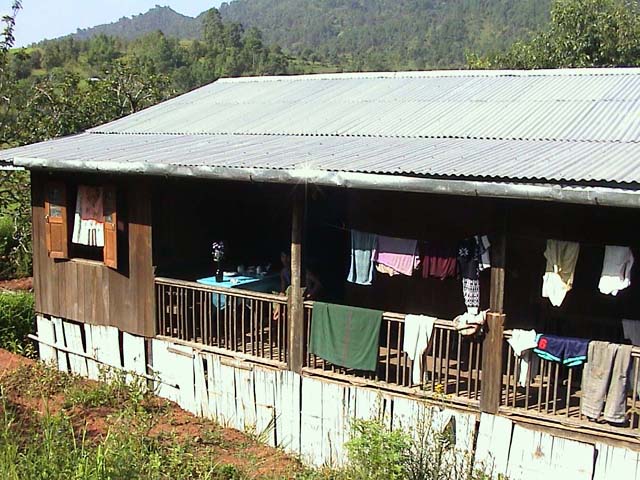
Extended families live in a large building, usually on stilts, called a Longhouse. Over dinner in the longhouse that night, Bob, in his way, made one three month old baby giggle which delighted and impressed the family. When Bob offered to buy the baby they all laughed and said no….but the mother then offered to sell him the rambunctious 18 month old sitting next to her!

Traveling India Bob-Style

The Indians have a wonderful sense of humor so Bob takes advantage of it and manages to turn everything upside down wherever we go.

In addition to an auto-rickshaw, India has bicycle rickshaws-a three-wheeler bicycle with a seat for two behind the rider-and is the basic means of transport especially in small towns and villages. We take a bicycle rickshaw ride in New Delhi from an old man and entertain the entire street of people when Bob insists on doing the pedaling with the old white haired guy Indian sitting beside me in the back…”slowly, slowly,” the rickshaw owner keeps repeating nervously as we weave through traffic……..

Later, when the umpteenth little girl comes begging from Bob as we are sitting in an auto-rickshaw he turns the begging routine on it’s head and asks her for a rupee…she obliges and gives him a coin…then he rewards her for her good-natured response by giving her several rupees to finish off the joke. When the sellers ask Bob what he is looking for and Bob answers that he wants rupees or nirvana or something just as ridiculously nebulous (silly) they just stop and look at him funny and then laugh—successfully diverted from their begging. “Yes everyone has their own way of getting money,” one says. It’s Bob’s turn to stop and think.

Suffering cabin fever Bob takes off on another afternoon to explore and get lost again. While walking, his attention is diverted by a beggar woman and her scantily clothed children but as he gets away from them a boy insists on shining Bob’s shoes. “Look” the shoeshine boy says, “you need shine!” Bob looks down and there is a huge glob of what was probably human shit on his sandle…he kicks his shoe and the shit toward the boy growling his sentiments… realizing he has been had by an accomplice. This is not so funny. The boy–startled and taken aback–retreats. This scam is described in several guidebooks as a maneuver to generate business for the shoeshine mafia. On the way back to the hotel Bob snarls at every Indian tout that approaches him and they immediately back off…I think this is called the disintegration stage of culture shock.

On a better note, in the mountain town of Shimla, people are sitting around the edges of a town plaza watching people watching people and Bob takes a picture of four local hip 20-something young men and then asks them for dollars in
exchange for their photo. They laughed heartily and Bob sensed they appreciated both the irony and the joke.

But if Bob doesn’t stop telling everyone we are from Iceland (“Where you come from?”) I am going to kill him…makes me feel like a complete fraud!

Four Taxis to Dinner In Mumbai

In Mumbai one night it was so ludicrous we just had to laugh…afterward.

Taxi number one only got us to the end of our street before Bob, realizing the driver didn’t know where the hell to go, jumped out of the car.

Taxi number two was an old old man that had to stop three times to get directions to Tamarind St. (Less than two kilometers away.) Each time he would say oh yes-like finally he knew just where to go-just enough reaction to be encouraging. He really had no idea where he was going but knew we wanted to eat so he took us right to a good restaurant across from Victoria Station…McDonalds! Oh my god, look where he brought us, I groaned. We paid him and got out.

Then Bob went from taxi to taxi on the street asking if any of the drivers knew where Tamarind St. or Meadows House or if they knew of the restaurant named Ankur. Taxi driver number three insisted he knew where he was going and drove around until we realized we were right back where we started-exactly one-half block from our hotel! In frustration we got out and left the taxi driver sitting there. “I don’t know what he was thinking,” Bob said in exasperation…”what did he think was going to eventually happen?” Maybe a miracle,” I suggested?

Then another driver said he could get us there…ok…one more time. The fourth time worked. I counted 11 people attending 8-10 tables. Tells you something about wages in India.

Bombay Renamed Mumbai

July 13-18, 2002
India forces you to look beneath the surface of things…there is more here than your eyes see…a midnight ride into the city from the airport in the non-A/C taxi with hot humid squalid air blowing the aroma of grey water and human waste across my face was not my idea of a good time. But we knew it. Expected it. Actually it was not as bad as I thought it would be and as I am writing this on the second day already I don’t notice it. Everyone remarks how cool it is for this time of year in India but after coming from a wintery South Africa it may as well be a tandoori oven.

Bombay was renamed Mumbai in 1996. Those that favored the change believe the name, derived from the goddess Mumba who was worshipped by the original Koli inhabitants, reclaims the city’s heritage and signifies it’s emergence from a colonial past. When I asked the taxi driver driving us from the airport which name he uses for the city he said that Mumbai was a new name and “people keep calling it Bombay so I guess we use both names,” he said shrugging-seeming not to care which name his city is called.

Eating In India
A thali dinner (there is no “th” sound in Hindi so it is pronounced t-holly) is a traditional meal on a large round platter that is served with small tin bowls (katoris) around a larger bowl of rice and costs 10-50 rupees ($l.00) or more if it contains meat. It usually consists of a variety of curry vegetable dishes,relishes, papadam, puris or chapatis and rice. Often there is a yogurt raita and rice pudding for dessert. We had thali twice at “The Majestic Hotel,” a plain large dining hall on the Colaba Causeway where we were staying. The restaurant was full of working locals, mostly men, some barefoot, some in pants and shirts and some Hindus and Muslims all in white, some in blue, yellow and white turbans-all who couldn’t keep their eyes off us Westerners. The non English-speaking waiter found the pictures in our Lonely Planet India a wondrous curiosity.

During lunch one day I struck up a conversation with two black African men at the next table. They were from Nigeria but one had gone to school in Madison Wisconsin. I asked if he thought he would ever go back to the States. No, he said, it is so much easier for us to be here…people are so nice…no hassling he said with a knowing look…I get that it is easier to be black in India than in the US.

A Sidewalk Miracle
A few steps down the street at a right angle from the hotel we are tempted by a large group of people eating at night from a pavement stall on the street. Huge thin handmade chapatis called rotis were twirled around in the air by the young chapati-maker and then cooked on a red-hot half-globe shaped grill. The chicken and lamb kabobs, dahl, (pureed split peas), bharta (pureed eggplant), curried lentils sweet and sour tamarind sauce and fresh hot chapatis exploding with flavor on your tongue.

But halfway through our meal a big truck drove up and several men got out and walked over and motioned to our table…table…have table…they said roughly and then stood and watched us intently waiting for their table. At first we refused to give up the table…they were not asking for the table of the Indian family behind us although they did take two of their chairs leaving the mother standing…how silly we Americans are-expecting fairness! What? I can’t believe they want our table…what are we supposed to do with our food…put it on a chair…the sidewalk…what? But the men just kept standing there staring at us…feeling very uncomfortable…so not wanting to be the ugly Americans we give up the table…finally figuring it must not be legal for the restaurant to have the 4 or 5 metal tables on the sidewalk. We gathered up all the little dishes, the chapatis and our water while they threw the table in the truck and took off!

Bob and I just sat there looking at each other for a few seconds…should we take the food to the hotel…no Bob says…so we set the food on a third chair and were proceeding with our meal as best we could when the truck came back with our table and the chairs belonging to the other family. A bureaucratic sidetrack? Now they can say they did their job? I don’t understand I said to the 7 year old boy with his family at the table behind us…what has happened? “A miracle!” he shouted with bright eyes as if he knew exactly what he was talking about!

Fiddler’s Creek Camp

t5vdleC6v9bjElbi1QdXwg-2006193172914229.gif

June 12, 2002 To the South African Border
In the morning before we leave camp, three guys walk up to our campfire as George is frying bacon; I walk up and introduce myself. Two of the guys don’t speak. They ask many questions…what is your truck carrying…where are you all from…where did you travel from…are you going to South Africa? I came within an ace of saying “yes, we are going to South Africa and I just finished reading “Bang Bang Club” and I want to see the townships described in the book but there was something a little off…they were much too reserved…South African police, Rod hisses when they leave.

At the border the immigration officials who are jealous of George and James go into a room to confer about George’s passport but they don’t come out again. I go to the truck and tell Rod and everyone else that they are keeping George…silence for two seconds…then Rod gravely says “you’re kidding aren’t you…” He didn’t think it was funny.

Fireside In The Delta

In Maun, Botswana, the overland truck had arranged for a makoro (canoe) safari out in the middle of the Ocavanda Delta. It included a four hour animal walk and swim in a swimming hole but I stay at camp. We discuss the use of the word “togs.” New Zealanders use it meaning a swim suit and the English use it to refer to any clothing.

That night we sit around the fire and the makoro polers entertain us with Hippo stories and magic tricks.

Then I thought of that one dark rainy day in Lisbon, Portugal, months before, when we had been walking through the Columbus plaza. It was empty except for a small group of Black vendors selling dark glasses out in the middle. Curious…because who would want dark glasses on a day like that, I walked up to them. Duh!

“Hashish?” they asked. “What the hell,” I had figured, and bought some. Then forgot about it…until we were sitting around that campfire that night in the ocavanga Delta in Botswana. So I brought it out and offered it to the kids…mostly Brits but also an Aussie and Kiwi couple (Bob and I were the only ones older than 25 on the truck). The look on Rod’s face-Rod the South African trip leader-was horrified. “You had that on you as we crossed all those borders?!” he yelled. The borders only having been Kenya, Tanzania, Malawi, Zambia and Botswana. 😉 “Yes,” I sheepishly answered. Then he made the kids smoke the whole bag before he would let us leave the campfire!

I crawl into the tent this night because I am tired of sleeping in dirt and wouldn’t you know it-that’s when the animals all came through the camp during the night-lions, jackals, elephants, zebras and hyenas bringing all their different voices with them. I now realize the polers all sleep around the campfire for a reason…

Cross Dressing At Kande Camp

PZmR20gwby0cg19rXgklIw-2006197131657399.gif

Sat 18th 2002 Town of Mzuza
We get off the bus and go to the market in Mzuza to buy clothes for the Cross Dressing Party at Kande Camp-we have drawn names of the opposite sex and have to dress them-we have a $3 limit. Walking back to the truck I take a picture of a street sign “No Stop!”

Malawi Lake Kande Camp Two Nights
We drive into camp past the Kumuka truck that is roasting a split pig with it’s head still on above a charcoal fire…OH SICK…the girls on the truck wail. By now we are pretty dusty and scruffy and everyone wants a shower before heading to the bar for a Fanta or beer. This bar owner is a bald guy in his 50’s with a huge round gold earring in one ear-I ask him for a Pimm’s Cup. He looks at me like I am nuts and says he ha”)

I drew Rod’s name for the Cross Dressing Party so I bought him a bra and hot pink half slip and funky shower cap-we make him take off his shorts before he puts on the half slip-he loves it! Someone bought Bob a pink and white dress that looks like one his 80 year old mother would wear. Lorelle is hillarius in a diaper with a pacifier in her mouth. Rod buys Janine a snappy little outfit with a black and white zebra “Hooters” cap. Adrian gets to wear a bright pink billowy taffeta dress that looks like a Balenciaga designer model.

This clothing must be sent here by aid groups in western countries because we never see African women wearing these things which are really inappropriate for this culture. The party is in the bar and riders from the other trucks get a kick out of us-they will have their turn the next night.