Ngorongora Crater

Firstviewofcrater.JPG

The Ngorongora Crater is a conservation area and National Heritage Site. After breaking camp in the Sarangeti, we drive another two hours up to the Crater rim where we set up camp so we can be ready for the drive down into the Crater the next morning. The crater is 16-17 km across; the difference between a park and a conservation area is that people can live in a park; so many Maasai life in the Sarangeti but none in the crater. The crater sides are covered in a dense rain forest; Black Rhino only here; no giraffes here because it is too steep for them to walk down; no Topi or Impala here; the alkalai lake is filled with pink Flamingos; Corey Bastards are mating; hyenas with their lowered backsides slither along…

The Land Rover dodges huge elephant poop on the roads meandering along the crater bed.

Maasai and Samali Ostriches: incubation 48 days; female watches the eggs during the day and the male at night. Biggest enemies are man and lions; Red Billed Duck; Black Winged Stilt; Black Headed Heron; White Heron; Sacred Ibis; Crowned Crane; Wida Bird; European Stock: coming from Europe with no passport and flies back in December-he is not ours, Francis says.

Common and Golden Jackal; Flamingos by the million who eat algae and salt that makes them pink; Spotted Hyenalives 35 years; noctural;4- 5 months gestation; he was walking the whole night that is why he is sleeping. No one else eats the Hyena except other Hyenas when they die. Lions may kill them but they don’t eat them. Male Lion eats first-big boss-then the mother and the cubs; 40 lions in the crater; sometimes you see no lion because they don’t know you are coming to see them and they just lie anywhere in the tall grass where you can’t see them, Francis says.

Wart Hog; monkey sitting on top of an Acacia Tree-the king of the world. A mini bus drives up. Ladies in nice clean white blouses sit in the back with their suitcases with wheels on them; probably staying at the expnsive Ngorongoro wildlife Lodge on the rim. “My god they are not even camping; not getting the full-on experience!” the kids yell out to each other laughing hysterically. By the way, at a potty stop, one of the kids spotted a tourist all dressed up like Safari Guy just stepping out of Magellan Catalogue. All the crew and kids laughed themselves silly.

Francis says that the animals in the crater are very polite because they haven’t been in the hunting block outside the crater where they learn to be scared of the human.

Black Headed Heron eating baby Black Mama snake; male elephant with biggest penus ever…swinging between his legs as he walks. Weighs 3 kg, Francis says. How does he know, Bob retorts.

We stop at Tak Tak spring for a rest and watch a school of Hippos.

When the zebras walk or run away from the car, their heads bob up and down telling the lions “I have seen you, I have seen you, I have seen you,” Francis says.

We drive around a bend to find five Forest Elephants all in a row. They are waiting for pictures, Francis says smiling. Then we drive up and out of the crater and head back to camp.

Animal Spotting The Big 5 In The Sarengeti

I love the remnants of the Swahili cadence in Victor’s English.

Giraffe: “It is raining and he is very happy there-he is getting a shower.”

Bob watching elephants: “This makes you feel badly there are zoos.

Topi: lives up to 20 years, gestation 7 months, smell and sight are bad so they stand on termite mounds to see the lions-so no Topi in the crater because there are no termite mounds in the crater.

Bob: “My everlasting memory of Africa will be the Acacia Tree.”

Sarengeti means endless in Swahili…endless horizons, endless silence, endless pleasure for us.

Grand Gazelle: male has long horns and female has short ones; Lilac Breasted Brawler: Black Jackal-scavenger-only kills rats or grasshoppers; Impala has one mate-the male has to fight to get the female.

Best 4-wheeling ever! Hillary really missed a good time when she took the helicopter in!

The park’s vultures: White Headed Vulture; Hyena; Jackal

This is pleasure-we are finally out of the chaos of the city. Writing helps assimilate our experiences so we can move on…

Glossy Starling: Marshall Eagle; Dove; Bee Eater; Francis: I have to study and put it all in my mind. Guinnie Fowl; “Monkeys are not afraid of you they just like to be by their friends.” Velvet Monkey; Water Buck: males have horns, stay close to the water and need green grass. His enemy is the lion.

The Hippos are grazing all night and in the morning they come back and are sleeping in the day, Francis says. They are mating in the water, delivering babies in the water. They kill many people because they know man is not a good animal. They stay in the water 10 minutes without his breathing. Gestation is 8 months and life span is 40 years. Many Hippos together is called a school: Just like children-they must be together. Now is midnight for them. They roam 5 km at night and return to the pond in the morning. The Park has to arrange for keeping the ponds filled with water because otherwise we can get a problem and Hippos have to die when their skin dries out.

Then Bob says to Francis: “There are humans that eat 25kg a day, the gestation is 9 months they eat animals and leave a big mess.” Francis is delighted “very good, very good” he says. Bob and Francis are friends.

Black Smith; Embrella Acacia-big old one; Maasai Giraffe: gestation 15 months; lives 35 years. When they are walking or when they are ambling their legs are together and when they are running their legs are asymetrical. It is illegal to kill this animal, Francis says. Leopard: a loner-if you see two leopards together either they are mating or it is a mother with her cub. After the baby is born the male is takes off. They are afraid of the dew, like a housecat, so they stay in the tree. At night they are coming down and hunting for their food. When they are killing they put the food in the tree and they are there eating for three days. For hunting they have to use their cunning because they run so slow-they have to hide somewhere and wait-like the lion. Cheetah runs 110 km per hour and is fastest land animal. He cannot climb-just walks. Don’t know if we’ll see him today because of the tall grass…

Much sighing-becoming more and more relaxed…like the animals….

Many Ostriches; Francis says the best animal viewing is July-Sept when the grass is brown and everything is dry and animals are gathered around the water holes. However, Bob saw more animals this trip than he did six years ago in August.

Saw part of a pride of male lions out in a field. Francis spotted a lioness on a rock sleeping-she is waiting for the sun; completely relaxed with one foreleg wrapped down around her rock. There are only 3000 lions in the park. Lives 16-20 years; gestation 5 months. Sometimes their teeth break and they can’t eat food and they have to die. They eat 40 kg of meat-can go one week without eating; nocturanl-very active at night. Later we drive up to a vehicle and two lionesses are lying in the shade against the back wheel. Several vehicles arrive and park in a semi-circle around the lions so we can all take pictures.

We are triumphant! We have seen the “Big Five,” Buffalo, Elephant, Leopard, Lion, Rhino.

Sarangeti Spoof: a person says they have spotted an animal and everyone tries to see it. It is not funny.

We stop at a Maasai Village on the way out of the Sarangeti. “They are people-not monkeys,” I say, and refuse to get out of the car. Most everyone else goes inside the village, made of sticks and bushes, to watch the males do their jumping dance and make the Wilderbeast sound while the females try to sell their necklaces. It costs $5 to go into the village-this is not a cultural exchange or an I-Thou experience either one.

Egyptian Geese; The elephants kill and they pile branches on top and wait for three days to make sure he isn’t going anywhere; Toni Eagle; Wilderbeast: they are very stupid, Francis says, if one crosses the river they all have to cross…like sheep. If they have been in the hunting block, when you stop the car they are not sure of their life. They remember those bad people there. If they have always lived outside the hunting block you can go right up to them and they are not afraid of you.

Maasai Warrior Tribe

Jumping3.JPG

Masaaiposing3.JPG

Beautiful tall Masaii men and women still maintain their tribal lifestyle and religion-wearing red to keep the lions away from their cows. They live in southern Kenya and northern Tanzania. The cow is the practical and spiritual focus of their lives. The religion is animistic-they see God in everything.

The women build the houses, gather the firewood, cook and take care of the children. Every day the woman walks five miles for water and firewood.
WoodWomen.JPG

The man tends the cattle and keeps the lions away. The man eats alone and she hides while he is eating. The Maasai only eat meat, milk and drink hot blood-but they do not eat any wild game.

A boy is cirumsized at about age 16. If he cries out he cannot get married because it means he is not a man. Women used to be circumcised (clitorectomy) also but Francis says that has stopped in the Maasai tribe.

The man can have more than one wife. Some believe if the live in a house they will get sick so they live in the bush and make fire with sticks. They use no medicine or hospitals. If they die they just throw them in the bush, Francis says.

They make a beer called Hadsa out of honey. They sleep on the skin of an animal. They eat birds and baboons. The Chief wears the skin of a baboon,. Children go to school from age 7 through 7th grade by law in Tanzania. If they are not in school there is trouble, Francis says. The 122 tribes in Tanzania are allowed to intermarry and that is why we are not fighting each other, Francis says. Tribes are Christian, Muslim and Animist. They can marry Whites, Francis says.

A Felluca Ride Up The Nile

gvSQ2vhpltKkixr9PjGld0-2006186175750571.gif

In Aswan, a felluca, an ancient sailboat of the Nile, is a common means of transport up and down the Nile River. It has a broad canvas sail and the boat itself has a shallow deck upon which are thick cotton covered pads to sit on and watch the dark waters of the Nile slide by in the hot dry desert wind during the day and to sleep on at night. Two gracious Nubian men in flowing jalabayas sailed the boat-one at each end-and cooked for us in a tiny area on a small propane stove.

The first afternoon, the wind became too strong and tangled the sails. Was amazing to see one small, lithe Nubian scoot up the mast to untangle the sail.

Before leaving Aswan, we sailed to nearby Kitchener Island where about 12 Nubian young girls-secondary school students studying to be teachers- surrounded us laughing and talking and asking questions-practicing their English. I love your sweet soft faces I said…oh thank you very much they said laughing. Then “I love you,” one said, probably coming from a lack of vocabulary to be able to say anything else.

A couple years ago I saw a contemporary rendition of the opera “Aida” in which a Nubian princess was captured by the Egyptian army. The music was composed by Elton John and the historical revision sympathetically illustrated the plight of the Nubians. After their lands were submerged under water when the High Dam was built, most Nubians today occupy the lowest paying jobs.

We sailed the Nile with six other people for an incredibly beautiful and langorous two day trip to Edfu. We were joined by a young couple from Milan Italy, another young couple from Paris and two friends-one from the Czeck Republic and the other from Slovakia. The two from Czech and Slovakia had just spent a year and a half in Israel as nannies and were relieved to be out of the country…not because of the danger from the Palestinians but because they didn’t care for the Israelis.

English has truly become the international language. Everyone on the felluca was fluent-the French girl saying that her generation was quite happy with English but that her parents and older sister still resented it.

The first evening over dinner we traded information and honest understandings about the foreign policies of our respective countries. The French girl described her insights into the story of “Chocolat” and the French guy talked about the 35 hour work week and how it has not created more jobs-just means that more work is now done in less time.

The Italian and French couples had a lot in common and were planning to meet again the night we got off the felluca-and I imagine they will remain friends-a wonderful thing that could not have happened a generation ago-the upside of globalism and a common language.

A Coptic Christian Guide

gvSQ2vhpltKkixr9PjGld0-2006186175750571.gif

In Luxor we did have a tour guide and it made all the difference. We were able to enjoy the sights without being constantly by the touts. A Coptic Christian, he explained that to be a registered tour guide you need four years at Cairo University and that he had two more years in history and languages.

I asked him what the difference was between the Coptic Christians and the Eastern Orthodox. He said the split came because of a differing understanding of the nature of Jesus. One believes that Jesus is both God and man and the other believes Jesus is just God. The way his Pope describes it, he says, is that the sun shines and you can see the light and feel the heat-two different aspects-but it is just one sun.

Rome

“Italy will return to the splendors of Rome, said the major. I don’t like Rome, I said. It is hot and full of fleas. You don’t like Rome? Yes, I love Rome. Rome is the mother of nations. I will never forget Romulus suckling the Tiber. What? Nothing. Let’s all go to Rome. Let’s go to Rome tonight and never come back. Rome is a beautiful city, said the major.” Ernest Hemingway, A Farewell To Arms.

Took one of those plush high speed TGV trains from Florence to Rome-one and a half hours. Wish the U.S. could have a similar system. A nice young guy in Bayonne, France who, while selling me some wonderful French perfume, told me about his three months he spent in the states and Canada-by traveling and sleeping on buses!

In Rome we checked in Pensione Cortorillo near the Termini (train station). This time there is a lift to the fifth floor. However, it was about 3 feet by 3 feet square. Bob thought he was going to be smart so he turned around and backed in with his backpack on. I walked in face first flat up against him. The inner doors (like French doors) barely closed behind me. Ok, good to go. Press the button nothing happens. Then Bob realizes that there is an outer door. So I have to back up through the door, turn around and back in so I can close the outer door. We get to the fifth floor. The lift stops. I look down through the metal grate of the lift and see the next floor about 12 feet down. Bob can’t see anything but now we can hear voices so I am thinking that since I can hear them maybe they will hear us holler for help. After some few seconds (which is long enough for many different thoughts to race through your head) Bob manages to turn his head far enough to see that behind him is another metal grate door and through it he sees the hotel proprietor waving frantically and yelling for Bob to open the door behind him which he does with great difficulty. Saved from eternal imprisonment in Rome.

The Vatican City, one of the most sacred places in Christendom, attests to a great history and a formidable spiritual venture. A unique collection of artistic and architectural masterpieces lie within the boundaries of this small state. At its centre is St Peter’s Basilica, with its double colonnade and a circular piazza in front and bordered by palaces and gardens. The basilica, erected over the tomb of St Peter the Apostle, is the largest religious building in the world, the fruit of the combined genius of Bramante, Raphael, Michelangelo, Bernini and Maderna.
We took a two-hour bus tour to get an overview of this city full of marble domes, Roman ruins with pieces lying willy nilly about, noseless and penusless statues and motorcycle dust. The tour was narrated in English but we only understood about half of it because of the Italian accent.

I had wanted very much to see the Trevi Fountain across from which was a delightful guesthouse where Barbara and I, in 1965, could look out on the fountain from our second floor window. We weren’t looking, unfortunately, when every last single bit of our luggage, and film, was stolen out of the trunk of my little red Spitfire Triumph that night. Legend has it that a traveler who throws a coin into the Fontana di Trevi, with its rumble of cascading water emerging from the back wall of the Palazzo, is ensured a speedy return to Rome and one who tosses two will fall in love in Rome. Well, in 1965 the first coin didn’t ensure such a speedy return but the second coin worked-my travel partner was charmed by a young Italian and spent a week longer in Rome while I went on toward Berlin by myself.

Rome is sensory overload of 2000 years of world history, art, architecture, politics and literature. We were exhausted after trying to absorb Florence and now Rome so we retreated gratefully to our room for a nap-falling asleep to the sound of music from “The Doors” and laughter from the young backpackers that filled the pension.

Michelangelo’s David

Bob is going on a walking tour where he will learn how the Renaissance Medici family ruled and held onto their city as an independent state for three centuries in face of pressure from the Papacy and how they commissioned some of the greatest art in the western world. He will learn about the political intrigues of the time and what precipitated Machiavelli’s “The Prince.”

Built on the site of an Etruscan settlement, Florence, the symbol of the Renaissance, rose to economic and cultural pre-eminence under the Medici in the 15th and 16th centuries. Its 600 years of extraordinary artistic activity can be seen above all in the 13th-century cathedral (Santa Maria del Fiore), the Church of Santa Croce, the Uffizi and the Pitti Palace, the work of great masters such as Giotto, Brunelleschi, Botticelli and Michelangelo. It is an UNESCO World Heritage Site.

In Florence in 1965, I have an indelible memory of walking along looking at Michelangelo’s unfinished works in the Galleria dell’ Accademia (Europe’s first school of drawing) lining both sides of a long hallway. Finally, at the end of the hallway I looked up and saw the most beautiful body I had ever seen standing on a four foot pedestal under a lighted dome…David…and reaching out and touching what I could have sworn was flesh…

Bob will have his own experience albeit probably quite a different one! Actually Michelangelo’s unfinished work was just as thrilling…like watching contorted bodies writhing-climbing-free of their prisons. Carved from a gigantic block of marble, David was finished in 1504 when Michelangelo was just 29…his work an inspired miracle!

The Atlas Mountains

pjSwKsKjPzr5gOYYAx9PKM-2006172104421567.gif

We took an excursion trip south and east past incredible green terraced fields and old Berber kasbahs (ancient Moroccan self-contained communities made out of the rust colored mud of the countryside)-seemingly idyllic-to the Atlas Mountains.

Our group consisted of Bob and I, a young couple from New Zealand in their thirties-one a computer/internet analyst and his partner a pharmacist, another couple about our age from Boston. He had been the president of a University in Iran before the Shah was deposed and she obviously was also well educated. He was able to escape and she soon after. He now teaches theoretical physics at a University in Boston. The fourth couple was young-he a music major at a California school. The last two were a couple of great guys from Italy that we called �The Italians! who gave us some menu items we could order when we got to Italy.

On the way to the Sahara we passed over the Atlas Mountains (about 12,000 feet) and through the towns of Tinerhir and Boumalne. The first night we slept in a small Berber Hotel that was in the process of being renovated at the head of the Dades Gorge. The room was cold with a concrete floor but offered
several very thick heavy blankets-like the blankets used on the camels. The evening included a walk up an incredibly beautiful gorge and a dinner of Chicken Tangine. Oddly there were only two small pieces of chicken for every four people but otherwise it was very good. In the morning we had a breakfast of rolls, coffee, butter and jam before continuing on to Erfoud and then to Merzouga. We stopped in Kassah for lunch. (The cafes with the best toilettes get the most tourist business!) We all had beef kabobs and moroccan salad (tomatoes, cucumber, olives, onions) and water.

In the afternoon we walked through a Berber kasbah. We took a trail through the fields to learn about tribal farming; then walked through the kasbah and into a building where some women weavers presented their carpets. Bob was a sitting duck by this time and we are now the proud owners of a small Berber carpet.

By evening we reached an area where we were put astride camels that walked single file for a couple hours at sunset through the largest sand dunes in the world (the Al-chabbi sand dunes) to a Berber tent camp. One rides a camel on a big thick blanket just behind the camel�s hump with the pubic bone rocking back and forth against the hump. I told Bob to be careful or I�d trade him in for a camel! The Berber guy leading the trek cautioned the men to be careful of their ‘iggs.”

The encampment consisted of cloth tents joined together with heavy blankets and pads on the ground. Two good looking young Berber men cooked delicious Tagine with beef, carrots, onions and potatoes which we ate sitting in a circle on the ground with bread and our hands in groups of four. They served orange slices sprinkled with cinnamon and mint tea for dessert. Afterward the boys played Berber beats on the drums. Roosters from a nearby encampment woke us up at a breathtaking sunrise over the dunes.

The next day offered an eleven hour brutal van ride back to Marrakech with a short stop to eat lunch on a terrace at a small restaurant in Tirhan. We both ordered a �hamburger� that turned out to be a stew of tiny meatballs in tomato, onion, eggplant mixture. It surprised the heck out of us but was very good.

A few hours out of Marrakech we were pretty nervous about the narrow and curvy mountain road and we begged the driver to stop and take a break-which he did. The roadside stand had fresh Tangine, soup mint tea, coffee and soft drinks. The very friendly older man standing behind the food bench was offering me a small bowl of soup for 1.5 euros when I heard the driver in a scolding voice tell the food seller to charge 5 euros.

In Marakech that night the Ali Hotel was full because there was a holiday that weekend (we never did figure out what it was.) There also was an international meeting of some kind in the city during this time. So we stayed in the Hotel Eddakhla-a pretty basic hotel on a pretty rough street with a lot of beggars, no lift-just stairs-very deep and steep and narrow and on top of that the WC and shower was down on the first floor. The room had a sink and bidet but was very stuffy with no window to the outside. Bob bristled when a young man at the desk demanded his passport �for the police,� Bob of course thinking he wanted to take the passport which would violate rule number one: never give up your passport to anyone for any reason!

Ate dinner at one of the hundreds of eating stalls set up in the square every night that serve harira, kabobs and fish stews. Some of the stalls specialized in goat head meat-complete with whole goat heads set up in a row for viewing-that was patronized almost entirely by the locals. However, we sat at a stall that was probably set up to attract the tourists. We had beef kebobs peppers, spinach, fish, moroccan salad olives and mint tea. It was the worst meal in Morocco and Bob was very offended when the waiter slammed a small tin plate down on the table and demanded a tip. There goes those filters again!

How people experience a country seems almost accidental at times!

A Dacha In Samarkand

7Z3XBdt3hLmJjqkmk2I6k0-2006190121351559.gif

After coming off the Kyrgyzstan trek, Peter, our trip leader, had arranged for us to go to Samarkand in Uzbekistan before continuing on up to Tashkent for the flight home via a week in Istanbul Turkey.

Beautiful…magical Samarkand…with more history than you can imagine. The population (412,300 in 2005) is the third-largest city in Uzbekistan and the capital of Samarkand Province. The city is most noted for it’s central position on the Asian Silk Road between China and the west.

We stayed at an old Russian “dacha” (summer home) used by Communist party members before the break-up of the Soviet Union.

Everyone was excited about a real shower, a real sit-down toilet and real beds. You line up there for toilet paper…someone said…pointing to a heavy babushka (old woman) sitting officiously behind a small table in the entry way. “No! No! Not tonight,” she grumbled loudly. “Tomorrow morning…toilet paper!” We were incredulous! But the sit-down toilets have no paper….we groaned. “No, No, Not tonight” she repeated. Someone else’s room didn’t have electric lights so an old guy was sent off to investigate…never did find out if light was discovered. Some rooms had tv’s with snowy reception of Russian programs…we were hoping to get some news but there was nothing we could decipher.

So gratefully, we all sat down on real sit-down benches at a real table in the garden outside the dacha for a feast after 18 days and nights eating on the ground. There was a smattering of Russians who joined us that were not on the trek…police…Peter said. One, who had too much too drink, bragged menacingly about how much power he used to have and now he was nobody. “Don’t answer him,” Peter advises.

Despite its status as the second city of Uzbekistan, the majority of the city’s inhabitants are Tajik-speaking. In 2001, after several abortive attempts, UNESCO inscribed the 2700-year-old city on the World Heritage List as Samarkand – Crossroads of Cultures.

Na Pali Trail Kauai Hawaii

After our son Josh graduated from Whitman College, he joined his former roommate and friend, Phil, in Kauai where they were to spend a couple years working and repairing some cottages that belonged to Phil’s dad near Poipu Beach that were damaged in a hurricane September 1992.

Hurricane Iniki caused more damage than any other hurricane to affect Hawaiʻi since records began. It hit the island of Kauai as a Category 4 on September 11. Iniki caused almost $2 billion in damage, mainly to Kauai. It remains the second costliest East/Central Pacific hurricane on record, only behind Hurricane Paul in 1982. Six died as a result. Iniki brought winds of 140 miles per hour (230 km/hr).

Phil’s dad’s house, closer to the beach, was lifted clear off the concrete pad. For weeks afterward people were finding papers and objects they knew belonged to him because he was a well-known Methodist minister on the island.

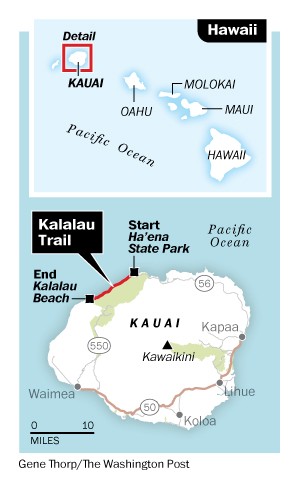
Bob and I took the opportunity visit Josh while he lived on the island. We hiked the Na Pali Trail, which, in retrospect probably wasn’t a good idea. But what did we know was up ahead. Namely a trail along side the mountain…very very narrow trail…with a vertical drop of 300+ feet to the ocean rocks below. At times all we had to hang onto were branches of bushes and trees. Alas we turned back before we got to the hippie beach.

When the work on the cottages was done, Josh worked for a restaurant in the nearby Hyatt Hotel. He was offered a promotion but opted to quit and go to culinary school. Phil, who had been an art major is an artist and stay at home dad while married with two children in Seattle. For Josh the rest is history.