Jinghong China

jWLtBzsBGHTUmbHjYHypj0-2006185073225366.gif

Photos

While I was in Guizhou Province, Bob headed off for Putuashan Island and then circled back to Shanghai via Hangzhou…then flew to Jinghong to meet me at the Banna Hotel. We picked up Sarah, a trek leader at the Forest Cafe, who led us by bus into the surrounding mountains to visit some Hani, Dai and Jinguo ethnic minority villages.

In one village I ran into a Frenchman I had met in Guizhou Province (a thousand miles away) who had enlisted the services of a car and driver so Sarah took off trekking with Bob and I joined Marco (French-Italian) on a visit to several Dai village homes on the way back to Jinghong where I met Bob at the hotel that night.

Bob was to fly to Bangkok and I to Hanoi from Jinghong but planes were full so we flew the 40 minutes north to Kunming to catch planes…Bob to Bangkok and me to Hanoi.

Miao Village In Guizhou

1wXSp3CkNsDoJl3s0SgHmw-2006171171225701.gif

In Shanghai, exploring the Lonely Planet Thorn Tree web site, I noticed a query from a young woman from Kaili in Guizhou Province who was offering to arrange a homestay in a Miao minority village in the mountains. We exchanged emails and I was excited to meet her. But then I received an email saying she was in Shanghai and could we meet for the train ride to Guizhou in a couple days. I returned that I couldn’t leave that soon but I could meet her in Kaili…then I never heard from her again. A mystery…or maybe she got an offer from someone to pay her fare back to Kaili…who knows. But I knew where I was going next! From Shanghai I flew to Guiyang, capital of Guizhou Province and stored my baggage at a hotel there before boarding a bus for the three hour ride to the city of Kaili.

When I got off the bus there, I was directed to another station around the corner with several rickety old buses waiting for passengers to various villages. I had no idea which bus would take me to Xiuang, the village I had been told by the English-speaking receptionist in Guiyang that would be celebrating their New Year’s holiday. Then I saw a smiling family waiting near one half-full bus. “Xiuang,” I asked. Yes, they nodded. But while we were waiting to board, a couple of men outside a nearby fence a few feet from us motioned us to approach them. It gradually became clear they were taxi drivers that wanted to take us to Xiuang. Between my motions and their language we all agreed to share the cost of the taxi so we piled in and were off…on a harrowing short-cut along steep mountain dirt roads with thousand foot drop-offs…to our village!

The people in the mountains in this southeastern Chinese province are not Han Chinese. Eighteen different minorities live within Guizou province and I was here to visit the Miao people in this gulley-like valley with identical hand-hewn wooden houses climbing the hills on all sides.

209915718_a429a4e0bb.jpg

209926509_dec6fd2f3f.jpg

The wooden houses are built on foundations of stone and constructed with wooden pegs…no nails or cement. Steep paths meander among the houses.

After some initial quandry as to where a hotel might be, if there was one, I came across a woman who led me to a small building…who would have thunk it was a hotel…for about $2.00 for the night. I was invited to join the family around their hotpot dinner downstairs…had no idea what I was eating but I was starved and it tasted delicious with smiling faces all around. No extra charge! There was no heat in the freezing room that night so I took the bedding off the other twin bed and added it to mine.

There are at least 130 different types of Miao people living in villages among the mountains and they have different dialects, headdress, and traditions. Yet, they all belong to one Miao minority. Their language is endangered as it has no written form and is used less and less among the younger generation who is often eager to learn English.

The next morning, walking along the main cobblestone path through the village I came across a young French couple…the only Westerners in the town…who were delighted to speak English with someone after hiking all over the mountains from village to village without a guidebook. “Just knock on a door” they said, and show the sign for sleep and eat and show money and you will be invited in,” they said. They were in their second year of travel before returning home to start a family. They had been traveling in the province two months and it was they who took me to Mr. Hou. Mr. Hou was the English teacher in the middle school there that drew students from villages all over the mountains. “By foot,” he said.

210633704_1745d7eb1b.jpg

210633628_6db0e86236.jpg

Mr. Hou invited me to stay for two days for $4 a day in his home, generously sharing three banquet meals a day around “hotpot” and dozens of small dishes of whatevers with him and his extended family of which there were many coming and going during each meal! While the men and women prepared the food, the guests all sang a local folk song. Then they asked me to sing a song…and I’ll be darned if my mind didn’t go panicky blank…all I could think of was Row Row Your Boat and I think that is really a French song! So I told them we had rock music and I couldn’t sing rock. They all nodded in agreement…to my relief I was off the hook!

The family and I joined round on 8 inch high stools and watched Mr. Hue chop the meat up on a thick round wood cutting block on the floor. Then slowly bowls of food appeared from another cooking room that the women had prepared and were set out on the floor around a “hotpot”or wok full of boiling broth sitting on a foot high round stand full of lit charcoal. Mr. Hue would chopstick some of the food he considered the best onto my small bowl of rice. The bones and small rejected bits were spit onto the floor. After every few bites the local hooch was poured round and after a song and a whoop everyone would gulp down the fiery fruit-flavored alcohol made by the grandmothers. It didn’t take long for the whoops and songs to exceed the eating. Humorously, I was given “just a small amount” each time..the villagers having experienced past catastrophes with drunk foreigners!

Finally the day came when the New Year’s biggest day would be celebrated…music, dancing…the women in wonderful traditional dress.

210851901_ed09870d37.jpg

210885497_88f1e95a8d-2.jpg

211284526_99c82f9754.jpg

During the daytimes I wandered through the small cobbled lanes leading through the houses and shops…trying my best to avoid the firecrackers thrown at the visitors by the small boys.

Although the New Years ethnic dances in costumes were delightful and the people warm-hearted and friendly, I was happy to leave the village. The small boys thought it was great fun to make the “foreigner” jump when they threw firecrackers at her feet…one landing on top of my backpack…nearly scaring me out of my wits. And on top of that Mr. Hou felt he had to direct my every move in the home…was terribly worried I would fall off the narrow log ladder to the upper level where he had cleared out a cozy room with a rock-hard bed. After all, I was “old.” 62! So by the third day I had had enough fireworks and directing!

While I was waiting for the bus back to Kaili, (there was no schedule…you just waited for the bus to show up) a newly-arrived young man from Amsterdam and I made friends with some Chinese English-speaking students from Hunan province who were there with their photography teacher and we nearly went to Langde village with them if there had been room in their van. I was sorry not to be able to go with these cheery young people who were so anxious to try out their English…some of the words inappropriately big and ostentatious…and some I didn’t even know the meaning of! Be sure to correct our English, they said! Well, we don’t use that word in normal conversation I would say and they would look so disappointed. We exchanged email “to practice English.”

“Kaili, Kaili, bystanders yelled at me as a small bus appeared…barely missing the food-vendors on either side of the dirt road leading up to the village. Then just as I was waiting to board, a Russian-American in his 80’s from NYC with a false leg nearly toppled off the bus with his bag into the street. We quickly traded some travel stories…he had been backpacking for years all over the world…refusing to give it up…very inspiring…and touching…

I headed back to Kaili, a comfortable and colorful Miao urban city with great food down small alleys, and was pleasantly surprised to find that my hotel room harbored a broadband high speed internet connection! This was not only Asia, but it was China after all and the appetite here for technology and communication devices is insatiable.

213543317_e1daf65c6e_m.jpg

213492238_197f89aa47.jpg

213563973_0e7b423433_m.jpg

213492164_3ac8d92d2e.jpg

After another bus back to Guiyang I spent the evening walking along the river than runs through the city, meandering up and down streets…getting lost and finding my way again…checking email at a large internet cafe with at least a hundred young kids all noisily playing video games. And eating wonderful street food!

The next night I headed off to Kunming on an overnight train…middle bed in a 6-bed compartment this time…but not without exploring the new Wal-Mart around the corner from the train station to replenish my battery supply!

Great Days Great Wall

East China.gif
Video
E found the website (www.wildwall.com) and the adventure offered intriguing potential…off the beaten track, away from the Chinese tourist groups that follow a guide with a microphone and colored flag held high in the air to designate location. After two short emails to William, arrangements were easily made and in the lobby of our Beijing guesthouse I met with the driver (No English) who carried a placard for “Mr. Bob.” After smiles and incomprehensible introductions his black auto carried us through a three-hour adventure negotiating Beijing traffic…bikes, pedestrians, tractors, donkey carts all navigate the same lanes, avenues, freeways where the basic rule is ” Bigger Has The Right of Way.” As throughout Asia, good brakes, good horn and good luck prevails.

My understanding was that we were to pick up another couple but as we finally exited Beijing for the countryside I began to make an alternative plan if perhaps this was an abduction…the imagination can wonder…

We finally entered mountain terrain and the pavement ended. After another 20 minutes we arrived at a small village surrounded by hills We parked and I carried backpack uphill to a courtyard surrounding a small idyllic farmhouse. There was evidence of other foreigners. William casually came out of the farmhouse and introduced himself. An Aussie couple, attired in the hippest of trek fashion had already arrived and they and I completed our trekking group. Subsequently I appreciated their humor, enthusiasm and good cheer and we shared good times and laughs.

After being shown my room, the first of many superb meals was served. Lily was William’s Chinese helper and sous chef…fresh trout in a spicy (picante) sauce. After the meal Schnapps was offered (an acquired taste I guess) and I learned that William was in his late forties, formerly from Liverpool England, but has lived in China for the past 15 years. He has a Chinese spouse and two sons. He is a former long distance runner, who because of his fascination with the Great Wall as a child, later decided to run it’s length. After an initial abortive try he was subsequently able to run most of the wall in the early 1990’s and it has since become his passion. He has authored several books, spear-headed environmental efforts and has become the local expert/personality/guru of all things Great Wall. On our hikes, whenever we were passed by local Chinese hikers he would be recognized and asked to pose for pictures. His affect was such that he always obliged with a smile and some Mandarin conversation.

For the next two days we arose at 5 a.m. and took off in darkness for a 4-6 hour trek that included a significant climb up to the Great Wall and then excursions for varying lengths of time on top of the wall. We were able to stand on the wall and observe the sunrise. Along the way there would be frequent stops for short antidotes or explanations of various aspects of the wall–its history, construction, functions etc.

The Wall was initially started in about 400 BC and continued until the Ming Dynasty (approximately 1600 AD). It was built in sections to protect the Han Chinese from the Northern nomads (Mongolian and Manchu). Initial construction was at points of obvious invasion routes…river valleys…and through the years the Wall was extended up the sides of the valleys and across mountain ranges. It is not one continuous structure but various branches meander and double back. Initial construction was simple but later architectural efforts became more sophisticated.
In c. 220 B.C., under Qin Shi Huang, sections of earlier fortifications were joined together to form a united defence system against invasions from the north. Construction continued up to the Ming dynasty (1368–1644), when the Great Wall became the world’s largest military structure. Its historic and strategic importance is matched only by its architectural significance and is a UNESCO World Heritage Site.

The areas we traversed were constructed of large carved stones, kilned bricks and morter which contained rice. As well as security, the Wall was used for storage, shelter and as a highway. It varied in width from two yards to 10 yards. In the area we were in, there has been no restoration and time and erosion have caused crumbling in many parts with an overgrowth of vegetation both on the sides and on top. It would seem that any minor earthquake could produce serious additional damage. William said his ecologic efforts have produced minimal results to date and he has been happy just to see that his efforts have caused fewer Chinese to litter. Ideally it would seem that stabilization against future damage without restoration would be the way to proceed. But the Wall is so long (estimates vary from 7000 to 10,000 kilometers) that total protection is impossible.

On descent: as frequently happens on hikes there is time for thought, reflection and subsequent contentment…and coming off the Great Wall of China in brisk warm autumn days a few magical to mystical moments. On one occasion while walking solo I heard leaves rustling in the trees –only a few colored leaves remained on each tree. Looking up the leaves would twirl on one tree then sequentially on another– like a self-conducted symphony—only in China. When I asked William whether his operation had reached a size sufficient for an assistant he replied, “I think I will see you again.”

Message from Ulaan Bataar

GyTjn0QZP9l6Qu21TubskM-2006198062551304.gif

Greetings-
Have been in Mongolia for the past week–initial few days in a ger bordering on a national park–lazy, relaxing days with hiking and Mongolian pony riding (when on the horse my feet nearly reach the ground). Then had only 2 days for Ulaan Bataar, the capital. Weather was so pleasant and culture such a change of pace following Russia that we decided to stay longer. However train only passes through town once a week, more time here than what we need but that’s ok.

First couple of days we did the home-stay thing but the hostess spoke no English and was a bit shy to interact so moved to a hotel. Lodging too expensive but all else cheaper–can take a taxi from one end of town to the other for less than a buck.

Yesterday went to a huge local market. Guidebooks said to take care re thievery (advice in the realm of one’s mother saying to wear a coat). But while there my packback received a gash and a similar long slash across my pant leg in the general area where someone saw me depositing change. I was aware of the contacts so nothing lost but do have a superficial cut on my thigh. That sort of action leaves an uncomfortable feeling. I was told that the local Mongolians are equally at risk but for some reason I stick out in a crowd (boyish good looks perhaps).

This city (Ulaan Bataar) has a bit of a cowboy feel–most roads not paved and well pot-holed, horse carts compete for space with autos who obey some sense of order only peripherally, older folks still wear their long brightly colored coats (deels) with and an orange sash, everyone under 40 in jeans, black leather jackets and constantly fiddling with their cell phones (same-same at all latitudes and longitudes). Tiz too bad as all interesting ethnic features/diversities will soon be lost–well on our way to a homogenized worldwide culture.

The Mongolians have features that are different than other Asians. They seem to universally dislike the Chinese but respond favorably when asked about Russians–surprising as the country was part of the Soviet Union until 1990. All that I have talked to however are much happier with independence. Too many soviet style buildings remain in the city and many of the people within the city still live in gers (50% by one guide book estimate).

Our next move is to Beijing; then no agenda. Probably will work our way down the east coast of China to Shanghai, then either inland or to Hainan Island in So. China Sea off the coast of Vietnam. Our fixed and booked trans-siberian itinerary ends in Beijing so then the fun begins with winging it again, buying train tickets in Mandarin, etc.-Chinese characters even harder for these poor foreigners than Cyrillic. Many Chinese find it difficult to believe that someone does not speak their language. And therein is the adventure.

Hope all are well. Please send money.
RLG

Life in a Mongolian Ger

GyTjn0QZP9l6Qu21TubskM-2006198062551304.gif

Video
Terelgj National Park, an hour by car outside of Ulaan Baatar, is a spectacular valley surrounded by high eroded rock formations, pine covered mountains and steppes carpeted with sheep, Mongolian horses and perennial wild flowers. We are immediately taken by the tour company van to the ger (the word “yurt” is of Turkic origin that the Russians use) of an older Mongolian man who welcomes us with delicious yak butter on thin hard bread, two kinds of dried cheese and milk tea. We are told his wife is in Ulaan Baatar visiting a daughter who works for a mining company.

We walk behind a yak pulling a cart with our luggage up the side of a small valley to our ger which will be our home for three days. A ger is a round structure with a wooden lattice framework with long poles extending up toward the apex of the ceiling…all covered with layers of felt. Our ger sits on a cement platform covered with linoleum and carpeting. At the center is a hearth where the fire is considered sacred. The door faces south, men traditionally enter and walk to the west of the fire and the women to the east. At the north, opposite the door is the Khoima where valued objects like an altar for the Buddah and family pictures are kept. We have two beds with regular mattresses, one on each side of the hearth, a candle and small table. The mattresses and camel cloth blankets…”Gold Sheep Brand Wool En Bl Anket” all made in China.

It has snowed the day before and a young woman lights our fire in the evening and again, silently, about five in the morning. Our meals, are beautifully served in a large nearby ger.

Hanging Out On Olkhon Island

Urr0g6ZfQ7ttYL19duYJfg-2006170133924757.gif
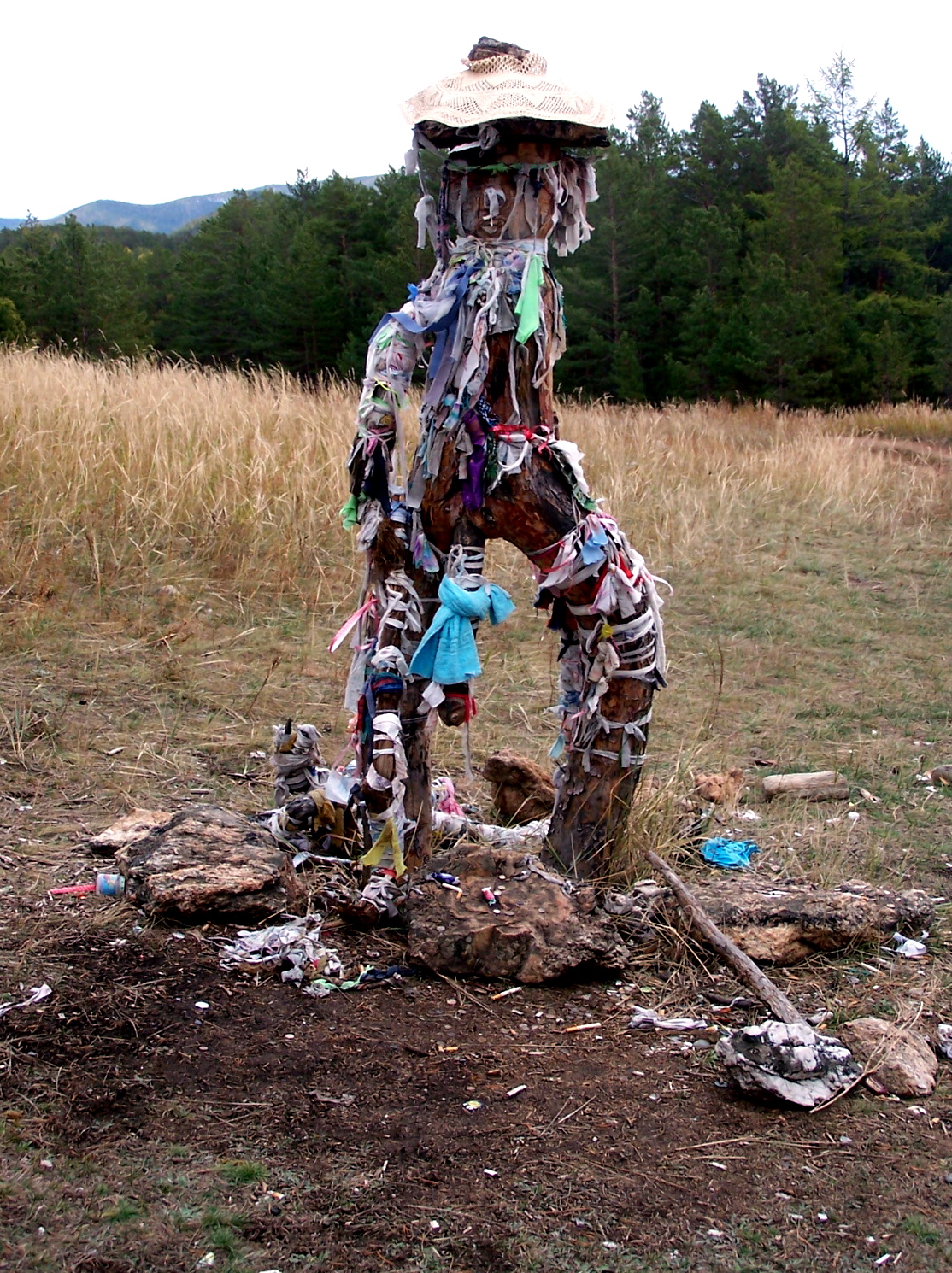
After hanging out a couple days…glad to be off the train…Gregory, a former University teacher of German, drove Bob and I, three Germans and a Pole on a half-day excursion to the north of the 70km long island to visit various geological sites and views of the lake but most especially to see a world renowned Shaman ceremonial circle called Three Brothers that is sacred to two faiths practiced here, Buddhism and Shamanism. Two years ago almost 300 Shamans from the world-over came together here. We lay a one rouble coin at the foot of the prayer flag pole while the “Sarma” or east wind blows fiercely over us.

The Buryats are of Mongolian descent…nomads who spent time herding their flocks between the southern shores of the lake and what is now northern Mongolia. They lived in felt-covered yurts and practised a mixture of Buddhism and Shamanism.

Gregory is driving Nikita’s four wheel drive van…a Russian vehicle designed 30 years ago and that was so successful they used it as an ambulance. “There is only one reason Russians sent the first man into space,” says Gregory the Kamikazi driver thumping over mud hole roads at least 90km per hour…”is because of the roads!” Later he says “we at the moment are using two wheels…if it gets really complicated we will use four!” “Normally we sacrifice two persons…usually 50% survive this trip!” Any of our U.S. vehicles would have rolled over at the first turn but this one mysteriously keeps it’s four wheels on the ground.

We pass through beautiful valleys with sheep and cattle farms…two of which are rich and have beautiful houses “because they don’t drink,” Gregory says. We pass by one small house of an old woman who lives alone with her cow…the rest of the houses in the area appear empty. We are shown an area that was a gulag during the Stalin era and whose inmates produced cans of caviar from the lake sturgeon that was then sent to the Kremlin for the enjoyment of the party bigwigs). I see a straggly triangular three wooden stick affair on the top of a hill and ask Gregory what it used to be. “Local KGB headquarters,” he says throwing his head back in laughter. I ask if the Russians and Buryats intermarry. “Seldom,” he says.

Five Hours to Olkhon Island

7yBXvp82X2gVlMeZe25DiM-2006198051115673.gif

The next morning we are picked up at our homestay in Irkutsk by a sullen driver who drives us five hours over pot-holes, through the taiga and across a bay of the beautiful blue Lake Baikal to the small Buryat fishing village of Khuzhir on Olkholn Island with a population of 1500 (half are Buryat). Urr0g6ZfQ7ttYL19duYJfg-2006170133924757.gif

We stay at Nikita’s Guest House (Siberia’s only real traveler’s hangout) for five days. Nikita, we are told by some of the guests, was at one time Russia’s table tennis champion. Two multi-lingual Russian girls seem to keep things hanging together and they serve us great garlic-charged meals in a communal dining area. The guests are all European…no Americans…and the conversation is spirited…two Swedes quickly challenge a comment I made that they interpreted as being critical of Socialism.

We enjoy the banya (bathhouse) with wood-heated hot water we can pour over ourselves…although the first time we signed up we were the first on the list and the water was still cold.

Yekaterinburg

7yBXvp82X2gVlMeZe25DiM-2006198051115673.gif

Yekaterinburg is most famous, however, as the place where Tsar Nicholas II and his wife and five children were murdered by the Bolsheviks in July 1918. Having seen where the bodies were interred in the family vault in the Hermitage Museum in St. Petersburg, we now traveled a few miles outside the city to view the site surrounded by a quiet forest of lodge pines and birches where the bodies were found and to see the beautiful Orthodox monastery and seven churches newly built in honor of each of the Romanoff “saints.”

We stop at the exact point where European Russia meets Asia and have our pictures taken wit one foot on each continent.

At Shirokorenchinskaya Cemetery we see monumental graves…one a life-size engraving in marble of a 35 year old gangster, with Mercedes keys dangling from his hand. I asked Shasha, our young English-speaking guide if the mafia was all gone in Russia today since these guys had finished each other off. “Yes,” he said, “now they are all in the government.” No fooling this young educated generation soon to take over the reins of this beleagued country where across the street you can see a vast memorial dedicated to the 20 million victims of Stalin’s Gulags many of which were in this Region. The bodies of 25,000 people from Yekanterinburg alone were found buried here.

A Day With Sasha

7yBXvp82X2gVlMeZe25DiM-2006198051115673.gif

I had watched “Russian Ark,” a movie about the history of the Hermitage before I left home so I was excited when we found Sasha, a university educated art historian, to take us through the museum (actually 5 linked buildings) set in a magnificent palace from which the tsars ruled Russia for one and a half centuries. Sasha had an unusually sophisticated command of the English language and an ironic sense of humor and made sure we knew the history and context of each painting we viewed…until we were absolutely exhausted.

We managed to keep up with him, however, when afterward he says “da da, you must experience a few more places” so off we trudged to see babushkas selling a few possessions…knick knacks, flowers and little piles of vegetables on the street, to buy historical propagada posters designed by Soviet-era Futurist artists in a little hidden art supply shop, to see the little Dostoevsky Museum which unfortunately was closed and finally by 10pm to view thirty-somethings drinking beer in a modern upscale bar right out of the Village in Manhattan…we were even instructed to go upstairs to see the industrial design bathrooms which had fixtures that looked like they were designed by Siemens and purchased from the KaDeWa Department store in Berlin.

Sasha was obviously very proud of this new Russia. Only we already knew that about 1% of the people, who buy everything they own on the black market, can afford a place like this where a beer will cost the equivalent of 20% of their monthly wage.

Traki, Karaites & Kibini Pastry

Trakai, on the outskirts of Vilnius, Lithuania, is a small settlement placed in the middle of five large lakes that is home to about 350 members of the Keraites, a minority community originally from Mesopotamia (modern day Iraq) who later migrated to Turkey. Keraite literally means “reader”. Their religion is a form of early Judaism mixed with reading of the Koran. (Imagine that !!—maybe we should inquire whether they have insights for current situations.)

Traki used to be one of Lithuania’s many capitals and the Keraites served as guards to the palace/castle…which Bob wanted to buy and occupy. We tasted the Karaites’ traditional dish called Kibinine, a small piping hot pastry stuffed full of delicious chopped meat and onions…juice squirting down one’s arms with each bite.

In an area selling crafts I met a woman who was exclaiming over two drunk locals…I asked her what country she was from and she said “San Francicsco.” She went on to say she was enjoying herself “but they won’t take our dollars here!” Speechless, I decided against asking if she had thought of visiting a money exchange window.