Elephants Monkeys & Snakes

A day trip north took me to an elephant training camp, monkey training school where they learn to twist off the coconuts and let them drop from the trees.

DSC00474.JPG

The snake show I could have done without. “Please do me a favor,” the driver says on the way home. He stops at five different shops and factories including the Orchid Farm and Butterfly Garden so he can get a coupon for gas. The Indian shops give two coupons. But who wants to buy overpriced Indian stuff in Thailand? This has happened to before so I should have known better. Exhausted, I draw the line at the last one. Never again. At least I didn’t let them pressure me into buying anything.

Koh Pha Ngan

Doug Luk and I took a break from Samui and put the car on the ferry for the two hour trip north to the island of Koh Pha Ngan for a couple days. Almost no car and truck traffic, motorcycles or pot-holes=bliss! This is the island, two-thirds the size of Samui, of the legendary full-moon parties but luckily we were there only during the post-half-moon party…the southeast beaches full of 20-something Europeans in dreadlocks and a slew of Israelis. We stayed on a serene northeast beach…me in an aircon bungalow and Doug and Luk in a 300 baht fan bungalow facing the Gulf Of Siam.

A drive up to the end of the paved road landed us at sunset in a sandy beach restaurant watching the sun go down while eating fresh-caught baracuda and spicy Thai salad…and we are leaving all this on the ferry in two days?!!

Big Onion Tour

Big Onion Tours, the word “onion” being a play on the Big Apple, offers tours of neighborhoods of NYC. We chose the “immigrant tour” which shows how different ethnic groups variously settled and replaced other groups around the island over the years—a continuum to the present. For example, Chinatown has almost completely taken over Little Italy and Christian churches have now become Buddhist Temples. The Church of the Transfiguration on Mott St, originally an Episcopal church dating from 1801 was transformed into a Catholic church in 1827 to attend to the needs of local Irish. As they moved out Italian immigrants dominated the parish. These days Mass is still said but services are in Mandarin and Cantonese.

Big Onion tour leaders are generally university grad students working on New York historcal theses and their presentations offer detailed historical information spiced with antedotes and humor. Our tour began near City Hall and included early history of the lower island evolving to the corruption and shananigans of Boss Tweed and Tammany Hall–much of which is not too different from the current modus operandi. At the time a nearby pond was a reservoir for unwanted blood-and-guts from area butchers. When its stench became overpowering its contents were removed by a canal, built for the purpose, and now known as Canal Street.

As the pond became filled the overlying area became the “Five Points” –the former Irish slum depicted in the Martin Scorsese film “Gangs Of New York” where five streets had converged–representing the five burroughs. Now two of the streets are obliterated by skyscrapers.

Nearby is the site of the African Burial Ground, a cemetery for the city’s early black residents most of whom were slaves. Black residents eventually moved further up the island to Harlem. Remains of over 400 bodies were found on a site that was slated for a government building in 1991. Following much protest, construction ceased and the ground was declared a National Historic Site. Most of the remaining nearby graves had already been covered over by skyscrapers years ago.

In the early 1900s millions of immigrants called the Lower East Side, Little Italy and Chinatown home and the area became “one of the world’s most densely populated neighborhoods,” said the tour guide. Bob and I looked at each other and we both said at the same time…”he’s never been to China!” However, the horrors of the tenements were real and are documented at the Lower East Side Tenement Museum.

The Bowery is a long avenue that was named by the Dutch for their word for “farm” as it linked New Amsterdam to the farms in present-day East Village. Horse drawn cable cars moved people and produce. In the early 1900’s the Bowery was lined with rough bars and flophouses and was the de facto border between Jewish Lower East Side and Little Italy. Jewish gangster Meyer Lansky helped organize rival gangs on both sides. A young grad student at Columbia, recently, researching the Bowery, found that Jewish prostitutes would frequent the Italian side of the street and the Italian prostitutes would parade the Jewish side….for the purpose of not running into family or friends of their own communities!

Recent gentrification has inspired the makeover of many original tenements and these days, the Lower East Side (LES) has become the new hip area with bars, restaurants and condos opening regularly and is our son Josh’s favorite neighborhood to visit when he gets off work at the Tocqueville Restaurant.

In this neighborhood, we ate a meal of grilled fish, sweetbreads, creamy cheese and bread and a glass of wine at a restaurant called Prune, whose chef was featured as one of the few respected female chefs in New York today. However, we had been walking all afternoon in the wind and we entered the restaurant with bags full of knishes, creme cheese, dried fruit and wine and hair blown all over. The manager met us at the door and very cooly asked what we were doing there. I wanted to curtly say “this is a restaurant isn’t it?” but I didn’t. I just said that we would like to be seated. The NY attitude strikes again. However the meal was ordinary at best and horribly overpriced. (I hope they read this review!)

Central Park

In any given week in the summer you can choose from any four or five street fairs and on this day we chose the Columbus Street Fair on the Upper West Side of Central Park. Stall after stall for blocks offered food, drink and interesting items to purchase…we bought two small narrow Japanese cups which we hoped would keep our coffee warmer in the morning.

Then we turned west…past The Dakota, John Lennon’s apartment where he was murdered, to Central Park where on any given day people come to this 843-acre park for sheer recreational pleasure…full of roller-bladers, skaters, bicyclers, runners, picnicers, softball players, frisbee throwers, concert goers and people-watchers.

We walked past Strawberry Fields, the three-acre landscaape dedicated to the memory of John Lennon that is planted with specimans from more than 100 nations and where Bob took a picture of the plaque “Imagine,” set into the walkway that commemorates my most favorite song in all the world. Further on we watched colorful figures artfully roller-blading to thudding electronic music.

We headed back to the subway through the Sheep Meadow where several hundred families were picnicing, tossing frisbees and generally lollygagging on the grass on this sunny pleasant Sunday.

Harlem

Probably the biggest surprise yet in New York is discovering that Harlem is not the ghetto as depicted in years past. Sprucing up campaigns have left streets spotlessly clean…little old men with brooms like those ubiquitous to China and other Asian countries…sweeping up on every block.

We followed the walking tour recomended in the Lonely Planet guidebook which, from the 135th St. subway station, took us past Columbia University in the distance to Striver’s Row between Frederick Douglas Blvd and Adam Clayton Powell Jr. Blvd. These two blocks of 1890’s architecturally interesting townhouses got their nickname in the 1920’s when aspiring African Americans first moved here. We passed the Abyssinian Baptist Church which had its origins from 1808 when a Lower Manhattan church was formed in response to segregated services. It moved here in 1920. Previous pastor and namesake of the nearby boulevard, Adam Clayton Powell Jr., became the first African American congressman. On the other side of the block we saw the Mother African Methodist Episcopal Zion Church (also originally in lower Manhattan) which played an important role establishing the underground railroad in the mid 1800’s. (Acres of African-American graves were covered over by skyscrapers in lower Manhattan that used to be populated by thousands of black slaves…a small area has been left open there as a memorial.)

On the NW corner of Adam Claton Powell Jr, Blvd and W 135th St. is the site of the Big Apple Jazz Club sometimes credited for how New York got its nickname. On another corner was the site of Ed Small’s Paradise, a hip spot in Harlem in the past and where management once fired a young waiter here named Malcolm Little, aka Malcom X. It’s now an office building. Nearby, the Harlem YMCA provided rooms for those denied a room in segregated hotels. Notable guests include James Baldwin, Jackie Robinson, Jesse Owens and Malcolm Little.
We headed south to Marcus Garvey Park, named for the unique Jamaica-born founder of the Back to Africa movement who lived in Harlem from 1916 to 1927. The park was filled with older black gentlemen playing chess.

We headed to 125th St, the main hub of Harlem activity where Bill Clinton has his offices. West on 125th we passed signs of Harlem’s “new renaissance” department stores and chains that are very controversial in Harlem today. Unfortunately the street as become another commercial mall–undistinguished and not much different than Lancaster Dr. in Salem, Oregon. The famed street peddlers are a thing of the past.

A giant white building at the corner of 125th and Adam Clayton Blvd was once the Hotel Theresa sometimes known as the “Black Waldorf-Astoria.” Entertainers playing the nearby Apollo stayed here. Fidel Castro insisted on staying here in 1960 because he thought he was being spied upon in lower Manhatten (suspect he was under equal scrutiny here).

We stopped at the famed Apollo Theater which usually has amateur nights on Wednesdays but this night was preempted by a play about Dorothy Height…a national figure I was familiar with when I volunteered for the Salem YWCA in the early 70’s. We were hungry and tired by this time so we skipped the Apollo and found a packed Amy Ruth’s Restaurant on W 116th St. where we thoroughly enjoyed soul food: gravy smothered pork chops, corn bread, fried catfish, collard greens– topping it all off with sweet potato pie. Then home via the subway.

Washington Heights

The “F” subway line, if you take it to the very end at the northern tip of Manhattan Island, lets you off in a Dominican neighborhood of Washington Heights. Everyone on the streets and in the stores were Spanish-speaking giving us the feeling we were in another country altogether!

The sidewalks were filled with cheap clothes…Bob snagged a turtleneck pull-over for $2.00 and I bought a pair of stylish black snow boots for $25. We had pork roast, ribs and fried sweet plantains at a restaurant but weren’t sure if we were getting a good sampling of Dominican food.

Hop On Hop Off Bus

A good way to get a good overview of New York and to get a good look at the architecture is to sit in the upper level of one of these buses and if you are lucky you will be able to understand the tour guide. Each guide has a definite personality…one having to duck down to the bottom level when we went over the Brooklyn Bridge because she was afraid of heights. Often the attitude is one that believes wholeheartedly that New York is the center of the world…one such comment made Bob and I wince as we glanced back at the European, Asian and Australian tourists on board.

One route we took included Brooklyn and a local retired teacher was the guide. His brassy Brooklyn attitude was funny until a question got an answer that made fun of the question. For example, one European asked if the lake in Prospect Park was man-made. Of course it is, New York is bedrock (you stupid person!). We got on the bus in Brooklyn, which amazed the guide. He asked question after question…over the loudspeaker…the sense we got was that he was looking for a way to make us the straight man and to give him something funny to say at our expense.

A Harley in Viet Nam

1wXSp3CkNsDoJl3s0SgHmw-2006171162818157.gif

June 10, 2004
While I was in Bangkok Bob flew to Vietnam. He wrote to say he had difficulties accessing the web today and spent most of the day traveling.

His emails:
Now in Da lat in the mountains about 300-400 km north of Saigon. It is at a 5000 foot elevation so cool–in fact feels cold. Probably about 55 degrees right now–everybody in a jacket. Feels like central Oregon and after the heat/humidity combo in Hanoi it is quite refreshing. I am at an internet cafe surrounded by adolescents screaming at success/failure with video games. Tiz too much–later.
B

June 11
good morning:
have been roaming around Dalat—much embroidery art done here–quite nice but also can have a hefty price–saw several landscapes that I liked–might pick up a small piece–just to have a representative sample. Bought several pieces in Hanoi–I really like their style of art.

Approached by a fellow this morning–call themselves “Easy Riders”–have big bikes and arrange trips off the beaten track–tempted to have him take me to Saigon via the Cambodian border and the Ho Chi Minh trail–he can also extend things to the delta (and probably to So. America for that matter)–he is 45-50 in age and has been doing this awhile. Am tempted as it would take me to areas I would not otherwise see and I am tired of the usual tourist routes. It would mean 300-400 km on the road and the limiting factor would be the ability of my butt to withstand several days in the saddle..

June 12
Another nice day in Dalat. It is a major tourist destination for Vietnamese—with it being a weekend the place is packed—had to inquire at three hotels before finding a vacancy…in evenings they close off the downtown streets to vehicles and streets/plazas are packed with people just walking and people watching. Not much to buy re handicrafts etc. but wonderful produce — however do not see it offered in restaurants. Am tired of Vietnamese cuisine and am overdosed on French bread.

NOTE: Next few days Bob spent in bed with some kind of virus….Bob worried about influenza-like syndrome and me thinking it was probably Dengue Fever as this is the season for it.

Sat June 18
hello–
Was going to leave Dalat today by bus for Saigon. This a.m. had second thoughts and decided would be much more fun and interesting and educational to do the bike thing. Tried to find my rider (named Budda–because his stomach and somatotype is identical to the icon) but could not arouse him by phone–he probably ditched me for other customers so went down to the local easy rider hangout cafe and there were at least a half dozen of the “boys” there. They start out by being very cool but then the pitch begins . I had experienced it twice before so he (Thui) was surprised when I cut to the chase, “How much for 3 days?”. So to see whether I would be able to tolerate we agreed on a sampler package of a day trip around Dalat. It worked out well–he is safe… informed, understandable (re accent), non-invasive and 48 yr/o–but looks 55 to 60.

Weather turned inclimant and last hour on the bike was wet. Purchased a plastic pancho but was totally saturated at the end of the trip. Was informed that my previous illness was do to too sudden climate changes, that there was no possibility that it could be bird flu because that entity does not exist in Vietnam! I was instructed that on return to hotel that I must wash my hair to get all the rainwater out so that I do not come down with any other ailment(s).

Tomorrow leave for 3 day trip to the coast just East of Saigon–he does not want to get closer because of increasing traffic and I appreciate his concerns. I will travel remainder of distance to Saigon by bus. So depart 8 a.m. tomorrow–I look like a Harley biker going down the freeway. Not sure how we’re going to get all my luggage on the bike but he says, “no problem’. Will not see internet again until Saigon.

NOTE: my daughter-in-law, Luk, a Thai, has also warned me to wash my hair after a rain. She said when it first rains there are bad chemicals in the rain that can hurt you. She could be referring to Acid Rain?
Eunice

Trekking Northern Thailand

gatQye8keZlS3vpnwrOvxg-2006186163905868.gif
As soon as we returned to Bangkok from Bali Bob took a train to Chiang Mai for a trek in northern Thailand near Mae Son Hong. I stayed in Bangkok to have some dental work done. This entry was written by Bob.

Chiang Mai is Thailand’s second city and the jump-off point for experiencing the northern hill tribes.
100_3454.JPG

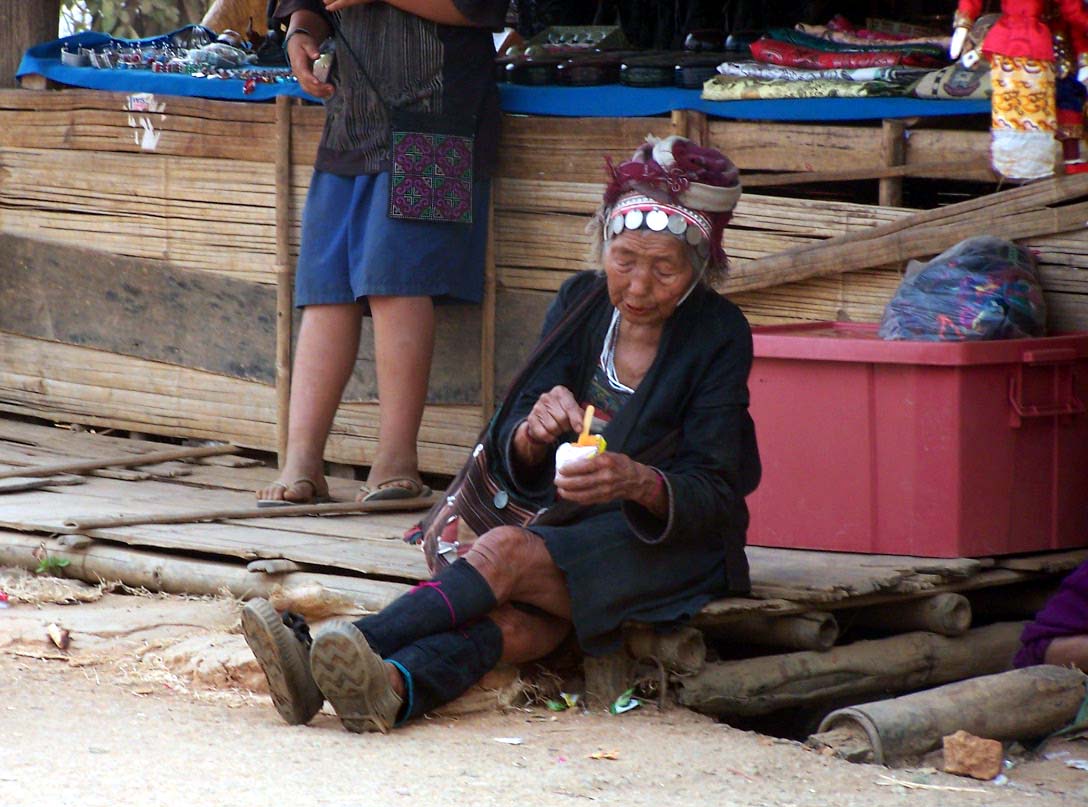
Mae Hong Son is in the trekking area–but quite a ways from Chiang Mai–drove there with several treks en route and spent one night in the town. There are many ethnic tribes–most renowned being the long necked ladies. When I was there not many tourists as it is hard to get to. We subsequently flew back to Chiang Mai–but that was included in the package. Did this on one of my early trips. On that trek we would walk for a day or two, spend nights in tribal villages and the van would pick us up at a designated site. Then onto the next trek–also did a little rafting but no rapids.

These peoples owe allegience to their ethnic group and national boundries are of no signifigance. They originally migrated from China and Tibet and now reside in southern China and in a geographic band across the north of Burma, Thailand, Laos and Vietnam.
100_3585.JPG

These tribes have taken taken advantage of the tourist influx and now offer their villages and homes as overnight lodging for trekkers. As they live in the hills there are no roads, autos and access is strictly by foot. So after a couple of days re-exploring Chiang Mai (its growing big time) I joined 5 other farangs (European and half my age) and a Thai guide for a 4-5 hr ride in the back of a pickup to the trailhead for a 3 day trek.

The walking is relatively easy but the heat/humidity combo is a killer. In 5 hrs we reach a Karen village, are given lodging in a bamboo slat hut and offered a “shower” from a barrel of cold water using a laddle to pour water on whichever body part is selected. A simple meal is offered–tasty but usually best not to ask what it is. Market comes to us as the local ladies show up with their handicrafts. The children run about and giggle at/with the strangers. During the night a pig was the victim of a noisy slaughter as the next day was a festival (new years).

On the previous trek along the Burmese border we had been invited to a wake for a child who had died that day (probably from congenital heart disease). But alcohol became the focus of the event and we made a hasty departure out a side door as belligerence unfortunately replaced festivity.

The next day of this trip offered many stream crossings over narrow logs and I was made suddenly aware that balance is one of the skills that diminishes with advancing youth. Oh well! But we made it to the waterfall for a rewarding swim and that night barbequed a suckling pig.

The last day offered a ride on a bamboo raft through several small rapids and the obligatory elephant ride (once is enough). My less than friendly elephant was named Toby with her cute baby following along behind. I kept thinking that I should have a seat belt. Toby, however, was sure footed, enjoyed the sugar cane and bananas that were sold at intervals along the route.

Mae Sai is just a border town in the far north I went to on another trip. Across the bridge is Burma. It is not a primary trekking destination. Used more for visa stamp-outs and Thais purchase stuff (primarily pornography I think that they cannot get in Thailand–or at any rate saw much of it being confiscated by Thai immigration.) From Chiang Mai it is part of a day trip –in a van–that also includes the Golden Triangle (people stand and have their picture taken under a Golden Triangle sign) and Mekong River/Laos border area. A boring trip.

Tip: The trips out of ChiangMai have become a bit too packaged and westernized–now include the obligatory elephant ride and a raft trip which is a token overcrowded experience. Ok if one has never done it but better if you are able to get off the beaten track like the trip to Mae Hong Son.

Stamp-Out to Burma

1wXSp3CkNsDoJl3s0SgHmw-2006171164904627.gif

“Stamping out” consists of leaving Krabi Thailand at a border crossing…in the case of Ranong the border is with Burma…and then “stamping” back into Thailand. To do this they went to the Thai immigration office at the port in Ranong to officially exit the country called “stamping out.” Then they hired a boat ($12) for a 40 minutes ride across the estuary to Burma. They paid $5 US (had to be a US bill) at the Burmese immigration office for a stamp in their passports to enter Burma. They walked around the little dumpy Burmese border town trying to avoid the sellers (the big sales item was Viagra…probably from India) for 30 minutes and then took the boat back across to Thailand where they returned to the Thai immigration office to get stamped back into the country for another 30 days.

In my case I had purchased a 60 day Thai tourist visa in Kunming China so I had another couple weeks in my passport. While Bob and Doug were monkeying around with this, Luk and I found a nice air-con hotel that would accept their little Shimizu “Ting Tong” (the name means “crazy”) for the night…having take-out dinner purchased from the local night market and eating it in our room … one of the best meals we had in Thailand…all of us feasting for about $3.

The next day we drove east to Surat Thani on the east coast of the Thai peninsula …visiting a famous Buddhist meditation teaching center (in English) on the way. Had strong thoughts of being dropped off here for a month but there was no air-con or even fans in the rooms and that even I was not ready for. I just settled for my good old TM mantra in my comfortable air-con room in Krabi.