Heli Skiing Bobbie Burns Canada
While temps are in the 90’s here in Oaxaca, my oldest son is buried in powder near Calgary…a 4 hour bus journey followed by a 15 minute heli flight into the lodge in the Selkirk and the Purcell mountains.
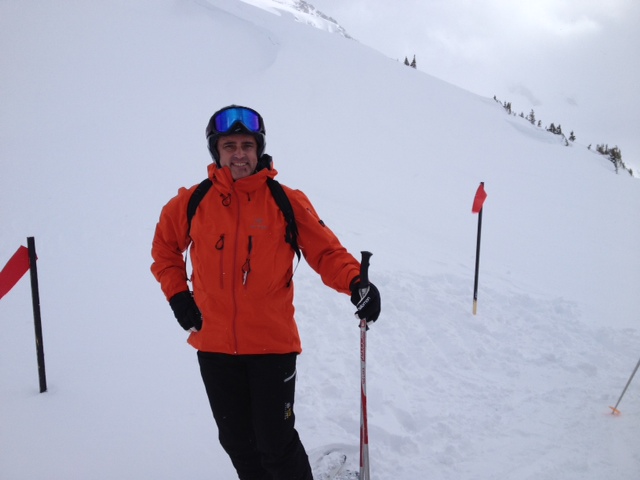
Greg
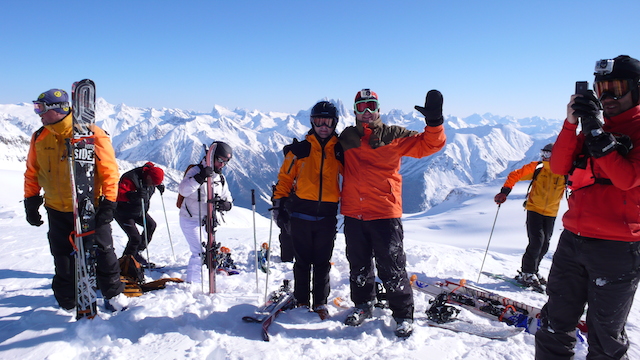
While temps are in the 90’s here in Oaxaca, my oldest son is buried in powder near Calgary…a 4 hour bus journey followed by a 15 minute heli flight into the lodge in the Selkirk and the Purcell mountains.
Greg
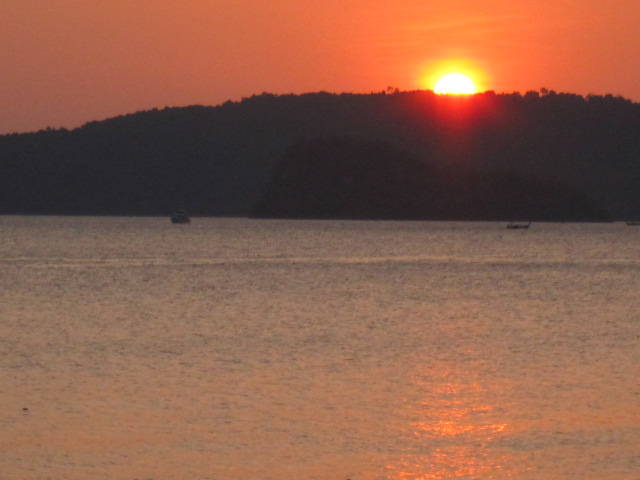
A lot of memories here where Doug and Luk lived 14 feet from the water on Khlong Muang Beach in Krabi until they nearly succumbed in the 2004 tsunami. Ten years ago! Seems like it happened yesterday and hard to believe so much time has passed since that tragic day when I learned about it in Bangkok and nearly had a heart attack when I saw the devastation on Krabi on TV! Many young Thai people today hardly remember it. I mentioned it to the young View Son Hotel receptionist but she just keep repeating…“no tsunami here, no tsunami here!”
After that day, in December 2004, Doug and Luk moved from the Pacific side…on the Andaman Sea…to Koh Samui in the Gulf of Thailand…on the other side of Thailand. Luk said there were too many ghosts at Krabi and she wouldn’t eat the fish anymore because she said the fish ate the people! Such is Thai culture.
However, we spent a wonderful day forgetting all the devastation…visiting the islands off Ao Nang in the Bob Marley “pirate” ship manned by Doug’s old rasta friends.
My Swedish friend took me to a Swedish enclave at the end of Fisherman’s Beach. OMG! Hundreds of Swedes on the beach and sitting in rows and rows of chairs all together. Most of them return every winter, my friend says.
We said goodbye on Feb 2 to the lovely staff at the guesthouse…including the funny katoey who would knock on the windows at night of the young Swede I was hunging out with! I flew to Samui for two days before catching a Bangkok Airways plane to Bangkok and Doug flew to Chiang Mai on Asia Air for another couple weeks until we both leave Thailand from Bangkok on Feb. 14.
I got “home” late last night from a day trip to a “village” just off highway 304 in Chachoengsao Province about two hours east of Bangkok. This visit had several advantages.
I got to see my friends Dave and Syy again and meet Syy’s mother, brother and two year old niece who slept the peaceful afternoon away in a cloth swing while we visited in an outdoor covered area attached to Syy’s mother’s house.
I got to see my Vietnamese friend Nick again. Nick is a flight attendant for United Airlines. I last saw him a couple years ago when he visited me, Doug and Luk on Koh Samui on a quick side-trip on his way to visit family in Viet Nam. He gave me a freshly minted copy of his memoirs on that visitthat included the story of his escape with his family from Saigon in 1975 when he was 7 years old and subsequently resettled in the middle of Kansas!
Dave, Syy and I were imagining Nick lounging in first class on his flight from LA to Bangkok this time too. But alas we gave him our appropriate condolences when he revealed that the flight was full, he got the flight attendant jump seat all the way from LA to Tokyo and a middle seat in coach seat from there to Bangkok! We truly hope that he got a better seat on his return flight this morning….having spent only one night in Bangkok!
And I got to find out how to catch a van to outlying areas. Skytrain to the Victory Monument. From the skytrain platform, look for one of the figures on top of the monument of a sailor holding a torpedo. Walk in the direction that the torpedo is pointing. Take an exit off the platform to the right…to a small street named Ratchatewi 11 that runs parallel to the raised BTS walkway above. About half way down that street look for a restaurant called Pong Lee. Next to the restaurant is a sidewalk desk to buy a ticket for the desired van. Show them a piece of paper that says in Thai (presumably you have found someone to do this for you) Pratchinburi/Klong Rang/Tawa Ravadee Hotel so they can direct you to the right van in a very long line of white vans lined up on the street. The fee for us was 130 baht one-way…or $4.00. (But Dave said it should have been 120 baht so we don’t know whether to blame Nick or me!)
Dave wrote a little description of the “village” for his email list that I think I will lift for this post because his description is much better than mine would be. He says:
<em>the village is composed of two adjoining houses, Na Tit’s abode and Syy’s mom’s old house. Syy’s moms house is now an empty shell housing a few relics of the past including a clock stuck at 5:30 and memory filled photos on the wall reminding one of an earlier time. The house has been gutted of all inner conveniences and last night I was forced to sleep on the hard wood floor, waking up with an ache in the back or maybe an ache in the heart for the old home.
The days are warm and mild, the chickens wake us up every morning at 5. Now we have to make the long walk through the overgrown remnants of what used to be a garden but is now planted with thorny eggplants to Somsak’s home for our tri daily meals. Since we were here last, Somsak has built 2 small adjoining rooms on the estate, one for mother and one for Far. Somsak and Duen’s small room was slammed with lightening not long ago which tore out their AC unit.
Ants and papayas seem to be the big cash crops this year. The backyard is filled with recently planted papaya’s already loaded with young green fruit. The homes that were removed this year from the village have been completely replaced by the tropical vegetation and now you can never tell they were ever there. As a result, there is a new natural feel to the village, having lost its human component, and has been replaced by a veritable green paradise.
We started our meal last night with a bang, eating big green and white ants with enormous abdomens that literally pop in your mouth, making a sound akin to popcorn bursting into action for the first time on the bottom of a hot grease filled frying pan.</em>
As I sit here writing this, I hear fireworks. It seems very familiar. Then I realize I am in Thailand not Oaxaca Mexico! I step out onto my small 8th floor veranda and see the sky between the buildings alive with light and sound. I feel right at home because I have no idea what the occasion is…just like most of the times there are fireworks displays in Oaxaca! 🙂 This is the 3rd fireworks in a month here. Last couple fireworks I figured was in honor of the King’s birthday.
This time…Christmas?!!
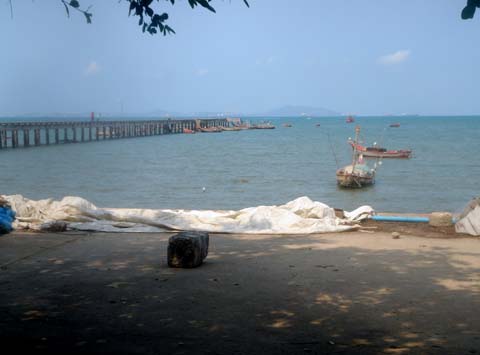
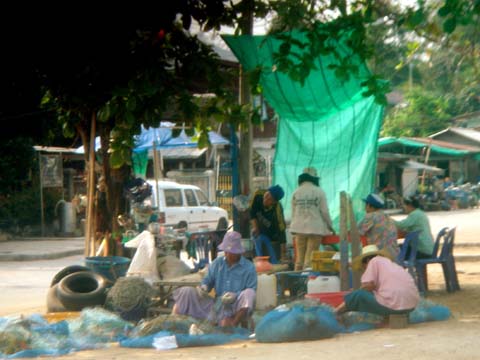
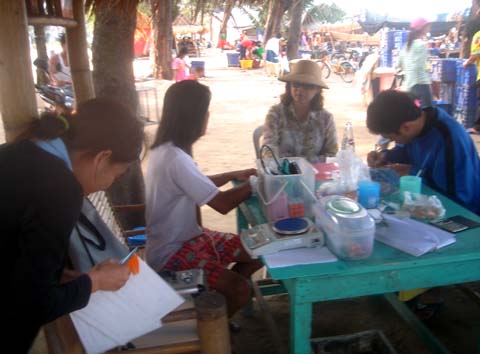
This week I went to Bang Phra fishing village near Chonburi on the Gulf of Thailand with my friend Jiraporn, Professor of Fisheries at Kasetsart University in Bangkok, who, with some of her students, are conducting a population study of the Swimming Crab, a small crab used mostly in soups and salads. There is a concern about the diminishing supply of crab. The students are temporarily living in the village for the duration of the study with a local university fisheries department contributing oversight.
I was blown away by the sense of community here…children playing with their families and each other…vendors bringing around food. I didn’t want to leave. I am now considering a month in this peaceful slow place when I return to Thailand. But I can assure you I won’t be wearing a jacket or a sweatshirt in the 95 degree weather like many of the Thais do!
Gulf of Thailand
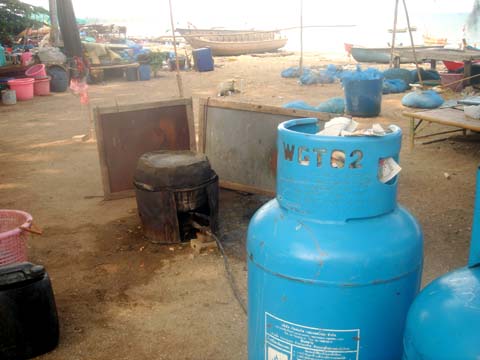
Using Propane To Cook Crab
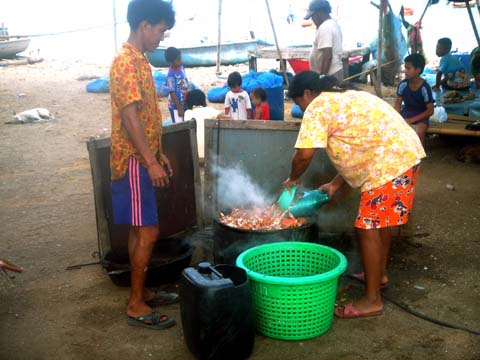
Cooked Crab
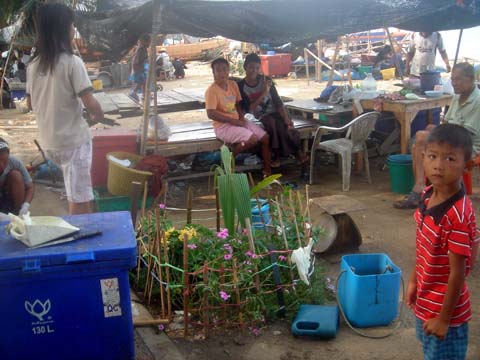
Fisher Family
Young Fisherman With His Child
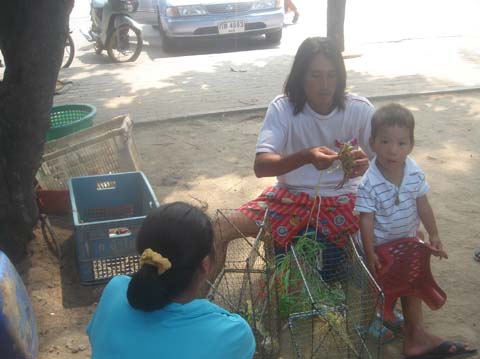
Repairing Nets
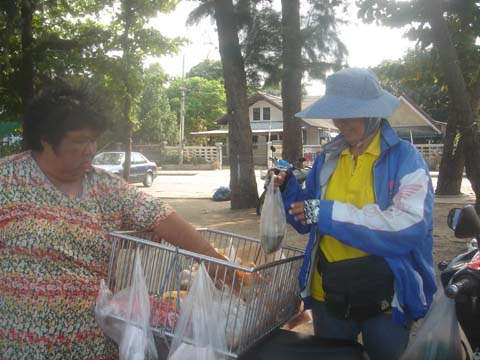
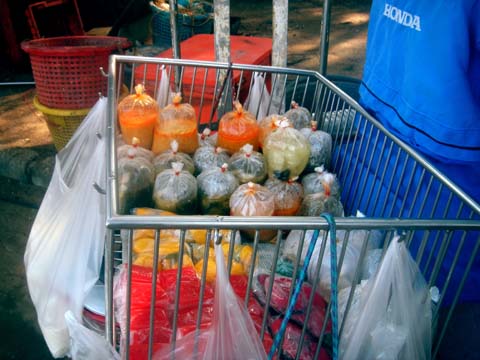
Buying Lunch
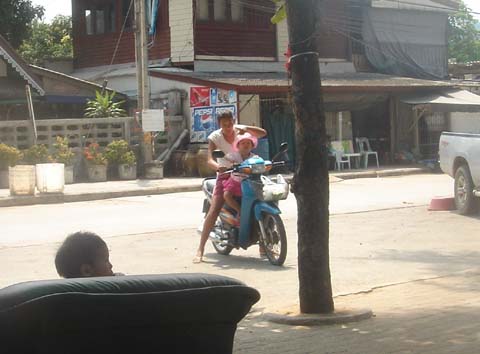
Motorcyclists In Front of Typical Shophouse Opposite the Beach
Vendor
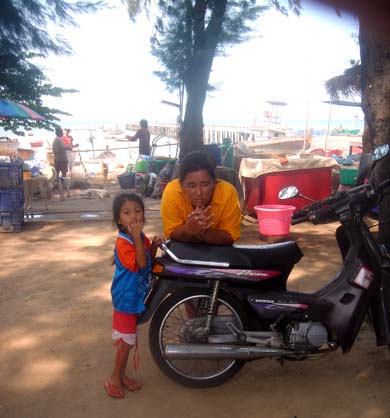
Soups And Other Items
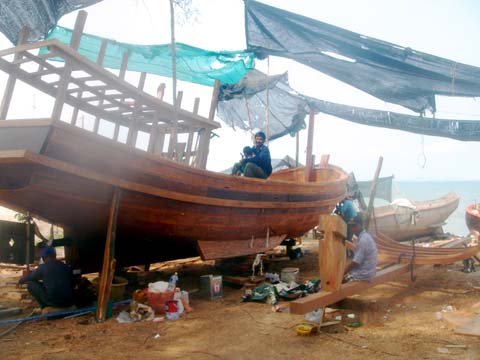
Building A New Boat
Jiraporn With Students
Have become familiar enough with Asia that the usual things you notice on the surface aren’t so eye-catching now. Am learning to adapt to surface cultural differences with less frustration. But adapting for a traveler briefly passing through is one thing. Another thing for someone spending significant time here. Much more difficult if you are having to learn how to navigate the unspoken expectations and assumptions.
“You eat like a monk,” she says. What do you mean, I ask, as I put my strawberries on the same plate where I have just eaten my fish. Monks are not supposed to enjoy earthly pleasures, like the taste and sight of food, she says. People earn merit by dropping bits of food into their begging bowls..food that gets mixed up together. So, not wanting to bother her for a fresh dish, I had put my strawberries on the same plate where I had eaten the fish. I had grossed her out. Caught again…unawares. I was shocked by the comment. And so it goes….
Other than that, have been spending time with mundane activites…dental appointments (teeth have really gone to pot recently) and great medical care at Bumrungrad Hospital…all details no one would be really interested in except me.
News in the Bangkok Post: Backpackers are furious for being blamed for a bed bug invasion. An entymologist at a local university says that Americans don’t like to take baths which has helped create the problem. Good grief! We are foreigners. We are dirty. Don’t we do the same thing to “strangers” at home…?
I spent five days visiting a Thai friend in her newly built home. She is a Professor of Fisheries at Kasetsart University and is encouraging me to accompany her to visit a field project in a small stream near the coast of the Gulf of Thailand…which I would love to do if we can coordinate our schedules. In exchange I am editing some research papers she is writing in English. Catching up on local politics, I mentioned that the Malay man sitting next to me on the plane to Bangkok had reminded me that the Prime Minister, unseated by the military coup last year because of corruption, did help the rural farmers. “Yes,” she said. “A piece of meat between the teeth!” This comment has added impact if you know that Thais take meticulous care of themselves…many using toothpicks after they eat…carefully covering their mouths with a hand so not to offend anyone. She and her university colleagues make no bones about their opinions of Thaksin and they feel that he will still be pulling the strings from the sidelines now that he is back in the country.
Son Doug and his Thai wife, Luk, flew up to Bangkok from Koh Samui to get off the island for a few days. We took a bus last Saturday to leafy Kanchanaburi…a couple hours northwest of Bangkok. Very hot and humid! The peaceful town on the Mae Nam Khwae River (River Kwai) belies it’s role in WWII as a Japanese-run POW camp where soldiers were worked to death building the “Death Railway.” You may remember the movie “Bridge On The River Kwai” telling the story of the brutal plan to carve a rail bed out of the 415km stretch of rugged terrain through the Three Pagodas Pass to the Thai/Burma border that was intended to be a supply route from Bangkok to Rangoon. Close to 100,000 forced laborers, captured Allied soldiers and Burmese and Malay prisoners, completed the railway in 16 months…only to have the Allied forces bomb the bridge across the river after just 20 months. The relatively small nondescript bridge has been reconstructed but you can imagine the planes careening down along the river…taking out the middle iron arcs. Tourists clog the bridge that is now just used by a short excursion train and pedestrians. Yes, it’s a bridge, says Doug when we visited it on a rented motorcycle. lol
I will take the one-hour flight to Samui on April 8 to spend a month there…after which Doug, Luk and I will fly to Kuala Lumpur for our “visa run.” This will be my first visit to Malaysia. Maybe there I can get away from the depressing news about the banking crisis at home…strange days…dangerous days…reverberating all through Asia.
About 5 miles from Cuatapec, Charly and I caught the annual Xalapa (pronounced halapa) Fair the night before we took the comfortable 1st class bus back to Oaxaca. A small nino was earnestly helping his mom set up her display of toys.

Some friendly guys from Puebla were helping set up the fair.

Young guy preparing a sweet bread.

A bar.

In search of a little alone time yesterday, I drove 40 miles (but two hours) north of Oaxaca City up into lush, pine-clad crests descending deep into river canyons to the Sierra Juarez, the birth-land of Benito Juarez, Oaxaca’s beloved favorite son.
Born in 1806 in the municipio of San Pablo Guelatao in the village of Santo Tomas Ixtlan, his parents died tragically when Benito was three. His uncle took him in and his childhood was spent mostly herding his uncle’s flocks in the surrounding hills. But Benito left for Oaxaca city in 1818 to live with his sister in the genteel, well-to-do Maza family where his sister worked as a cook. He gained exposure to music, books, politics and people that was not possible for a poor boy in the country. He ended up studying law and eventually entered politics…rising from state to federal legislator, then Supreme Court judge, and finally was unanimously elected governor by Oaxaca’s legislature in 1849. He was elected Mexico’s president for three terms…interrupted first by civil war and then by the French Intervention. He toiled day and night to realize his dreams for Mexico but died “from exhaustion” in 1872.
I stopped in nearby Ixtlan de Juarez, quickly perused the small rotating Monday market but skipped the huge baroque church built with fortunes made with slave labor growing cochineal (used to make the magnificent red dye) where I would have seen this:

Read More
Made another trip to the Tlacalula Sunday Market last week with my next door neighbors Ana, Steve and little Oscar. Bought some carved coconut shell halves made for drinking our wonderful Mexican chocolate and then in my impending senility just walked off and left them on the table…not the first time this has happened. But with my new telescopic lens I did get some nice long shots of some of the colorful women vendors that come down out of the Sierra mountains to sell their turkeys, baskets, vegetable produce etc. They don’t like their pictures taken…not respectful. And they often feel that to have their picture taken means that their spirit is stolen…so have to be surreptitious.
Then we tried to find the little town of San Marcos high on a hill west of Tlacalula. After wending back and forth through Maguay, vegetable fields and pastures on dirt paths (could hardly call them roads) and with a little direction from a shy old campesino in a checkered shirt and white straw hot and with a wooden stick in his hand for herding a few cattle, we finally see before us a large green sign: “Servicios de Salud de Oaxaca. San Marcos Tlapazola, Tlacolula.”
As we slowly enter the tiny town we see an older guy sitting on the steps of a tienda…seemingly asleep with his head draped down his chest…but we think it was the tranquilizing effects of his afternoon mescal. Winding our way up a hill above the town for a few great pictures we come across a group of giggling women and girls standing in their Sunday best in front of a covered plaza. “Get their picture,” I urge Ana but when she pulls out the camera they all run back through the gates laughing…ignoring the exhortations of a group of men and boys on the roof above. Shyly peeking around the corner they tell Ana there is a wedding that day. On the way back through the town we see another plaza full of people. I stop to look. Two cute young girls walk up to the car and ask our names and where we are from. They were also celebrating the wedding…their primo (cousin). A couple of men drinking mescal next to them joined in on the conversation…in English. It is not uncommon to find old men speaking the English they learned during their norteno migrations. The young ones are all up north…the small villages nearly empty. It was a Sunday and all the vendors were in Tlacalula so we will have to return one week-day to buy some unglazed pottery that the women are famous for in this town of San Marcos.
On our way back to Oaxaca City we stopped by Mica and Bardo’s in Huayapam armed with beer and the makings for white russians. Mica cooked up a great cena and I gave her a cd I burned of an Italian singer that is popular in Brazil…Ornella Vanoni. I had used one of her songs, “L’Appuntamento” (also made popular in the US by the soundtrack of Oceans 11) in a video I made of our trip to Hierve el Agua and Mica had asked for more of her music. Later four men friends from Puerto Escondido stopped by…a typical Sunday at Mica and Bardo’s.
I drove Lester and Max to San Pedro de Cajonos yesterday. Left at the intersection at Tlacalula and then an hour and a half up into the Sierra del Sud mountains. Beautiful drive. San Pedro hangs on a cliff above a valley. The Blas family makes Alebrijes there.
Getting back to Oaxaca City about 5pm, I drove up Guerrero St. where Max lives to find milling crowds of frantic people who were attempting to undue the effects of PFP tear gas with handkerchiefs soaked in vinegar and Coca Cola. A march had just gotten to the city and the PFP didn’t much take to having the Zocalo surrounded by APPO supporters.
Exhausted from the day’s drive, I went to bed at 8pm to find out the next morning that over 2000 people, many innocent bystanders, had been arrested and beaten and taken to jails…but not charged. I also found out that Max had a method to his madness…knowing I might have been caught in the middle of it all had I stayed in the city.

Supuat drove me to Tha Tan…right on the Thai-Burma border directly north of Chiang Mai to see several minority groups, Lisu, Lahu, Akha and Longnecks, that live there.
Last year in southern Yunnan China, I visited Lahu, Lisu and Mien mountain people many of whom had migrated into Thailand years ago. The Karen and Shan and Longneck people in and near Tha Ton have been forced out of Burma by the junta who took over the Burmese government in the early 90’s. They do not speak Thai and they have their own languages, but Supoat, my guide, being from the area, speaks the local Chiang Rai dialect that is common to all the people.
About seven years ago Thailand launched a program to pave the roads into the mountains, so instead of trekking dirt trails we are able to drive into the villages. We visit the Lahu first.


Akha Woman


The Longnecks are refugees from Burma and do not have Thai citizenship so they are confined to small areas where the women weave items in small thatched shelters to sell to the tourists and the men grow rice on the mountainsides. The Longnecks wear gold-colored metal coils around their necks that actually does not elongate the neck but they look long because over time the shoulders slope down. I buy some lovely woven scarves for $1 each.
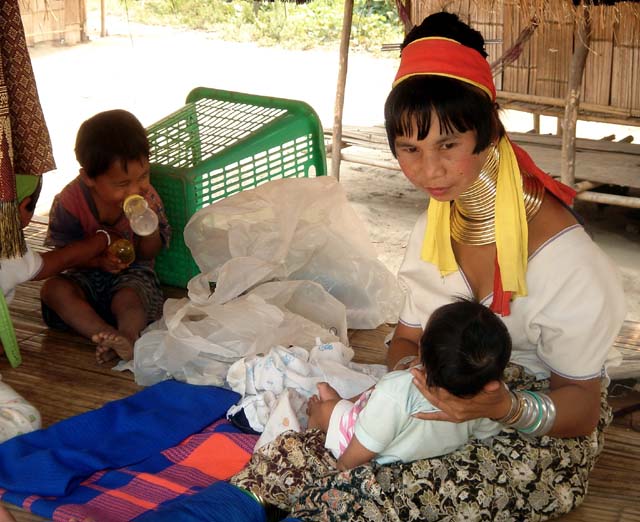

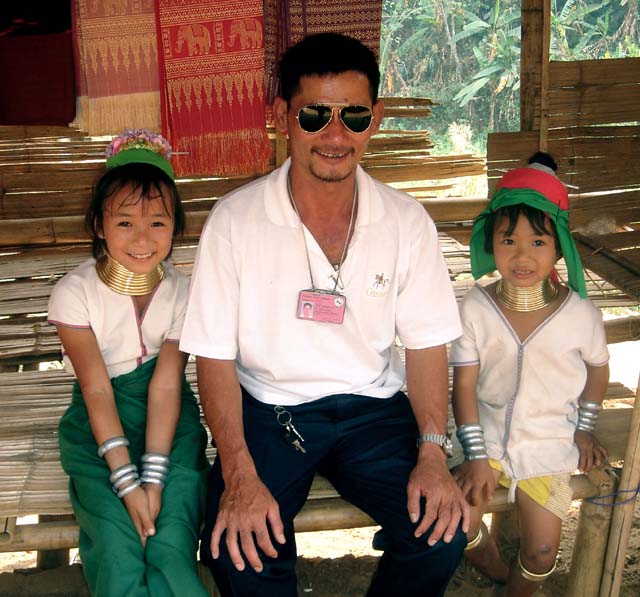
My driver with two smiling Longneck girls.
The last village is Lisu. We park in the schoolyard. Supoat knows the family we visit. The yard, with children, pigs and chicken running free is well-swept.

I notice a chubby woman sitting in a nearby chair…looking miserable. Questioning her we decide she is passing a gallstone. Her husband is out looking for their pig he can butcher to sell to their neighbors so he can have money to take her to the doctor in Chiang Mai. I commiserate with her…I know how painful gallstones are. She kindly invites me to stay and eat with the family but Supoat carefully refuses…we don’t want to trouble the family at this time and we need to be on our way back to Chiang Mai.

Slicing Palm for cooking

Leaving the village we pass under a colorful arch…past small piles of old clothing that used to belong to villagers who have passed on. The clothes are there for spirits who might need them when they come back, I ask. Yes, he says. In the background you can see smoke from “slash & burn” fires that take place this time of year when the locals burn harvested fields.

 Laughingnomad