Hanging Out On Olkhon Island

Urr0g6ZfQ7ttYL19duYJfg-2006170133924757.gif
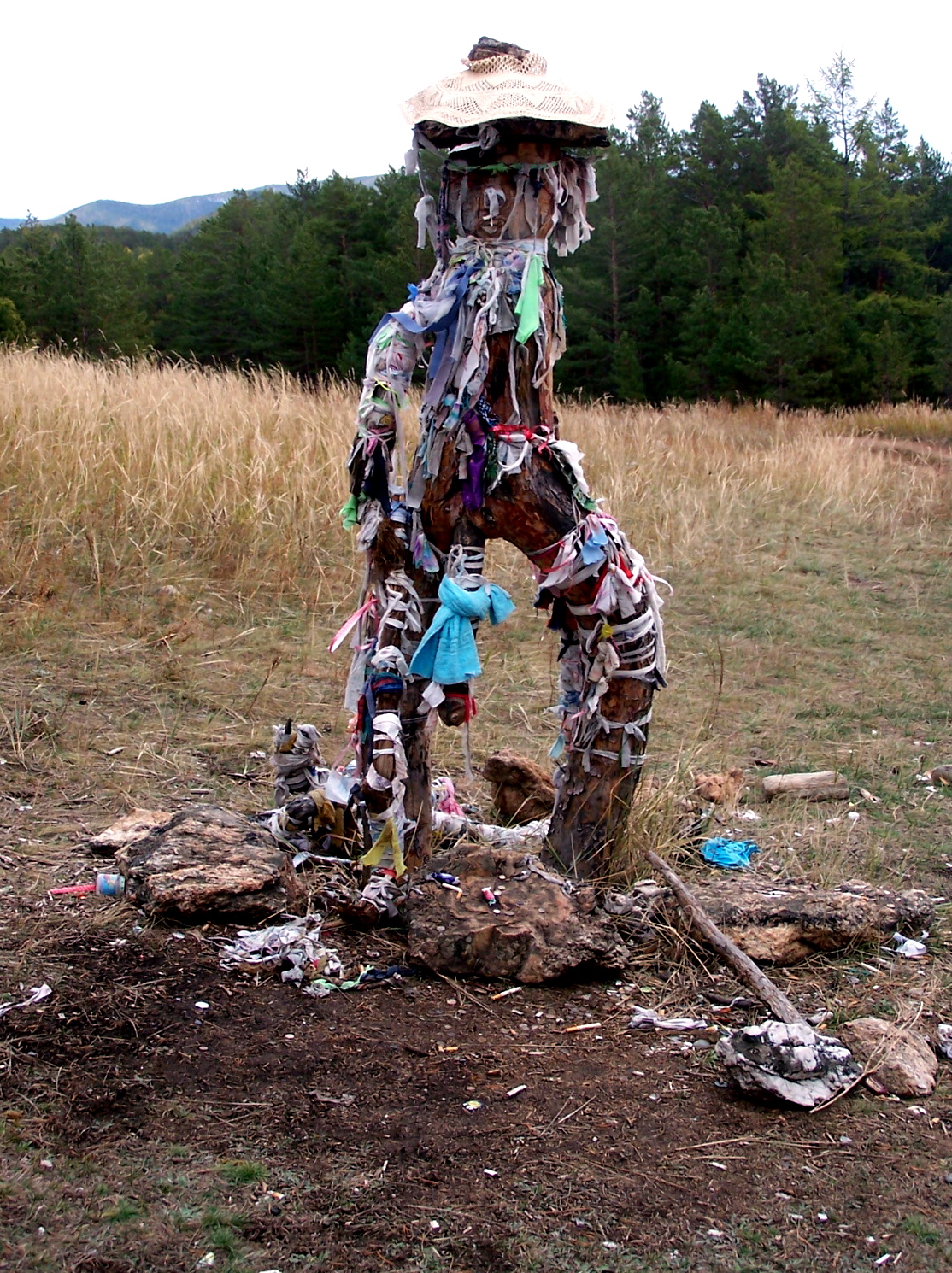
After hanging out a couple days…glad to be off the train…Gregory, a former University teacher of German, drove Bob and I, three Germans and a Pole on a half-day excursion to the north of the 70km long island to visit various geological sites and views of the lake but most especially to see a world renowned Shaman ceremonial circle called Three Brothers that is sacred to two faiths practiced here, Buddhism and Shamanism. Two years ago almost 300 Shamans from the world-over came together here. We lay a one rouble coin at the foot of the prayer flag pole while the “Sarma” or east wind blows fiercely over us.
The Buryats are of Mongolian descent…nomads who spent time herding their flocks between the southern shores of the lake and what is now northern Mongolia. They lived in felt-covered yurts and practised a mixture of Buddhism and Shamanism.

Gregory is driving Nikita’s four wheel drive van…a Russian vehicle designed 30 years ago and that was so successful they used it as an ambulance. “There is only one reason Russians sent the first man into space,” says Gregory the Kamikazi driver thumping over mud hole roads at least 90km per hour…”is because of the roads!” Later he says “we at the moment are using two wheels…if it gets really complicated we will use four!” “Normally we sacrifice two persons…usually 50% survive this trip!” Any of our U.S. vehicles would have rolled over at the first turn but this one mysteriously keeps it’s four wheels on the ground.

We pass through beautiful valleys with sheep and cattle farms…two of which are rich and have beautiful houses “because they don’t drink,” Gregory says. We pass by one small house of an old woman who lives alone with her cow…the rest of the houses in the area appear empty. We are shown an area that was a gulag during the Stalin era and whose inmates produced cans of caviar from the lake sturgeon that was then sent to the Kremlin for the enjoyment of the party bigwigs). I see a straggly triangular three wooden stick affair on the top of a hill and ask Gregory what it used to be. “Local KGB headquarters,” he says throwing his head back in laughter. I ask if the Russians and Buryats intermarry. “Seldom,” he says.

Irkutsk…”Paris of the East”

7yBXvp82X2gVlMeZe25DiM-2006198051115673.gif

Off the train again, we dump our luggage at Nadia’s, our homestay and look for a cafe where there just might be an English menu. We find one…not too expensive…that looks full of the city’s hoi paloi. A tall man in a 3/4 length leather coat and fairly long hair by Russian standards, slowly enters the cafe. He moves almost majestically and sits at the coffee bar drinking a single espresso..jeweled ring on each pinky finger…while he waits for a table…whispering solemnly in the ear of the pretty, attentive waitress. He takes off his jacket and carefully hangs it before sitting down. He has a blue shirt on with pink stripes. I want to cast him in a movie.

Later, behind me on our way to the internet cafe, click, click. I move my smooth slow stroll to the side. Click click, she quickly passes on a mission to some unknown destiny.

To Siberia & Lake Baikal

7yBXvp82X2gVlMeZe25DiM-2006198051115673.gif

Video

We boarded a Moscow train at midnight. We are headed across Russia on the trans-siberian train system. However we will be breaking up the trip by getting off in Yekaterinburg and Irkutsk, with a side excursion to Lake Baikal, in Russia and Ulaan Bataar in Mongolia on the way to our final destination…Beijing China.

The next morning one of our cabin-mates, (there are four of us…two racks on each side of the cabin) Vladamir, starts his day with a bottle of beer. Enjoying the changing colors of the trees as we climb and dip through the Urals our cabin mates and we share all our packed lunches with each other and Vladamir, who knows no English shares his vodka with us. Diana, who is a translator in German/Russian for a Moscow law firm) does speak English, tells me there is no Russian like Frank Sinatra…and that she doesn’t like Antonio Banderas because he is “dark.” (We have discovered that anyone “dark” is called “black” and is discriminated against…as are homosexuals…hardly anyone out of the closet here.)

Unknown to each other, they are both traveling to their home town of Yekaterinburg, the third biggest city in Russia, to visit their parents. On the way our rich Moscow train passes through dirt-poor even though picturesque villages and Vladamir gets off at a town famous for it’s glass factory to buy a set of crystal glasses (about a dozen glasses for about $20) and bag of apples from the sellers who are tapping at our window. Regulars know what to buy at each stop-whether a bag of berries picked by bucket in the forest or a baked chicken from a babushka (grandmother). We even saw men hawking huge chandeliers. One man was trying to sell a stuffed bird with a wing span six feet wide!

An ex-pirate by the name of Yermak, who is recognized as the founder of Siberia, crossed the Ural mountains and challenged the fur traders for control of the land. In November 1581 he raised the Russian flag. By 1900 over a million people had made he long march to the squalid and overcrowded gulags of Siberia and the word, Siberia, came to mean a place for criminal and political exiles.

In 1891 Tsar Nicholas III began construction on the railway from Moscow to Vladivostock on the east coast of Russia near the Sea of Japan. The greater part was built without heavy machinery bu by men wit nothing more than wooden shovels. Nevertheless, they could lay up to 2.5 miles of rail in a good day, according to the Trans-Siberian Handbook. Most of the labor force had to be imported as local peasants were already employed on the land and the workers came from as far away as Italy and Turkey but the Chinese coolies were terrified of the Amur tigers with which the area full and the government subsequently turned to the prisoners in the gulags to relieve the shortage of labor.

The trans-Mongolian line (to Beijing) branches off from the main Trans-Siberian route (to Vladivostock) at Zaudinsky and follows the well worn route of the ancient tea caravans that traveled between Beijing and Moscow in the 18th and 19th centures. In those days traders made the 7865km journey in no less than 40 days. Since the railroad began operating in the mid-1950’s the journey now takes about 5.5 days.
Read More

Traki, Karaites & Kibini Pastry

Trakai, on the outskirts of Vilnius, Lithuania, is a small settlement placed in the middle of five large lakes that is home to about 350 members of the Keraites, a minority community originally from Mesopotamia (modern day Iraq) who later migrated to Turkey. Keraite literally means “reader”. Their religion is a form of early Judaism mixed with reading of the Koran. (Imagine that !!—maybe we should inquire whether they have insights for current situations.)

Traki used to be one of Lithuania’s many capitals and the Keraites served as guards to the palace/castle…which Bob wanted to buy and occupy. We tasted the Karaites’ traditional dish called Kibinine, a small piping hot pastry stuffed full of delicious chopped meat and onions…juice squirting down one’s arms with each bite.

In an area selling crafts I met a woman who was exclaiming over two drunk locals…I asked her what country she was from and she said “San Francicsco.” She went on to say she was enjoying herself “but they won’t take our dollars here!” Speechless, I decided against asking if she had thought of visiting a money exchange window.

Life Becomes More of Adventure

Old Town Vilnius is now on the UNESCO list of World Heritage Sights. Some graffiti seems significant in this country where a staggering 91% of the 64% of the population who turned out to vote gave a resounding yes to membership in the European Union and that just this last April became a full-fledged member of NATO: “Your Life Becomes More and More of Adventure” and “The important Thing Is To Express Yourself!” are examples of graffiti everywhere.

One of the more vivid images of Europe this year, but especially of Vilnius, is the sight of slim, long-legged beauties strutting confidently with an air of success in slip-on spike heels and showing off flat tanned bare midriffs above skin tight jeans that come within an inch of the pubic bone. There are solariums (tanning beds) on every other block…no fish-white bellies here. I asked a young woman in former East Berlin what is behind the styles in dress and she answered “It is self-expression…we want to dress according to how we feel.” I asked if the school authorities allowed the students to wear these clothes to school and she said they wouldn’t DARE prevent us from dressing the way we want to dress!

But on the other hand Sasha, our guide to the Hermitage in St. Petersburg, will say “these are nice girls…not prostitutes…but they have $100 in each eye!” There will be no going back to rigidly defined socialist customs in these countries!

Bob & The Europeans

There is something in the European demeaner/attitude that brings out my anti-establishment posturing. On the flight from the U.S. to Frankfurt (Lufthansa Air) my seat was broken. “No problem,” said the sweet little blond frauline in braids. “We’ll find you another seat after everyone boards.” “Perhaps in first class” I suggest. (87.3% joking but it’s always worth a try). “I DON’T THINK SO” was the authoritarian autocratic response of this idealic frauline now converted to “big nurse.”

On boarding an open top tour bus in Berlin I ask the attendant (100% joking) whether this is the bus to Paris? I DON’T THINK SO.” is the less than friendly response while he is thinking “scheiskoff!” In Krakow our taxi driver parked his upscale white Mercedes next to a bright orange-colored street rod. “Maybe you ought to paint your taxi that color,” I suggested. Predictably…”I DON’T THINK SO!” Suspect that my attempts at humor need a total revamping.

Europeans perceive Americans as large, loud and naive. (This does not apply to me of course.) I think that the Europeans are a bit dorky. Especially men wearing shorts and regular shoes with black socks. Oh well.

Traveling continues to be a learning experience–the perception/interpretation of other cultures as well as our ability to tolerate/adapt/react is a challenge. The language barrier contributes to frustration but that is my problem, not theirs. I’m in their country. Still working on the smile. But occasionally it is difficult to smile when confronted/frustrated. Am going to schedule a session with the Buddah who seems to have a corner on smiling.

Most encounters however are rewarding. And each day offers the promise of a new adventure/experience–and that is exciting. However, it seems that adrenaline rushes are good for a day or two–then need a day of R&R. This sort of thing did not seem as necessary back in my frivilous youth. The R&R days usually are not planned…they just occur as in “crash.”
Later,
RLG

Krakow Poland

EHcDvLBEX5UlHHY96lAFi0-2006185062720933.gif

We are out of the unusually hot and humid Czech Republic. After an all night train we are in cool Krakow Poland. We accept an offer by a young English speaking man at the train depot and end up in a hostel…six flight up…”old building…no lift!”

The historic centre of Cracow, the former capital of Poland, is situated at the foot of the Royal Wawel Castle. The 13th-century merchants’ town has Europe’s largest market square and numerous historical houses, palaces and churches with their magnificent interiors. Further evidence of the town’s fascinating history is provided by the remnants of the 14th-century fortifications and the medieval site of Kazimierz with its ancient synagogues in the southern part of town, Jagellonian University and the Gothic cathedral where the kings of Poland were buried. It is a UNESCO World Heritage Site.

The first night out we look for Polish food and find ourselves in a Hungarian restaurant instead!

The next night we move to a nice little Jewish neighborhood-Kamimierz-with little cafes and jazz music up and down the street…and Internet hot spots to boot! There are fewer than 150 Jews in Krakow now. Most of the hotels in this neighborhood are full of young people from Israel visiting Auschwitz and Bzerzenka…surrounded by big burly bodyguards…

By the way In Poland, if you’re invited to dinner at someone’s house and you’ve had enough to eat, DO NOT clear your plate! This means that you want more, and your hosts will really get their feelings hurt if you refuse another helping. Same for drinking–always leave a little bit in the glass.

Former East Berlin

I am off to Starbucks to spend an hour over coffee while checking my email but their Hotspot internet service is down. It’s a good time to revisit the former eastern sector of the city. Berlin’s architecture is stunning…old and new. Cranes hang suspended everywhere over the city. The Wall fell in 1989 and Germany has not looked back.

The West German Bundestag moved the capital of Germany from Bonn to the eastern sector of Berlin located in the middle of former East Germany and from a former wasteland has sprung a new urban district…a symbol of Germany’s Unity and the country’s success. The Brandenberg Gate is fully visible now with only strips of stone inset into the streets and sidewalks to show a new generation (dressed in retro east German clothing to tweak their parents) where the Wall once stood.

Concrete grey Friedrichstrasse in the former east sector is now the new hip place to be…hardly remembered from my 1965 trip to Europe. I asked a young English speaking guy “(I am German American,” he says) in a music shop to suggest some popular Berliner music but came away with two interesting “out there” Norwegian jazz CD’s.

Checkpoint Charlie that in 1965 released me and a friend from the American sector into the grey colorless landscape of East Berlin is now a tourist site.
Read More

Email From Paul In Ruilli

YUqE3FCf1Hd9CjfG1qqmt0-2006171132705308.gif

Before we left Chongquing Jana and I got an email from Paul, one of the Ruili kids. Jana and I were both very touched that these kids considered spending time with us so special that one of them even forgot about his own birthday! How many 17 year olds at home would spend an evening with two older women? When we were leaving Ruili, Paul had said to Jana that Chinese people feel sad at parting. When Jana said that we do too, but in so short a time we have become friends, Paul responded by saying, No, it does not take a long time. The email is best read in Paul’s own words:

Eunice, Jana:

howtimefly
I feel very happy, because
i can receive your email! i have told my parents message about you! They feel very move! i know, you are old, however, you are healthy, but you don’t afraid difficulty, from the U S A to China! Do this need nerve!
My mother is 43, i know women’s age is a secret, but she does not mind! she want to travel, my father agree her, but she said to me: i’m afraid.’
This is a chinese’s word about travel.
Why the USA is a developed country, but China is a developing country! problem in there, thinking!
Now is 23:27, my mother asks me to do homework, i
must go now!
Finally, i hope i can see you again, i represent duan na, fantasy, stv thank you again, thank you give us so wonderful time!

yours: paul
good luck to you!

Perspective On China

China is big.

The population is staggering with a billion and a half people. It’s a matter of getting perspective. Our home state of Oregon only has about 1.5 million people. By comparison Hong Kong has 7 million. Westerners hear mainly about the Chinese cities of Hong Kong, Beijing and Shanghai, but Guangzhou, the first mainland city we visited two hours north of Hong Kong is a westernized city of commerce with nearly 7 million people…it’s province of Guangdong having 46 million. Kunming, which reminds us of Denver Colorado…a mile high, cold but sunny…has nearly 4 million people but its located in rural province of Yunnan that has nearly 44 million people.

Guilin has nearly 1.4 million people…it�s province of Guangxi having nearly 75 million. Yangshuo, an hour south of Guilin, felt like a small village in comparison with the bigger cities but the guidebook shows it with a population of 300,000…bigger than our home town of Salem, Oregon.

Chengdu has over 11 million people but it’s province, Sichuan, has 109 million. Chongqing, the city where we started our Chang Jiang (Yangze) River trip, is a sophisticated lively city that reminds us of San Francisco with 5.8 million people…it�s province having 32.5 million. You get the idea–lots of Chinese folks—and lots more on the way even with their one child policy. Ultimately a formidable group.

How is China Doing?
As near as we can tell, China’s cities and it�s citizens are doing well. The significant story is in the poorer rural areas where only 10% of China’s land mass is capable of agriculture…encouraging genetic engineering of food to force an increase in production and where unemployment and disastisfaction is high…and where China’s leadership will continue to be challenged by demonstrations that are never reported in the Chinese or Western press.

The arguments against the Yangze River dam pale in comparison to the country’s need for electricity…and in comparison to the economic power China will become because of it. Mao Tse Tung decreed nine categories of enemy: landlords, rich peasants, counterrevolutionaries, bad elements, rightists, traitors, foreign agents, capitalist-roaders and…The Stinking Ninth…intellectuals. The motto then was “Serve The People.” “To Be Rich Is Glorious” is the motto used now by a new practical generation…the first to grow up with no spirituality, no Confucius and no interest in politics…unhampered by religion and it’s dogmas-Taoism, Buddhism and even Christianity-unhampered by emperors, by chairmen, by gods.

China’s youth wants democracy and freedom. But the Chinese “never know when to stop,” says Paul Theroux who recounted his trip through China by train in the 80’s in his “Riding The Iron Rooster.” Where will the brakes come from when China is headed toward excess…in a China already plagued by corruption?

When I asked one of the teenagers in Ruili if he could go to Hong Kong if he wanted to answered “No Money…No Happy!” Another, Paul, a teenager who plays the guitar in his rock band, when asked what he thought about Hong Kong, answered: “Paradise!” You Western capitalist running dogs…look out for the younger generation in Communist China…the generation that is so excited that they are finally free to work hard…free to put money in their pocket…already making materialism in the West look ascetic.

I would love to have a conversation with Ma Jian, the poet, painter and writer who, being harassed by communist cadres, left Beijing in the early 80’s and traveled through China for three years. In his book “Red Dust” Ma foreshadowed the thinking of the next generation when he recounted his thoughts after getting lost and nearly dying in a desert: Walking through the wilds freed me from “worries and fears, but this is not real freedom. You need money to be free.”

When, after a student demonstration in the 80’s in Guangzhou, Paul Theroux asked Andrew, a university student, if he expected to become a capitalist-roader, Andrew answered “I think we have a lot to learn. We want to use the good features of capitalism but not the bad ones.” “Is that possible? Paul asked. “We can try” Andrew answered. Maybe it is only fair that now China gets it’s turn to try…