Strangers in the “hood”

I’ve never been in a city that has such diverse but tight little neighborhoods. The first question asked by anyone you meet, after what do you do, is where do you live. Soon you know the tenant up the stairs, the cashier on your corner deli and some of your neighbors at the yoga salon on your block..it’s like a little village…you belong…here.

One way to identify the subtleties of a neighborhood is to attend it’s summer street fair. The fair in our neighborhood, called Atlantic Antic, stretched all the way from the Brooklyn Art Museum to the East River…almost two miles. There were the usual food stalls (mostly Soul and Jamaican), beer stations and sidewalk clothing displays (many hand-made African motif). Every 20 feet or so a different music group blasted out African drumming, old-style singing like the Ink Spots of years ago-the vocalists sporting hot pink and lime green jackets, hip-hop, soul, jazz and rock.

There was table after table with information about the local arts activities, local pre-school and kindergarten opportunities, school events, parent organizations, nanny services, environmental concerns, local zoning issues, and all the rest of the latest local political advocacy efforts. Even the candidates for the upcoming New York City mayoral election dropped by. Children everywhere…on backs, on fronts, on shoulders, in strollers, those who could walk running amok. Hillary Clinton’s “It Takes A Village To Raise A Child” has taken on a whole new meaning for me!

Each neighborhood has it’s subtleties. Many of the stalls offered African clothing and jewelry that were hand-made by their sellers. I was trying on a pair of earrings and sharing a mirror with a middle-aged lady in one small stall and suddenly she turns and says to me…”this is so much fun! I just love this fair! Love it! We never have anything fun like this in our neighborhood.” “Where do you live?” I ask. “Queeeeeens,” she grumbled! We both laughed, although I didn’t quite know why I was laughing…I guess just because she was laughing. We haven’t spent much time in Queens yet.

Bob was finished with the fair, however, as soon as he was confronted head-on by a large group of police with a few others circling around behind him. Apparently we had been followed. Bob had been video taping the fair as he walked along…panning the people and stalls of goods along each side of the street. One of the young policemen approached Bob and asked what he was doing here. “What is the problem?” Bob asked, oblivious to any criminal activity. “Why are you taking pictures of this?” as he pointed toward the sidewalk and the buildings. Bob was becoming progressiely nonplussed. The cop said, “that building.” Bob said “what, where?”

We hadn’t even realized we were in front of the Post Office! Bob then explained that he was just panning and video taping the street fair. “You can’t take pictures of public buildings,” the cop said. “Oh, then we aren’t supposed to take pictures of the Empire State Building or Ellis Island or the white house,” Bob thought. Bob, by this time was wondering “why me?” and he was finished with the fair. The last similar confrontation for Bob was in Dar es Salaam Tanzania. But that time the phony cop was after Bob’s wallet. The offense was photographing public buildings (also a post office in Dar).

We are still asking ourselves what it is that is causing people to regard us with suspicion here. I certainly don’t think we fit the typical terrorist profile–but then we are not your typical “local” either. Or maybe there is just some reverse karma regarding postal institutions.

The New York Attitude

The New York attitude is a lot more complicated than simple rudeness. According to a local, it’s a mixture of being tough, brave, on your toes, jaded, overworked and intensely focused. Who needs to be pulled into a conversation or potential conflict with a crazy person. Why would I want to be waylaid with small talk when this 15-minute commute is the only time I have to myself all day?

But beneath all those jaded exteriors where no one is making eye contact, beneath all those masks, there is a sense that those who live in New York are all in this together…whether waiting for the next train rerouting, watching the homeless man tap-dancing through the subway car or waiting for the next 9/11.

One evening I sat next to a twenty-something on the subway who was reading a Chiang Mai Thailand guidebook. When I asked if she was traveling there (so much for not talking to subway riders) she flashed a quick smile and asked if we had been there. We just got back from Thailand a month ago, we said. Then she wanted to know which neighborhood we lived in in Brooklyn (usually the first question you get). She wanted to know if we had any suggestions for a guesthouse with it’s own bathroom. Bob referred her to a place he had stayed that also offered reasonable mountain hiking tours among the indigenous villages…just what she wanted. Have a great time, we said as she got off in her Brooklyn Heights neighborhood.

I think the tough outer shell that many New Yorkers adopt is out of necessity. How else to keep your sanity intact in a city that’s rife with all sorts of people. Busy, overworked, highly focused and goal-oriented locals must balance a skittish energy with surviving in a city where it is difficult to succeed…where just the apartment rent will often suck as much as three fourths of their income.

Service workers are efficient and task oriented and come off to us friendly Left Coasters as downright cold. On the other hand, when I want to be outside our apartment sometimes I will sit on the stoop and read the paper. To my surprise, about 30% of the people walking by will look up and say good morning or good afternoon. But then I am in their neighborhood. On a certain level I have some sort of an identity.

People in big cities in other countries of the world do not seem as cold, distant and rude, Bob and I say to each other…but then I think that even though we often wish service workers in other countries would be given training in customer service, there is not the added pressure coming from the efficiency ethic in those cities…and as a whole the people are ethnically homogenous so that social interactions are already predictable, easy and nonthreatening.

But this is my take and not Bob’s. Bob thinks that it is a learned, conditioned behavior and has a cascading effect. If people are nasty to you several times each day then it puts you in a nasty mood (fragile, friable and ultimately bitchy) and it snowballs from there…like coming home and kicking the dog when someone at work yells at you. Anyone with any other ideas?

Third Culture Kids

Third Culture Kids are children of expatriate families who live for a significant proportion of their lives in a culture other than their own, where they travel to many countries other than their own passport country. This results in the adaptation and incorporation of certain characteristics from a variety of cultures into their own personalities.

These kids were first studied in significant numbers by sociologists in the 1960’s and the initial subjects were drawn from American children of missionary, diplomatic or military families. Other terms that have been used are Global Nomads, army brats, transnationals, transculturals, and internationally mobile children.

Researchers discovered that overwhelmingly and across the globe TCKs merge their birth culture with the culture of the host countries they’ve lived in to create a third, very distinct culture of their own. What was surprising was that there were also a distinct set of personality traits exhibited that were not dependant on the countries in which they grew up or their family background. In other words, an Australian missionary kid who grew up in the Philippines, Zambia and Brazil, would share a distinct set of personality trais in common with a Swiss diplomat’s child who had lived in Japan, America, Fiji and Spain. These trais were defined as being ‘third culture” thus giving birth to the term “Third Culture Kids.”

The major problem that TCKs face as they grow up is to define where they truly belong. They are products of the sum of their experiences, rather than a product of the native soil of their passport country. Their multicultural upbringing encourages a stronger worldview and well-developed cross-cultural skills. These kids are able to get along with people of many different races. Having a less clearly defined sense of belonging to one definite “us” means they are less comfortable with dealing with a foreign “them.” They are able to view events from a wider perspective, more used to adapting to the view points of the people and cultures where they have lived as well as to the views of the people of their passport country. Some TCKs, however, experience rootlessness and a constant, unresolved grief due to the loss of contact or breaking off of relationships. Life becomes even more difficult for them when they go back to live in their own country where defining social signifiers like fashion trends and music have changed.

Even those of us in the West who travel to many different countries over a long period of time as adults, however, often find ourselves developing a “Third Culture” personality, more elegantly described by Pico Iyer in his book “The Global Soul.”

For more information you can visit www.tckworld.com.

Thainess And The West

The July 2005 edition of the slick upscale magazine for English-speaking foreigners called The Big Chilli ran an article with interviews of prominent Bangkok residents to get their views of what constitutes Thai culture. Two were Thai and two were western expats living permanently in Bangkok. This is what they had to say.

Jai
Korn Chatkavanij, a member of the Thai Parliament, believes that the Thai language and way of life has more to do with the soul than the surface. There is no English equivalent to the Thai word “jai” he says, but the closest you can come is “heart.” William J. Kausner, Professor at the Institute of Security and International Studies at Chulalongkorn University adds that the core element of the traditional Thai persona is the “cool heart” where “one is enjoined to preserve a sense of emotional equilibrium, treading the Buddhist ideal of the Middle Path, avoiding both extremes and overt expressions of socially disruptive emotions such as anger, displeasure, annoyance, and hatred. Confrontation is to be avoided at all costs as any open and direct conflict makes Thais psychologically uncomfortable, says Professor Kausner.

Mr. Chatikavanji says that this lack of confrontation makes Thai culture more tolerant…willing “to roll with the punches.” This, then, makes Thais traditionally adept at indirect expressions of antisocial emotions through gossip, anonymous letter, pamphlets, etc. says Professor Klausner.

On the other hand, Ms. Khunying Chamnongsri, an author, poet, social worker and Chairperson of the Rutnin Eye Hospital says that tolerance comes naturally from the inside. “It doesn’t count if it is done consciously. This can be seen through the Thai ‘wai’ (bowing to another in greeting with hands together as if in prayer,) not touching people’s heads or pointing with your feet.

Relationships and Inclusion
“Foreigners are often surprised when Thais ask them their age, because their ego feels that their privacy has been invaded. But Thais ask this question, Ms. Chamnongsri says, out of a sense of friendliness and inclusion, extending sister and brotherhood. In the old days, and often even now, a friend will immediately ask if you have had something to eat and if not you will be offered food…even if it is only a glass of water. In rural areas you see jugs of water in front of homes with long stemmed ladles so that people can help themselves to a drink. “This all shows a sense of inclusion, concern and welcome. We don’t have a strong sense of self-centeredness or egocentricity since throughout our history people have lived together very much as communities creating a notion of extended family,” says the professor.

Philip Cornwell-Smith, author, says that Thainess is all about relationships which will trump the economics or rules of the situation every time. It comes from a different logic based on a sense of loyalty and kinship rather than on abstract principles, leaving people from other cultures startled by Thai choices and behaviors.

Way Of Life
Thais are not an ideological people, says Mr. Chatkkavanji…adding that most of the world’s problems have been caused by ideology. “We talk more about a way of life and have a general feel of what we need to do to get along. Since we don’t confront we try to find ways to compromise. This is a key word in Thai society and it infuriates ideological youth.” Equilibrium, anti-confrontation and emotional detachment are seen by Thais as positive aspects of Thai society.

Sanuk (Fun and Play)
Play, says Philip Cornwell-Smith is a fundamental Thai value that continues all the way through life and is not viewed as being a childish thing. Len (play), and deun len (walk play) means going around just wandering and looking at things. My son’s wife is always saying “lets go look around.”

Status Consciousness
Professor Klausner goes on to say that Thais accept their hierarchical order of society whether a person is on the lower or upper rungs of the socio-political ladder. It is interpreted as a justification for continued unaccountable control by those in power and acceptance by the disadvantaged of their exploitation.

Respect For Others
An innate respect for others is a part of Thainess, says Khunying Chamnongsri. “You can see it in gestures, smiles and what you do for others and that this contributes to Thai success in the service industry. “Krengjai” is the moral imperative to be considerate towards and avoid bothering or offending others, as well as the traditional value of “katanyu” or gratefulness towards one’s parents, teachers, and others who have protected or supported you. The Four Sublime States of Consciousness: compassion, loving kindness, sympathetic joy and equilibrium are central to Thai culture so they value not hurting or impinging on the well-being of others,

Contact With The West
At present, Professor Klausner says, there is a burgeoning civil society which wants to change the rules of the game by substituting equality and individual civil and political rights, for status; and popular participation, the rule of law and good governance, for unaccountable power.

Ms Chamnongsri laments that Thai values are not as present as they used to be. “Times change,” she says, “and there are both positive and negative influences that come with the dynamics of cultural interchange that contribute to today’s fast paced life, the breaking-up of extended families and the new values of materialism.” “Copying the ways of the West, believes Korn Chatikavanji, “will inherently destroy the Thai way of life. Politicians don’t think about happiness as much as they do about development and economic growth. Do people really want to create an ‘American way of life’ here in Thailand,” he asks? “90% of Thais would say no, so we really need to define Thainess. As Anand Panyarahchun said 15 years ago, ‘There is no Thai or Farang way. There is only the right or wrong way.'” Professor Klausner believes that Thai traditional attributes will assure that a more individualistic and egalitarian society that emerges is still one where respect, graciousness, gentility and civility prevails.

Exposure to Thai culture is a gift to those of us from the West who visit Thailand.

It is July 2005 and the end of this travel segment…I will fly back to Los Angeles from Bangkok on China Air and then on to Oregon for a month where we will repack and fly to New York on JetBlue at the end of August to sublet an apartment in Brooklyn until January 2006.

A Harley in Viet Nam

1wXSp3CkNsDoJl3s0SgHmw-2006171162818157.gif

June 10, 2004
While I was in Bangkok Bob flew to Vietnam. He wrote to say he had difficulties accessing the web today and spent most of the day traveling.

His emails:
Now in Da lat in the mountains about 300-400 km north of Saigon. It is at a 5000 foot elevation so cool–in fact feels cold. Probably about 55 degrees right now–everybody in a jacket. Feels like central Oregon and after the heat/humidity combo in Hanoi it is quite refreshing. I am at an internet cafe surrounded by adolescents screaming at success/failure with video games. Tiz too much–later.
B

June 11
good morning:
have been roaming around Dalat—much embroidery art done here–quite nice but also can have a hefty price–saw several landscapes that I liked–might pick up a small piece–just to have a representative sample. Bought several pieces in Hanoi–I really like their style of art.

Approached by a fellow this morning–call themselves “Easy Riders”–have big bikes and arrange trips off the beaten track–tempted to have him take me to Saigon via the Cambodian border and the Ho Chi Minh trail–he can also extend things to the delta (and probably to So. America for that matter)–he is 45-50 in age and has been doing this awhile. Am tempted as it would take me to areas I would not otherwise see and I am tired of the usual tourist routes. It would mean 300-400 km on the road and the limiting factor would be the ability of my butt to withstand several days in the saddle..

June 12
Another nice day in Dalat. It is a major tourist destination for Vietnamese—with it being a weekend the place is packed—had to inquire at three hotels before finding a vacancy…in evenings they close off the downtown streets to vehicles and streets/plazas are packed with people just walking and people watching. Not much to buy re handicrafts etc. but wonderful produce — however do not see it offered in restaurants. Am tired of Vietnamese cuisine and am overdosed on French bread.

NOTE: Next few days Bob spent in bed with some kind of virus….Bob worried about influenza-like syndrome and me thinking it was probably Dengue Fever as this is the season for it.

Sat June 18
hello–
Was going to leave Dalat today by bus for Saigon. This a.m. had second thoughts and decided would be much more fun and interesting and educational to do the bike thing. Tried to find my rider (named Budda–because his stomach and somatotype is identical to the icon) but could not arouse him by phone–he probably ditched me for other customers so went down to the local easy rider hangout cafe and there were at least a half dozen of the “boys” there. They start out by being very cool but then the pitch begins . I had experienced it twice before so he (Thui) was surprised when I cut to the chase, “How much for 3 days?”. So to see whether I would be able to tolerate we agreed on a sampler package of a day trip around Dalat. It worked out well–he is safe… informed, understandable (re accent), non-invasive and 48 yr/o–but looks 55 to 60.

Weather turned inclimant and last hour on the bike was wet. Purchased a plastic pancho but was totally saturated at the end of the trip. Was informed that my previous illness was do to too sudden climate changes, that there was no possibility that it could be bird flu because that entity does not exist in Vietnam! I was instructed that on return to hotel that I must wash my hair to get all the rainwater out so that I do not come down with any other ailment(s).

Tomorrow leave for 3 day trip to the coast just East of Saigon–he does not want to get closer because of increasing traffic and I appreciate his concerns. I will travel remainder of distance to Saigon by bus. So depart 8 a.m. tomorrow–I look like a Harley biker going down the freeway. Not sure how we’re going to get all my luggage on the bike but he says, “no problem’. Will not see internet again until Saigon.

NOTE: my daughter-in-law, Luk, a Thai, has also warned me to wash my hair after a rain. She said when it first rains there are bad chemicals in the rain that can hurt you. She could be referring to Acid Rain?
Eunice

Inconsistent Thai Values

After nearly a dozen visits and about six months time in the city, over the last several years, we have gotten to know Bangkok a little. In this city with a population of over 9 million people we can get anywhere we want to go…as long as our destination is near the Skytrain, subway line and boat ramps or as long as we can communicate with the taxi driver. Haven’t braved the buses yet but we do take the motorcycle taxis back and forth down Sukhumvit 22 to our dentist at the end of the street…surely risking our lives in the process!

It’s interesting to watch the people embarking public transportation in Bangkok. They stand politely aside as they wait for debarking travelers to get off before they step into the trains. (In China it’s an all out battle of people coming off against the people trying to get on!) Once on, people are usually very respectful…if they are Thai…careful not to bump each other.

One jaw-dropping gesture, for an American, is that anytime a small child embarks a crowded Skytrain or subway car with packed adults standing cheek to jowel, the nearest adult of any age will quickly jump up and invite the child to take his/her seat…leaving the beaming child to look up at it’s parent as if to say, I am really special today aren’t I?

We have never experienced a culture that has such implicit respect for their little ones. You never see adults scowling at children or admonishing them…in public at least. Children always get an admiring glance and an enthusiastic accommodation from adults around them. The interesting result is that you never see an unruly child. This is very humbling to observe. At home we often see parents humilating their children in public by yelling, shaking and even slapping or spanking them.

On the other hand, it is common for young women in small villages to leave their children in the care of others while they exchange sexual favors in Bangkok. A pretty young woman who was perming my hair, works in an upscale hotel beauty salon during the day and as a bar girl at night…her parents left to care for her two children in her northern Isaan village. It has been said that as many as one out of thirty very poor young women, who do not consider themselves prostitutes, will trade sex for money, dinner and shopping from the nearest Western or Japanese or Korean “ATM man.”

This activity often has more than the usual side effects however. Sadly, Thai women are often overcome with depression. It has been said that once Thai women consort sexually with a Westerner, the local Thai men will not have anything to do with them and they often remain single and without any way of supporting themselves. The Bangkok Post this week reported on a 23 year old young woman who had jumped from the Skytrain to her death on the pavement below because, her friend reported, her Western “boyfriend” had just broken up with her. From the point of view of the Western male, the gratitude and soft sensuous, accommodation of the Thai woman is a welcome relief.

I asked my friend, Jiraporn, a university professor here, who lived ten years in the States, what she thinks about this. “They are young and don’t know what they are doing. “Village families are poor and need the money the girls send home so everyone just turns their heads, she whispered kindly.

Trekking Northern Thailand

gatQye8keZlS3vpnwrOvxg-2006186163905868.gif
As soon as we returned to Bangkok from Bali Bob took a train to Chiang Mai for a trek in northern Thailand near Mae Son Hong. I stayed in Bangkok to have some dental work done. This entry was written by Bob.

Chiang Mai is Thailand’s second city and the jump-off point for experiencing the northern hill tribes.
100_3454.JPG

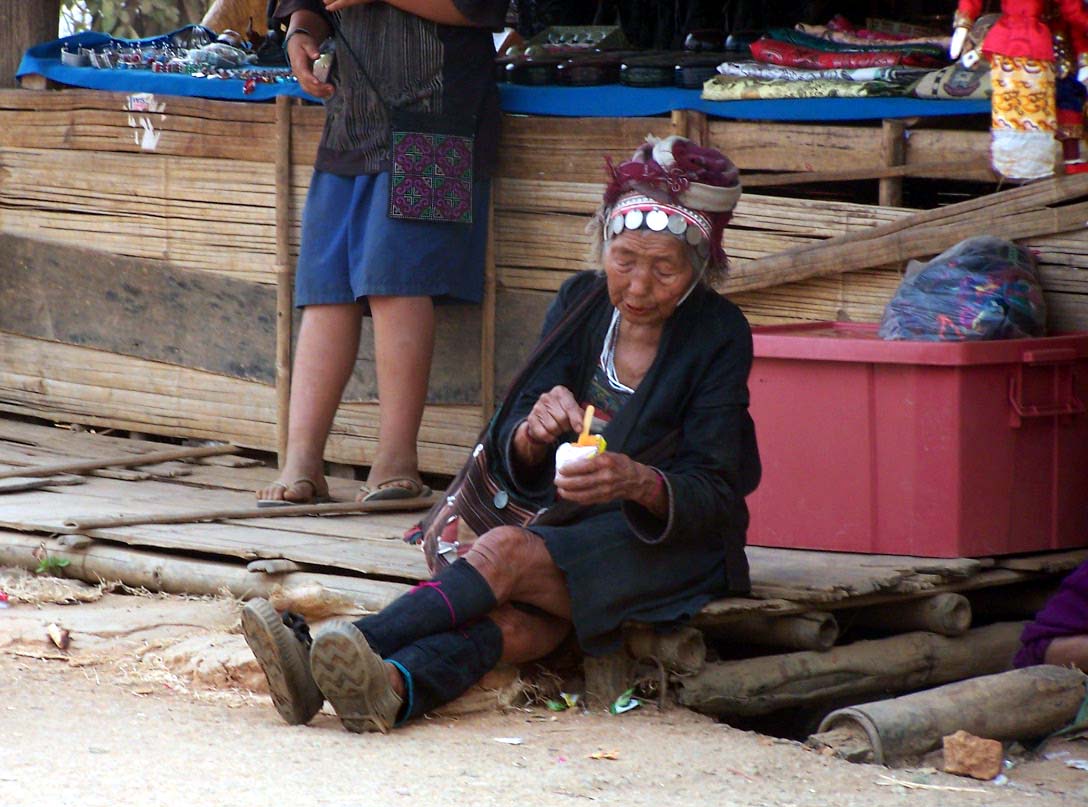
Mae Hong Son is in the trekking area–but quite a ways from Chiang Mai–drove there with several treks en route and spent one night in the town. There are many ethnic tribes–most renowned being the long necked ladies. When I was there not many tourists as it is hard to get to. We subsequently flew back to Chiang Mai–but that was included in the package. Did this on one of my early trips. On that trek we would walk for a day or two, spend nights in tribal villages and the van would pick us up at a designated site. Then onto the next trek–also did a little rafting but no rapids.

These peoples owe allegience to their ethnic group and national boundries are of no signifigance. They originally migrated from China and Tibet and now reside in southern China and in a geographic band across the north of Burma, Thailand, Laos and Vietnam.
100_3585.JPG

These tribes have taken taken advantage of the tourist influx and now offer their villages and homes as overnight lodging for trekkers. As they live in the hills there are no roads, autos and access is strictly by foot. So after a couple of days re-exploring Chiang Mai (its growing big time) I joined 5 other farangs (European and half my age) and a Thai guide for a 4-5 hr ride in the back of a pickup to the trailhead for a 3 day trek.

The walking is relatively easy but the heat/humidity combo is a killer. In 5 hrs we reach a Karen village, are given lodging in a bamboo slat hut and offered a “shower” from a barrel of cold water using a laddle to pour water on whichever body part is selected. A simple meal is offered–tasty but usually best not to ask what it is. Market comes to us as the local ladies show up with their handicrafts. The children run about and giggle at/with the strangers. During the night a pig was the victim of a noisy slaughter as the next day was a festival (new years).

On the previous trek along the Burmese border we had been invited to a wake for a child who had died that day (probably from congenital heart disease). But alcohol became the focus of the event and we made a hasty departure out a side door as belligerence unfortunately replaced festivity.

The next day of this trip offered many stream crossings over narrow logs and I was made suddenly aware that balance is one of the skills that diminishes with advancing youth. Oh well! But we made it to the waterfall for a rewarding swim and that night barbequed a suckling pig.

The last day offered a ride on a bamboo raft through several small rapids and the obligatory elephant ride (once is enough). My less than friendly elephant was named Toby with her cute baby following along behind. I kept thinking that I should have a seat belt. Toby, however, was sure footed, enjoyed the sugar cane and bananas that were sold at intervals along the route.

Mae Sai is just a border town in the far north I went to on another trip. Across the bridge is Burma. It is not a primary trekking destination. Used more for visa stamp-outs and Thais purchase stuff (primarily pornography I think that they cannot get in Thailand–or at any rate saw much of it being confiscated by Thai immigration.) From Chiang Mai it is part of a day trip –in a van–that also includes the Golden Triangle (people stand and have their picture taken under a Golden Triangle sign) and Mekong River/Laos border area. A boring trip.

Tip: The trips out of ChiangMai have become a bit too packaged and westernized–now include the obligatory elephant ride and a raft trip which is a token overcrowded experience. Ok if one has never done it but better if you are able to get off the beaten track like the trip to Mae Hong Son.

Sights And Ceremonies

The Balinese are Hindu…but a Hinduism that is overlaid by ancient animist beliefs…a world away from the Hinduism as practised in India. To the Balinese, spirits are everywhere and offerings are put out in shrines in every field and on the street in front of every home and shop to pay homage to the good spirits and to placate the bad ones. A few sticks of incense are stuck in among some fancy food and various flowers that are carefully laid in little hand-made reed trays. Once the gods have eaten the essence of the food it is left discarded.

One afternoon on the beach, amid a crowd of chanting and drumming Balinese, we saw two men with 12-foot long propane torches burning something through the open ends of a colorfully decorated large bamboo “box.” After a few questions from some on-lookers we were amazed to discover that a cremation was taking place. DSC00367.JPG
The body of a 12 year old girl had been carried on the shoulders of several men to the cremation ground in a high, multitiered tower made of things like bamboo, paper, string, tinsel, silk, mirrors and flowers. Along the way celebrants, followed by a noisy gamelan sprinting along behind, shook the tower, run it around in circles, spinned it around, threw water at it and generally created anything but a stately funereal crawl…all precautions taken to confuse the deceased spirit and ensure that it would not find it’s way back home. Male relatives did their duty by poking around in the ashes to make sure that no bits of body were left unburnt…which actually took quite a long time. And where did the spirit go? Why to a heaven that is just like Bali!

Vibrant Bangkok

Bangkok Air From Koh Samui to Bangkok again. Not a pretty city but it’s vibrant. The populace, as with much of Asia, lives outdoors-almost all 10 million of them. It is increasingly cosmopolitan and this year seems to have more farangs (Westerners) than I can recall in my several former visits here.

It is a paradox of a city. Some big money and big establishments with big prices but the vast majority is poor and the cost of living (by most western standards) is inexpensive. Traffic predictably chaotic with frequent gridlock. Travel by sky train and new subway system redeeming (and air-conditioned).

Walking is an adventure with uneven and poorly constructed sidewalks, often with holes, open pits, and unstable underfoot tiles– exposed haphazard electrical wiring and the mangiest dogs anywhere –all of them breeding exponentially. Hard to tell if they have any owners. Half of the dogs have orthopedic disability either from vehicle vs dog and/or intracanine squabbles. They sleep on the sidewalks during the day and roam at night occasionally in packs that cause a pause and change of direction for us pedestrians.

Shops, vendors, food stalls on wheels, open front restaurants, open sewers, tuk-tuks; all contribute to a cacophany of sound and smell that paradoxically continue to be both enticing and repelling. Bangkok is not renowned for it’s aesthetics. It is visited for it’s populace…the Thai people.

Smiles and accomodation prevail—but who knows what is lurking beneath…best to accept the presentation at face value and not analyze. The attitude, dictums of the Budda prevail. Mei pen rai (“whatever”).  As a passenger on a motorcycle taxi the driver, without looking, pulls out and speeds into the flow of traffic. “Slowly, slowly”, says I. “Mai pen rai, Budda will take care of us,” is the nonchalant response. The concept of liability has not reached these shores. Persons or events are either lucky or not lucky. Inevitable comparison of societies is fraught with subjectivity and tilted by one’s biases. Perhaps it is best (and more just) to live and let live. Enough. RLG

Miao Village In Guizhou

1wXSp3CkNsDoJl3s0SgHmw-2006171171225701.gif

In Shanghai, exploring the Lonely Planet Thorn Tree web site, I noticed a query from a young woman from Kaili in Guizhou Province who was offering to arrange a homestay in a Miao minority village in the mountains. We exchanged emails and I was excited to meet her. But then I received an email saying she was in Shanghai and could we meet for the train ride to Guizhou in a couple days. I returned that I couldn’t leave that soon but I could meet her in Kaili…then I never heard from her again. A mystery…or maybe she got an offer from someone to pay her fare back to Kaili…who knows. But I knew where I was going next! From Shanghai I flew to Guiyang, capital of Guizhou Province and stored my baggage at a hotel there before boarding a bus for the three hour ride to the city of Kaili.

When I got off the bus there, I was directed to another station around the corner with several rickety old buses waiting for passengers to various villages. I had no idea which bus would take me to Xiuang, the village I had been told by the English-speaking receptionist in Guiyang that would be celebrating their New Year’s holiday. Then I saw a smiling family waiting near one half-full bus. “Xiuang,” I asked. Yes, they nodded. But while we were waiting to board, a couple of men outside a nearby fence a few feet from us motioned us to approach them. It gradually became clear they were taxi drivers that wanted to take us to Xiuang. Between my motions and their language we all agreed to share the cost of the taxi so we piled in and were off…on a harrowing short-cut along steep mountain dirt roads with thousand foot drop-offs…to our village!

The people in the mountains in this southeastern Chinese province are not Han Chinese. Eighteen different minorities live within Guizou province and I was here to visit the Miao people in this gulley-like valley with identical hand-hewn wooden houses climbing the hills on all sides.

209915718_a429a4e0bb.jpg

209926509_dec6fd2f3f.jpg

The wooden houses are built on foundations of stone and constructed with wooden pegs…no nails or cement. Steep paths meander among the houses.

After some initial quandry as to where a hotel might be, if there was one, I came across a woman who led me to a small building…who would have thunk it was a hotel…for about $2.00 for the night. I was invited to join the family around their hotpot dinner downstairs…had no idea what I was eating but I was starved and it tasted delicious with smiling faces all around. No extra charge! There was no heat in the freezing room that night so I took the bedding off the other twin bed and added it to mine.

There are at least 130 different types of Miao people living in villages among the mountains and they have different dialects, headdress, and traditions. Yet, they all belong to one Miao minority. Their language is endangered as it has no written form and is used less and less among the younger generation who is often eager to learn English.

The next morning, walking along the main cobblestone path through the village I came across a young French couple…the only Westerners in the town…who were delighted to speak English with someone after hiking all over the mountains from village to village without a guidebook. “Just knock on a door” they said, and show the sign for sleep and eat and show money and you will be invited in,” they said. They were in their second year of travel before returning home to start a family. They had been traveling in the province two months and it was they who took me to Mr. Hou. Mr. Hou was the English teacher in the middle school there that drew students from villages all over the mountains. “By foot,” he said.

210633704_1745d7eb1b.jpg

210633628_6db0e86236.jpg

Mr. Hou invited me to stay for two days for $4 a day in his home, generously sharing three banquet meals a day around “hotpot” and dozens of small dishes of whatevers with him and his extended family of which there were many coming and going during each meal! While the men and women prepared the food, the guests all sang a local folk song. Then they asked me to sing a song…and I’ll be darned if my mind didn’t go panicky blank…all I could think of was Row Row Your Boat and I think that is really a French song! So I told them we had rock music and I couldn’t sing rock. They all nodded in agreement…to my relief I was off the hook!

The family and I joined round on 8 inch high stools and watched Mr. Hue chop the meat up on a thick round wood cutting block on the floor. Then slowly bowls of food appeared from another cooking room that the women had prepared and were set out on the floor around a “hotpot”or wok full of boiling broth sitting on a foot high round stand full of lit charcoal. Mr. Hue would chopstick some of the food he considered the best onto my small bowl of rice. The bones and small rejected bits were spit onto the floor. After every few bites the local hooch was poured round and after a song and a whoop everyone would gulp down the fiery fruit-flavored alcohol made by the grandmothers. It didn’t take long for the whoops and songs to exceed the eating. Humorously, I was given “just a small amount” each time..the villagers having experienced past catastrophes with drunk foreigners!

Finally the day came when the New Year’s biggest day would be celebrated…music, dancing…the women in wonderful traditional dress.

210851901_ed09870d37.jpg

210885497_88f1e95a8d-2.jpg

211284526_99c82f9754.jpg

During the daytimes I wandered through the small cobbled lanes leading through the houses and shops…trying my best to avoid the firecrackers thrown at the visitors by the small boys.

Although the New Years ethnic dances in costumes were delightful and the people warm-hearted and friendly, I was happy to leave the village. The small boys thought it was great fun to make the “foreigner” jump when they threw firecrackers at her feet…one landing on top of my backpack…nearly scaring me out of my wits. And on top of that Mr. Hou felt he had to direct my every move in the home…was terribly worried I would fall off the narrow log ladder to the upper level where he had cleared out a cozy room with a rock-hard bed. After all, I was “old.” 62! So by the third day I had had enough fireworks and directing!

While I was waiting for the bus back to Kaili, (there was no schedule…you just waited for the bus to show up) a newly-arrived young man from Amsterdam and I made friends with some Chinese English-speaking students from Hunan province who were there with their photography teacher and we nearly went to Langde village with them if there had been room in their van. I was sorry not to be able to go with these cheery young people who were so anxious to try out their English…some of the words inappropriately big and ostentatious…and some I didn’t even know the meaning of! Be sure to correct our English, they said! Well, we don’t use that word in normal conversation I would say and they would look so disappointed. We exchanged email “to practice English.”

“Kaili, Kaili, bystanders yelled at me as a small bus appeared…barely missing the food-vendors on either side of the dirt road leading up to the village. Then just as I was waiting to board, a Russian-American in his 80’s from NYC with a false leg nearly toppled off the bus with his bag into the street. We quickly traded some travel stories…he had been backpacking for years all over the world…refusing to give it up…very inspiring…and touching…

I headed back to Kaili, a comfortable and colorful Miao urban city with great food down small alleys, and was pleasantly surprised to find that my hotel room harbored a broadband high speed internet connection! This was not only Asia, but it was China after all and the appetite here for technology and communication devices is insatiable.

213543317_e1daf65c6e_m.jpg

213492238_197f89aa47.jpg

213563973_0e7b423433_m.jpg

213492164_3ac8d92d2e.jpg

After another bus back to Guiyang I spent the evening walking along the river than runs through the city, meandering up and down streets…getting lost and finding my way again…checking email at a large internet cafe with at least a hundred young kids all noisily playing video games. And eating wonderful street food!

The next night I headed off to Kunming on an overnight train…middle bed in a 6-bed compartment this time…but not without exploring the new Wal-Mart around the corner from the train station to replenish my battery supply!