Late Saturday Night Out

Saturday afternoon, Gerardo and I went by collective taxi to Huayapam to take some cds full of Mike’s pictures he had taken of the soccer game to Bardo’s son Pavel. Returning to the city about 9pm we decided to stop by the Cucuracha for mescal…place was pretty empty for Saturday…and no live music. Walking back to my apartment we met Benito, a Zocalo troller (for free beer and food from the extranjeros-foreigners in English). The girl he was with wanted us to go with them to a club with live Mexican music & kereoke during the breaks. A bucket of six beers was 40 pesos or $4. The place was packed…people singing traditional Mexican songs along with the kareoke singer…Gerardo translating for me. A lot of culture in those songs…some putting goose bumps on me. One song was about an angry woman who had decided to put a stop to what I interpreted was the mysogyny from the males…her voice rising to amazing screaming decibles toward the end.

By 4am Gerardo walked me home through the barricades…stopping to talk to the four guards standing around a fire they were feeding with paper garbage…one older…the others young…one holding a long metal rocket launcher to give a signal if any trouble approached.

Sunday was obviously a down day with no activity on my part.

I Could Be In India

I was reading through some of my blog entries about India the other day and then I came upon this Slate.com article about India and laughed so hard I nearly cried. It’s really good to laugh.

Trying Really Hard To Like India

from: Seth Stevenson
Posted Friday, Oct. 1, 2004, at 2:27 PM ET

“In the mid-1970s, famed author V.S. Naipaul (of Indian descent but raised in Trinidad) came to India to survey the land and record his impressions. The result is a hilariously grouchy book titled India: A Wounded Civilization. Really, he should have just titled it India: Allow Me To Bitch at You for 161 Pages. I hear you, V.S. This place has its problems. As you point out, many of them result from the ravages of colonialism � and some are just India’s own damn fault. Still, I’ve found a lot to love about this place. For instance:

1) I love cricket. The passion for cricket is infectious. When I first got here, the sport was an utter mystery to me, but now I’ve hopped on the cricket bandwagon, big time. I’ve got the rules down, I’ve become a discerning spectator, and I’ve settled on a favorite player (spin bowler Harbhajan Singh, known as “The Turbanator”�because he wears a turban). I’ve even eaten twice at Tendulkar’s, a Mumbai restaurant owned by legendary cricketer Sachin Tendulkar. Fun fact: Sachin Tendulkar’s nicknames include “The Master Blaster” (honoring his prowess as a batsman), “The Maestro of Mumbai” (he’s a native), and “The Little Champion” (he’s wicked short). His restaurant here looks exactly like a reverse-engineered Michael Jordan’s Steak House. Instead of a glass case with autographed Air Jordans, there is a glass case with an autographed cricket bat. And in what could turn out to be a dangerous habit, I’ve begun going to Mumbai sports bars to watch all-day cricket matches. These last like seven hours. That is a frightening amount of beer and chicken wings.

2) I love the Indian head waggle. It’s a fantastic bit of body language, and I’m trying to add it to my repertoire. The head waggle says, in a uniquely unenthusiastic way, “OK, that’s fine.” In terms of Western gestures, its meaning is somewhere between the nod (though less affirmative) and the shrug (though not quite as neutral).

To perform the head waggle, keep your shoulders perfectly still, hold your face completely expressionless, and tilt your head side-to-side, metronome style. Make it smooth�like you’re a bobble-head doll. It’s not easy. Believe me, I’ve been practicing.

3) I love how Indians are unflappable. Nothing, I mean nothing, seems to faze them in the least. If you live here, I suppose you’ve seen your fair share of crazy/horrid/miraculous/incomprehensible/mind-blowing stuff, and it’s impractical to get too worked up over anything, good or bad.

(This is a trait I admire in the Dutch, as well. They don’t blink when some college kid tripping on mushrooms decides to leap naked into an Amsterdam canal. Likewise, were there a dead, limbless child in the canal� an Indian person might not blink. Though he might offer a head waggle.)

4) I love how they dote on children here. (I’m not talking about dead, limbless children anymore, I’m being serious now.) At our beach resort in Goa, there were all these bourgeois Indian folks down from Mumbai on vacation. These parents spoiled their children rotten in a manner that was quite charming to see. In no other country have I seen kids so obviously cherished, indulged, and loved. It’s fantastic. Perhaps my favorite thing on television (other than cricket matches) has been a quiz show called India’s Smartest Child, because I can tell the entire country derives great joy from putting these terrifyingly erudite children on display.

5) I love that this is a billion-person democracy. That is insane. Somehow the Tibetan Buddhists of Ladakh, the IT workers of Bangalore, the downtrodden poor of Bihar, and the Bollywood stars of Mumbai all fit together under this single, ramshackle umbrella. It’s astonishing and commendable that anyone would even attempt to pull this off.

6) I love the chaos (when I don’t hate it). Mumbai is a city of 18 million people�all of whom appear to be on the same block of sidewalk as you. If you enjoy the stimulation overload of a Manhattan or a Tokyo but prefer much less wealth and infrastructure. this is your spot. (Our friend Rishi, who we’ve been traveling with, has a related but slightly different take: “It’s like New York, if everyone in New York was Indian! How great is that!”) And whatever else you may feel, Mumbai will force you to consider your tiny place within humanity and the universe. That’s healthy.

There’s more good stuff I’m forgetting, but enough love for now. Let’s not go overboard. As they say in really lame travel writing: India is a land of contradictions. A lot of things to like and a lot of things (perhaps two to three times as many things) to hate.

It’s the spinach of travel destinations, you may not always (or ever) enjoy it, but it’s probably good for you. In the final reckoning, am I glad that I came here? Oh, absolutely. It’s been humbling. It’s been edifying. It’s been, on several occasions, quite wondrous. It’s even been fun, when it hasn’t been miserable.

That said, am I ready to leave. Sweet mercy, yes.”

One Oaxacan Migrant Family

Yesterday I went to Tule…a small town of about 15,000 near Oaxaca City. What a charming place. Most of the men are gone up north, my driver said (as a huge brand new black diesel pickup backed up to a vendor’s booth) and come back before Christmas. Yes, I know, I said.

I read that as much as 70% of Oaxaca’s budget is augmented by money from the migrants. The problem is that this takes the pressure off the local political system to make substantive changes in the economy.

I am finding out that some migrants up north are willing to live in crummy conditions so they can save every penny and then come back and build a house and buy a car. Everyone’s dream. On their web site June 17 MSNBC featured an article entitled “Migrant’s Money Goes A Long Way In Mexico. The article goes on…”Last year, Mexican migrants sent home a record $20 billion, making them Mexico’s biggest foreign earner after oil, according Mexico’s Central Bank. In the first four months of this year, the amount was $7 billion, a 25 percent increase over the same period last year. Half of it flows into poor villages like Boye, a corn-growing community of 900 people founded by Otomi Indians long before Europeans came to the Americas. Clementina Arellano grew up with her six brothers in a shack in this dusty town. She now has a home with Roman-style pillars at the doorway and a garden full of flowers and singing birds. How did she transform her fortunes so dramatically? By waiting tables and sweating in a furniture factory for about 10 years in Hickory, N.C., and sending home up to $500 a month.”

I am still emailing a girl I mentored for several years while working with a violence prevention/alternative education program for Latino school drop-outs. Her Mixtec family lives/lived high in the Oaxacan mountains. The girl, I’ll call her Maria, isn’t in the US legally and can’t come back, but she told me in an email that I could go with her family to her village next time they came down. She said they had a huge house that was “big enough for the whole village to fit into” and there would be plenty room for me. I know because I saw a picture of it when I was in her home. In the summers, when other migrant children were attending the Summer Migrant School Program, Maria and her siblings would continue working in the fields to help their parents earn money.

Maria had never been anywhere in town except school and wasn’t socialized vis a vis US culture. She and her cousin were angry…had joined a gang and were getting into fights in school. I used to take them places…would always have a thermos of coffee in the car with me. Now Maria says whenever she smells coffee she thinks of our trips…cute. Most of the Mixtec families from Oaxaca were wonderful and I fell in love with the people.

Maria had two incisors that were growing straight out of her gums. A local dentist was willing to extract them for free (write it off) and give her braces. At her last appointment she sold her jacket to buy him some flowers. I told the receptionist later to make damn sure he knew where the flowers came from.

The parents would leave the children, some just toddlers, on their own for two months every year and return to Oaxaca to work on “their land” so they wouldn’t lose their right to it…since the land is communal and if it isn’t worked a certain amount of time each year, they would lose access to it and would also be ostracized from the community, Maria said.

Maria was in the program for nearly 8 years…from the time she was in the 7th grade until she was a junior in high school and finally went to a live-in alternative high school program. She is now living with a significant other…has a two year old and is in a nursing program at Portland Community College and working. Her primary language is Mixtec. She has done this on her own. She was very artistic and had dreams of being a clothing designer…or maybe just wearing the clothes that designers design. She would draw these jaw-dropping pictures of girls in gorgeous elegant dresses…

I understand why the teachers are striking! Basta!

Mexican Cumbia Dancing

I had forgotten how much fun it is to dance to Mexican music! I think I am a Mexican trapped in a gringo body! Last Friday, Gerardo and his mom, Socorroo, invited me, a few of her friends, Michael, a charming very long-haired young guy from LA who is staying with the family while he studies English, Chin, a young guy from San Francisco but originally from Taiwan, an Australian couple who will be moving to one of the apartments in my building and a few others to go dancing with her at El Pescador at 510 Miguel Cabrera St…only a couple blocks from my apartment. Two bands play the club…one up and one down. The one up was a kind of Mexican cumbia band with a drum pad, an incredible singer, a bass guitar and electronic keyboard. We started at 4pm and after many drinks, including the local Mescal and some finger food delicioso, we closed up the place at 10:30 when everyone drifted off to other clubs.

DSC00617.JPG
Chin and one of Gerardo’s mom’s friends.

Chin was really cute. His face was red all night…blushing from all the attention he was getting from the middle-aged Mexican women in the group who were having great fun dancing in their very suggestive way…especially when we formed a circle putting each person inside by turns! Chin will never be the same after Mexico!

I was sitting next to the Australian woman who I thought was Mexican. After some time I finally turned to her to greet her in Spanish. She laughed a great laugh as she answered me in English! In past lives her husband was a heavy metal rocker and his hearing is nearly gone so he is now playing Mexican music. His wife is also in the music business where they met and married two years ago. They are a hoot as many Australians are! It will be fun to have them in the apartment building. But don’t get a TV, her husband warned me…you’ll just be tempted to listen to English!

After the club closed, Gerardo’s mom and I joined Gerardo and his classmates who were having farewell drinks for their visiting law professor from Mexico City at an upscale place called El Pichon north of the city. The group is studying to be tour guides and I had a rather interesting conversation with a twenty-something young guy sitting next to me who wanted to know all the terms for making love. Why is it that some middle aged American women want to be with young Mexican guys in Mexico, he asked. This information was new to me. Some tour guide he is going to make, I thought.

DSC00627.JPG
Two of the girls in the tour guide class.

DSC00628.JPG
Law professor and Socorro in earnest conversation.

Attempting a conversation in Spanish with the law professor, I learned a fine distinction between words. We were talking about the coyotes who take Mexican migrants across the border to work. I mistakenly called them ciyotes with a long “i”. Puzzled, he finally figured out I was refering to coyotes with a long “o”. He laughed and told me that, ironically, a ciyote is the sole of the foot (or shoe). A coyote is an animal…and also what the curriers are called. You never forget words that are corrected on-the-spot.

This Mexico gig is going to be alright, I thought at the end of the night. But going to have to figure out an excuse for turning down drinks in this country!

Emails From Leila

WOW what a city. BANGKOK is alive. It is New year for them amd they celebrate with water. The streets are alive with people walking arround with water pistols and clay. Everyome is om thr street. You goota srr it to belirve it. I a, tryimg hard to stay dry. I a, im a pub lookimg out the door. Free intermet here too. The ,usic is nom stop. The people have beem doimg this for 3 days. I arrived here on Khao San Rd this mormimg 5 a, om bus from Laos. This key pad is worm out amd I a,guessing the keys. I am mot drumk. Love you all Leila

Eumice get in here. The city is alive. You would love it. Wear a bra. Pleasr come Leila. Hree internet here im pub. Ill check soom. leila

I groan. Leila is on Kao San Road where all the backpackers stay. I don’t know if I can take any more of this! I am 62. She is only 50!

Songkran Water Festival

Day before yesterday was New Years in Lao. Yesterday was New Years in Thailand, although the celebration continues for several days in these countries. We get it again! Leila took a cheap bus to Kao San Road while I flew on Lao Air…which the U.S. state department forbids their employees to fly on, I might add.

A German guy sat next to me who is based in Vientiane but developing cooperatives all over Asia. He is on his way back to Germany for Easter week. If you want to write, he said, visit Monyghenda in NW Cambodia. He is a former monk who went to the US for a degree and has started an organization called “Buddhism For Development” in Battambong, Cambodia. Oh how I wish!

Pulling into Sukhumvit 22 I was very glad I only had to go from the taxi to the front door of the guesthouse (Bourbon St.) Meanwhile kids spilling water from the Skytrain ramps onto unsuspecting pedestrians below and even more kids hosing people from the sidewalks. This morning on my way down to breakfast, a young farang was at the reception desk with a water gun. “Not finished,” I asked. “Yes, I’m finished…this is for self-defense,” he asserted.

Feels good to just chill out and cat-nap in my room today.

Sabaidee Pi Mai Lao!

Lao New Year (and in Thailand) is a time to encourage young people to absorb the spirit of cleaning their temples, houses, stupas of their ancestors and apparently the bodies of anyone, especially the foreigners they come across. The purpose of cleaning is to create new and better lives for the new year…making stronger health and prosperity while all the bad elements of the past year are washed away with the dirty water. Using hoses, buckets, pans and water guns young people soak anyone within reach…hoses often aiming for the crotch…buckets poured over the head. Our wet T-Shirts are definitely iffy looking.

Westerners accomodate the cold onslought with enthusiastic screeches which delights the kids. Then comes the white sweet-smelling powder sprinkled all over the head and face.

Leila and I had made a deal with a Tuk Tuk (pronounced Took Took) driver to spend the morning taking us to visit nearby silk and cotton weaving projects.
PICT0693.JPG

DSC00553.JPG

DSC00556.JPG

PICT0692.JPG

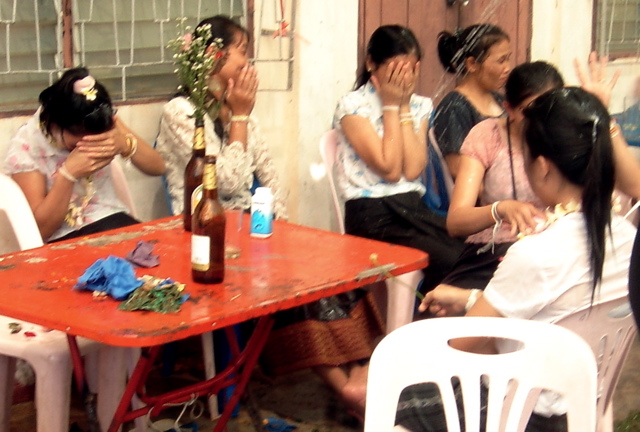
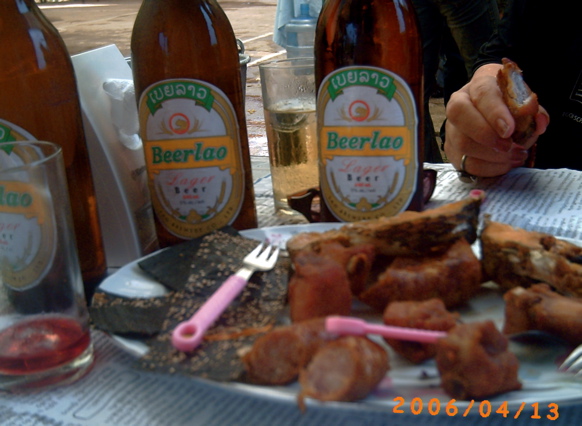
The UN sponsored “Lao Cotton Company” had closed for the day and the many water-soaked employees were all outside partying…drinking free wine and beer, eating soup, seaweed, pork and fish and dancing to a Lao band. Leila and I were kindly invited to join them so we fetched Villa, our driver, and made him join us. A table was set up for us and food brought. One after the other of the many younger boys wanted to dance with us…many making us drink a glass of beer first. To his delight Leila taught one young guy the swing…kids turning the hose on all of us all the while.
DSC00584.JPG

DSC00590.JPG

PICT0701.JPG

PICT0703.JPG

After many beers and much dancing and soaking, the head of the Project offered to open the store for us. We crazily piled up ridiculously inexpensive hand-woven sheets, pillow slips, fabric for curtains and table cloths to take home with us. Now to get it all on the plane I am having to throw away half my clothes which I didn’t have many of anyway. But my cozy little home in Mexico will look beautiful.

President Khamtay wishes the people of Lao a good new year in the English language Vientiane Times. “The year of the dog will be a great year; we have already begun the year by implementing the resolution of the 8th Party Congress, state five-year plan and we will continue to carry out the 10 year strategic plan for developing the country,” he said. Plans. Communist bureaucracies apparently not much different than democratic ones.

Culture Shock

as my mother would have said.): Am taking the liberty of posting Bob’s April 3 email describing homecoming culture shock after arriving home in Oregon from Asia…very succinct.

good morning;
On Comcast internet—
and it’s fast.
What a pleasure.
The air is fresh.
It’s brisk.
Everything green.
No plastic in heaps.
Highways/byways orderly
No motorbikes
But–
the streets are dead–
nobody out
prices outasight
telephone menus on most calls
(should probably compose one for my phone)
It does rain—again and again

Tha Ton Thailand

gatQye8keZlS3vpnwrOvxg-2006186163905868.gif
Supuat drove me to Tha Tan…right on the Thai-Burma border directly north of Chiang Mai to see several minority groups, Lisu, Lahu, Akha and Longnecks, that live there.

Last year in southern Yunnan China, I visited Lahu, Lisu and Mien mountain people many of whom had migrated into Thailand years ago. The Karen and Shan and Longneck people in and near Tha Ton have been forced out of Burma by the junta who took over the Burmese government in the early 90’s. They do not speak Thai and they have their own languages, but Supoat, my guide, being from the area, speaks the local Chiang Rai dialect that is common to all the people.

About seven years ago Thailand launched a program to pave the roads into the mountains, so instead of trekking dirt trails we are able to drive into the villages. We visit the Lahu first.

DSC00517.JPG

DSC00481.JPG

DSC00514.JPG
Akha Woman

DSC00489.JPG

DSC00490.JPG

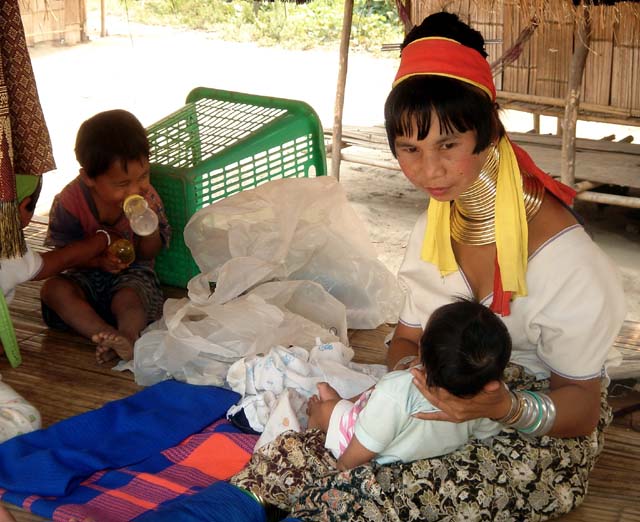
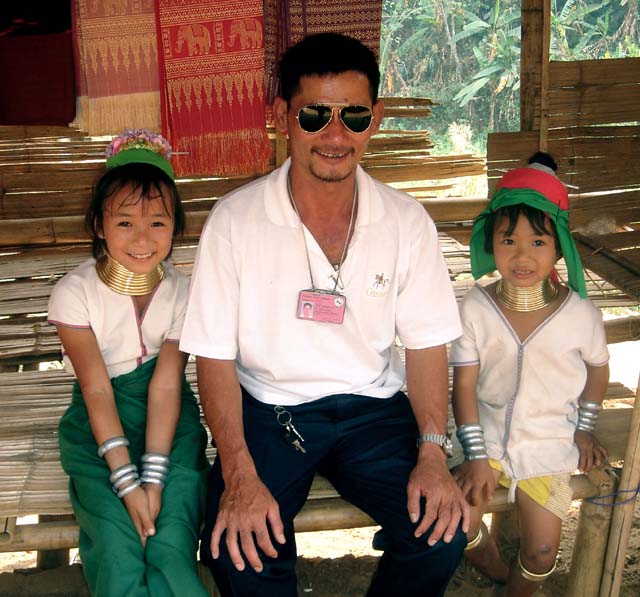
The Longnecks are refugees from Burma and do not have Thai citizenship so they are confined to small areas where the women weave items in small thatched shelters to sell to the tourists and the men grow rice on the mountainsides. The Longnecks wear gold-colored metal coils around their necks that actually does not elongate the neck but they look long because over time the shoulders slope down. I buy some lovely woven scarves for $1 each.

DSC00505.JPG

DSC00504.JPG

DSC00512.JPG
My driver with two smiling Longneck girls.

The last village is Lisu. We park in the schoolyard. Supoat knows the family we visit. The yard, with children, pigs and chicken running free is well-swept.

DSC00522.JPG

I notice a chubby woman sitting in a nearby chair…looking miserable. Questioning her we decide she is passing a gallstone. Her husband is out looking for their pig he can butcher to sell to their neighbors so he can have money to take her to the doctor in Chiang Mai. I commiserate with her…I know how painful gallstones are. She kindly invites me to stay and eat with the family but Supoat carefully refuses…we don’t want to trouble the family at this time and we need to be on our way back to Chiang Mai.

DSC00518.JPG
Slicing Palm for cooking

DSC00526.JPG

Leaving the village we pass under a colorful arch…past small piles of old clothing that used to belong to villagers who have passed on. The clothes are there for spirits who might need them when they come back, I ask. Yes, he says. In the background you can see smoke from “slash & burn” fires that take place this time of year when the locals burn harvested fields.

DSC00529.JPG

Reverent Inquiry

In spite of my petty but honest day-to-day frustration with bureaucratic silliness while traveling in most developing countries, I treasure the lives of the people who ironically seem to have integrity…congruity. The way they live is understandable in relation to their history, geography economics and culture-not to be compared to any other place. Rather than judge, a friend says she tries to engage �others�� with a �reverent curiosity� to describe how she travels. I try to be more intentional-I borrow her idea and call it �reverent inquiry.� I do want to respect the dignity of those I am coming to visit without giving up my own chosen values.