Santorini & Sifnos

pjSwKsKjPzr5gOYYAx9PKM-2006172105305371.gif

As the ferry approached the island through the caldera you see a red-brown black and pumice grey terraced cliff face that looms hundreds of feet above the water with brilliant-white buildings with blue trim reflecting the Aegean Sea hanging off the side. But all those beautiful buildings hanging off the cliffs of Santorini, as it turns out, are all hotels, boutique shops, cafes and restaurants with a few blue domed Byzantine churches mixed in.

Walked into a cafe for breakfast of coffee and pastry the first morning to the sounds of Portland’s own Pink Martini playing on the stereo. While walking around the town-Bob in his perennial shorts-we passed a group of Spanish teenagers and one was heard in English “look at that guy-he’s wearing shorts-makes no sense! Do you think it made any impression on Bob?

After exploring the island’s archaelogical and historical sites and lying on black sand beaches there was not much else to do unless you were twenty years old and wanted to spend all night in the discos-so we ferried it six hours to another, smaller island-Sifnos.

Sifnos
At the harbor port of Kamares we took a bus the five miles up a windy road to Apollonia where we checked late into the Sifnos Hotel-tired and hungry. There was only one other patron in the hotel, a French publisher who returns to the island every spring. Apostolos, the hotel proprietor, welcomed us each with an Ouzo. Then he treated the French woman and Bob and I with Mezedhes (appetizers) and we sat for the next two hours eating and talking culture and politics. This is what I had been waiting for! Marie, the French publisher was reading the memoirs of Edward W. Said the professor at Columbia University whose books are popular reading these days for an understanding of the middle east.

Apollonia is an amalgam of three very charming hilltop villages with connecting white-washed buildings with flower-draped balconies lining immaculate narrow marble footways. The people actually live and work here and one gets the feeling this is how they prefer things. The shops are only open during the summer so most of the locals have other work the remainder of the year, Apostolos says.

Sifnos is 16km by 8km-great for walking-so Bob took off the next day for a five hour walk following a trail with one great view after another along the way up to an acropolis with a church and some ruins from 600BC. Almost the entire island was terraced 2-3000 years ago when the islanders supported themselves with agricultural products but since the advent of tourism and vehicle ferries the walled terraces now mostly grow yellow and white daisies and blood-red poppies and support the lonely burro and the goats. It is interesting that the people built their town in and around the many ruins; Greece taking for granted its antiquity.

This island has given us a welcome respite from noise and activity; none of the shops were open yet and their owners were painting, sweeping, repairing all over-preparing for the summer-eager and hopeful.

Apostolos says the Greek Orthodox church is very powerful in Greece-and very conservative-legislating every aspect of family life which is the all-important institution next to the church. Families stay together always-even if/when children move away there is almost daily contact, he says. Marie, the French lady said that yes, the Greeks seem open and friendly but there it stops-they are very clannish and no one on the outside gets into the inner circles. She and Apostolos recommend reading “Three Summers” by Margareta Liberaki published also in English.

Women
My sense about the young women I have seen especially in the less developed countries of Spain, Portugal, Morocco and Greece is that they are a pretty savvy lot. Nothing will hold them back now!

As there was a strike on the day we planned to take the ferry back to Athens, we asked Apostolos if we could have the hotel room for the afternoon. “Of course, of course,” he says, “life is simple, life is simple!” When we were ready to leave, he gave us each a going away drink of Ouzo. I don’t want to leave this place…I am grateful for this journey; I have learned these ways so far to say thank you: Greek-efsharisto, Spanish-Gracias, French-merci, Portuguese-obrigado/a, Italian-grazie.

Back in Athens, I sat in the internet cafe with a young Anglican priest from Britain who was bicycling his way to Haifa Israel. Not worried, he said. The other fellow, was a UN Police Observer from South Bend, Indiana stationed in Kosovo making 90,000 a year. He was in Athens on leave. Meeting people like this is one of the reasons I like going to Internet cafes.

The Atlas Mountains

pjSwKsKjPzr5gOYYAx9PKM-2006172104421567.gif

We took an excursion trip south and east past incredible green terraced fields and old Berber kasbahs (ancient Moroccan self-contained communities made out of the rust colored mud of the countryside)-seemingly idyllic-to the Atlas Mountains.

Our group consisted of Bob and I, a young couple from New Zealand in their thirties-one a computer/internet analyst and his partner a pharmacist, another couple about our age from Boston. He had been the president of a University in Iran before the Shah was deposed and she obviously was also well educated. He was able to escape and she soon after. He now teaches theoretical physics at a University in Boston. The fourth couple was young-he a music major at a California school. The last two were a couple of great guys from Italy that we called �The Italians! who gave us some menu items we could order when we got to Italy.

On the way to the Sahara we passed over the Atlas Mountains (about 12,000 feet) and through the towns of Tinerhir and Boumalne. The first night we slept in a small Berber Hotel that was in the process of being renovated at the head of the Dades Gorge. The room was cold with a concrete floor but offered
several very thick heavy blankets-like the blankets used on the camels. The evening included a walk up an incredibly beautiful gorge and a dinner of Chicken Tangine. Oddly there were only two small pieces of chicken for every four people but otherwise it was very good. In the morning we had a breakfast of rolls, coffee, butter and jam before continuing on to Erfoud and then to Merzouga. We stopped in Kassah for lunch. (The cafes with the best toilettes get the most tourist business!) We all had beef kabobs and moroccan salad (tomatoes, cucumber, olives, onions) and water.

In the afternoon we walked through a Berber kasbah. We took a trail through the fields to learn about tribal farming; then walked through the kasbah and into a building where some women weavers presented their carpets. Bob was a sitting duck by this time and we are now the proud owners of a small Berber carpet.

By evening we reached an area where we were put astride camels that walked single file for a couple hours at sunset through the largest sand dunes in the world (the Al-chabbi sand dunes) to a Berber tent camp. One rides a camel on a big thick blanket just behind the camel�s hump with the pubic bone rocking back and forth against the hump. I told Bob to be careful or I�d trade him in for a camel! The Berber guy leading the trek cautioned the men to be careful of their ‘iggs.”

The encampment consisted of cloth tents joined together with heavy blankets and pads on the ground. Two good looking young Berber men cooked delicious Tagine with beef, carrots, onions and potatoes which we ate sitting in a circle on the ground with bread and our hands in groups of four. They served orange slices sprinkled with cinnamon and mint tea for dessert. Afterward the boys played Berber beats on the drums. Roosters from a nearby encampment woke us up at a breathtaking sunrise over the dunes.

The next day offered an eleven hour brutal van ride back to Marrakech with a short stop to eat lunch on a terrace at a small restaurant in Tirhan. We both ordered a �hamburger� that turned out to be a stew of tiny meatballs in tomato, onion, eggplant mixture. It surprised the heck out of us but was very good.

A few hours out of Marrakech we were pretty nervous about the narrow and curvy mountain road and we begged the driver to stop and take a break-which he did. The roadside stand had fresh Tangine, soup mint tea, coffee and soft drinks. The very friendly older man standing behind the food bench was offering me a small bowl of soup for 1.5 euros when I heard the driver in a scolding voice tell the food seller to charge 5 euros.

In Marakech that night the Ali Hotel was full because there was a holiday that weekend (we never did figure out what it was.) There also was an international meeting of some kind in the city during this time. So we stayed in the Hotel Eddakhla-a pretty basic hotel on a pretty rough street with a lot of beggars, no lift-just stairs-very deep and steep and narrow and on top of that the WC and shower was down on the first floor. The room had a sink and bidet but was very stuffy with no window to the outside. Bob bristled when a young man at the desk demanded his passport �for the police,� Bob of course thinking he wanted to take the passport which would violate rule number one: never give up your passport to anyone for any reason!

Ate dinner at one of the hundreds of eating stalls set up in the square every night that serve harira, kabobs and fish stews. Some of the stalls specialized in goat head meat-complete with whole goat heads set up in a row for viewing-that was patronized almost entirely by the locals. However, we sat at a stall that was probably set up to attract the tourists. We had beef kebobs peppers, spinach, fish, moroccan salad olives and mint tea. It was the worst meal in Morocco and Bob was very offended when the waiter slammed a small tin plate down on the table and demanded a tip. There goes those filters again!

How people experience a country seems almost accidental at times!

Mt. Kailash Tibet And West Nepal Trek

Bob circles the holy mountain. For the story and pictures of his experience go here.

Bob mentioned that when he did his Kora (trip) around the holy mountain of Kailesh in Tibet you always knew who the Jains were because they circumnavigated the mountain clockwise and the Hindus and the Buddhists walked around counter-clockwise. The belief is that if you make so many trips around the mountain in a lifetime (something like 24) that you can achieve freedom from your sins on earth.

Bob Climbs Kilomanjaro

HF0m0NezqDnitkljwNP8lg-2006188095850902.gif
Kilomajaro.jpg

Marengo Route.jpg
BobatKilomajaro.jpg

Bob’s Report:

Curious how one thing leads to another. It all started at the local fitness club. In the bravado of a post-workout discussion we proposed adventures that would be a goal to keep our workouts both frequent and intense. The suggestion that appealed to us was to climb Mt. Rainier in Washngton State. We decided to do it and six months later realized that the effort was similar to running a marathon with risk, thrill, and danger elements thrown in.

Subsequent to the climb, I found myself on the mailing list of a prominent climb leader. His brochures detailed the many climbs he had scheduled for the next year. I skimmed one pamphlet that described plans for a Mt. Kilomanjaro climb in Kenya and filed it in a corner of my desk pile as being impossible. But as I reread the brochure several times over the ensuing weeks I began to think, “why not?” “What am I waiting for?” Eventually I sent in a deposit and had another goal for which I needed to maintain regular workouts.

Trekking in Kyrgyzstan

7Z3XBdt3hLmJjqkmk2I6k0-2006190120654814.gif

The fall of 1995 Bob and I joined an REI adventure tour company based in Seattle Washington on an 18 day trek in the highest and most dramatic part of the central Tian Shan mountain range of south Kyrgyzstan in Central Asia.

Uzbekistan Airways, flying in from New York, landed in Tashkent Uzbekistan where we visited a couple from our home town of Salem Oregon who happened to be there as volunteers for USAID. We had told our friends via email where we would be staying, but upon failure of the phone system, they simply slipped a note under our door, a local custom in lieu of telephones, letting us know where and when to meet them.

When we arrived at a restaurant parking lot to board the bus, to our dismay, we found several Uzbekis hovered over many and myriad motor parts lying on the ground. “Have some tea,” they said as they pointed toward a nearby tea house, “and we will be ready soon!” Riiight…we thought. To our relief, after watching them reassemble the inner workings of the motor for an hour, we were motioned back to the bus by Peter, our trip guide.

To reach the trekking area in Kyrgyzstan it was necessary to cross a small oddly carved out thumb of Tajikistan from Uzbekistan. However, the two countries don’t get along and when we arrived at the Tajik border the guard held up the bus…apparently wanting baksheesh to let us pass. Peter was adamant about not wanting to set a precedent of paying them off so there we sat in the hot sun, eating the best melon we have ever had in our lives to quench our thirst. Finally, Peter had the driver take a roundabout road across the Fergana Valley to reach our staging area in Kyrgyzstan where the driver had to pull some very crooked logs over a stream to get the bus across…we chose to wobble across on our feet.

Aksu.jpg

The trek included walks up breath-taking beautiful stream-filled and flowered valleys and over high ridges to more valleys. Shepherds from their permanent homes in the lowlands summer their sheep and horses on the grassy mountain-sides. Sheer glossy Ak-Suu peak, one of the world’s best extreme rock-climbing destinations that had just before opened up to climbers since the fall of the Soviet Union glinted at the head of the glacial valleys. The first sobering day saw a climb team carry out a dead British compatriot that had fallen off the peak.

nomads.jpg

As we leisurely meandered up the trails, children of the local nomads would come running, sometimes with a kettle of tea or chay in their hands, yelling “pen!” “pen!” Have pen? Pens and paper are the most prized gifts, although Peter discouraged us from giving the kids anything…preferring to have them see us as friends rather than a rich Western source of material goods.

Alaska.jpg

Peter’s favorite “gift” was to bring photos of the locals that he had taken on previous treks in the area. The amazed smiles and giggles of the nomads that had never seen themselves in a picture was tear-jerking.

twoincentralasia.jpg

Every couple days, locally hired shepherds carried our gear on horses over narrow mountain trails to succeeding camps…the trek trip just before ours losing a horse hundreds of yards to a river below. We would set up our own tents. The potty was a hole dug out behind some rocks. In the mornings chay (tea) was brought to our tents to get us awake. In the evenings, Victor, our Russian cook, would wok up a delicious dinner like stew of spicy laghman (noodles) with cabbage and lamb bought from the locals. Dumplings (chuchvara) fresh yogurt (ayran) and home-made bread with raspberry jam and butter (sary may) kept us filled up.

After dinner at night, Peter, in real life a young non-practicing attorney from Colorado, would regale us with his rock climbing and trekking stories. One day he stumbled across a friend on the trail, a professional climber from Idaho who was checking out the newly opened climb area. A motivational speaker in the states, he mezmerized us that evening with a story of an Annapurna climb in Nepal during which a Russian climbing partner became disoriented and insisted on going up the line instead of down during a storm. The Russian was never seen again. Right at the climax, before we could find out what happened to the poor climber, we saw a huge lingering flash of red hot color fill the western sky! Only later, reading an English language paper in Istanbul Turkey on our way home, did we find out that it was the Russian manned space flight returning to earth in Kyrgyzstan.

Na Pali Trail Kauai Hawaii

After our son Josh graduated from Whitman College, he joined his former roommate and friend, Phil, in Kauai where they were to spend a couple years working and repairing some cottages that belonged to Phil’s dad near Poipu Beach that were damaged in a hurricane September 1992.

Hurricane Iniki caused more damage than any other hurricane to affect Hawaiʻi since records began. It hit the island of Kauai as a Category 4 on September 11. Iniki caused almost $2 billion in damage, mainly to Kauai. It remains the second costliest East/Central Pacific hurricane on record, only behind Hurricane Paul in 1982. Six died as a result. Iniki brought winds of 140 miles per hour (230 km/hr).

Phil’s dad’s house, closer to the beach, was lifted clear off the concrete pad. For weeks afterward people were finding papers and objects they knew belonged to him because he was a well-known Methodist minister on the island.

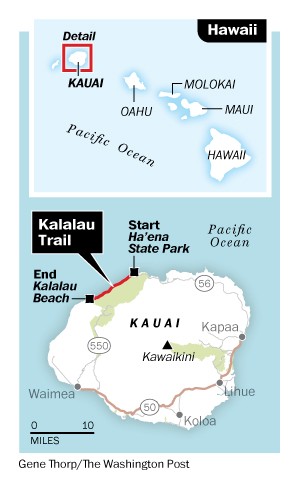
Bob and I took the opportunity visit Josh while he lived on the island. We hiked the Na Pali Trail, which, in retrospect probably wasn’t a good idea. But what did we know was up ahead. Namely a trail along side the mountain…very very narrow trail…with a vertical drop of 300+ feet to the ocean rocks below. At times all we had to hang onto were branches of bushes and trees. Alas we turned back before we got to the hippie beach.

When the work on the cottages was done, Josh worked for a restaurant in the nearby Hyatt Hotel. He was offered a promotion but opted to quit and go to culinary school. Phil, who had been an art major is an artist and stay at home dad while married with two children in Seattle. For Josh the rest is history.