Trekking Northern Thailand

gatQye8keZlS3vpnwrOvxg-2006186163905868.gif
As soon as we returned to Bangkok from Bali Bob took a train to Chiang Mai for a trek in northern Thailand near Mae Son Hong. I stayed in Bangkok to have some dental work done. This entry was written by Bob.

Chiang Mai is Thailand’s second city and the jump-off point for experiencing the northern hill tribes.
100_3454.JPG

Mae Hong Son is in the trekking area–but quite a ways from Chiang Mai–drove there with several treks en route and spent one night in the town. There are many ethnic tribes–most renowned being the long necked ladies. When I was there not many tourists as it is hard to get to. We subsequently flew back to Chiang Mai–but that was included in the package. Did this on one of my early trips. On that trek we would walk for a day or two, spend nights in tribal villages and the van would pick us up at a designated site. Then onto the next trek–also did a little rafting but no rapids.

These peoples owe allegience to their ethnic group and national boundries are of no signifigance. They originally migrated from China and Tibet and now reside in southern China and in a geographic band across the north of Burma, Thailand, Laos and Vietnam.
100_3585.JPG

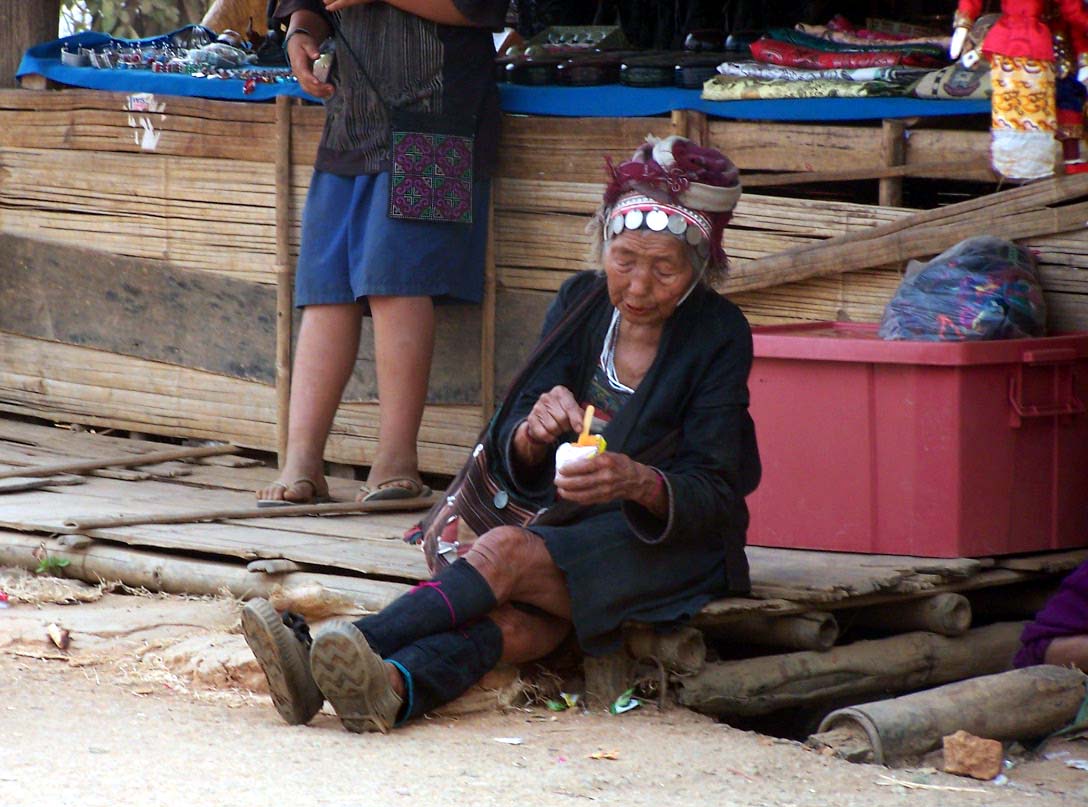
These tribes have taken taken advantage of the tourist influx and now offer their villages and homes as overnight lodging for trekkers. As they live in the hills there are no roads, autos and access is strictly by foot. So after a couple of days re-exploring Chiang Mai (its growing big time) I joined 5 other farangs (European and half my age) and a Thai guide for a 4-5 hr ride in the back of a pickup to the trailhead for a 3 day trek.

The walking is relatively easy but the heat/humidity combo is a killer. In 5 hrs we reach a Karen village, are given lodging in a bamboo slat hut and offered a “shower” from a barrel of cold water using a laddle to pour water on whichever body part is selected. A simple meal is offered–tasty but usually best not to ask what it is. Market comes to us as the local ladies show up with their handicrafts. The children run about and giggle at/with the strangers. During the night a pig was the victim of a noisy slaughter as the next day was a festival (new years).

On the previous trek along the Burmese border we had been invited to a wake for a child who had died that day (probably from congenital heart disease). But alcohol became the focus of the event and we made a hasty departure out a side door as belligerence unfortunately replaced festivity.

The next day of this trip offered many stream crossings over narrow logs and I was made suddenly aware that balance is one of the skills that diminishes with advancing youth. Oh well! But we made it to the waterfall for a rewarding swim and that night barbequed a suckling pig.

The last day offered a ride on a bamboo raft through several small rapids and the obligatory elephant ride (once is enough). My less than friendly elephant was named Toby with her cute baby following along behind. I kept thinking that I should have a seat belt. Toby, however, was sure footed, enjoyed the sugar cane and bananas that were sold at intervals along the route.

Mae Sai is just a border town in the far north I went to on another trip. Across the bridge is Burma. It is not a primary trekking destination. Used more for visa stamp-outs and Thais purchase stuff (primarily pornography I think that they cannot get in Thailand–or at any rate saw much of it being confiscated by Thai immigration.) From Chiang Mai it is part of a day trip –in a van–that also includes the Golden Triangle (people stand and have their picture taken under a Golden Triangle sign) and Mekong River/Laos border area. A boring trip.

Tip: The trips out of ChiangMai have become a bit too packaged and westernized–now include the obligatory elephant ride and a raft trip which is a token overcrowded experience. Ok if one has never done it but better if you are able to get off the beaten track like the trip to Mae Hong Son.

Jinghong China

jWLtBzsBGHTUmbHjYHypj0-2006185073225366.gif

Photos

While I was in Guizhou Province, Bob headed off for Putuashan Island and then circled back to Shanghai via Hangzhou…then flew to Jinghong to meet me at the Banna Hotel. We picked up Sarah, a trek leader at the Forest Cafe, who led us by bus into the surrounding mountains to visit some Hani, Dai and Jinguo ethnic minority villages.

In one village I ran into a Frenchman I had met in Guizhou Province (a thousand miles away) who had enlisted the services of a car and driver so Sarah took off trekking with Bob and I joined Marco (French-Italian) on a visit to several Dai village homes on the way back to Jinghong where I met Bob at the hotel that night.

Bob was to fly to Bangkok and I to Hanoi from Jinghong but planes were full so we flew the 40 minutes north to Kunming to catch planes…Bob to Bangkok and me to Hanoi.

Yangshau

East China.gif

Currently in a delightful city (Yangshau) that is on the Yangtze River about 100 miles north of Shanghai.

China’s autumn has been fantastic, the people interesting (and challanging) and the food tasty (most of the time) even if we do not always know what we are eating.

Spent 3 days north of Beijing trekking the Great Wall (I waved to the folks in space so hopefully they were able to see me) and then did a couple of climbs on China’s sacred mountains (Tai Shan and Lao Shan).

The climbs were more like our day hikes in Oregon but still a good workout–spent one night on the summit and got up with several hundred Chinese to view the sunrise–magical and mystical as an orange globe emerging from a cloud bank. The Chinese, however, take a tram to the summit and were quite surprised that a foreigner of my age would want to walk up the mountain. “Singjingbing” (“crazy”) is the frequently heard comment.

China is a very dynamic country and going through rapid metamorphoses–in 10 yrs it will be quite different and maybe not for the better–they aim for modernization and construction is booming. However on the lanes, streets and freeways autos compete with pedestrians, bikes, and hand drawn/animal drawn carts. The expression “Chinese fire drill” prevails. Crossing a street is an adventure.

Market economy is obvious and pervasive–Karl Marx can only be shaking his head.

Tiz OK to laugh with the Chinese but not at them (have made a couple of social/cultural guffaws).

Off the tourist track we foreigners are still an oddity and draw many long stares. Younger children say “hello” and then giggle. I say “neehow” (hello) and they giggle even more. The smaller kids are cute as can be; as they get older (teens) jeans and cell phones prevail and there is the loss of cultural diversity.

Air pollution, autos, hacking & spitting, littering (everything: restaurant bones, trash, spit goes on the floor–at an internet cafe I was admonished by the propriator for putting my backpack on the floor–did not appreciate her concern until I realized what all else is on the floor and had the insight that she was trying to prevent backpack contamination.)

Then the Chinese sweep–everywhere things are swept with grass brooms but that is as deep as the cleaning process goes. But as always the fun is in observing and appreciating cultural differences (a two way street as they laugh at me)
later. B

Tai Shan Sacred Mountain

East China.gif

Located midway between Beijing and Shanghai, “Tai Shan” is probably the most famous of the five sacred mountains of China. According to legend Tai Shan represents the head of Pan Gu, who after creating heaven and earth, dies from exhaustion and his limbs and head fall to earth as the five mountains. Subsequent emperors were required to climb the mountain in order to be considered an appropropriate ruler. Both Confucius and Mao felt obliged to scale the summit (5068 feet).

The sacred Mount Tai (‘shan’ means ‘mountain’) was the object of an imperial cult for nearly 2,000 years, and the artistic masterpieces found there are in perfect harmony with the natural landscape. It has always been a source of inspiration for Chinese artists and scholars and symbolizes ancient Chinese civilizations and beliefs. It is an UNESCO World Heritage Site.

I had no idea what to expect but planned on spending a night on the summit so packed my pack with multiple contingencies to include extra clothing, rain gear, food, water etc. All unnecessary, of course, as vendors and shops lined the route from bottom to top altho prices became proportionately more expensive with elevation.

The majority of the route is along carved and/or constructed stone steps which are several centuries old. Multiple temples and shrines line the way. These have cultural and spiritual significance for the Chinese but without English explanation went over my head and remain largely unappreciated. Trees, under which various emperors rested, are noted and enshrined.

Along the route the Chinese would often give me the thumbs up sign–perhaps because of being a foreigner (“laowai”–the word has a derogatory connotation like farong or gringo or honkie) or perhaps my age, perhaps both. Frequently they would request (demand) to carry my backpack (I sweat easily) and were dismayed and occasionally argumentative when I communicated that I preferred to carry my own pack. My interpretation was that they felt they should be “taking care of” the foreigner.

Photos of ancient sites & scenery were encouraged but attempts to photograph poverty, filth or anything less than ideal were met with negative feedback or at least wonderment on why anyone would want to take such a picture. The Chinese have elevated posing to an art form and always include themselves in the scene.

I reached the summit about 5pm and found it to be crowded with all shapes and sizes of Chinese who had taken a bus to the half way point and then a tram the remainder of the way to the summit. As the sun set it became increasingly cold and vendors rented out Chinese military overcoats. The laowai (foreigner) had difficulty finding one that would fit–precipitating smiles to giggles to gaffaws. The lodging was somewhere on the negative side of adequate and without heat the night was cold enough to interfere with sleep.

After a knock on the door at 5 a.m. I joined a huge entourage of Chinese for a hike to a lookout where we sat and waited for the sunrise. It was spectacular with an orange globe rising from a white bank of clouds…this coupled with a lone pine tree next to a pagoda…represented my interpretation of the quintessential and mystical China.
the summit.JPG

Lao Shan Mountain Climb

East China.gif

Spent 3 days in Quin Dao…one in new part of town, one in old town and one on a mountain north of town called Lao Shan–subsequently took train to Tai’an and climbed Tai Shan–one of the 5 holy mountains in China–it was an all day effort but not that difficult–more like a hard day hike in the Columbia Gorge in Oregon–spent the night on the top–accomodation somewhat less than basic but inexpensive–then was awakened a 5 a.m. to join the rest of the Chinese tourists to a lookout point to see the sunrise–it was quite impressive–took a tram down and now am south of Qufu–tomorrow have an “offer” to see the countryside so will probably see what that entails–do not know whether it is an overnight or what.

Have found that the Chinese usually have the best of intentions but something gets lost in the communication/language gap–on the mountain had people wanting to carry my backback–don’t think it was for financial gain but they just wanted to take care of an “older” foreigner–when I refused it often became a tug-of-war. On my way south and plan to stop in Nanjing and Langshou–there is another shan south of Shanghai that the guide book said is thee mountain to climb in China–but would like to meet up in Shanghai–probably +/- one week from now.

Had another couple of days of diarrhea with a near miss experience on Lao Shan–am sorry to hear that the upper respiratories have reached you again–but am glad that you are not proximate as the cold you gave to me in Russia took 3-4 weeks to resolve. Keep me updated–each time I get to an internet access I will forward to a word or two.
l. B

Great Days Great Wall

East China.gif
Video
E found the website (www.wildwall.com) and the adventure offered intriguing potential…off the beaten track, away from the Chinese tourist groups that follow a guide with a microphone and colored flag held high in the air to designate location. After two short emails to William, arrangements were easily made and in the lobby of our Beijing guesthouse I met with the driver (No English) who carried a placard for “Mr. Bob.” After smiles and incomprehensible introductions his black auto carried us through a three-hour adventure negotiating Beijing traffic…bikes, pedestrians, tractors, donkey carts all navigate the same lanes, avenues, freeways where the basic rule is ” Bigger Has The Right of Way.” As throughout Asia, good brakes, good horn and good luck prevails.

My understanding was that we were to pick up another couple but as we finally exited Beijing for the countryside I began to make an alternative plan if perhaps this was an abduction…the imagination can wonder…

We finally entered mountain terrain and the pavement ended. After another 20 minutes we arrived at a small village surrounded by hills We parked and I carried backpack uphill to a courtyard surrounding a small idyllic farmhouse. There was evidence of other foreigners. William casually came out of the farmhouse and introduced himself. An Aussie couple, attired in the hippest of trek fashion had already arrived and they and I completed our trekking group. Subsequently I appreciated their humor, enthusiasm and good cheer and we shared good times and laughs.

After being shown my room, the first of many superb meals was served. Lily was William’s Chinese helper and sous chef…fresh trout in a spicy (picante) sauce. After the meal Schnapps was offered (an acquired taste I guess) and I learned that William was in his late forties, formerly from Liverpool England, but has lived in China for the past 15 years. He has a Chinese spouse and two sons. He is a former long distance runner, who because of his fascination with the Great Wall as a child, later decided to run it’s length. After an initial abortive try he was subsequently able to run most of the wall in the early 1990’s and it has since become his passion. He has authored several books, spear-headed environmental efforts and has become the local expert/personality/guru of all things Great Wall. On our hikes, whenever we were passed by local Chinese hikers he would be recognized and asked to pose for pictures. His affect was such that he always obliged with a smile and some Mandarin conversation.

For the next two days we arose at 5 a.m. and took off in darkness for a 4-6 hour trek that included a significant climb up to the Great Wall and then excursions for varying lengths of time on top of the wall. We were able to stand on the wall and observe the sunrise. Along the way there would be frequent stops for short antidotes or explanations of various aspects of the wall–its history, construction, functions etc.

The Wall was initially started in about 400 BC and continued until the Ming Dynasty (approximately 1600 AD). It was built in sections to protect the Han Chinese from the Northern nomads (Mongolian and Manchu). Initial construction was at points of obvious invasion routes…river valleys…and through the years the Wall was extended up the sides of the valleys and across mountain ranges. It is not one continuous structure but various branches meander and double back. Initial construction was simple but later architectural efforts became more sophisticated.
In c. 220 B.C., under Qin Shi Huang, sections of earlier fortifications were joined together to form a united defence system against invasions from the north. Construction continued up to the Ming dynasty (1368–1644), when the Great Wall became the world’s largest military structure. Its historic and strategic importance is matched only by its architectural significance and is a UNESCO World Heritage Site.

The areas we traversed were constructed of large carved stones, kilned bricks and morter which contained rice. As well as security, the Wall was used for storage, shelter and as a highway. It varied in width from two yards to 10 yards. In the area we were in, there has been no restoration and time and erosion have caused crumbling in many parts with an overgrowth of vegetation both on the sides and on top. It would seem that any minor earthquake could produce serious additional damage. William said his ecologic efforts have produced minimal results to date and he has been happy just to see that his efforts have caused fewer Chinese to litter. Ideally it would seem that stabilization against future damage without restoration would be the way to proceed. But the Wall is so long (estimates vary from 7000 to 10,000 kilometers) that total protection is impossible.

On descent: as frequently happens on hikes there is time for thought, reflection and subsequent contentment…and coming off the Great Wall of China in brisk warm autumn days a few magical to mystical moments. On one occasion while walking solo I heard leaves rustling in the trees –only a few colored leaves remained on each tree. Looking up the leaves would twirl on one tree then sequentially on another– like a self-conducted symphony—only in China. When I asked William whether his operation had reached a size sufficient for an assistant he replied, “I think I will see you again.”

Reflections on the Steppe

GyTjn0QZP9l6Qu21TubskM-2006198062551304.gif

We are lucky…days are brisk but sunny…the sun glints off bare hills covered in golden fall grass. This feels like fall in southeast Oregon where I grew up. I soak it all in while Bob goes on a 4 hour hike through birch groves and box canyons full of grazing mustangs. How do you know they were mustangs I ask Bob…he says” they had labels on each side.” Places were steeper than he anticipated…had to run from one tree to another to keep from falling down the hill.

The next afternoon we paid three dollars to an elder Mongolian in traditional clothing to take us riding horses through the hills with him. Give him his head, I said to Bob who was trying to make his horse gallop! But there was no saddle horn on the tiny saddle to hang onto and it was difficult to post in the ornate metal stirrups. Mongolian saddles are definitely different than Western saddles I was used to as a girl in cowboy country USA. Still, the same freedom I used to feel…while riding…in the wind…in the hills…where I grew up… This is as close to heaven as it gets I thought…connected…connected to the earth.

Hiking Olkhon Island

Urr0g6ZfQ7ttYL19duYJfg-2006170133924757.gif

Back at Nikita’s “resort” I spend half a day taking care of monkey business while Bob goes hiking around the island. It is the end of September but Siberia lives up to it’s reputation. It is cold. On the trip to the island it snowed and now each day hovers below zero with chilling winds and puddles that don’t thaw. In another six weeks the lake will begin to freeze and the island will be cut off until the ice is thick enough for vehicular driving. The thaw will not arrive until May. We did not bring appropriate clothing and each dash from the cabin to the squat toilet is a determined gritting.

Tomorrow at 6pm we leave on the train for Ulaan Baator Mongolia.

Young Czech Prime Minister

NikaFEAe66TwIiJDaeZZ7w-2006198180634090.gif

The Prime Minister of the Czech Republic, Stanislav Gross, is 32 years old and looks 20! We are realizing how little information we have gotten in the US in the last 15 years about the dynamics in and among Europe and the former communist satellites! “Our new Czech Prime Minister is very clever,” the young waitress says. “He and I went to the same school and we all liked his ideas and his speaking ability.” But I made the catastaphic mistake of calling her country “Czechoslovakia!” “You have made a big mistake, she says,” because we have been the Czech Republic since 1992!”

I have to quote a description out of “History Of The Present” by Timothy Garton Ash…written in the 1994: “The sleeping beauty of Central Europe has not merely been awakened by a prince’s velvet kiss. She has put on black tights and gone off to the disco. While Budapest developed gradually into a modern consumer city starting in the 1970’s, Prague has emerged from its time warp suddenly and explosively. Instead of the magical museum, lovely but decaying, there is color, noise, action: street performers, traffic jams, building works, thousands of young Americans…would-be Hemingways or Scott Fitzgeralds…millions of German tourists, betting shops, reserved parking places for France Telecom and Mitsubishi Corporation, beggars, junkies, Skpenritter of all countries, car alarms, trendy bars, gangsteers, whores galore, Bierstuben, litter, graffiti, video shops and Franz Kafka T-shirts.” We didn’t notice any American kids in this year of 2004…maybe they have moved on to other frontiers…the son of a friend brought one back to the US to marry a few years ago.

Built between the 11th and 18th centuries, the Old Town, the Lesser Town and the New Town speak of the great architectural and cultural influence enjoyed by this city since the Middle Ages. The many magnificent monuments, such as Hradcani Castle, St Vitus Cathedral, Charles Bridge and numerous churches and palaces, built mostly in the 14th century under the Holy Roman Emperor, Charles IV. The historic center of Prague is an UNESCO World Heritage Site.

We took a city walking tour and when I commented to our leader that she knew a lot about the city’s architecture and architecture in general, she shared that yes, she was a civil engineer…but that it wasn’t her first choice because when the new government vetted the former communist members, of which her father was one, she said she was kept, by association, from choosing what she wanted to study in school. (It was common for people to belong to the communist party in order to get a good job, but not believe in it.) She said she would have preferred social science and psychology but she was told she had a choice of civil engineering. Bob thinks there is more to this story but it is a fact that the Czech parliament voted in a “lustration”law, that Vaclav Havel reluctantly signed, to vet all former Communist members. In any case, her husband is an artist and she showed us little noticed public art and memorials…like the small burial plot of a student shot by police in an early resistance demonstration and who is now honored as a hero on each anniversary. We get the feeling there are cautious watchers of this new democracy.
Read More

Big Noses In The Back Again!

YUqE3FCf1Hd9CjfG1qqmt0-2006171132705308.gif

Bus to Dali
As we pulled ourselves up into the luxury express bus we felt that we were living large…we wouldn’t have local color but we would have comfort for a change. Jana, looking at the TV monitor up front says, oh we’ll have a TV. Oh goody I said sarcastically…another Chinese movie. Then Jana said, “Guess where we are sitting?” Where, I asked looking around? The “Big Noses” are in the back again, Jana gasped!!!

But the road was good and we enjoyed the three hour trip through beautiful terraced valleys dotted with Naxi villages with red brick houses and swooping rooflines. Most houses had big double gate/doors with brass handpulls. We noticed some solar panels and saw one satellite dish on top of an official looking building. Listening to Hotel California by the Eagles, we incongruently flew past women walking slowly by the sides of the road carrying heavy loads of wood and brush on their backs.

The bus dropped us off by the highway near Old Dali before it proceeded up the road five miles to the New Town. Horse carts waited to pick up travelers…we asked to be taken to Yu’an Garden or Guesthouse Number 4 as it is called by the locals…a lovely compound with garden, free internet, homey laundry lines and showers and squat toilets down the walkway. The first chilly night we walked down the street to Marley’s Cafe and, huddled next to a charcoal fire with two other tables of western travelers, ate a delicious chicken soup.

We have discovered that after a day of bumpy bus rides, smelly squat toilets, freezing showers, hard beds in unheated guesthouses, frustrating efforts to communicate, hacking and spitting, ever present acidic gas that burns your nostrils and throats from the burning charcoal used for cooking and heat, a bed will do wonders.