International Driving

Don’t know if it’s just Oaxaca or maybe it’s the whole of Mexico. However, my dentist says that drivers in Oaxaca are worse than in Mexico City! But in Xalapa they were ever so polite…big fines meted out if they are not.

But you are taking your life in your hands in Oaxaca. The taxis and buses are the worst…speeding, honoring no lanes…forcing you over. No stop signs, lights, when there are lights and when they are working, are suggestions only. And then there are the “topes” or speed bumps everywhere. Never know when one is coming up unless you watch the cars ahead and hope they slow down…however, one, with drivers from Veracruz, didn’t slow down until they got to the tope. Then they stopped. Bam. Their little car could do it. My big Toyota Land Cruiser couldn’t. So I slammed right into the back of their car. Good thing no one was hurt. Good thing for insurance.

Actually I expected this…but thought I’d get side-swiped by a bus. Now I know why Mexican immigrants in the north get into so much trouble! A couple years ago in my home town in Oregon I was T-boned by an immigrant going through a red light at about 60 miles an hour…she had no insurance. No one has insurance here except the expats.

There are rules here…just not the posted ones. And heaven help you if you don’t obey them! Boils down to buses and taxis and very small cars do what they want…and that includes just about everyone. Except the gringa with the Toyota with a US license plate. Yes, I know I should have put more space between me and car in front. You get conditioned to keep close…cars, buses and taxis will try to edge into even a sliver of space forcing you over. If you leave a lot of room…say a couple car lengths you never get to where you are going because the whole city will move in front of you.

DSC00006.JPG

Thailand is no better. Was rear-ended by a motorcycle there once. Today got an email from Bob who is living in Thailand: “Now if I could only learn to control my mini-rage reactions at Thai drivers,” he says.

“Earlier this week I was driving in a line of autos and a bus tried to pass the whole line of 5-6 cars. He encountered oncoming traffic and cut in front of me–not really in front more like forced me onto the shoulder.

I offered selected auditory and visual feedback. (Had to laugh because the same thing happens here in Mexico!)

But the curious cultural phenomena is that I was the heavy in that I lost my cool. But driving is very unsafe here–most trips (even to the market) produce an anxiety or at least an edge of apprehension. And the Thais cannot park. It is humerous to watch them attempt a parallel park, most often most of the car is left somewhere out on the street. And I have two significant dings being clipped me while I was parked. Oh well…..” 

I think I detect a note of Thai-speak in that syntax.

Trekking Northern Thailand

gatQye8keZlS3vpnwrOvxg-2006186163905868.gif
As soon as we returned to Bangkok from Bali Bob took a train to Chiang Mai for a trek in northern Thailand near Mae Son Hong. I stayed in Bangkok to have some dental work done. This entry was written by Bob.

Chiang Mai is Thailand’s second city and the jump-off point for experiencing the northern hill tribes.
100_3454.JPG

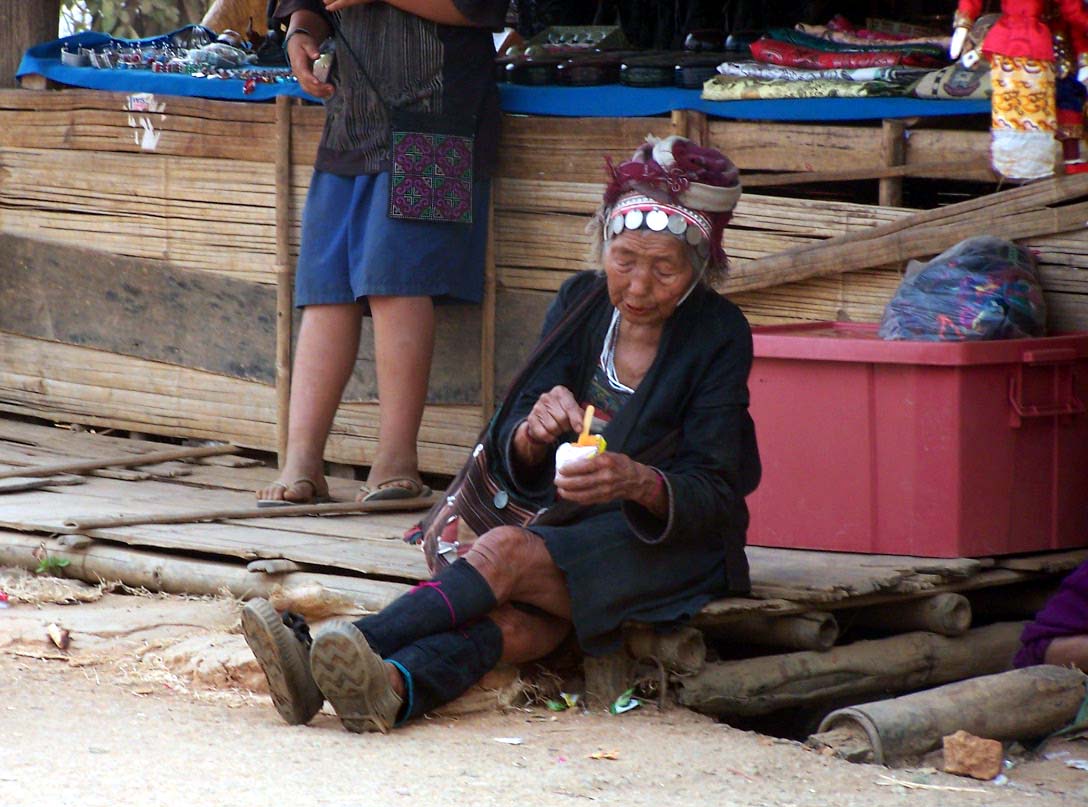
Mae Hong Son is in the trekking area–but quite a ways from Chiang Mai–drove there with several treks en route and spent one night in the town. There are many ethnic tribes–most renowned being the long necked ladies. When I was there not many tourists as it is hard to get to. We subsequently flew back to Chiang Mai–but that was included in the package. Did this on one of my early trips. On that trek we would walk for a day or two, spend nights in tribal villages and the van would pick us up at a designated site. Then onto the next trek–also did a little rafting but no rapids.

These peoples owe allegience to their ethnic group and national boundries are of no signifigance. They originally migrated from China and Tibet and now reside in southern China and in a geographic band across the north of Burma, Thailand, Laos and Vietnam.
100_3585.JPG

These tribes have taken taken advantage of the tourist influx and now offer their villages and homes as overnight lodging for trekkers. As they live in the hills there are no roads, autos and access is strictly by foot. So after a couple of days re-exploring Chiang Mai (its growing big time) I joined 5 other farangs (European and half my age) and a Thai guide for a 4-5 hr ride in the back of a pickup to the trailhead for a 3 day trek.

The walking is relatively easy but the heat/humidity combo is a killer. In 5 hrs we reach a Karen village, are given lodging in a bamboo slat hut and offered a “shower” from a barrel of cold water using a laddle to pour water on whichever body part is selected. A simple meal is offered–tasty but usually best not to ask what it is. Market comes to us as the local ladies show up with their handicrafts. The children run about and giggle at/with the strangers. During the night a pig was the victim of a noisy slaughter as the next day was a festival (new years).

On the previous trek along the Burmese border we had been invited to a wake for a child who had died that day (probably from congenital heart disease). But alcohol became the focus of the event and we made a hasty departure out a side door as belligerence unfortunately replaced festivity.

The next day of this trip offered many stream crossings over narrow logs and I was made suddenly aware that balance is one of the skills that diminishes with advancing youth. Oh well! But we made it to the waterfall for a rewarding swim and that night barbequed a suckling pig.

The last day offered a ride on a bamboo raft through several small rapids and the obligatory elephant ride (once is enough). My less than friendly elephant was named Toby with her cute baby following along behind. I kept thinking that I should have a seat belt. Toby, however, was sure footed, enjoyed the sugar cane and bananas that were sold at intervals along the route.

Mae Sai is just a border town in the far north I went to on another trip. Across the bridge is Burma. It is not a primary trekking destination. Used more for visa stamp-outs and Thais purchase stuff (primarily pornography I think that they cannot get in Thailand–or at any rate saw much of it being confiscated by Thai immigration.) From Chiang Mai it is part of a day trip –in a van–that also includes the Golden Triangle (people stand and have their picture taken under a Golden Triangle sign) and Mekong River/Laos border area. A boring trip.

Tip: The trips out of ChiangMai have become a bit too packaged and westernized–now include the obligatory elephant ride and a raft trip which is a token overcrowded experience. Ok if one has never done it but better if you are able to get off the beaten track like the trip to Mae Hong Son.

Bali Indonesia

YO7AUDZtFfSX7xB1nfH9pw-2006170165110990.gif

Bali.JPG

Godday!!! (with an Aussie accent we picked up here!)

We are currently in Bali Indonesia. It was a spur of the moment decision to head down here. Tomorrow we plan on renting a car & will tour/explore the island for another 2-3 weeks. The past 5 days have been Hindu holidays/holydays and everything has been shut down. On Friday the evil spirits visited so the Balinese do not let anyone (other than delivering mothers) out of their houses for 24 hrs–in the hope that the spirits will interpret that the island is uninhabited and leave well enuf alone for another year. So we bought provisions, TP, and movies and hibernated for a day.

Before renting a jeep I need a Balanese driver’s license but with the holidays all goverment facilities have been closed. So tomorrow we take off. Have been on the tourist side of the island (mostly Aussies–not too far from Austrailia) so am anxious to escape and find some neighborhoods a little less hyper. The local vendors have a penchant for calling me “Boss!” which at first rubbed me the wrong way until we found out that Aussies call each other “Boss” and the locals have just picked up the label!

We are about 10 degrees south of the equator and it is hot and humid–probably the most humid place I have experienced. Adaptation to the conditions is minimal. Tiz rainy season–we had not seen rain for 3 months–so it was fun– have gone out for runs in the rain the past couple of days–like a warm shower.
RLG

Hanging Out On Olkhon Island

Urr0g6ZfQ7ttYL19duYJfg-2006170133924757.gif
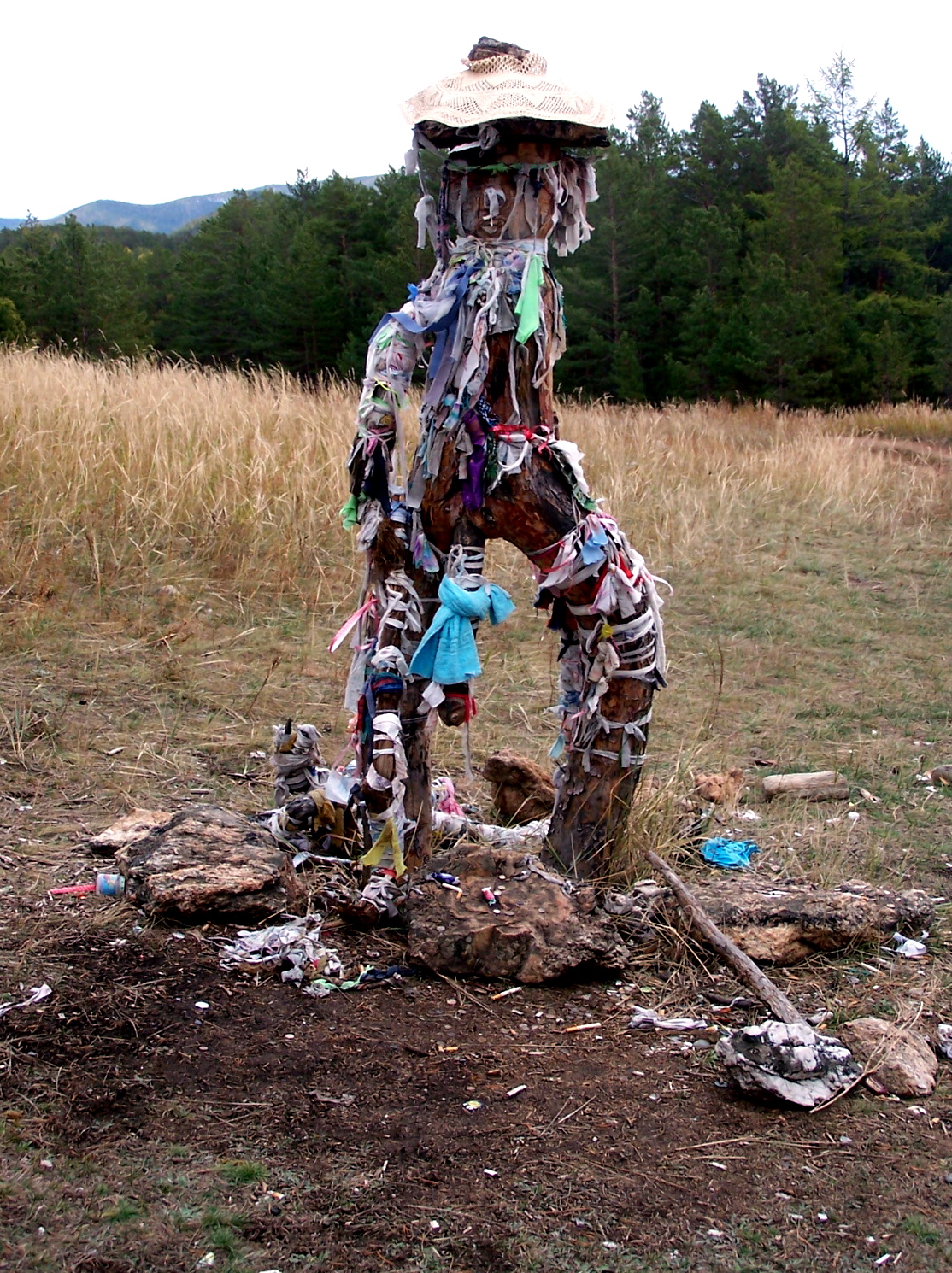
After hanging out a couple days…glad to be off the train…Gregory, a former University teacher of German, drove Bob and I, three Germans and a Pole on a half-day excursion to the north of the 70km long island to visit various geological sites and views of the lake but most especially to see a world renowned Shaman ceremonial circle called Three Brothers that is sacred to two faiths practiced here, Buddhism and Shamanism. Two years ago almost 300 Shamans from the world-over came together here. We lay a one rouble coin at the foot of the prayer flag pole while the “Sarma” or east wind blows fiercely over us.

The Buryats are of Mongolian descent…nomads who spent time herding their flocks between the southern shores of the lake and what is now northern Mongolia. They lived in felt-covered yurts and practised a mixture of Buddhism and Shamanism.

Gregory is driving Nikita’s four wheel drive van…a Russian vehicle designed 30 years ago and that was so successful they used it as an ambulance. “There is only one reason Russians sent the first man into space,” says Gregory the Kamikazi driver thumping over mud hole roads at least 90km per hour…”is because of the roads!” Later he says “we at the moment are using two wheels…if it gets really complicated we will use four!” “Normally we sacrifice two persons…usually 50% survive this trip!” Any of our U.S. vehicles would have rolled over at the first turn but this one mysteriously keeps it’s four wheels on the ground.

We pass through beautiful valleys with sheep and cattle farms…two of which are rich and have beautiful houses “because they don’t drink,” Gregory says. We pass by one small house of an old woman who lives alone with her cow…the rest of the houses in the area appear empty. We are shown an area that was a gulag during the Stalin era and whose inmates produced cans of caviar from the lake sturgeon that was then sent to the Kremlin for the enjoyment of the party bigwigs). I see a straggly triangular three wooden stick affair on the top of a hill and ask Gregory what it used to be. “Local KGB headquarters,” he says throwing his head back in laughter. I ask if the Russians and Buryats intermarry. “Seldom,” he says.

Sleepover In Soweto

S12J2pKbmw6zVZyRvmb7L0-2006193181305721.gif

A Sleepover in Soweto-Africa’s largest township
On our way to India we stopped in Johannesburg for two days to stay with Lolo Mabitsela in her Bed and Breakfast in Soweto-a township about 30 minutes outside the city where most of the violence occurred in the years leading up to the end of apartheid. Lolo’s nephew who runs Jimi’s Face To Face Tours, picked us up at the Johannesburg airport in his van.

Soweto has always had a small and thriving middle class and after all the press about the violence before the end of apartheid they are anxious to get the message out.

About one million people live in the township that was designated for blacks and established in the early 1900’s. The community is still poor and more than half of its adults are unemployed. Roughly twenty percent live in one room tin and cardboard shacks. Lolo, a retired high school principal and school inspector, lives in middle class Diepkloof Extension, however, in a new two story brick faced multi bedroom/bathroom home that would sell for half a million dollars in California. A member of Parliament lives across the street.

Lolo raised several of her niece’s children and her one natural child is an attorney and works for the Justice Department. But she said that blacks didn’t have electricity and she never saw TV in a township until about 1982. She worked 35 years as a teacher and for that she only receives a $300 a month pension. This is because blacks didn’t pay into the pension fund because they were not going to be given pensions.

Lolo cooked us a feast of dumplings, oxtail stew, fried chicken, carrots, beets, salad and fruit. The cuisine includes other traditional treats such as mealie-pap, samp, spinach and ‘mabele’ porridge.

The next day she drove us to the largest hospital in the southern hemisphere where we walked through the pitiful emergency area with people inside and outside lying on gurneys. Most of the doctors are young white doctors from other countries eager for the experience they will gain here-especially with weekend knife and gunshot wounds.

The next morning she drove us to the beautiful Museum Africa housed in what used to be a fruit and vegetable market. One section dealt with the four and a half year trial of 156 people opposed to apartheid that were arrested in 1956. All, many of whom were white allies of the freedom fighters were eventually acquitted. Most of the defense were white and the trial was held in a Jewish Synagogue.

Another interesting section depicted the places and activities of Mahatma Gandhi who lived for a time in Johannesburg. His philosophy of “Satyagraha” or passive resistance was shaped by his 10 year resistance to black discrimination in South Africa.

Finally we drove out to Liliesleaf Farm where Mandela and about 10 other political activists were arrested during a resistance planning meeting. Apparently they had been given away by someone on the inside. The beautiful 29 acre farm and buildings now in an upscale Johannesburg suburb-far from Soweto-had been purchased with Communist Party funds for the use of the freedom fighters. It has been a guest house but recently was sold and will become a museum next year.

Back in Soweto we drove by Mandela and Winnie’s old house that has since been bombed, by Winnie’s new big beautiful home and Archbishop Tutu’s home (yes, he still lives in Soweto! Two Nobel Prize winners on the same street!

For dinner we stopped at a tavern owned by one of Lolo’s former students and had a wonderful supper of African delicacies-mielie pap (corn porridge picked up with the fingers and dipped into a gravy), lamb ribs in gravy, chicken, beet salad, lettuce salad, green mango chutney, cole slaw and I can’t remember what else.

I asked Lolo what happened between Mandela and Winnie. She said it was personal and had to do with the bedroom. But it is only speculation as to who was sabataging the relationship and for what reason. Mandela has since married the pretty widow of the President of Mozambique.

As a single divorced mom Lolo didn’t say how she was able to afford her home. The most curious thing though, was that there was not a single African-motif item in the entire house. A walk inside and you could have been in a quaint B&B in a western country…the new black rich…

Reflections on Africa
We loved Africa and feel sad to be leaving. But the one single strong impression is how little Africans everywhere we traveled, black and white, knew about the outside world and how few, even those who could afford to, had ever traveled out of their own countries. The news media is pathetic and our references to current people and events went clear over the heads of the people we talked to whether it was the sophisticated gay Afrikaner managers in the Waterkant office across the street or Lolo in Soweto.

Jimi, our driver who was born and raised in Soweto and who picked us up at the airport said that he didn’t know what poverty was until he made a trip to the Congo one year… “that was poverty,” he exclaimed! Ironic.

Jimmy’s Face to Face Tours arranges overnight stays with families in Soweto, including Lolo’s Guesthouse, for $52 a night per person, including breakfast and transportation to and from the township, at 8.15 rand to the dollar. Information: (27-11) 331-6109 or (27-11) 331-6132, http://www.face2face.co.za.

Lolo’s Guesthouse: Diepkloof Extension. lolosbb@mweb. co.za. Lolo Mabitsela charges about $50 a night for two, which includes dinner and breakfast. She can accommodate up to four and can be reached at 011 (27-11) 985-9183 or at 011 (27-82) 332-2460.

The Soweto page of Johannesburg’s Web site, http://www.joburg.org.za/soweto, has the most useful visitor information for the township. Gauteng Tourism Authority has regional info at http://www.guateng.net. You can also contact the Soweto Tourism Association’s Dumisani Ntshangase, 011-27-73-310-5886, or Zodwa Nyembe, 011-27-72-437-3944.