Burmese Repatriation (or not)

A couple nights ago I went to the Thailand Foreign Exchange Club in the penthouse of the Maneeya Building to sit at the bar along with all the foreign correspondents and reporters and see a documentary and listen to a panel of speakers about the repatriation (or not) of the 160,000 Burmese refugees in the camps in Thailand along the Burmese border.

As with everything else in the world, this issue is incredibly complicated too. Apparently the Burmese army didn’t get the memo about the cease-fire in a dirty war against the Shan, Karen and Mon minorities. There is no political stability or rule of law and many of the refugees either have no place to go back to because their land was confiscated and homes burned or they are petrified of violence perpetrated by the Army. With no transparency, rumors and tension abound. The UN is supposed to be coordinating this but they are kept in the dark too by the Burmese government who is calling the shots (so to speak) and no one seems to know what will happen…and killings and rapes go on with impunity.

In this information vacuum and continuing threat of violence, the minorities have issued some conditions: A nationwide ceasefire between the ethnic armed groups and the Army, rule of law and human rights improved, military bases withdrawn in the areas where they would return, landmines in areas cleared in areas where refugees would return, minority representatives must be at the table during planning and decision making and implementation. The repatriation process must conform with international principles of repatriation ensuring that refugees would return voluntarily and in safety and dignity and that those who do not wish to return to their original place can choose to live elsewhere. This last one will be particularly sticky with the Thai government. This will take years.

During the Q&A a guy stood at the microphone and started ranting loudly and vociferously about the lack of care and attention being given to the Rohingya Muslims who are native to Burma, but who are ethno-linguistically related to the Indo-Aryan peoples of India and Bangladesh (as opposed to the Sino-Tibetan people of Burma). The region of Rakhine (Arakan) was annexed and occupied by Burma in the 1700s thus bringing the Rohingya people under Burmese occupation.

As of 2012, 800,000 Rohingya live in Burma. According to the UN, they are one of the most persecuted minorities in the world. Many Rohingya have fled to ghettos and refugee camps in neighboring Bangladesh, and to areas along the Thai-Myanmar border.

This was all brewing of course 10 years ago (indeed for the last 30 years) when we visited Burma and found the people to be sweet and very friendly. They were hungry to talk to foreigners if they could speak some English…usually the people who had been English teachers before India left. (See my other blog entries re Burma) Now with the opening of Burma it’s all coming to a head.

In the Burma Couchsurfing group I think every backpacker in SE Asia will be there this winter…hopefully witnessing but avoiding harm if they are sensible enough to not try and sneak their way into the border areas.

Doctors Without Borders & Burma

Aid to Burma
Wednesday June 4
Press Conference with Doctors Without Borders
Foreign Correspondent’s Club of Thailand in Bangkok

Question: How many people still need help?
Answer: Cannot estimate people who still need help…there are little huts among many little rivers…don’t know what was a village…was it there…how many huts were lost. Could get into the west…were obstructed from getting into the east by the authorities. So we cannot say how many people still need help.
Read More

Press Conference on Burma

Tuesday May 27 2008

Dr. Surin Pisuwan, Secretary General, ASEAN, reporting at the Foreign Correspondent’s Club in Bangkok Thailand on the donors’ conference Sunday with Gen. Than Shwe of Myanmar and UN chief Ban Ki Moon in Yangon. The key issue has been the loosening of strict controls on foreign aid workers pressing for unfettered access to the disaster zone. To counter Burmese fears of “hidden agendas” by Western workers, ASEAN has agreed to coordinate all relief efforts.

What has been achieved is far more than what was expected. A new humanitarian “space,” however limited, so that ASEAN with the support of the UN can engage with the Myanmar authorities. That humanitarian space needs political support because in and of itself it cannot be sustained. The secty general of the UN and ASEAN has asked for the full cooperation of the aid community.
Read More

Hanoi Not Burma

Well, I gave up on getting a visa to Burma. “You retired? What was your last job? What organization did you work for?” And he didn’t like my passport. Too many stamps from too many countries. Maybe I am a journalist? “We’ll call you,” he said. Never got a call. So I went back yesterday. “We’ll call you,” he said.

My Thai friend and I are scheduled to fly on the 29th so yesterday, she sweet-talked Air Asia into letting us change our route from Bangkok to Hanoi. That’s the only way to do it in Asia, she says. “I need very much a favor from you,” she said to the customer service rep.

So we have reservations for the 29th through June 1 at the Classic Street Hotel in the Old Quarter Hanoi…my third visit there and very much looking forward to it.

Aung San Suu Kyi

18016136-Dassk4.jpeg

In August of 2002, next door to a restaurant in the small village of Taunggy, Burma, I struck up a conversation with a young university student who was tending a small bookstore. “Can everyone speak (out) in America,” he asked. “Yes, we can,” I said, thinking I will not tell him about “politically correct” speech. He nodded sadly.

A few people, forbidden to talk about politics with foreigners, tried oblique approaches to the subject. One man with delicious donuts on a platter came up to me at the market and said to me in perfect English that he used to be an English teacher. Then he disappeared and returned a few minutes later with his wife who wanted to meet me. “She wants to go to America-so bad,” he said. I made several attempts to ask him to have tea and then dinner with us but was disappointed when he looked furtively around him and told me he couldn’t do that. The government has forbidden the people to talk to foreigners about politics but they are afraid to be seen talking to you (a foreigner) at all as it could mean trouble for them.

However, in Bagan our hired tour guide for a day to view the pagodas, told me that some Americans once told him that that there was a lot of fighting in Burma but that he reassured them there was no fighting in his country. I bit my tongue thinking of the BBC special the night before on satellite TV (that few in Burma can afford). It described the fighting between the ethnic minorities and the military near the Thai border where camps harbored thousands of refugees. American and European doctors regularly cross the border under cover of fire to care for the Karen and Shan tribal people who are suffering from a government policy of ethnic cleansing by burning their villages and killing the people outright or overworking them to death in forced labor groups. I’ll bet he is a government informer,” I said to Bob. “I think so too,” Bob said.

I have been watching the efforts of the international community to free Aung San Suu Kyi, the freely elected leader who has been under house arrest for 4 years and now for a 5th.

Suu Kyi’s Freedom Struggle
The Boston Globe
Published: May 21, 2007
Read More

Stamp-Out to Burma

1wXSp3CkNsDoJl3s0SgHmw-2006171164904627.gif

“Stamping out” consists of leaving Krabi Thailand at a border crossing…in the case of Ranong the border is with Burma…and then “stamping” back into Thailand. To do this they went to the Thai immigration office at the port in Ranong to officially exit the country called “stamping out.” Then they hired a boat ($12) for a 40 minutes ride across the estuary to Burma. They paid $5 US (had to be a US bill) at the Burmese immigration office for a stamp in their passports to enter Burma. They walked around the little dumpy Burmese border town trying to avoid the sellers (the big sales item was Viagra…probably from India) for 30 minutes and then took the boat back across to Thailand where they returned to the Thai immigration office to get stamped back into the country for another 30 days.

In my case I had purchased a 60 day Thai tourist visa in Kunming China so I had another couple weeks in my passport. While Bob and Doug were monkeying around with this, Luk and I found a nice air-con hotel that would accept their little Shimizu “Ting Tong” (the name means “crazy”) for the night…having take-out dinner purchased from the local night market and eating it in our room … one of the best meals we had in Thailand…all of us feasting for about $3.

The next day we drove east to Surat Thani on the east coast of the Thai peninsula …visiting a famous Buddhist meditation teaching center (in English) on the way. Had strong thoughts of being dropped off here for a month but there was no air-con or even fans in the rooms and that even I was not ready for. I just settled for my good old TM mantra in my comfortable air-con room in Krabi.

Volcanos in Tengchong

YUqE3FCf1Hd9CjfG1qqmt0-2006171132705308.gif

A young Chinese woman on the bus had struck up a conversation in English…telling us about the sights around Tengchong. We thought that maybe we could pay her to guide us to the nearby Hot Springs but the plan was aborted after her friend drove us around in a minivan…we paid for an expensive Bai minority lunch…we looked at a hotel we didn’t want…and after the driver took us to a hotel that we didn’t ask to go to…and we still don’t know the name of. The receptionists didn’t know a word of English but we managed to get a double room. The lights dimmed every time someone used the elevator, the dreaded evil kareoke bar was on the next floor down, the telephone rang at least twice a night with no one at the other end of the line. It was ok though because it had a WC and hot shower after 9pm and there was internet down the street a few meters, through some big iron doors and up some dark stairs to a huge room full of young boys playing computer games. There was a girl on each floor with hot water and towels. Supposed to have had dance hall. restaurant, beauty shop but nothing was operating except the dreaded evil kareoke bar and the parking lot inside the hotel compound.

The first day we just hung around the neighborhood and found great homemade dumpling soup made by a very friendly Chinese woman in the market. Bought a CD of a Chinese pop singer and a bag of fresh peas in the pod and delicious tomatoes to snack on…and after some looking Jana finally found an undershirt…in military green camaflage.

We had lunch at the Myanmar Tea House…asked a couple of English speaking Burmese men when they had come to Tengchong…1988 one said…everyone exclaiming at once…one: I fled my country…we saying, oh, since the military junta took over after the last election…told one I guessed he was a University professor in Rangoon and he said laughing…oh, about 30 years ago! I suspect these men may have figured in the opposition during the last election. That night we went back for dinner taking my laptop to treat the owners and their son and a couple young Burmese/Indian patrons with bleached crewcuts to a slideshow of our month in Burma last August.

The next day we struck out for the Tengshong Guest Hotel where there was a map that was promised at the reception desk…first I and then Jana trying to gesture our need for information…seeing the wheels turning in their heads…big pain in the arse Westerners that don’t speak Chinese…until one receptionist gave Jana a card for the T.C.C. backpacker cafe!

After walking a mile with me limping behind Jana, we practically hugged 25 year old Li Bing with his long ponytail and big smile. You saved our lives in Tengchong we wailed. For two hours were reveled in our conversation in English while he cooked us a great lunch…club sandwich for Jana and fried pork with french fries for me…a nice break from the noodle soup we were eating since leaving Lijiang. In his traveler tip book a couple from the Netherlands wrote that both Lonely Planet and Let’s Go guidebooks were useless in Tengshong, “need to put TCC Cafe in those books!!!”

There are over 90 volcanic cones in Tengchong county…22 of them with preserved craters. Jana and Li climbed one large nearby cone called Dakong Shan or “Big Empty Hill” (which pretty much sums it up) while I gave a verbal little three year old girl, Zhou Xiue Ping and her mother, Yang Yong Lai, an English lesson in the warm sun…fireworks, shoes, pants vs the English trousers, ice cream. When I pointed to a picture on my Magellan Point-to-Pictures International Translator and said “tomato” she looked perplexed…finally saying “oh, tomahto!” Jana, having climbed the ubiquitous Chinese steps all the way up to the crater of Big Empty Hill said that the view of the valley peppered with craters was stunning…thinking about what it must have been like millions of years ago…all erupting…

He Ho To Rangoon

Burma.gif

Flight to Rangoon From He Ho
Question: How do you know the Westerners standing behind you in the airport check-in line are not American? Answer: Their backpacks are pink, purple, yellow and orange. Probably French I say to Bob.

Then we take the shortest bus ride in history the 150 meters from the airport to the airplane! Waiting for the plane to take off we saw the ground crew standing at attention while the plane revved up…and then they all saluted briefly to the pilot before they walked off…waving…and we were off to Rangoon.

At the Rangoon airport we discover how a local gets a cheap taxi ride…jump into a car with a paying tourist! Images: on the way to the hotel we see half a dozen men sitting on top of a huge load of rice sacks having their lunch…tea cups and plates spread out-all. Some places not seen in Rangoon the first time: Beauty Saloons, Denney Fast Food Station, McBurger (complete with arches) and J’Donuts. Military trucks seem to be used to transport the citizens…or else they are government mandatory work parties. A “Drive Safely” sticker is on the back of every single vehicle…after awhile you don’t even notice them of course.

Talking Talking…Chinese guy in back of us on the plane…Indian guy on the train to Shimla…Moroccans on the ferry…the Italians…the Spanish…talking talking. It takes so many words? Where are the British and the Germans when I need them?

It occurs to me that my soul needs soothing…I am really hungry for some down and dirty American rock music…life-filled…defiant…power-filled…the personification of confidence…no wonder oppressed youth (and others) all over the world clamor for it. “I will not be broken!” Walking down the street a guy squatting at a tea stall yells out, “What is your country?” America, I yell back at him. “Springsteen!” he yells. “Born In the USA,” he sings again and again and we can hear him singing behind us all the way down the block. Later, walking around that afternoon I see a young guy coming toward me with a Sex Pistols T Shirt. “Where did you get your T Shirt,” I ask him…he answers with a thumbs up. That is how I feel too on this day.

In Rangoon we will take a flight back to Bangkok where we will rest and arrange for our visas to Viet Nam.

Trek to Pa-O Villages

Burma.gif

Bob was happy to get out and stretch his legs on a two day trek in the hills above Kalaw. His guide used to be a chemistry teacher and school principal who only made about $8.00 a month teaching school. So now he makes $15 for a two day trek in the hills.

teacherturnedguide.jpg

They visit several villages…the people know and love him and welcome the people he brings to their homes for a meal and overnight stay in exchange for the tips they receive.

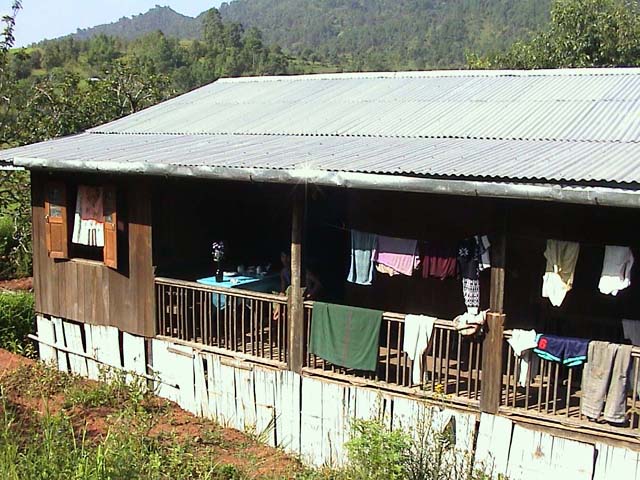
longhouselaundry.jpg

Bob was introduced to a young woman who had been his guide’s chemistry student. She quit studying chemistry in the local high school because she could make 10 times more money raising garlic. If the progress of the country depends on education, it is going to be a very long time before these humble people dig themselves out from under their oppressive military regime. Makes one wonder if this is by design.

Extended families live in a large building, usually on stilts, called a Longhouse. Over dinner in the longhouse that night, Bob, in his way, made one three month old baby giggle which delighted and impressed the family. When Bob offered to buy the baby they all laughed and said no….but the mother then offered to sell him the rambunctious 18 month old sitting next to her!

Schwenguan

Burma.gif

We took a taxi back over the mountain from Tounggye to Schwenguan where we were to catch a train for the three hour ride through beautiful terraced rice fields and vegetable patches to Kalaw-a mountain hill station used by the British. But as with practically every government runvenue they wanted to be paid in dollars. I had a $20 on me but the fair was only $4 for the both of us (foreigner rate-foreigners pay many times more than the locals for everything). Bob refused to pay the $20 so there we stood. I gave some kyets to some teenagers to take me to find a money changer but no luck. By the time I got back Bob had dug $5 out of his backpack. We’re on the train!

At HeHo for lunch we reach through the train window and pick out boiled peanuts and deep fried mashed potato balls from the big round shallow basket a pretty woman holds on her head. We took a great picture of the small girl with arms crossed in disappointment who had only small raw potatoes to sell which no one was buying of course.