Bang Phra Fishing Village

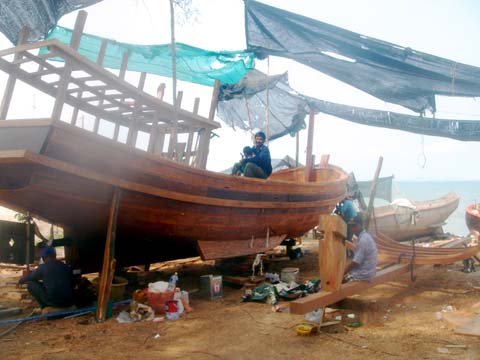
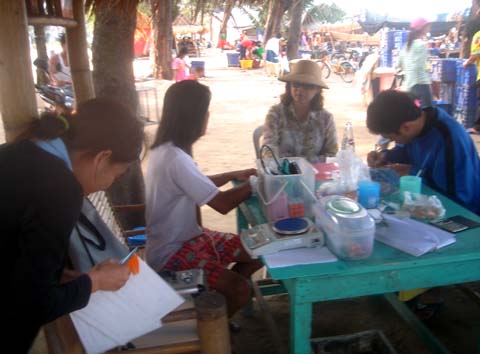
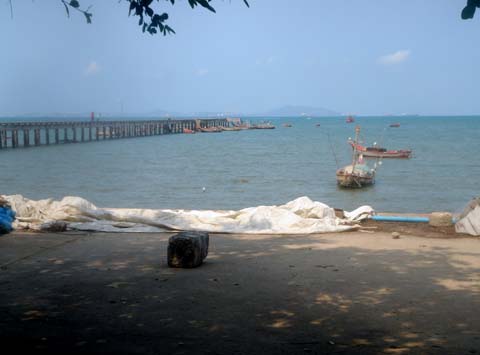
This week I went to Bang Phra fishing village near Chonburi on the Gulf of Thailand with my friend Jiraporn, Professor of Fisheries at Kasetsart University in Bangkok, who, with some of her students, are conducting a population study of the Swimming Crab, a small crab used mostly in soups and salads. There is a concern about the diminishing supply of crab. The students are temporarily living in the village for the duration of the study with a local university fisheries department contributing oversight.

I was blown away by the sense of community here…children playing with their families and each other…vendors bringing around food. I didn’t want to leave. I am now considering a month in this peaceful slow place when I return to Thailand. But I can assure you I won’t be wearing a jacket or a sweatshirt in the 95 degree weather like many of the Thais do!
Gulf of Thailand
Gulf of Thailand

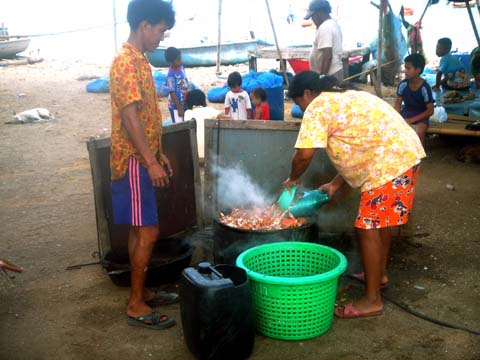
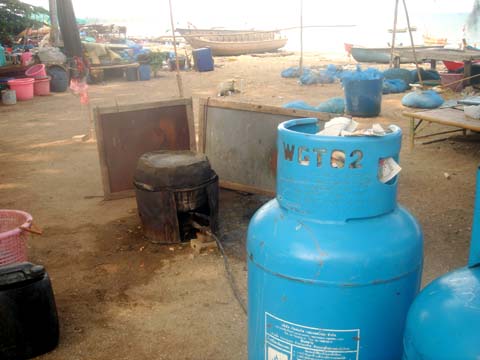
Using Propane To Cook Crab
how-to-cook.JPG

Cooked Crab
cooked-crab.jpg

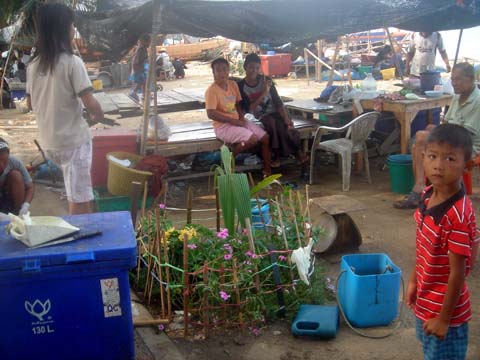
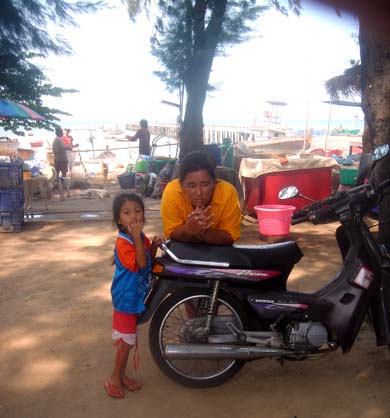
Fisher Family
fisher-family.JPG

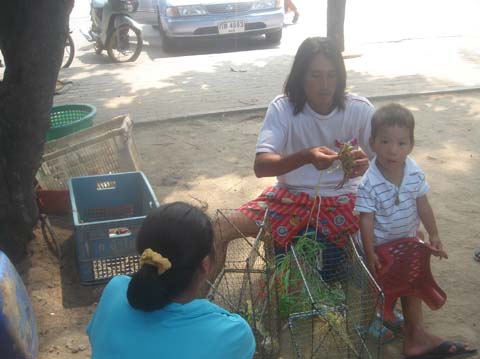
Young Fisherman With His Child
fisherman.JPG

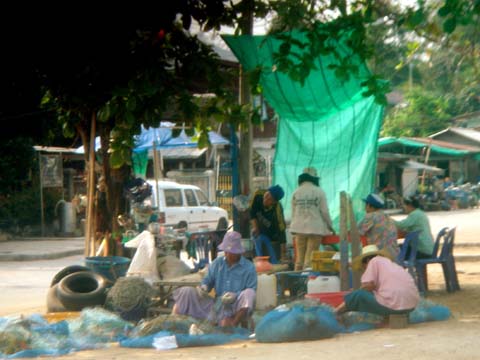
Repairing Nets
repairing-nets.JPG

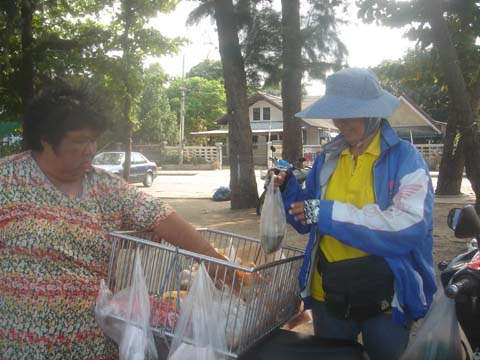
Buying Lunch
buying-lunch.JPG

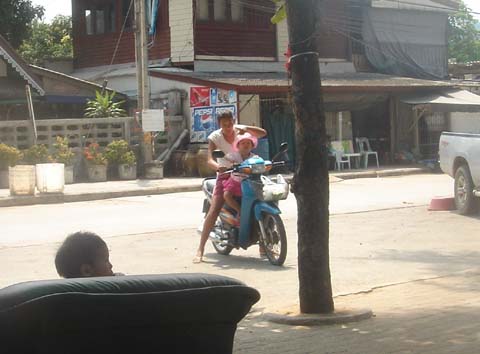
Motorcyclists In Front of Typical Shophouse Opposite the Beach
motorcyclists-in-front-of-shophouse-opposite-the-beach.JPG

Vendor
vendor.JPG

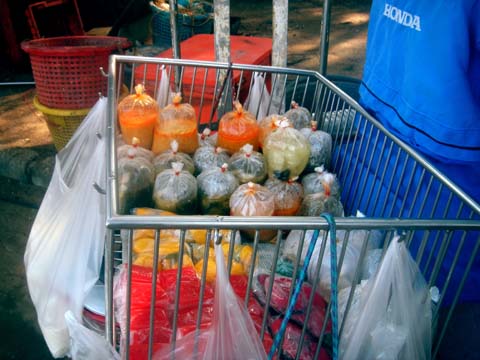
Soups And Other Items
lunch.JPG

Building A New Boat
building-new-boat.JPG

Jiraporn With Students
jiraporn-with-students.JPG

Oaxaca Open Art Studios

Today, friends Sharon and Sueki, a woman visiting from Tucson Texas who we met at Pachote Oganic Market, and I joined a tour of Mexican artist’s homes in San Agustin Etla…about half an hour north of the city. Many of these artists are famous in Mexico and beyond and their art was striking…one a ceramicist who has develped a new process mixing clay with polyester that burns out in the firing…leaving air tunnels in the tile so his gigantic wall hangings are lighter.

One…a hand-made paper artist…gave us a history of paper and an ecological perspective. We also visited a jaw-dropping art museum that is located in an old huge thread factory that has recently been restored under the tutelage of the famous Mexican artist Toledo. The four colors of clay found in Oaxaca…orange, green, yellow and red…combine to create a beautiful setting for a gallery and paper factory overlooking the San Augustin valley.

Then we join photographer, Marietta Bernstarff, (born in Mexico but educated in the U.S. and who also led the tour through the thread factory) in her beautiful home overlooking the mountains and valleys of San Augustin. http://www.laluztalleres.com/about.htm. She remarked that most of the people in this valley are not Oaxacans but descendents of the workers imported here from all over Mexico to build the original factory.

After stopping at a small open-air restaurant for Comida Corrida (midday meal) where we had chicken mole and a beer, we stopped by the home of a Dutch couple that have lived in San Augustin about 15 years. Ineke Granstadts is a jewelry-maker whose daughter markets her jewelry all over the U.S. including Manhattan. We wanted to see her studio she made by hand out of straw bales and stucco.

Then we circled through some other valleys..a beautiful day in a monsoon rain…taking pictures along the way….ending the day with hot chocolate in Oaxaca City.

Our Brooklyn Neighborhood

Video

We are sub letting a pleasant newly refurbished two bedroom apartment on Pacific St in a multi-ethnic, gentrified Brooklyn neighborhood called Boerum Hill. Bob and I enjoy exploring New York opportunities and other sites via the internet on our respectie laptops in the four-story apartment building that is WiFi equipped. We have three keys…one for the front door, one for an inner door and one for our apartment door. An Asian mailman drops the mail for the four building tenants onto the floor through a slot in the wall by the front door at the top of the stoop…each occupant sorting out his own mail. The New York Times and the Wall Street Journal arrive on the front step each morning. The apartment directly across the street is condemned by the city…a big green rectangle with an X in it sprayed on the wall. Drivers seem to feel comfortable leaving their cars on the streets and there is rarely a vacant parking space—am glad that we left our autos in Oregon.

New York has recently reinstated a recycling program so there are multiple plastic barrels at the bottom of the stoop..one for garbage, one for paper and one for plastic and bottles… we were promptly and curtly corrected as to proper sorting by one of the tenants soon after our arrival. There is a contingent of garbage police and fines of $25.00 are given out if items are sorted into the wrong container.

Plastic bags of empty beer and pop bottles are often hung on the wrought iron fences that someone (a guy, freelancer, I think, who scuries the neighborhood carrying several stocked black plastic bags) will pick up and return to the store for the deposit. Once a month bigger items, like furniture, discarded TVs, microwaves etc., are left out for large item garbage pick-up. One day every other week cars are required to be parked on alternate sides of the street so the mobile street cleaners can sweep by unfettered. They usually just end up double parked on the other side of the street which makes for interesting traffic snarls in the mornings…cars honking as if it would make any difference.

There are two large grocery markets within about four blocks either way from the apartment. We wheel our groceries home in a two wheeled wire cart…just like the locals…and wheel our laundry to the nearest coin-operated facility a block and a half away. Down the steps, to the right and on the corner is the Boerum Hill Cleaners run by a gracious Korean family. Swing around the corner and up the block is the wide Atlantic Avenue that stretches all the way to the East River…which really isn’t a river but a narrow estuary of the Atlantic Ocean that surrounds the western end of Long Island.

On the next corner is a deli of multi-ethnic food items, fresh produce, and flowers run by Chinese family who speak Cantonese, English and Spanish. Turn right at the deli and the Islamic community fills the next several blocks…a school, apartments, halal food outlets selling California dates and multiple small cluttered storefront shops selling clothing, soap, perfumes, religious cds, books, and other unfamiliar items…in the middle of this mini-world…a U.S. Post Office. The call to prayer can be heard five times daily on the loudspeakers at a mosque nearby.

Across Atlantic Ave.is St. Cyrus of Turva Cathedral Belarussean Autocephalos Orthodox Church. Next to the church is a middle eastern restaurant owned by a Jordanian family with wondrously fluffy pita bread made fresh upon order. Pita bread, lamb kabobs, and a pint each of humus and babaghanouj provides a wonderful lunch with leftovers. Next door is a laid back French bistro (which we learned means “quickly” in Russian) that offers two entrees for the price of one on Wednesday evenings…and Bobby Dylan is heard on the stereo while sipping a glass of French wine. Next is a garden shop. Where do people garden? I wonder. Next is a New Orleans style restaurant with a live jazz trio featuring an older black gentleman vocalist whose style pulls me in, hook line and sinker. Next is a black Baptist pentacostal church.

Down Atlantic the opposite way and is an organic juice and food market. On either side of the market are two more churches…the Iglesias de Dios Pentacostal Church and the Templo Christiano de Brooklyn for the local Spanish-speaking Puerto Ricans and Dominicans. Further down Atlantic on either side of the street are multiple antique shops, retro clothing shops, and many more corner delis.

Tthe Cobble Hill neighborhood is two blocks distant. It is a gentrified neighborhood centered around Smith St — a bit too hip avenue full of French bistros, Mexican, Thai, Peruvian, Italian, sushi, Indian, New York sandwich delis, West Indian, Cuban, soul food, Jamaican, Chinese take-outs and various sorts of fusion restaurants, bakeries, coffee shops, specialty meat markets… most offering free delivery… and upscale bars full of younger after-work clientele just off the subways from their Manhattan jobs.

Interspersed in between are beauty shops that offer a multitude of mysterious hair styles to their black clients. In a stuffed-to-the-ceiling Chinese variety store on one corner ANYTHING needed in an average household can be found. Schools pour out black and Spanish-speaking children in the afternoon and young nannies push their little charges in strollers. Young entrepreneural men and women have developed a business of walking dogs, four, five six at a time, all behaving perfectly on their leashes…the back pockets of the dog walkers full of plastic bags at the ready if needed for dog do-do. There is a $1000.00 fine for not picking up the stinky stuff…Paris could benefit from this law.

The next street over from Smith is Court Street…with even more upscale restaurants and specialty shops. Walking farther down Court St. is an almost exclusively Italian neighborhood with Italian restaurants, bakeries and delis, a couple beauty shops and an old fashioned movie theater with a really bad sound system. The opposite direction on court leads to downtown Brooklyn and its signiture streets of Fulton and Flatbush ……located there is Junior’s , locally famous for its cheesecake… (they will quickly tell you that President Clinton ate there).

And we haven’t even begun to explore Park Slope, Red Hook or DUMBO and the Brooklyn Heights. Josh lives in nearby Greenpoint, a facimile of Warsaw Poland….only Polish heard on the street and Polish magazines sold in the smoke shops…and great pierogi restaurants.

All of these neighborhoods are filled with writers and artists…an inmigration from the expensive artist lofts in “The Village” (you don’t say Greenwich Village) and the hip SOHO district which means South of Houston St. pronouned “Howston.” Bob still confounds Amy and Josh by insisting on calling it Hewston St. by it’s Texas city pronunciation! And, like San Francisco, the locals know you are a visitor unless you refer to Manhattan as “The City.” People from New Jersey are called the “Bridge & Tunnelers.” And there you have it.
Great Days Great Wall

East China.gif
Video
E found the website (www.wildwall.com) and the adventure offered intriguing potential…off the beaten track, away from the Chinese tourist groups that follow a guide with a microphone and colored flag held high in the air to designate location. After two short emails to William, arrangements were easily made and in the lobby of our Beijing guesthouse I met with the driver (No English) who carried a placard for “Mr. Bob.” After smiles and incomprehensible introductions his black auto carried us through a three-hour adventure negotiating Beijing traffic…bikes, pedestrians, tractors, donkey carts all navigate the same lanes, avenues, freeways where the basic rule is ” Bigger Has The Right of Way.” As throughout Asia, good brakes, good horn and good luck prevails.

My understanding was that we were to pick up another couple but as we finally exited Beijing for the countryside I began to make an alternative plan if perhaps this was an abduction…the imagination can wonder…

We finally entered mountain terrain and the pavement ended. After another 20 minutes we arrived at a small village surrounded by hills We parked and I carried backpack uphill to a courtyard surrounding a small idyllic farmhouse. There was evidence of other foreigners. William casually came out of the farmhouse and introduced himself. An Aussie couple, attired in the hippest of trek fashion had already arrived and they and I completed our trekking group. Subsequently I appreciated their humor, enthusiasm and good cheer and we shared good times and laughs.

After being shown my room, the first of many superb meals was served. Lily was William’s Chinese helper and sous chef…fresh trout in a spicy (picante) sauce. After the meal Schnapps was offered (an acquired taste I guess) and I learned that William was in his late forties, formerly from Liverpool England, but has lived in China for the past 15 years. He has a Chinese spouse and two sons. He is a former long distance runner, who because of his fascination with the Great Wall as a child, later decided to run it’s length. After an initial abortive try he was subsequently able to run most of the wall in the early 1990’s and it has since become his passion. He has authored several books, spear-headed environmental efforts and has become the local expert/personality/guru of all things Great Wall. On our hikes, whenever we were passed by local Chinese hikers he would be recognized and asked to pose for pictures. His affect was such that he always obliged with a smile and some Mandarin conversation.

For the next two days we arose at 5 a.m. and took off in darkness for a 4-6 hour trek that included a significant climb up to the Great Wall and then excursions for varying lengths of time on top of the wall. We were able to stand on the wall and observe the sunrise. Along the way there would be frequent stops for short antidotes or explanations of various aspects of the wall–its history, construction, functions etc.

The Wall was initially started in about 400 BC and continued until the Ming Dynasty (approximately 1600 AD). It was built in sections to protect the Han Chinese from the Northern nomads (Mongolian and Manchu). Initial construction was at points of obvious invasion routes…river valleys…and through the years the Wall was extended up the sides of the valleys and across mountain ranges. It is not one continuous structure but various branches meander and double back. Initial construction was simple but later architectural efforts became more sophisticated.
In c. 220 B.C., under Qin Shi Huang, sections of earlier fortifications were joined together to form a united defence system against invasions from the north. Construction continued up to the Ming dynasty (1368–1644), when the Great Wall became the world’s largest military structure. Its historic and strategic importance is matched only by its architectural significance and is a UNESCO World Heritage Site.

The areas we traversed were constructed of large carved stones, kilned bricks and morter which contained rice. As well as security, the Wall was used for storage, shelter and as a highway. It varied in width from two yards to 10 yards. In the area we were in, there has been no restoration and time and erosion have caused crumbling in many parts with an overgrowth of vegetation both on the sides and on top. It would seem that any minor earthquake could produce serious additional damage. William said his ecologic efforts have produced minimal results to date and he has been happy just to see that his efforts have caused fewer Chinese to litter. Ideally it would seem that stabilization against future damage without restoration would be the way to proceed. But the Wall is so long (estimates vary from 7000 to 10,000 kilometers) that total protection is impossible.

On descent: as frequently happens on hikes there is time for thought, reflection and subsequent contentment…and coming off the Great Wall of China in brisk warm autumn days a few magical to mystical moments. On one occasion while walking solo I heard leaves rustling in the trees –only a few colored leaves remained on each tree. Looking up the leaves would twirl on one tree then sequentially on another– like a self-conducted symphony—only in China. When I asked William whether his operation had reached a size sufficient for an assistant he replied, “I think I will see you again.”

Hutongs in Beijing

East China.gif

Quin-dynasty Beijing was redesigned with mazes of mud and brick walled courtyards after Genghis Khan’s army reduced the city to rubble and is “now the stomping ground of a quarter of Beijing’s residents. According to Lonely Planet, those that stay in hutong pooh pooh the dubious charms of the city’s new high rises claiming that hutong preserves a powerful sense of togetherness where everyone helps each other out…as the Chinese say “close neighbors are better than distant relatives.”

A foreign tour group to Beijing during the 2008 Olympics will be driven down smooth recently-built wide boulevards where these hutong are fronted by glass and steel with no idea of what lay behind. A glimpse across the city reveals thousands of cranes…a building for each…against a grey smog-filled sky. Just before we got to Beijing the Chinese were marking the 40th anniversary of the estalishment of diplomatic ties by celebrating the French Cultural Year in China and a joint French-Chinese fly-over by stunt pilots had to be cancelled because of lack of visibility.

For many hutong, the Olympic bid was the kiss of death…get here before the next phase of road-widening schemes again reshape the city, says Lonely Planet.

Far East Youth Hostel

East China.gif

The last time I was in China it was freezing cold in January 2003. The weather is fantastic this October day in 2004.

After slogging it out across Russia and Mongolia, we soak up creature comforts at the friendly Far East Youth Hostel located among the back alleyways of one of Beijing’s ancient hutongs where young backpackers pick the cheap dorm rooms next to the self-catering kitchen and laundry room in the basement and we, of course, choose a double room upstairs with all the Chinese tourists for about $25.

Downstairs is a “coffee bar” featuring a wide screen TV for viewing one of scores of dvd movies, three high speed internet terminals and a book case full of tattered novels and old travel guides.

Several tables of travelers share experiences and information…one with an Israeli guy trying to explain his country’s posture regarding Palestine to a couple of doubting Norwegians (Europe is generally pro-Palestine which is one reason the Europeans have trouble with the U.S.)

The compound includes a courtyard across the alley with a budget restaurant where I tried to order soy sauce in Mandarin (chiang yo) and got rice instead because of the tone I used.

On the back end of the courtyard are even cheaper dorms housing mostly young male West Europeans. After setting up the tiny computer speakers and coffee pot we step outside the doors of the cozy hostel and find ourselves dodging old men on bicycles between humming dumpling shops and cheap clothing stores blasting Chinese hip-hop and techno. At dinner we laugh at the English menu…among the choices are “Hot Pot of Old Duck With Chinese Medicine” and “Soup Of The Ox Reproductive Organs.” This is as good as it gets. If home is where the soul likes to be…I am there…at least for now.

And then…Bob packed up…and left.

Reflections on the Steppe

GyTjn0QZP9l6Qu21TubskM-2006198062551304.gif

We are lucky…days are brisk but sunny…the sun glints off bare hills covered in golden fall grass. This feels like fall in southeast Oregon where I grew up. I soak it all in while Bob goes on a 4 hour hike through birch groves and box canyons full of grazing mustangs. How do you know they were mustangs I ask Bob…he says” they had labels on each side.” Places were steeper than he anticipated…had to run from one tree to another to keep from falling down the hill.

The next afternoon we paid three dollars to an elder Mongolian in traditional clothing to take us riding horses through the hills with him. Give him his head, I said to Bob who was trying to make his horse gallop! But there was no saddle horn on the tiny saddle to hang onto and it was difficult to post in the ornate metal stirrups. Mongolian saddles are definitely different than Western saddles I was used to as a girl in cowboy country USA. Still, the same freedom I used to feel…while riding…in the wind…in the hills…where I grew up… This is as close to heaven as it gets I thought…connected…connected to the earth.

Hanging Out On Olkhon Island

Urr0g6ZfQ7ttYL19duYJfg-2006170133924757.gif
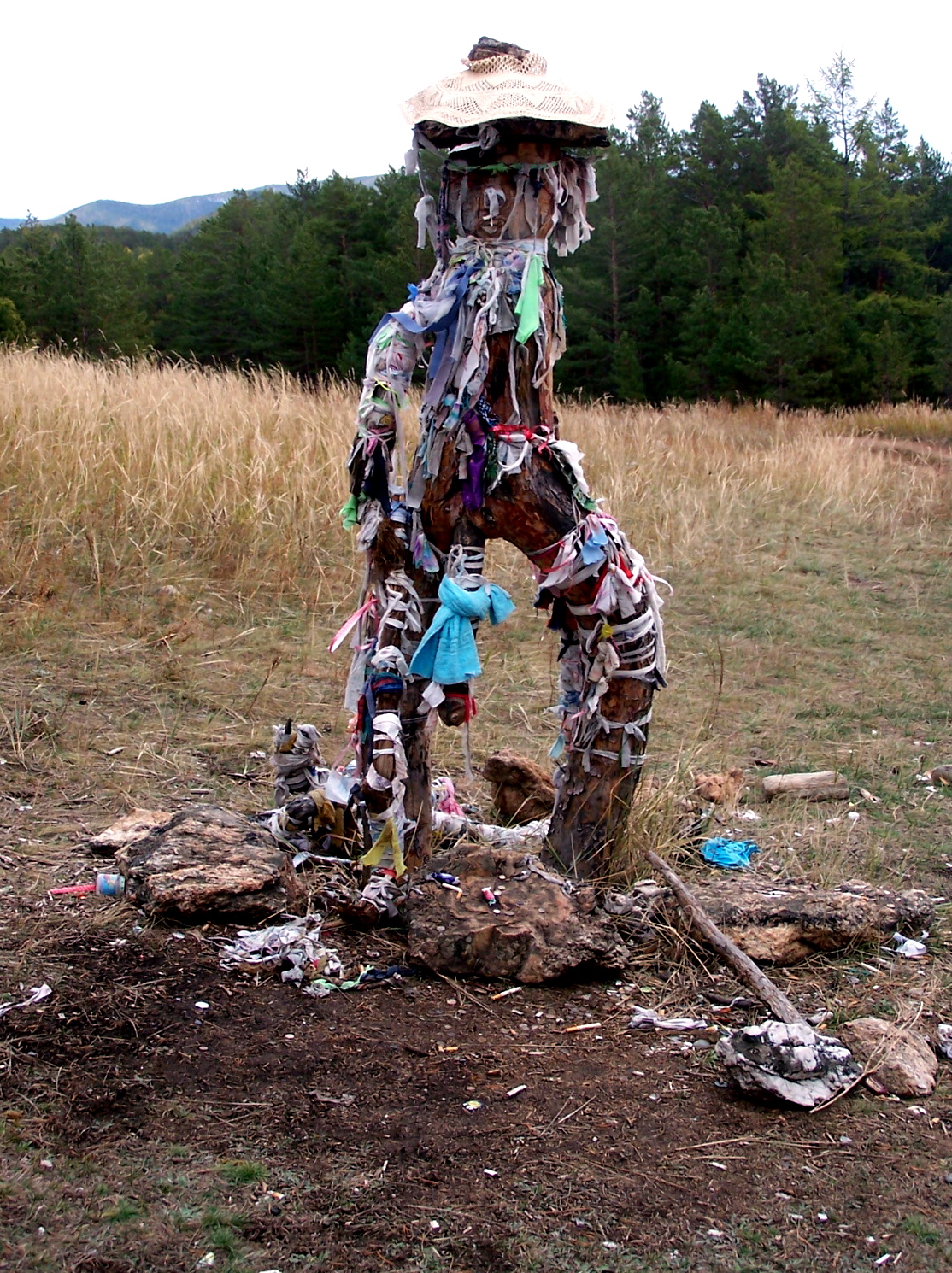
After hanging out a couple days…glad to be off the train…Gregory, a former University teacher of German, drove Bob and I, three Germans and a Pole on a half-day excursion to the north of the 70km long island to visit various geological sites and views of the lake but most especially to see a world renowned Shaman ceremonial circle called Three Brothers that is sacred to two faiths practiced here, Buddhism and Shamanism. Two years ago almost 300 Shamans from the world-over came together here. We lay a one rouble coin at the foot of the prayer flag pole while the “Sarma” or east wind blows fiercely over us.

The Buryats are of Mongolian descent…nomads who spent time herding their flocks between the southern shores of the lake and what is now northern Mongolia. They lived in felt-covered yurts and practised a mixture of Buddhism and Shamanism.

Gregory is driving Nikita’s four wheel drive van…a Russian vehicle designed 30 years ago and that was so successful they used it as an ambulance. “There is only one reason Russians sent the first man into space,” says Gregory the Kamikazi driver thumping over mud hole roads at least 90km per hour…”is because of the roads!” Later he says “we at the moment are using two wheels…if it gets really complicated we will use four!” “Normally we sacrifice two persons…usually 50% survive this trip!” Any of our U.S. vehicles would have rolled over at the first turn but this one mysteriously keeps it’s four wheels on the ground.

We pass through beautiful valleys with sheep and cattle farms…two of which are rich and have beautiful houses “because they don’t drink,” Gregory says. We pass by one small house of an old woman who lives alone with her cow…the rest of the houses in the area appear empty. We are shown an area that was a gulag during the Stalin era and whose inmates produced cans of caviar from the lake sturgeon that was then sent to the Kremlin for the enjoyment of the party bigwigs). I see a straggly triangular three wooden stick affair on the top of a hill and ask Gregory what it used to be. “Local KGB headquarters,” he says throwing his head back in laughter. I ask if the Russians and Buryats intermarry. “Seldom,” he says.

Five Hours to Olkhon Island

7yBXvp82X2gVlMeZe25DiM-2006198051115673.gif

The next morning we are picked up at our homestay in Irkutsk by a sullen driver who drives us five hours over pot-holes, through the taiga and across a bay of the beautiful blue Lake Baikal to the small Buryat fishing village of Khuzhir on Olkholn Island with a population of 1500 (half are Buryat). Urr0g6ZfQ7ttYL19duYJfg-2006170133924757.gif

We stay at Nikita’s Guest House (Siberia’s only real traveler’s hangout) for five days. Nikita, we are told by some of the guests, was at one time Russia’s table tennis champion. Two multi-lingual Russian girls seem to keep things hanging together and they serve us great garlic-charged meals in a communal dining area. The guests are all European…no Americans…and the conversation is spirited…two Swedes quickly challenge a comment I made that they interpreted as being critical of Socialism.

We enjoy the banya (bathhouse) with wood-heated hot water we can pour over ourselves…although the first time we signed up we were the first on the list and the water was still cold.

Free-Wheeling Moscow

7yBXvp82X2gVlMeZe25DiM-2006198051115673.gif

Video

2004-09
Like in the big Central European cities we visited, there are cranes everywhere… old soviet buildings built during the Stalin era are scheduled to be razed and new one modern ones put up. Foundations for Stalin’s “Seven Sisters, called “Wedding Cakes” by foreigners, were laid in 1947 to mark Moscow’s 800th anniversay when Stalin decided that Moscow suffered from a ‘skyscraper gap’ compared to the USA.

Inextricably linked to all the most important historical and political events in Russia since the 13th century, the Kremlin (built between the 14th and 17th centuries by outstanding Russian and foreign architects) was the residence of the Great Prince and also a religious centre. At the foot of its ramparts, on Red Square, St Basil’s Basilica is one of the most beautiful Russian Orthodox monuments. It is a UNESCO World Heritage Site.

Moscow is a free-wheeling city. To the ambitious there are no limits…the streets around the hotels outside Red Square are lined with black Mercedes and BMW’s with black glass windows guarded by black leather clad “goon” drivers…looking like the mafia. I find a fancy hotel where there is free WIFI in the lobby while participants in a European Union meeting saunter back and forth and high-heeled jeans-wearing translators wait around having lively conversation with pipe-smoking goons.

While I sit here uploading text on our blog, Bob wheels off to find the American Medical Clinic where he has a smoldering tooth extracted by a Russian-speaking dentist before we get on the trans-siberian train for Yekaterinburg (birthplace of Yeltsin) Lake Baikal and Mongolia beyond. We miss each other at the end of the day and it costs me 600 roubles to get back to the flat in a taxi because I’m too chicken to hazard the buses and metros.

The night we saw “Spartacus” at the Bolshoi Theater, our bags were searched by monstrously big “security,” one at least seven feet tall. Tanya says, “I never see them there before…” I ask if it is because of terrorism and she says yes, terrorism. By the way, the suicide bomber that killed several of the people in front of the metro entrance was only about 5 minutes from her flat…she says she was at that metro only a few minutes before the bomb went off. People in Moscow worry she says, but what can you do? Yes, I said, I know, thinking of our Josh who works at a restaurant in lower Manhattan.

We are in the ozone at the Bolshoi, the first ballet for Bob who now says he is ready to take ballet lessons if you can picture that and we enjoy conversations with people around us during the intermissions…one older woman from Berkely and a young woman who is here for a few months to volunteer with an AIDS education Non Profit Organization. Come to find out, over a glass of champaign and caviar-filled pastry, her boyfriend, having graduated from Harvard, is working in Chicago as a chef and they are moving to Manhattan…so of course I take her email address to give to Josh.

We leave on a midnight train for Yekaterinburg.