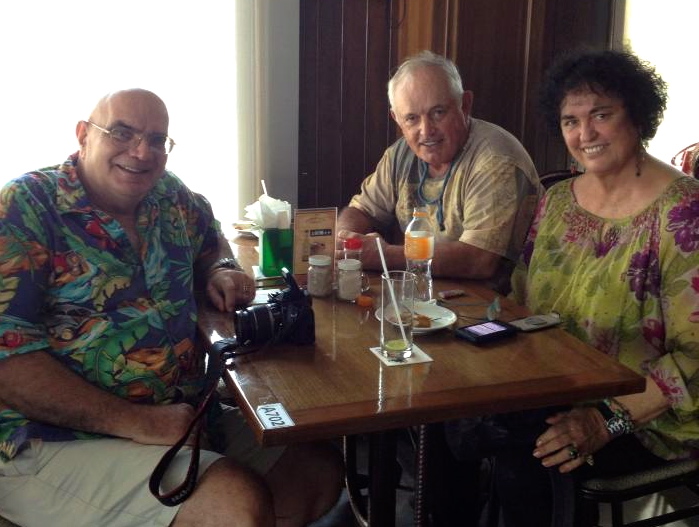
Thanksgiving in Bangkok

Cincinnati Bob, Oregon Bob and me

The American owner of the Bourbon Street Bar and Grill, just off the Ekamai skytrain exit, really served up quite a TG buffet feast. Oregon Bob bussed it in from Pattaya, about an hour outside Bangkok, and Cinncinnati Bob, a good friend and golfing buddy of my husband’s, interrupted his trip in Viet Nam for his birthday and to join us for the Thanksgiving meal.

Surreal Senility Or Sneaky Sane?

3brashinappropriate.jpg

This cartoon originally appeared on womensEnews.org.  Check out more of the New Yorker cartoonist’s work at lizadonnelly.com (“How I Do and Don’t want to be Helen Thomas.”) and on her Open Salon blog.

89 year old Helen Thomas, a virtual institution in the Washington Press Corp, when ambushed by a rabbi, growled that Israel should get the hell out of Palestine and and that the Israelis there could move to Poland, Germany and the U.S.  Wow! Talk about speaking truth to power! It was too much for PC ears to take and she resigns her political column. The Washington press corps is pondering taking away her front row seat where she has needled presidents for generations. Hmmm.

_______________________

I have recently endured flights from Bangkok to Hong Kong, Hong Kong to Oregon, Oregon to Las Vegas, Las Vegas back to Oaxaca where I live. Right now, I don’t care if I see another airport or security line as long as I live. You don’t think jet lag combined with culture shock doesn’t turn the world into more of a surreal event than it already is?

Combine this with two months of demonstrations with round-the-clock fireworks, rockets, petrol bombs and gunshots and then three days of riots where 30,000 tires turned Bangkok black and 25 buildings were burned down…one of them Asia’s second largest mall…more than 90 people killed and a couple thousand injured…over 400 arrested and 200 disappeared…a volcanic eruption in Iceland that brought air travel to a halt nearly the world over and almost detained my dentist for weeks, floods, earthquakes, tsunami warnings…an outrageous “oil spill” that is surreal in itself. Add to that bombings in Iraq, Afghanistan and Pakistan killing hundreds. A video  released by Wikileaks.com shows a U.S. helicopter attack on a group of people in Baghdad (and also their good samaritan rescuers) in which they were all killed including two Reuters journalists. Looked like a surreal video game except that it was horrendously real. Then a vicious Israeli attack on a Turkish flotilla attempting to break the Israeli blockade of Gaza by taking in supplies to the Palestinians. Helen Thomas conveniently took that off the front pages. (News junkie that I am, it’s a good thing I don’t have TV.)

Then Las Vegas, surreal in itself, where my son spent a week telling me all about the coming world financial crisis…backing it up with all his audio tapes by “renowned economic experts.”  Having read about the German bail-out of the Greeks and fear that Spain and Italy will follow, and with our debt in China’s hands it sounded rational to me. Buy gold and silver and get out of the market my son tells me. But…but…Come live with me in Oaxaca, I said, where people already live like people in the U.S will in the future.  It’s called self-sufficiency.

Finally it feels weird to be back in a relatively tiny slow Oaxacan pueblo after six months in Bangkok and Hong Kong.   70,000 teachers are striking again and a caravan to a barricaded Trique village in the mountains suffered the shooting death of a Trique woman and a Finnish human rights worker by a rival Trique group aligned with the government.  The weirder thing is that the demonstrators in Bangkok wore red T-shirts and the Triques wear red ethnic dress…at least the women.

A few days ago I took a nap about 3:30 in the afternoon. When I woke up, feeling quite refreshed, I went into the kitchen and checked the clock. 6:30, it said.  Oh my gosh, I thought, I slept clear through the night…not an uncommon occurrence these days! So I made coffee, toasted a bagel, and went out onto the veranda to check my email.

As I was sitting there facing the park, I noticed the sky getting dark. Oh, a storm must be coming in, I thought. I went on checking email (most of which are Couchsurfing.com forum posts) and Twitter where I get the latest information on the political aftermath of the Red Shirt rally in Thailand.  When  I looked up again the sky was a little darker…but no wind was coming up as is usual just before a storm, which, btw, took down one of the huge trees in the Zocalo the other day…the crack of it sending people running every direction. Somebody should prune!

So onto my Facebook updates.  By then the sky was really getting dark. I thought about that Mayan calendar that ends in 2012.  I noticed that my friend Rico was on line on Facebook chat so I asked him, Why is the sky getting dark?  He ignored me, however,  and started describing all his latest. Damn. Typical Rico, I thought.  But why is the sky getting dark!  By this time, I was really getting freaked out. RICO! What is going on?!!!  Dunno.  Is a storm coming in?  Don’t think so. It goes on like this.

Serious concern here. Finally I checked the date/time on my computer thinking maybe I didn’t change the time zone from Asia to Mexico…a 12 hour difference. No, it’s ok. Then I noticed the computer said it was Wednesday.  It should have said Thursday. What day is it, Rico? Wednesday, why?

As is obvious by now to my dear readers, in all this time it never once occurred to me that it was 6:30 in the evening.  Damn. Is this what I have to look forward to? Quit reading the news, I hear you telling me.  But isn’t this what senility really is?  Thoughts wondering aimlessly…alone…among their own disconnected damaged brain cells…oblivious to the world?

I take heart, though, from 89 year old Helen Thomas, who, btw, I think is sneaky sane. Me? Dunno. At 66 it doesn’t look good.

Back Home in Oaxaca

Whew!  What a ride! A week in Vegas, a month in Salem Oregon, a week in Hong Kong, 5 months in Thailand (4 in Bangkok and a month on Koh Samui) a week in Hong Kong again, 2 weeks in Salem, 10 days in Vegas and now back home in Oaxaca. Right now, I don’t care if I see another airport again!

Oaxaca is in the middle of an historical heat wave. Am I still in Thailand? Three fans on in my bedroom at night. Oh where is that Thai A/C?! Too hot to go grocery shopping!  (Maybe I’ll lose some weight.) Tomorrow I’ll just water my plants and drink what’s left of my Arizona Iced Green Tea.  And then take a nap.

Big Cleanup Day In Bangkok

About 10,000 Bangkok residents, including teenagers and foreigners have joined hands to help the (BMA) clean Ratchaprasong Intersection and surrounding areas in the ‘Big Cleaning Day’ activity. Said that they must help clean Bangkok together because it is their home. Shops, give away free drinks,
lunches, snacks, and yogurt…

Recap on Thailand

The current situation in Thailand is not necessarily due directly just to the political history,  but indirectly because of all the long-standing alliances and divisions between parties, the military and the privy council members who are all trying to position themselves before the elections.

This current round of conflicts started with the 2006 coup that resulted in a government installed by the military. Then Thaksin was elected prime minister. He was the first PM that did anything for the rural poor…a health system and high-interest micro loans to farmers. So the NE rural people (Reds) think he is wonderful.

Then Thaksin was indicted for corruption (bilked the country of a few billion baht of taxes and some other stuff) and fled the country when he was sentenced to 3 years in prison. The government froze about 2/3 of his money and recently returned it to the treasury. Many people think Thaksin would like to return to Thailand, get his money and return to power. He represents new money.

Meanwhile the Yellows (Royalists) and the PAD party, complaining about corruption, held the government house hostage for 193 days in 2008. These folks are supported by old money, many in the Thai diaspora and many in the University system and are called “elites” by the Reds because they feel condescended and disrespected especially by the privileged in Bangkok (and local government house leaders I might add because they line their pockets and wield power just like the people in Bangkok.

When the police tried to dislodge the Yellows with grenades and tear gas they went to the airports (my Yellow friend says) for protection. Of course they must have known the government would shut down the airports then. This resulted in the current government with the election of the current Prime Minister by a coalition of parties in the Parliament with general elections scheduled for this fall.

The Reds, meanshile had been holding “Democracy Workshops” all over Thailand and convinced the people that the interim government wasn’t elected so therefore Thailand wasn’t practicing democracy. IMO an election does not a democracy make in Thailand anyway because there is no division of powers between the courts, the Parliament and the Prime Minister…indeed there is political and economic collusion at every level.

So it is in the political interest of Thaksin and his proxy party to dismantle the government (dissolve the parliament now and have elections) now instead of waiting until the scheduled elections in the fall. There are reasons for this. One is that the military still wields a great amount of political power in Thailand. If the elections were now, it means that the new Military General that is scheduled to replace the current one would be appointed by a new Prime Minister (Thaksin or his stand-in) whose party would certainly be elected. However, the current Prime Minister and his party (who would certainly lose an election) want to stay in power long enough to appoint the new head of the military.

So. Thaksin is paying 500 to 1000 for each rural Red to come to paralyze the city of Bangkok and force Abhisit (current Prime Minister) to step down and dissolve the parliament and have elections now. The timing of elections is part of what the negotiations were about that failed. Abhisit is backed by a coalition of parties opposed to Thaksin and they are holding firm.

When the Reds held a press conference at the Foreign Correspondent’s Club of Thailand just before the rally started, they insisted that the rally would be peaceful. No weapons. The journalists didn’t buy it. They also wanted to know who was paying the Reds. Presenters answered that most of the demonstrators were volunteers. The journalists didn’t buy this either. (Incidentally, one of the four Red presenters was introduced as the “accountant.”

The problem came when weapons appeared. Many weapons were stolen from a military barracks before the rally started…probably with help because some in the military and 70% of the police are Red sympathizers. For months before the rally started bombs were going off all over Thailand.

Everyone is wondering who the “men in black” were that were seen April 10 shooting with high powered rifles when 27 people died including 4 military officers. Don’t believe the press when they portray the Reds as having only sling shots. They were armed with rocket propelled grenades and other weapons. Some people think this is part of a battle between military factions underneath the Red Rally. Recently, one demoted general, Sae Deang, purported to be behind the Red Shirts, was assassinated. Some are speculating that it was vengeance for the killing of several military officers on April 10.

This is the first time I have said this publicly, but IMO I think the meeting between Thaksin and Hun Sen (no love lost between Cambodia and Thailand) resulted in hired Cambodian mercenaries. It would make sense because Thai blood runs thick and it seems unnatural for Thais to be killing Thais. JMO.

So for 6 weeks the Red leaders had been using volatile rhetoric to stir up the Red demonstrators at the main stage…backed by very loud DJ music. Reds kept pouring in from up-country and the “camp” strethed all the way from the main rally site among all the malls and 5 star hotels to the business district of Silom. There were huge screens about every 50 yards so people camping in the street could see and hear what was going on on the main stage. Red Guards dressed in black guarded the demonstrators and some were seen carrying weapons. ID cards were issued and people searched before entering the site. Foreigners (witnesses) were welcomed and treated well. When it looked like the police were about to close in they exchanged their red shirts for multi-colored ones to hinder identification.

Another Thailand watcher characterizes the rally demonstrators this way:

Some of the foreign press are painting the endgame as the Alamo, but it is not. It is a lot closer to Jonestown or Waco.

Like those latter two cases, a highly charismatic leader figure (in our case operating from a distance, shopping in Paris while his minions sweat in the 94°weather) has taken an inspirational idea: in one case Christianity, in the other democracy, and reinvented it so that mainstream Christians, or real democrats, can no longer recognize it. The followers are trapped. There is a siege mentality and information coming from outside is screened so that those trapped believe they will be killed if they try to leave. Women and children are being told that they are in danger if they fall into the hands of the government, and to distrust the medics and NGOs waiting to help them. There are outraged pronouncements that they’re not in fact using the children as human shields, but that the parents brought them willingly to “entertain and thrill” them. There is mounting paranoia coupled with delusions of grandeur, so that the little red kingdom feels it has the right to summon the United Nations, just like any other sovereign state. The reporters in Rajprasong who are attached to the red community are as susceptible to this variant of the Stockholm syndrome as anyone else.

The international press must separate out the very real problems that the rural areas of Thailand face, which will take decades to fix, from the fact that a mob is rampaging through Bangkok, burning, looting, and firing grenades, threatening in the name of democracy to destroy what democracy yet remains in this country.

Then talks failed and the Red leaders announced they were giving themselves up (probably handed a deal by the govt) because if terrorism carries a death sentence.  The demonstrators responded with tears and jeers. Before the leaders left, the main speaker called for Bangkok to be burned. (you can see video of this with English subtitles on my blog here.  It is interesting, however, that 83 Yellows were convicted of terrorism for shutting down the airports in 2008 but most of them are free today.  Can you imagine world headlines stating that Thailand hung 83 terrorists?

Meanwhile, CRES, the Thai department in charge of security, has gone on live TV to defend why the police needed to use live ammo.  They showed caches of arms and firebombs retrieved from the rally site. But it may not be over yet. Regrouping reds have announced another Bangkok rally in June.

This is just a skeleton outline  My info has come from Thai friends and following articles and tweets since November but also following events since the coup in 2006 that I witnessed in Bangkok in 2006.

Political Options For Thailand?

Simon Montlake has an article in the Christian Science Monitor speculating on the political future now that the rally is over. It doesn’t bode well for Thailand because neither the the Yellows (PAD Party) or the Reds (Thaksin) will accept the validity of a government by the other. This is how he ends the piece:

The red shirts, known as the United Front for Democracy against Dictatorship (UDD), called for snap elections in Thailand, which has been roiled by political turmoil since 2006. An election is likely to return a government allied to Mr. Thaksin, the former premier.

Earlier this month, Prime Minister Abhisit Vejjajiva offered to dissolve parliament in late September, paving the way for a November election. But UDD leaders rejected the proposal, part of a reconciliation package. Mr. Abhisit, who must call elections by December 2011, hasn’t said if he would stick to this timetable after ordering the crackdown.

Duncan McCargo, an expert on Thailand at the University of Leeds, in England, says it is hard to imagine a quick return to parliamentary politics after the recent upheaval. But he warns that early elections may not end the crisis, as rival “yellow-shirt” protesters oppose any restoration of Thaksin’s influence.

“The big fear is that whoever wins the election will face some repetition of the 2008-2010 protest cycle, since neither red shirts nor yellow shirts will accept the legitimacy of the other’s position,” he writes in an e-mail.

Security officials say the string of arson attacks was organized and that black-clad gunmen had stopped firefighters from tackling at least one blaze. In some attacks, looters also cleared out stores and bank ATMs.

Last month, Nattawut Saikua, a UDD leader, encouraged poor protesters to loot malls in the event of a crackdown. “When we are panicked, we will smash glass windows of these luxurious shopping malls and run amok inside,” he said, according to Human Rights Watch.

Kung, the protester at the temple, said he didn’t take part in any looting but had little sympathy for store owners. “People don’t have money. Do you understand?”

Bangkok Calming

 Well, the most you could say about this recent conflict in Thailand is that even if the rancor remains for decades, there is a whole generation that is now politicized.  The Reds from up-country have undergone a process known here as ta sawang, or a “brightening of the eyes” — an awakening, a realization of a truth they had not recognized.  Unfortunately their eyes followed Thaksin who recognized them as a huge voting block.

But in the northeast the rage goes on. The nation reported this morning that Education Minister Chinnaworn Boonyakiart on Friday formed two panels, one in charge of fact-finding related to the arson attacks of three schools in the Northeast and another responsible for assessing the damage.

During the first day of curfew on Wednesday, two arson attacks were reported in Nong Khai and Yasothorn.

Ban Tha Chiang Krua School in Nong Khai’s Seka district was burned down. The arson happened at Ban Yang Krue Nong Thom School in Yasothorn’s Muang district.

During Thursday’s curfew, Ban Wang Keng School was torched at Khon Kaen’s Nam Phong district.

Burning Of Bangkok

Just about eight minutes after the Red Shirt leaders gave their last speech on the main rally stage to jeers and tears, just before they gave themselves up to police who were closing in, flames and black smoke from burning tires has nearly covered 20 sites of the city for the last three days.  In the clash, protestors used everything from rocket propelled hand grenades, petrol bombs,  and molotov cocktails to slingshots and rocks and the military used hi-powered rifles, tear gas and tanks, although the BBC took video of the Reds using rifles too.  On wednesday, several people were killed…including both Red Shirts and at least one soldier. Anger at what was perceived as a biased media resulted in reporters being targeted and an Italian photographer dead. Hundreds were wounded including 3 other reporters.

Central World, the second largest shopping mall in Asia was burned out, the old Siam Theater, a cultural icon, was burned among about 3 dozen buildings, people being harbored in a wat were attacked, a TV station was attacked with staff having to be airlifted out by helicoptors, soldiers wounded, almost the entire country came under Emergency Rule and the government is enforcing a 9pm to 5am curfew…much to the consternation of young backpackers.  The MRT subway and BTS skytrain has stopped until further notice. The battle has spread to the provinces with at least two provincial halls being burned. So much for  peaceful Thai farmers.  The following Washington Post story with links to photos depict the disaster.

Thai military breaks up red-shirt protests in Bangkok


Story: Thai soldiers assault ‘red shirt’ encampment in Bangkok

The military launched an offensive to evict anti-government protesters from central Bangkok, a move that left parts of the city near anarchy.


Unrest in Thailand

Thailand has a long history of political unrest and protests. View a graphic showing the relationship between pro- and anti-government demonstrators over the last four years.

Graphic


Protest in Bangkok

View a graphic that chronicles the protest in Bangkok, Thailand.

Red Shirt Leaders Surrender

Washington Post Foreign Service
Wednesday, May 19, 2010; 2:06 PM

BANGKOK — Thai soldiers launched an assault Wednesday against “red shirt” protesters in a military operation that forced anti-government protest leaders to surrender but left parts of Bangkok in the grip of near-anarchy.

This Story

View All Items in This Story

View Only Top Items in This Story

Enraged by the offensive, protesters set fire to Thailand’s stock exchange and Southeast Asia’s second-biggest shopping mall, looted luxury boutiques and fired grenades and guns in areas previously untouched by the mayhem. Disorder spread to at least seven provinces, and protesters set fire to town halls in three northern cities.

In an effort to contain the violence, the government imposed an overnight curfew on Bangkok and extended it to 21 provinces. It also banned coverage of the unrest on local television channels, which limited themselves to government announcements.

At least five protesters and an Italian freelance news photographer were reported killed in Wednesday’s clashes, and about 60 other people were wounded. But there were indications that the death toll could rise. The Associated Press quoted witnesses as saying at least six more bodies were recovered in the capital’s protest zone after the military assault.

Speaking on television, embattled Thai Prime Minister Abhisit Vejjajiva said he was “confident and determined to end the problems and return the country to peace and order once again.”

But exiled former prime minister Thaksin Shinawatra, whose followers formed the red shirt movement, warned that military attacks on the protesters could spawn mass discontent and lead to guerrilla warfare, Reuters news agency reported. “There is a theory saying a military crackdown can spread resentment, and these resentful people will become guerrillas,” the agency quoted Thaksin as saying.

In an offensive launched at daybreak after days of escalating confrontation, armored vehicles smashed through barricades made of sharpened bamboo poles and rubber tires while heavily armed troops raced deep into territory occupied for more than a month by protesters.

As the military advanced toward the center of the fortified encampment, protest leader Jatuporn Prompan announced that he and other “core leaders” would turn themselves in to police. He pleaded with followers to leave the area to avoid further bloodshed.

“We have no more words to speak because all your hearts are already far beyond death,” Jatuporn said. “Today we will stop the death but we will not stop fighting. People keep dying; let’s stop the death together.”

An angry mob ignored the appeal for an orderly retreat and set fire to parts of Central World Plaza, an upscale nearby shopping mall, under the gaze of fashion models pictured on billboards advertising luxury clothing. Thick smoke billowed from the shopping center and also from Siam Theatre — a popular movie house — a government-owned bank and other buildings. Rioters set fire to the Thai stock exchange, which had closed early because of the violence. Some protesters began setting up new barricades and fought running battles with soldiers.

The government said it had the situation under control but also declared that a curfew would go into effect at 8 p.m. and continue until 6 a.m. Dazed tourists struggled to get back to their hotels through military checkpoints amid sporadic rounds of gunfire. Electricity went off in residential areas far from the protest zone.

There also were reports of unrest elsewhere in Thailand, a close military ally of the United States and popular tourist destination that touts itself as the “land of smiles.”

An angry mob ignored the appeal for an orderly retreat and set fire to parts of Central World, an upscale nearby shopping mall, under the gaze of fashion models pictured on billboards advertising luxury clothing. Thick smoke billowed from the shopping center and from the Siam Theatre — a popular movie house — as well as a government-owned bank and other buildings. Rioters set fire to the Thai stock exchange, which had closed early because of the violence. Some protesters began setting up new barricades and fought running battles with soldiers.

This Story

View All Items in This Story

View Only Top Items in This Story

The military eventually halted its advance on the center of the protest zone, saying it wanted to let people leave. The government said it had the situation under control but also declared that a curfew would go into effect Thursday. Dazed tourists struggled to get back to their hotels through military checkpoints amid sporadic rounds of gunfire. Electricity went off in residential areas far from the protest zone.

There also were reports of unrest elsewhere in Thailand, a popular tourist destination that touts itself as the “land of smiles.”

Most of the trouble outside Bangkok occurred in northern regions, the main base of support for Thaksin, a billionaire former police officer who wants to return to Thailand and to power. In Khon Kaen, a major city, protesters torched the town hall. In another big northern city, Ubon Ratchathani, about 1,000 red-shirt sympathizers set fire to city hall, gutting it, a resident said.

Such incidents show that far from settling Thailand’s deep political divisions, Wednesday’s assault threatened to polarize the country further. The protesters first gathered in central Bangkok to try to force early elections to replace the government, which was chosen by parliament, not a popular vote. It took power from a government loyal to Thaksin, who was overthrown in a military coup in 2006. What began as a peaceful movement for change, however, became increasingly unruly as hard-line militants took up arms and protest leaders lost control of their own cause.

Although the government clearly won the battle this week, it now faces the more difficult task of winning what will probably be a long campaign to restore enduring calm and to prevent pockets of resistance coalescing into a threat that could jeopardize the entire country’s stability.

In Bangkok on Wednesday, trouble spread beyond the “red zone” into Sukhumvit, a main thoroughfare usually clogged with foreign tourists. At Asoke, a major hub, red-shirt sympathizers set fire to tires outside a police station and blocked the street with buses. A crowd of bystanders cheered. A fire truck was chased away, leaving the fires to rage unchecked. They were later put out, and the crowd dispersed.

Jeremy King, a private fund manager and longtime British resident of Bangkok, said the onlookers’ cheers signaled a surprising degree of “grass-roots support for the red shirts.” But he was also surprised, he said, by “how quickly the crowd evaporated . . . and the fires were put out when the order came to stand down.”

Special correspondent Nate Thayer in Bangkok and staff writer John Pomfret in Washington contributed to this report.