Resilience

A man sleeps every night on a wrought iron bench in the park across the street from my apartment in Oaxaca Mexico.  At 6 o’clock,  he wakes and prepares for the day. He is dressed in slacks and a sweater over a white shirt. From my veranda I watch as he meticulously folds up a big black sheet of plastic that he sleeps under…carefully shaking it out after each fold…matching the corners perfectly.  He has two small backpacks that carefully hold his belongings.  He washes his face and hands from a bottle of water and then picks up several pieces of cardboard that he sleeps on and puts them under one arm.  He puts on a pair of glasses. Then he picks up a short white “stick” and unfolds it into full length.  The tip of the walking stick is red. He walks down the street toward LLano Park.   I wonder, what does a blind man do for work in Mexico…”

These stories, as Obama has said, “tell us that even in the most trying times, amid the most difficult circumstances, there is a generosity, a resilience, a decency, and a determination that perseveres…”

Their resolve is our inspiration.

Trouble In Egypt

An explosion has taken place in the ancient area of Al Hussein-Cairo, Egypt, the number of killed and wounded is still unsettled.  How the bomb was exploded is not exactly specified.   It’s the most glorified and valued area for Egyptian and every Muslim; for both Sunni Muslim and Shiite Muslim this place is highly sacred. It’s the place where prayer is practiced every day, and it’s the place where Al Hussein (Prophet grand son) is believed to be buried.  It is also the place of an important market and center of business where hundreds of Egyptians make a living on selling goods and offering services to visitors.   It is well known that the place is a preferred spot for Egyptians and foreigners to spend an evening, says one Egyptian.

The news agencies are saying it was a militant Islamic group.

“Muslims usually comes to this place seeking spiritual calmness and peace of soul, not it’s ridiculous to claim that a cowered act like this would be made by a Muslim or some one who understand and believe what Islam is,” says this Muslim. He believes it was Mossad, the intelligence arm of the Israeli government.

But consider this.  If it was done by an Islamic group why would an Islamic do such a thing?  Here is one answer.

I know next to nothing about Islam but it just so happens that I just finished reading Bernard Lewis’ 2002 book “What Went Wrong? The Clash Between Islam and Modernity In the Middle East.”  He takes 105 pages to itemize, often from journals and diaries, the gradual contacts of Islamics with the West, from the beginning of Islam, and the resulting modernizing influences of the West over the centuries on the Middle East. (This book was written for the Western reader so my apologies for copying much of what may already be known.) Then he goes on to say: Read More

Geo-Piracy In Oaxaca?

In Oaxaca, Geographers Deny Surveillance Charges

Narco News Bulletin
By Nancy Davies
Commentary from Oaxaca
February 21, 2009

Amid a storm of accusations, defenses, campus condemnation, public pronouncements and news articles, the Union of Organizations of the Sierra Juarez of Oaxaca (UNOSJO) has condemned the mapping project called Mexico Indigena, a sub-project of Bowman Expeditions. The founder and director of UNOSJO, Aldo Gonzalez, launched a campaign to alert indigenous communities of Mexico and the world to the risks involved in giving access to Bowman Expeditions under whatever name.

What is the true reason for a geographic survey of the Sierra Juarez paid for by both the US and Mexican governments? Many possible reasons come to mind, such as theft or purchase of forest timber, locating natural resources like minerals or water, narcotics activities, bio-piracy, counter-insurgency, geo-piracy, and preparing for privatization of communal land. UNOSJO’s press release discusses several possibilities.

The American Geographical Society (AGS) director, Jerome Dobson, asserts that academics commonly accept US Army funding, and hand over their results with no qualms. AGS sponsors Bowman Expeditions in places like Columbia and Jordan. Gonzalez advises other communities not to permit such mapping projects. “You’ll be sorry,” he asserts. It is not yet clear what the Mexico Indígena project sought in the Sierra Juarez.


Aldo Gonzalez showing map
D.R. 2009

In a formal press conference held on Thursday, February 19, Gonzalez disclosed UNOSJO’s charges against the Mexico Indígena Project, and Bowman Expeditions, claiming geo-piracy and lack of ethical conduct in the communities of the Sierra Juarez. Two communities among nine spread over a geographical mountain area of perhaps 10,000 hectares agreed to continue the project after UNOSJO objected, and cooperated by supplying investigators detailed information.

Gonzalez claims the investigation in the Sierra Juarez failed to inform the population regarding two aspects of its funding: the US military; and Radiance Technologies, a weapons business.

Although the Mexican government clearly participated and partially funded the project through its two agencies, Semarnat and PROCEDE, it has thus far made no statement in the face of accusations launched against the Mexico Indígena Project.

Gonzalez claims a possible violation of national sovereignty and violation of the autonomy of indigenous peoples. For all that, he has refrained from asserting as if it were proved, that the Mexico Indígena team was spying.

Spying? Bowman Expeditions has been in Iraq and Afghanistan with “embedded” sociologists, psychologists, and geographers. These teams gather terrain and cultural intelligence to make easier the task of the military, who can use information regarding the culture, family relations and psychology of the local people, as well as close details of streets and passages. According to Wikileaks, posted on December 11, 2008, a 122 page handbook dated September 2008 presents the US military’s controversial anthropology based counter-insurgency techniques. Formally titled “Human Terrain Team Handbook” the document comes out of the US Army’s $190 Million “Human Terrain System” [HTS] program. According to the handbook, Human Terrain Teams are 5-9 person intelligence teams made up of serving military, contractors and “academicians”. The teams are designed to assist a commander’s irregular warfare operations by using anthropological and intelligence techniques to exploit cultural, political and family relationships in a region. The material is unclassified, but has not been publicly released though official channels.

So is Mexico Indígena a Human Terrain System (HTS) project? Both use human participation. Geographers and academics are in the area to gather on-the-ground information with local input. Most important: they have the same parent origin and funding source. UNOSJO soon discovered that Mexico Indígena is a Bowman Expedition, like those carried out in San Luis Potosi, México; the Antilles; Colombia, and Jordan; all are sponsored and financed by the Foreign Military Studies Office (FMSO) of the US Army, among others. FMSO prepares a world data base which is an integral part of the HTS used for counterinsurgency by the US Army, and which could be used against indigenous pueblos or anyone else involved governments choose.

The history of the controversy: Read More

Deconstructing A Childhood Religion

This documentary shows how a “modern” articulate and caring non-practicing Muslim woman tries to come to terms with her childhood religion.  I could have substituted myself in the film, with the exception of the catalyst of 9/11, replacing the word “Islam” with the word “Catholic.”  Do we ever have a free choice of religion as an adult when we have had religion inculcated in us as a child by loving nurturing grandparents, parents, aunts, uncles and the culture around us?   Where does religion stop and personhood begin. Or do they become one and the same?  Are we ever “there” in our personal “jihad” or struggle to know who we are.  What is our truth which is neither an overreactive denial of nor a blind identification with…our childhood religion?

Sheep Camp Bread To NY Times?

I’ll bet anything this recipe came from an Irish sheep camp much like my father’s. The recipe’s originator, Jim Lahey of the Sullivan Street Bakery in New York ought to give you a hint.

The easiest bread recipe ever

By Gail Jokerst

February 18, 2009 edition Christian Science Monitor

Every so often a recipe crosses my path that is too good to keep to myself. If it’s straightforward to prepare and success follows, I spread the word to food-loving friends from Boston to California. Which is exactly what happened recently after I tasted a memorable rustic bread at my sister-in-law Ruth’s home in Wisconsin. With just four ingredients – flour, water, salt, and a measly 1/4 teaspoon of yeast – it could certainly be classified as basic. But it was also remarkable for its flavor, textures, and the unusual method used to make it. Moist and chewy inside with a crisp crust that shattered when I bit into it, the bread reminded me of the best Italian and French loaves I’ve bought from big-city bakeries. Only this creation came from my sister-in-law’s oven, her Dutch oven to be precise.

No-Knead bread

3 cups all-purpose flour

1/4 teaspoon granular yeast

1-3/4 teaspoons salt

1-1/2 cups plus 2 tablespoons water

Cornmeal for sprinkling

Combine flour, yeast, and salt in a large bowl. Stir in water till the mixture is blended. The dough will be loose and wet. Cover the bowl with plastic wrap and let the dough rise at room temperature 12 to 19 hours– the longer the better.

Flour a work surface and turnout the dough on it. Flour your hands and sprinkle the top of the dough lightly with flour. Turn the dough over on itself a couple times and then let it rest 15 minutes. Form the dough into a ball using as little flour as possible. The dough will seem somewhat fluid but it will form a ball. (It’s tempting to use a lot of flour here but don’t. The dough should stay moist.)

Place the dough seam-side down on a smooth-surfaced towel sprinkled with cornmeal. Lightly dust the top of the dough with flour or cornmeal, then cover it. Let the dough rise till doubled (about 2 or 3 hours).

At least a half hour before the dough has finished rising, place a Dutch oven with a lid in the oven and preheat the oven to 450 degrees F. Remove the pot from the oven and carefully turn over the dough and place it in the Dutch oven. Then shake the pot to distribute the dough evenly. Replace the lid and bake for 30 minutes. Remove the lid and bake another 10 to 15 minutes or until the top is golden and the loaf sounds hollow when tapped.

– Adapted from The New York Times

    Cont from Christian Science Monitor:

When Ruth was ready to make this loaf, I kept her company in the kitchen as she measured the ingredients into a bowl. Then I watched as she mixed them all together to form a shaggy mass that did not appear to have a promising future. Unlike most bread doughs, which are kneaded till satiny, this dough was neither smooth to the touch nor kneaded. In fact, it was stickier than any dough either of us had ever handled.

Although tempted to add more flour and yeast, we resisted the urge to obey years of bread-baking instincts and faithfully followed the remaining directions. We let the dough rise overnight as instructed. Then we formed it into a ball, waited while it rose again, and baked it inside a steaming-hot Dutch oven.

When we lifted the lid 30 minutes later, we were amazed to see a gorgeous, golden round loaf sporting professional looking splits across the crown. In another 10 minutes, we pulled the boule from the oven and listened to the crust crackle as it cooled on the counter. Read More

The End Of Wall Street As We Know It

“On Thursday, Sept. 18, 2008, the astonished leadership of the U.S. Congress was told in a private session by the chairman of the Federal Reserve that the American economy was in grave danger of a complete meltdown within a matter of days. “There was literally a pause in that room where the oxygen left,” says Sen. Christopher Dodd (D-Conn.). (more »)

Last night PBS Frontline aired “Inside The Meltdown”  for those of us who lost half of our retirement and would like to know what happened.

Watch and weep.

Valentine’s Day Story

On any day, in the park across from my apartment, young people, away from the prying eyes of parents and grandparents, can be seen  laughing and playing with each other affectionately…though the kissing never seems X rated. People walking past them pay them no attention…as if they weren’t there…giving silent assent.  I have seen this in other Mexican cities. This morning I came across this LA Times article describing an uproar in Guanajuato.

“A town famous for an Alley of the Kiss passes a law against public displays of affection, sparking a passionate outcry.

By Ken Ellingwood
February 14, 2009

Reporting from Guanajuato, Mexico — Once upon a time, there was a city where people came from far and wide to kiss.

The place was blessed with gold and silver, but its kissing legend, passed down like an heirloom, made it rich beyond measure. It tells of a fair maid named Ana who fell in love with Carlos, a poor miner who lived across a narrow alley. The young lovers met on their balconies, stretching across the tiny gap to kiss in the moonlight.

But their love was star-crossed: Ana’s father forbade the romance and threatened to kill his daughter if he discovered the lovers together again. The next night, he caught them and, true to his warning, stabbed Ana with a dagger. Dying, Ana reached out and Carlos kissed her hand — the couple’s final kiss.

The children of this city have learned this lovers’ saga by heart and told it over and over to the hopeless romantics who come to see the spot, known as the Alley of the Kiss, and to share a good-luck kiss there.

So it came as a terrible shock to people here last month when word spread that the city’s leaders had issued an edict: Kissing in public was forbidden. Violators would be punished.
The news set off a storm over smooching that, weeks later, still has tongues wagging in picturesque Guanajuato, a mining town in central Mexico — and reveals a lot about the ways of Mexico, where you don’t need to get a room to express your love for each other. Like any good Valentine’s Day story, this one ends with a kiss.

The affair blew up in January, when Guanajuato’s City Council, led by the socially conservative National Action Party, or PAN, approved an ordinance on public behavior to replace a 32-year-old law. The ordinance tackled problems such as unlicensed street vendors and jaywalking. But it also targeted offensive language and “obscene touching.”

The mayor, Eduardo Romero Hicks, was asked what sort of public act would be punishable. He said the law would ban agarrones de olimpiada, which translates roughly as “Olympic fondling.” (In an interview later, he explained that this meant “fondling far beyond the norm . . . extreme eroticism in public places.”)

Garden-variety kissing, the mayor said, was never the target.

But leftist opponents depicted Romero and his PAN colleagues as latter-day inquisitors bent on imposing strict morals on the rest of Guanajuato, a tranquil town with cobblestone streets and hillside homes painted in eye-popping hues of orange, pink and electric blue.

The outcry was swift. Protesters gathered in front of City Hall to kiss en masse. The news media got into the act, and pretty soon Romero and his city were at the center of an unflattering national controversy. A satirical video posted on YouTube played a familiar cumbiacumbia-style tune with reworked lyrics and depicted Romero in a priest’s collar. One editorial cartoon showed a couple kissing in a bird cage suspended by a fixture shaped to spell “PAN.”

It mattered little that the mayor announced within days that the measure would be suspended. All of Mexico seemed ready to take to the ramparts in defense of a treasured institution: the kiss.

“The attitude toward kissing is a good thermometer of the tolerance of a society,” columnist Federico Reyes Heroles wrote in the Reforma newspaper. He said trying to limit public kissing was like outlawing miniskirts — the stuff of totalitarian countries. “Eros is part of life,” he wrote.

In liberal Mexico City, officials have rallied to the cause of the kiss by summoning residents to a massive Valentine’s Day kiss-in on the main plaza. Organizers are hoping for thousands of kissers at today’s event, perhaps enough to land a spot in the Guinness World Records book.

In unveiling the kiss-athon, the city’s tourism secretary, Alejandro Rojas Diaz Duran, appeared to toss a dart in Guanajuato’s direction by pointing out that PAN members were welcome to join in. He said Mexico City “has always been the example of what Mexican society’s values should be.”

If so, public kissing would be high on the list. Compared with the United States, Mexico is a very smoochy place. Mexicans of all stripes kiss each other on the cheek when saying hello and goodbye. Children and parents slobber over each other with abandon. Even strangers merit a kiss; Americans might be taken aback by the Mexican custom of kissing someone on the cheek when being introduced.

Take a walk through many public parks in Mexico City and it can feel as though you’ve stumbled onto Lovers’ Lane, with couples in tight embrace on wrought-iron benches or entwined on the grass beneath shade trees. The capital’s vast and woodsy Chapultepec Park is so well known as a make-out zone that it has a racy nickname: Chapul-tetrepo, tetrepo, the last part of which can be translated as, “I climb you,” as one would a tree.

It’s not only teens locking lips on the street; middle-aged couples also are given to public displays, sometimes with surprising urgency. Making out in the park avoids the prying eyes of siblings, parents, grandparents, aunts and uncles who form the typical extended Mexican family. And there is an overall expressiveness that sets Mexicans apart from the northern neighbors.

“We’re more romantic. We show our feelings,” said Dulce Nancy Gonzalez, a 25-year-old doctor who on a recent day accompanied her boyfriend to the steps of the Alley of the Kiss for a lucky smooch. Tradition holds that kissing on the third step brings 15 years of good luck.

“It’s not hard for us to show our feelings,” Gonzalez said after she and her boyfriend of three weeks shared several kisses of the sort you’d never plant on grandma. “For us, it’s harder to hide them.”

In that spirit, Guanajuato’s leaders are adopting an “if you can’t beat ’em, join ’em” approach. Having shelved the controversial ordinance for more review, Romero has gone all the way, declaring his city the “Capital of the Kiss.”

Officials are hanging banners and printing postcards that celebrate various flavors of kissing (all G-rated and mostly showing family situations). Merchants are reportedly working on the recipe for a margarita-type drink that would be called the beso, Spanish for “kiss.”

Guanajuato’s residents have come to view the noisy affair as a cautionary tale about the futility of trying to lasso romance. Or the silliness of politicians. Or both.

On a recent day, Jorge Garcia and Vanessa Atzmuller, teens in matching white hoodies, stretched across the table of a sidewalk cafe near City Hall. They met halfway, touching lips softly, the way Ana and Carlos might have.

This time, they all lived happily ever after.”

I’ll bet you anything in the world it was complaints by norteno tourists who sparked the attempted shut-down of the kiss. LOL  For me, watching these playful carefree kids is much more uplifting than reading the daily headlines.

Thoughts After Guatemala

Who are we really?

One of the reasons I like indigenous people is the humility with which they harmonize with their surroundings and environments…but progress and modernity upset this natural equilibrium.  Which is what I think we are witnessing in the world today. Have just finished  Martin Prechtel’s (half native American from New Mexico who became a shaman in a Mayan village in Guatemala. And just started reading Bernard Lewis’s last book “What Went Wrong?” The clash between Islam and modernity in the middle east.  But that’s another conversation.

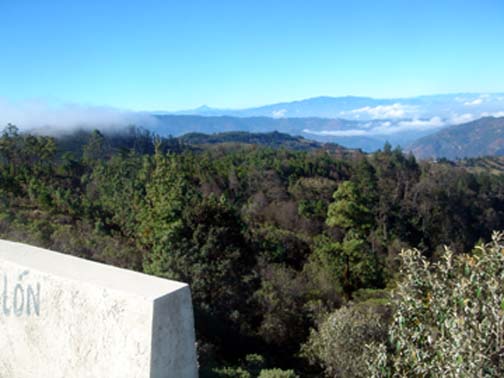
In the most remote Mayan mountain village we visited, at 13,000 feet and 7 hours from the nearest city, I met a man, looking like he was in his 40’s and dressed norteno (brown leather jacket and levis) who had spent the last 9 years working all over the States.  He was hungry for conversation. I looked at the villagers and at him, seeming so out of place, but knowing he was still essentially Mayan, and  wondered how he feels about his place in his village now.  I wondered about the younger ones too…having abandoned the traditional dress and the huipiles worn now only by the old women…huipiles that soon will only be seen in museums.

We all think about identity and the essential questions.  There are no black and white answers. Martin Prechtel was the son of a Canadian indigenous woman who taught on their Pueblo reservation in New Mexico and a Swiss paleontologist.  He felt lost but found a place and his identity in a traditional Mayan community. Then Guatemala’s generals (with the help of powerful interests including the United States) declared a brutal war on it’s own people that lasted for years and years until Prechtel’s village became paved over with tourists and false incantations for a fee.  Prechtel carried the “Village Heart” back to the “land of the dead” and wrote three books at the request of his Mayan shaman teacher who could see that the traditional world view was being destroyed from without…due to the encroachment of Christianity in cahoots with big business and progress…and guns.

“Shamans say the Village Heart can grow a brand new World House if it is well-dressed in the layered clothing of each indigenous soul’s magic sound,  ancestral songs and indigenous ingenuity. The wrecked landscape of our World House could sprout a renewed world, but a new language has to be found.  We can’t make the old world come alive again, but from it’s old seeds, the next layer could sprout.  This new language would have to grow from the indigenous hearts we all have hidden [within us.]”

Martin Prechtel, writer, teacher, speaker, musician and healer,  in “Secrets Of The Talking Jaguar.”

San Cristobal Chiapas

On the way back to Oaxaca from Guatemala we stopped in San Cristobal for four days. You may remember San Cristobal from the 1994 demands of the Zapatista rebels led by the mask-wearing Maros.  Well, a lot of other people must have heard about it to because the town was filled to the hilt with European tourists.  Restaurants of all kinds galore.  Rude Italian backpackers…well…a lot of other backpackers are rude too though.  Clean, no stop signs or lights and cars take turns…and stop for pedestrians!  All in all a big surprise!

The overnight bus to Oaxaca not bad but slept most of that day and the next. When we took our baggage to the check-in the guy looked at us…looked at the baggage…looked at the tickets…tapping his finger on them.  I knew what was coming. “Money for coffee,” he said!

Oaxaca to Guatemala And Back

dsc00005.jpg

dsc00014.jpgdsc00003.JPG

After a lovely visit with my son in Las Vegas, I thought I would have an uneventful Mexicana flight back to Oaxaca.  But of course not.  Changed planes in Mexico City and was told to sit at a certain gate.  About 10 minutes before boarding time I noticed that “Oaxaca” was not posted on the board.  I asked some folks sitting near me if they were going to Oaxaca too.  So asked at the desk again.  Oh, the gate has been changed, they said!  So we all ran. At least I thankfully got the green light in Oaxaca and didn’t have to have all six bags searched. Then heard about the AeroMexico flight that was diverted to Portland because of fog in Seattle…travelers sitting on the plane for four hours at which time the plane flew back to Mexico City and then back to Seattle again.  Don’t think I’m taking a Mexican plane again anytime soon.

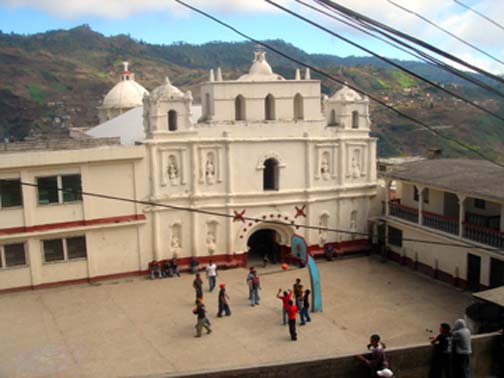
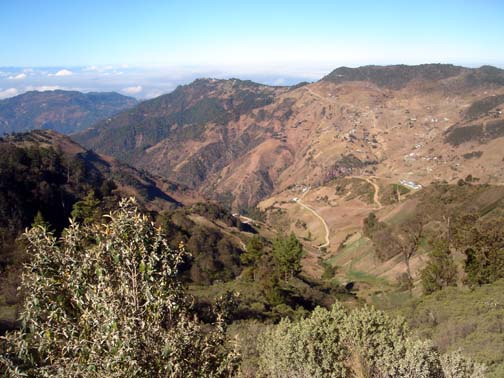
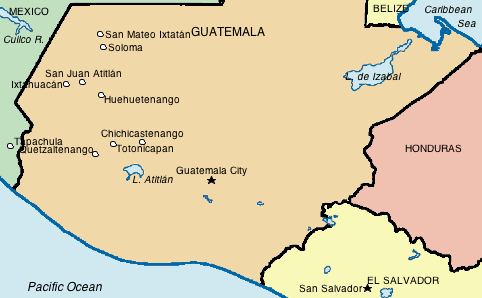
Barely had a week to unpack when I joined two friends for a trip to Guatemala to visit small Mayan mountain village markets in the north for two weeks.  Our base was Quetzaltenango (Xela the locals call it, and the 2nd largest city in Guatemala) and took crowded chicken buses and overflowing “collectivo” vans to outlying villages each day…the longest a 7 hour ride to San Mateo Ixtatlan (at 13,000 feet) where older women still wore the “sunburst” huipil.  Half the population of Guatemala is still rural…houses crawling up the mountainsides with no visible roads.  Breathlessly snaking along S curves, with only mountain tops and a dozen volcanos poking through the clouds,  it felt as if we were looking out the window of a plane. Each village still has it’s own language, dress and culture…the most beautiful was the “red and purple village” where men and women both still wore elaborate hand-woven clothing in the traditonal way signifying whether single, married, status etc.

Villages We Visited