Grueling Border Wait

The wait at the Russian-Mongolian border is a grueling 5-6 hour wait for customs to go through each carriage and take our passports, return to the office to fill out forms and then return with our passports. Olga takes a six inch wad of $20 bills out of her hand bag and counts it three times.

We are desperate to get off the hot claustrophobic train and get some cold fresh air. We find a very small market a hundred yards from the train where we buy dried apricots, apples and dried noodle soup.

To relieve the bordom a young guy from Chicago (they have put most of the foreigners on this carriage) pulls out his frisbee and plays with an older guy from Australia out on the platform and when one toss ends up on top of the carriage, the guy from Chicago climbs up to get it but can’t resist the urge to pose playfully for all the cameras that appear down below…but not for long. Officials appear and grab all our cameras removing batteries, film & digital chips and tapes. They spend an hour filling out forms and waiting…for what…an offer of money? No one wants to pay money but we shuffle and wait nervously. Finally just before the train pulls away the cameras etc. are returned to their relieved owners.

The Mongol border is a good 2-3 hour wait too… Mongolian sellers and money changers come on board. Olga takes an offer from a guy wanting to exchange our Russian money but then slams the cabin door in his face as she lets in a Mongolian woman who gives us a better offer. Olga has obviously done this before.

After crossing six time zones out of a total of 9 or 10 in Russia, the train thankfully rolls into Ulaan Baatar at 7 the next morning.

The Tajik and Olga

7yBXvp82X2gVlMeZe25DiM-2006198051115673.gif

The Tajik and Olga
In Irkutsk, when we find our seats on the train to Ulaan Baatar, we find a good-looking 40 year old Muslim man from Tajikistan in our cabin. He has studied English in school when he was a boy by showing us how tall he was, and remembers a few words. He shows us pictures of his wife and four kids back at home in Tajikistan. We show him pictures on the computer of our trek in 1996 in Kyrgzstan although aware that the Kyrgeez and Tajiks don’t really like each other very much.

We are able to figure out that he is returning to Ulaan Baatar to operate a “caterpillar” at a gold mine after a three-month summer break with his family. We soon put our sausage and cheese and bread on the little table and he pulls out his bottle of Vodka. He is charming and has a wonderful smile and a quick laugh…I like this man.

The next day Olga, an energetic middle-aged blond, begs to move from her assigned seat near the toilet at the end of the carriage so she joins us…immediately kicking the mellow Tajik up to the top bunk and spreading her belongings from one end of the cabin to the other. Fluent in English, she says she gave up her doctoral studies in Chemistry in 1993 because there was no work in her field, to become an entrepreneur and she makes the trip to Mongolia and China every few months to buy merchandise…”everything for health” she says. She instructs us where to get a cheap hotel in Beijing and gives me an empty bottle to have the Chinese traditional pharmacist fill for my psoriasis.

Soon she and the Tajik are really going at it in Russian…the bluster again…and I ask her what they are talking about. Olga is incensed: “He leaves his wife in Tajikistan to work in another country but when I ask him if she works he says no she has to stay at home and only leave when she is with him!” This goes on for awhile and is actually quite entertaining to watch…then she non-plusses Bob by showing him a picture of man (XY) and woman (XX) and showing him that with an unfinished “X” (referring to the “Y” that “there is a mistake!” When he objects she says “well maybe women are more clever. He just looks at her.

Hiking Olkhon Island

Urr0g6ZfQ7ttYL19duYJfg-2006170133924757.gif

Back at Nikita’s “resort” I spend half a day taking care of monkey business while Bob goes hiking around the island. It is the end of September but Siberia lives up to it’s reputation. It is cold. On the trip to the island it snowed and now each day hovers below zero with chilling winds and puddles that don’t thaw. In another six weeks the lake will begin to freeze and the island will be cut off until the ice is thick enough for vehicular driving. The thaw will not arrive until May. We did not bring appropriate clothing and each dash from the cabin to the squat toilet is a determined gritting.

Tomorrow at 6pm we leave on the train for Ulaan Baator Mongolia.

Hanging Out On Olkhon Island

Urr0g6ZfQ7ttYL19duYJfg-2006170133924757.gif
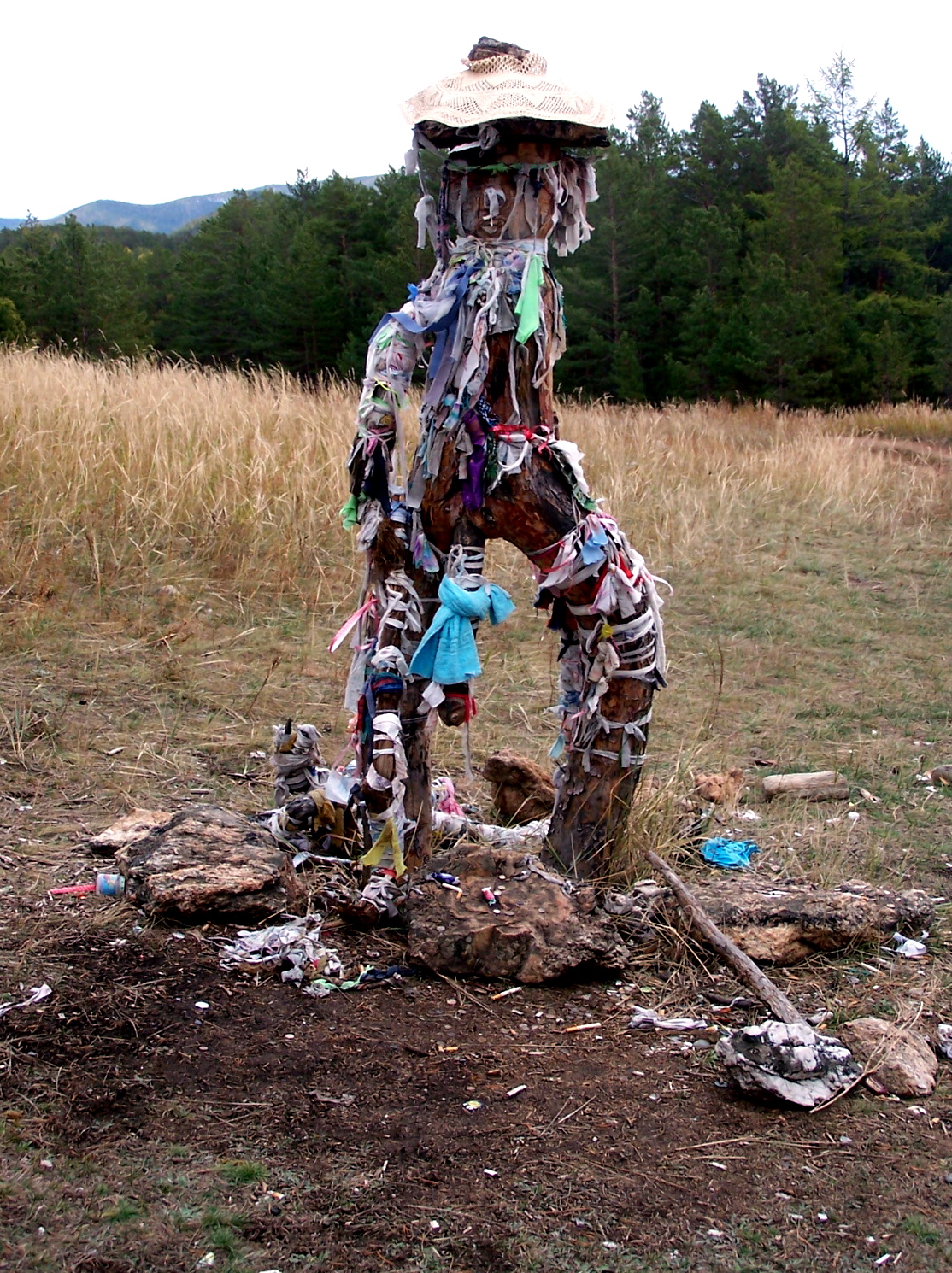
After hanging out a couple days…glad to be off the train…Gregory, a former University teacher of German, drove Bob and I, three Germans and a Pole on a half-day excursion to the north of the 70km long island to visit various geological sites and views of the lake but most especially to see a world renowned Shaman ceremonial circle called Three Brothers that is sacred to two faiths practiced here, Buddhism and Shamanism. Two years ago almost 300 Shamans from the world-over came together here. We lay a one rouble coin at the foot of the prayer flag pole while the “Sarma” or east wind blows fiercely over us.

The Buryats are of Mongolian descent…nomads who spent time herding their flocks between the southern shores of the lake and what is now northern Mongolia. They lived in felt-covered yurts and practised a mixture of Buddhism and Shamanism.

Gregory is driving Nikita’s four wheel drive van…a Russian vehicle designed 30 years ago and that was so successful they used it as an ambulance. “There is only one reason Russians sent the first man into space,” says Gregory the Kamikazi driver thumping over mud hole roads at least 90km per hour…”is because of the roads!” Later he says “we at the moment are using two wheels…if it gets really complicated we will use four!” “Normally we sacrifice two persons…usually 50% survive this trip!” Any of our U.S. vehicles would have rolled over at the first turn but this one mysteriously keeps it’s four wheels on the ground.

We pass through beautiful valleys with sheep and cattle farms…two of which are rich and have beautiful houses “because they don’t drink,” Gregory says. We pass by one small house of an old woman who lives alone with her cow…the rest of the houses in the area appear empty. We are shown an area that was a gulag during the Stalin era and whose inmates produced cans of caviar from the lake sturgeon that was then sent to the Kremlin for the enjoyment of the party bigwigs). I see a straggly triangular three wooden stick affair on the top of a hill and ask Gregory what it used to be. “Local KGB headquarters,” he says throwing his head back in laughter. I ask if the Russians and Buryats intermarry. “Seldom,” he says.

Irkutsk…”Paris of the East”

7yBXvp82X2gVlMeZe25DiM-2006198051115673.gif

Off the train again, we dump our luggage at Nadia’s, our homestay and look for a cafe where there just might be an English menu. We find one…not too expensive…that looks full of the city’s hoi paloi. A tall man in a 3/4 length leather coat and fairly long hair by Russian standards, slowly enters the cafe. He moves almost majestically and sits at the coffee bar drinking a single espresso..jeweled ring on each pinky finger…while he waits for a table…whispering solemnly in the ear of the pretty, attentive waitress. He takes off his jacket and carefully hangs it before sitting down. He has a blue shirt on with pink stripes. I want to cast him in a movie.

Later, behind me on our way to the internet cafe, click, click. I move my smooth slow stroll to the side. Click click, she quickly passes on a mission to some unknown destiny.

Goodbye to Vladamir

Vladamir makes crying motions with his fingers running down his cheeks as we prepare to leave him on the train. Astrakhan in 2–5 he writes on a piece of paper…Astrakhan in 2005 we say to him as he helps us to get off the train with our baggage…carrying his address and phone number carefully in my backpack.

To Irkutsk With Vladamir

7yBXvp82X2gVlMeZe25DiM-2006198051115673.gif

The evening we are to leave Yekaterinburg on the train, Bob loses his change purse containing a credit card getting out of a mini-bus. Olga’s son drives us in his car to the internet cafe on the way to the train station so Bob can email the bank.

Waiting for Bob, he and I have an interesting conversation. I make a comment about the importance of having all the information you can get your hands on and he agrees…free press or no. He tells me he has been reading a web site about American foreign policy and is afraid, that since we invaded Iraq, that someday we might go to war with his country. Alarmed, I try to reassure him that this would be very unlikely and give him my email address and ask him to send me the url.

We get on the train at midnight to find two adult women and a child in our berths and no amount of turning on the lights and loud talking and piling of our luggage in-between the beds will dislodge these people who are stubbornly pretending to be asleep.

We collar the carriage “mother” as I call her (who almost wouldn’t let us on the train in the first place because she was confused by the fact that we were ticketed through to Ulaan Baator) and she finds us a new cabin with Vladamir (is every Russian man called Vladamir?) who seems to be pretty familiar with this route. He is a diesel engineer on his way further east to Chita to “advise,” we gather, considering we have two words in Russian and he has maybe three in English. We settle in, glad there are only three of us instead of four.

The next morning we share each other’s food and he orders delicious Russian borscht for us all from the attendent at the end of the carraiage who makes our soup in a space maybe four feet by three feet at the most. Then Vladamir wants to talk…to tell us everything…in Russian. We get maybe a tenth of it by interpreting body language. “Maxi, maxi, he says and points to Bob when he shows him the map of Nepal and Mt. Everest.

I see some Russian girls dressed in skin tight pants with flat stomach showing beneath a short jacket and above a very short mini-skirt and knee-length spike-heeled boots with very pointy toes and with little short-handled purse slung over the shoulder clicking along the platform. “Russian girls,” I say to Vladamir. This he understands. “Russian gerls! Russian gerls! he exclaims proudly. Cick click they go down the concrete platform. They love the clicking…you can tell. They will spend a month’s earnings on a pair of shoes. There are websites with 40,000 of these girls looking for western men to marry, Sasha told us in St. Petersburg. They are sharp and are disappointed in their own men who only seem to want to spend their time drinking beer and vodka.

Hot Train Carriages

7yBXvp82X2gVlMeZe25DiM-2006198051115673.gif

Most carriages are of East German origin solidly built and warm in winter. Each carriage is staffed by an attendant whose “den” is a compartment at the end of the carriage. She collects your tickets, lets down the steps at stations, and comes round with a vacuum cleaner and a small broom dipped in a bucket of dirty water to keep the carpets swept. She maintains the samovar, opposite her compartment, which provides a continuous supply of boiling water for drinks and cups of dried soup. She is the ruler over all that happens in the carriage and you are her subject.

The only place where passengers may smoke is in the unheated area between carriages. In second class, there is a bathroom (such as it is) at both ends of the carriage and compartments have four births…two on each side with a little ladder that swings out for the person lurching onto the top bunk. (First class has only two bunks in each compartment but is twice the price so we are going second class.) People wear slippers to pad around in especially when headed toward the toilet where the floor is usually wet. Track suits are the fashionable attire of the Russians. There is a small table in-between the two bottom births under the window that passengers can use to share their lunches with each other and on which sets the vodka bottle.

During the day you will find yourself sitting on your bottom berth sharing the sitting space with one of the passengers from the top bunks. During the night, with window and door closed, the compartments are claustrophobic and hot as hell (as are most of the homes and public building, by the way.) One night in frantic despair of getting any sleep I take a pillow and lie on the filthy floor in the space between the cars where there is some cool fresh air.

We welcome our breaks from the train at various stops. Bob hops off in the freezing cold in his shorts and does some jumping jacks causing the locals on the platform to stare at this grey-haired foreigner in disbelief. Bob actually wonders later why all the locals don’t do this. This is dangerous however for another reason: if the train takes off while you are off the train all your belongings will be tallied and taken off the train at some unknown station! A Swiss couple we heard about luckily had enough money with them to hire a taxi to speed toward the next stop to overtake the train.

To Siberia & Lake Baikal

7yBXvp82X2gVlMeZe25DiM-2006198051115673.gif

Video

We boarded a Moscow train at midnight. We are headed across Russia on the trans-siberian train system. However we will be breaking up the trip by getting off in Yekaterinburg and Irkutsk, with a side excursion to Lake Baikal, in Russia and Ulaan Bataar in Mongolia on the way to our final destination…Beijing China.

The next morning one of our cabin-mates, (there are four of us…two racks on each side of the cabin) Vladamir, starts his day with a bottle of beer. Enjoying the changing colors of the trees as we climb and dip through the Urals our cabin mates and we share all our packed lunches with each other and Vladamir, who knows no English shares his vodka with us. Diana, who is a translator in German/Russian for a Moscow law firm) does speak English, tells me there is no Russian like Frank Sinatra…and that she doesn’t like Antonio Banderas because he is “dark.” (We have discovered that anyone “dark” is called “black” and is discriminated against…as are homosexuals…hardly anyone out of the closet here.)

Unknown to each other, they are both traveling to their home town of Yekaterinburg, the third biggest city in Russia, to visit their parents. On the way our rich Moscow train passes through dirt-poor even though picturesque villages and Vladamir gets off at a town famous for it’s glass factory to buy a set of crystal glasses (about a dozen glasses for about $20) and bag of apples from the sellers who are tapping at our window. Regulars know what to buy at each stop-whether a bag of berries picked by bucket in the forest or a baked chicken from a babushka (grandmother). We even saw men hawking huge chandeliers. One man was trying to sell a stuffed bird with a wing span six feet wide!

An ex-pirate by the name of Yermak, who is recognized as the founder of Siberia, crossed the Ural mountains and challenged the fur traders for control of the land. In November 1581 he raised the Russian flag. By 1900 over a million people had made he long march to the squalid and overcrowded gulags of Siberia and the word, Siberia, came to mean a place for criminal and political exiles.

In 1891 Tsar Nicholas III began construction on the railway from Moscow to Vladivostock on the east coast of Russia near the Sea of Japan. The greater part was built without heavy machinery bu by men wit nothing more than wooden shovels. Nevertheless, they could lay up to 2.5 miles of rail in a good day, according to the Trans-Siberian Handbook. Most of the labor force had to be imported as local peasants were already employed on the land and the workers came from as far away as Italy and Turkey but the Chinese coolies were terrified of the Amur tigers with which the area full and the government subsequently turned to the prisoners in the gulags to relieve the shortage of labor.

The trans-Mongolian line (to Beijing) branches off from the main Trans-Siberian route (to Vladivostock) at Zaudinsky and follows the well worn route of the ancient tea caravans that traveled between Beijing and Moscow in the 18th and 19th centures. In those days traders made the 7865km journey in no less than 40 days. Since the railroad began operating in the mid-1950’s the journey now takes about 5.5 days.
Read More

Free-Wheeling Moscow

7yBXvp82X2gVlMeZe25DiM-2006198051115673.gif

Video

2004-09
Like in the big Central European cities we visited, there are cranes everywhere… old soviet buildings built during the Stalin era are scheduled to be razed and new one modern ones put up. Foundations for Stalin’s “Seven Sisters, called “Wedding Cakes” by foreigners, were laid in 1947 to mark Moscow’s 800th anniversay when Stalin decided that Moscow suffered from a ‘skyscraper gap’ compared to the USA.

Inextricably linked to all the most important historical and political events in Russia since the 13th century, the Kremlin (built between the 14th and 17th centuries by outstanding Russian and foreign architects) was the residence of the Great Prince and also a religious centre. At the foot of its ramparts, on Red Square, St Basil’s Basilica is one of the most beautiful Russian Orthodox monuments. It is a UNESCO World Heritage Site.

Moscow is a free-wheeling city. To the ambitious there are no limits…the streets around the hotels outside Red Square are lined with black Mercedes and BMW’s with black glass windows guarded by black leather clad “goon” drivers…looking like the mafia. I find a fancy hotel where there is free WIFI in the lobby while participants in a European Union meeting saunter back and forth and high-heeled jeans-wearing translators wait around having lively conversation with pipe-smoking goons.

While I sit here uploading text on our blog, Bob wheels off to find the American Medical Clinic where he has a smoldering tooth extracted by a Russian-speaking dentist before we get on the trans-siberian train for Yekaterinburg (birthplace of Yeltsin) Lake Baikal and Mongolia beyond. We miss each other at the end of the day and it costs me 600 roubles to get back to the flat in a taxi because I’m too chicken to hazard the buses and metros.

The night we saw “Spartacus” at the Bolshoi Theater, our bags were searched by monstrously big “security,” one at least seven feet tall. Tanya says, “I never see them there before…” I ask if it is because of terrorism and she says yes, terrorism. By the way, the suicide bomber that killed several of the people in front of the metro entrance was only about 5 minutes from her flat…she says she was at that metro only a few minutes before the bomb went off. People in Moscow worry she says, but what can you do? Yes, I said, I know, thinking of our Josh who works at a restaurant in lower Manhattan.

We are in the ozone at the Bolshoi, the first ballet for Bob who now says he is ready to take ballet lessons if you can picture that and we enjoy conversations with people around us during the intermissions…one older woman from Berkely and a young woman who is here for a few months to volunteer with an AIDS education Non Profit Organization. Come to find out, over a glass of champaign and caviar-filled pastry, her boyfriend, having graduated from Harvard, is working in Chicago as a chef and they are moving to Manhattan…so of course I take her email address to give to Josh.

We leave on a midnight train for Yekaterinburg.