What Is A Farang?

Or what does “farang” mean to the Thai people. It has been said that the word derives from the French. It is also the Thai word for guava so you hear farang-eating jokes. To make it work “kee nok” means bird shit but alo is a type of guava. So you can see where this going.

Bob and I both feel that the author’s analysis is rather over-simplified and defies the existence of the many upstanding western teachers and business people you will see on the sky train at rush hour but you do not see at Patpong night clubs. And we question the views of a westerner trying to explain how Thais see them. But the author does raise some interesting points to think about especially if you are living here:

What Is A Farang?
By Kenneth Champeon
http://www.thingsasian.com/goto_article/article.3281.html
“Sometimes you can learn most about a people by studying how it views other peoples. In Thailand, the most common and prominent visitors from outer space are the farangs, a versatile term that may apply to foreigners, Westerners, “white” people; like any term deriving from a loose racial category — Negro, Oriental — it has its uses, but ultimately defies precise definition. The average Thai’s conception of farangs is roughly as follows. First of all, farangs are extraordinarily large; this and their pale skin and variably-colored eyes and hair contribute to their otherworldliness — and, to many Thais, their resemblance to ghosts. Farangs are also rich. While it may be true that the income of an average person of European ancestry far surpasses that of the average Thai, many farangs in Thailand are there precisely because they have little money. But good luck trying to tell a Thai this. Gouging foreigners wouldn’t be nearly so much fun if it were known that often they too have to struggle to make ends meet.

On a related note, Thais are also generally of the opinion that farangs are stingy. This because a farang’s property is his own and no one else’s, whereas a Thai is more accustomed to viewing his property as shared amongst family and friends. Farangs are also individualistic, meaning that they do things like travel alone, scale mountains alone, and engage in antisocial behavior such as the reading of books. On a recent visit to America from Thailand, one of the things I first noticed was how few groups I saw: everyone seemed to be on his own, atoms crossing each others’ paths but never meeting. While the Thais have a grudging respect for the farang’s capacity to go it alone — calling him geng, or “skillful” whenever he does something of which an individual Thai deems himself incapable — for the most part I suspect that they find individualism to be unsettling, as it goes against the Thai respect for family, social cohesion and obeisance to authority.

But the main point I would like to make here is that farangs — Westerners as experienced by Thais, in Thailand — are a world apart from Westerners everywhere else. Many if not most farangs in Thailand are oddballs, rejects, runaways: hippies, druggies, alcoholics, sex maniacs, beach bums. Asked to describe a farang, a Thai is likely to imagine one of two creatures: the odiferous, long-haired backpacker, or the pot-bellied, beet-red barfly. And he may be surprised to learn that he has more in common with the average Westerner — a regular job, a stable family life — than the average Westerner has in common with farangs.

This because farangs in Thailand live according to a morality all their own, neither Western nor Thai, though drawing in some part from both. So, for example, a Westerner newly arrived to Thailand may be opposed to prostitution on principle, but the longer he stays the more he will come to condone it and he may even come to participate in it. He has gone some way toward becoming a Thai male, roughly three-fourths of whom have visited prostitutes, but he has not gone all the way. (He may draw the line at prostitutes he believes to have been coerced, for instance.) A farang is in the unique and often uncomfortable position of being judged according to three very different standards of conduct: that of Thais, that of Westerners, and that of farangs, and a certain amount of maneuvering if not outright deception will be required to satisfy all three. On the other hand, farang morality can be profoundly liberating — as, in some sense, it is no morality all, but instead boils down to whatever you can afford so long as it keeps you out of jail. (And what’s more, staying out of jail may boil down to what you can afford — in terms of bribes.)

Indeed one of the reasons that farang morality can be so amorphous is that the Thais are exceedingly tolerant, so that behavior that might not fly elsewhere in the world receives, in Thailand, a good-natured shrug or merely a bewildered stare. Farangs are barbarians anyway — why chide them for acting like barbarians? And in some cases the Thais are simply in awe of the liberties farangs are prepared to take. Unfortunately this only reinforces the common notion that all Westerners sunbathe in the nude, drink like fish and treat Thai baht as if it were Monopoly money.

And tolerance, of course, has its limits: very often the word farang is used in a derogatory or resentful manner, when a Westerner has overstepped the bounds of admissible conduct or has done something that brings shame to Thailand or its people. Indeed one occasionally hears the word spoken in the same tone that an English-speaking homophobe might use for the word “faggot”, where both classes of people are seen as a kind of contagion affecting some mythically pristine social body. In many cases, of course, such scorn is justified, as Thailand’s reputation would be much improved if its less savory farangs — the drug traffickers, the pedophiles, the football hooligans — were to get lost. But it also reveals the extent to which Thailand is a racist society — and, paradoxically, one in which whiteness among Thais is prized while whites themselves are often ridiculed.

One indicator that farangs constitute a unique subculture is the existence of a magazine dedicated to them: Farang, which carries the regrettably narcissistic subtitle “You! You! You!” Although I have once appeared in its pages, much of Farang’s content is uninteresting to me, me, me and my friends, friends, friends — extreme sports, “hard” sex and similar amusements for the chronically bored. But all too often such things are what draw farangs to Thailand and keep them there. For many farangs Thailand is less a country than it is a playground, a place where childhoods can be relived or lived for the first time. And if the Thais can profit from providing the conditions for this to occur, then they are usually more than happy to oblige, especially as the Thais are generally more insouciant than are their Western visitors, many of whom seem never to have learned how to smile.

And it is partly for this reason that many Thais view the mighty farang not with awe but with an emotion by which farangs might be surprised: pity. Where are your mother and father? How often do you see them? How many siblings do you have? Questions like this are as urgent to a Thai as they may seem irrelevant or impertinent to a farang, but they are nothing more than variations on the question: Why on earth are you in Thailand, alone? Don’t you — this is another fairly common question — get lonely? A farang may deny this up and down, but the truth is that loneliness is precisely what he has come to Thailand in order to cure. What, I asked a farang friend of mine headed back to the US, do you fear most about returning? “Alienation,” he replied, without skipping a beat. And farangs are not just fleeing loneliness; many indeed are fleeing the very (and very dysfunctional) families about which the Thais are so inquisitive. “Westerner,” a Thai once told me — and she was referring in particular to Americans and their convoluted family trees — “is fucked up.” So there you have it.

Sadly, the fucked-upness of farangdom is not something to which the Thais are entirely immune, and indeed they sometimes display an uncanny ability to adopt or at least imitate the worst, because most conspicuous and alien aspects of Western behavior. But because the Thais are more grounded than their farang counterparts, whose ideas of what is right and wrong have been so assaulted by rapid social change that they are all but nonexistent, the reverse is more often than not the case, with farangs coming to embrace values in Thai society that they see dying in their own. This in part explains why so many farang men are attracted to Thai women, who represent for the men an ideal of womanhood — which may be as simple as finding contentment in the mere raising of children — that in their cultures may no longer exist. So in many cases a farang is a social reactionary, at least from the perspective of the society from which he originates. But to a Thai he may seem progressive.

Throughout most of this essay I have spoken of farangs as if they were all male, and that is because most of them are, and because I am, but there are plenty of female farangs too. And they are, almost without exception, regarded as beautiful by Thais, men and women alike. Thai women in particular see strength as well as beauty, but the more observant of them will sooner or later realize that this strength is sometimes a disguise meant to conceal deep uncertainties. Thai women tend to give an appearance of malleability that hides a solid core; with farang women the reverse is often true. Commonly the result is that farang women urge Thai women to stand up for themselves only to bemoan their own loneliness and insecurity, and the counselor ends up being the counseled. At once strong and sick: this more generally may be said to represent the farangs through Thai eyes.

Then again I suspect that for most Thais — that is, the Thais in the countryside — the farang is largely a comic figure, someone to wave at or make fun of, as he drives a motorcycle that is too small for him or fumbles his way through a language too musical for him. “Fa-lang, fa-lang!” — this accompanied by pointing fingers and toothy smiles (or laughter discreetly covered by a small hand) is very often the most recognition that a farang will receive on any given day. And it’s quite enough, really.”

Posted by laughingnomad on July 14, 2005 10:44 PM

Stories Of The Bangkok Street

Ten baht (25 cents) for a motorcycle taxi gets me to the American educated dentist down the soi and around the corner in little more than a minute…scared to death that the trucks, cars, motorcycles, light poles, garbage bins and food stands we swerve past will take off my long western legs. Have been in and out of Bangkok several months and have seen just about every specialist (all women) in the dental office…implants, crowns, surgery, cleaning….the cost about 1/20 of the cost at home. Have only have one root canal to go before flying home on July 27th.

A walk up the street past the food stalls, fruit markets, massage shops and Indian tailors…into the big expensive air conditioned Park Queen Hotel, through it’s busloads of Japanese tourists and out the back door into the hot air again takes me through a lovely park on my way to the Sky Train. If I pass through about 6:00 in the evening I stop and watch relaxing rows of Thais and farangs (foreigners) alike practicing Tai Chi to slow meditative flute music. People with their children lie on the grass asleep…catching a cool breeze wafting off the pond. Sometimes a small group of little ones can be seen sitting on the grass with their parents listening to a story teller.

Have walked up the steps to the BTS sky train above busy Suhkumvit Rd so many times I don’t even get out of breath anymore. I can either catch the clean comfortable air conditioned train in the direction of Mo Chit at the end of the line or the other way to On Nut or I can walk across and down some steps to the other side of the street where I can buy some unsweetened yogurt, swiss meusli and eggs in the Villa Market. I can take my used books to the Elite Book Shop next to the market and exchange them for others and then stop in the Starbucks on the way back to read the English language newspapers…Bangkok Post or The Nation with almost daily coverage of corruption in Prime Minister Thaksin’s government and criticism of the way the PM is handling the violence in the south. Government authorities finally admit in today’s paper that they have found Bird Flu in 25 provinces. I am glad we are leaving soon.

With no patience for waiting around, Bob has been roaming around the mountains in northern Thailand and Viet Nam. I am in a new serviced apartment down a little soi off Suhkumvit 22. I have a king sized bed, kitchen, satellite TV (that gets knocked out when it rains) and a broadband internet connection in my suite. My Mac laptop is hooked up to some miniature speakers and my iTunes provides plenty of music. The smiling workers at the front desk keep good track of me.

A short walk away and I have my choice of a dozen massage shops…an hour long foot massage which includes legs, arms head and neck costs about $5 while a two hour full-body Thai massage sets me back a whole $7.00. I will miss these when I go home.

On Friday nights I can take a motorcycle taxi through the sois (side streets) to listen to a great blues band at Tokyo Joe’s. And the food is great. The lead singer and guitar player seems American but he says he is Danish! I can get a great beef stew in this bar. The rest of the week features progressive jazz bands…which Thais generally find very uncomfortable to listen to…so it seems odd to see Thai band members wailing away on sax’s and guitars. Most of the patrons are farangs and last Friday I had a great conversation with a young French English-speaking couple who have been in the city almost a year putting together a visitor’s magazine. I envy their courage to strike out on a publishing adventure like this.

A Bus To Trang

While I was on Koh Samui visiting Luk, while Doug was in Oregon, we decided to hop a bus for Trang where Luk’s family lives. This is my second visit here. We stayed in a nice hotel…Luk trying out the kareoke downstairs with her cousin and some friends…and visiting her mother and grandparents again.

I bought some jewelry in a local shop…had my ears pierced again and visited the Sunday market where we ate some delicious local food which, being in the south of Thailand is a bit different.

At the end of our visit, at the bus station, Luk bought a traditional Thai cake for her friend that was taking care of her dog, Ting Tong on Koh Samui.

On the way back a motorcycle hit the rear of the bus. Watching the bystanders, police and others through the window of the bus for an hour in the heat was more than I could take. There had been many buses passing us to Koh Samui. I left the bus and approached the driver who was just standing by the side of the road and asked if we couldn’t please leave the bus and get on another one…but just then he took his seat behind the wheel on the bus and we were off…aborting my ready attempt to throw a hissy fit and thoroughly embarrass Luk.

After a month on Koh Samui with Luk, I took a flight back to Bangkok on Bangkok Air.

“Oh New Shoes Lost Me!”

1wXSp3CkNsDoJl3s0SgHmw-2006171163517229.gif

After a flight from Bangkok on Bangkok Air, I have been enjoying my 26 year-old daughter-in-law on quiet Khlong Muang Beach in Krabi Province the last couple of weeks while my son Doug is in Oregon. Luk’s English is delightful and I hesitate to puncture her enthusiasm by correcting her but alas she must learn correct English. She often helps her friend Cie manage some resort bungalows up the street and they spend down time in the office with a pile of Thai kareoke CDs…singing their hearts out together…nearly always innocent and young romantic fantasies proclaiming lifelong love…tears falling when hearts are broken.

I am staying in the same bungalow that Doug and Luk were living in when the tsunami hit their sliding glass doors…15 feet from the water and even closer at high tide when tsunami detritus gets washed up each day. This morning I shivered when I sat up in bed to look out at the beach covered with dingy colored beach towels and empty plastic water bottles.

The owners upstairs are members of a delightful extended Muslim family…they speak no English but when mom comes downstairs with an offer to share their dinner…a big steaming bowl of homemade Tam Yam with freshly caught fish…a special treat here in Krabi…I bow deeply with hands folded and I give them no other words except kwop kum kha…thank you. I thoroughly enjoy their broad smiles in acceptance of my eager gratitude.

Luk and I are both trying to lose our “poom pooy” (fat) tummies (not that Luk has a fat stomach) so we often only eat omelets for breakfast and delicious broth soup with vegetables and pork for dinner made by a friendly Thai lady up the street. She doesn’t want to eat after 4pm…”it’s poom pooy to eat at night” she says. However, once in awhile I ride behind Luk on the motorbike to Au Nong Beach, 20 minutes down the coast, to splurge on something special …like the fresh hot cinnamon rolls with big juicy raisins at Lavinia…an Italian restaurant. Before heading back to beat the rain, we buy a couple newspapers that will eventually get peed on by Luk’s dog, Ting Tong. I check email and maybe buy a couple pirated DVD movies….Cinderella for her and Hotel Rwanda for me.

On another day we motorbike to a nearby moving market. I like to buy mangosteens, mangos and small ripe tomatoes from one of the Muslim vendors to munch on when I get hungry…passing up the small custards with difficulty. Luk likes the chili chicken satay on a stick.

For bigger excitement we sometimes take the songthaow, a small covered pick-up with two benches in the back facing each other, to Krabi Town where we can buy almost anything we want…even KFC and Swanson’s Green Tea Ice Cream. On my last trip, an elderly Thai silversmith on the street made me a necklace to enclose my tiny little wooden image of Buddah that was given to me by a monk during a blessing at a wat (temple) north of Bangkok.

Then it’s back to our quiet little beach where we are becoming part of the neighborhood…waving to familiar motorbike riders…buying water from the same little market each day…greeting Bum Pom, a lean young Muslim boatman who has been working on his long-tail boat under the bridge during this rainy season, his broad smile showing a missing front tooth…dreadlocks pulled into a ponytail hanging down his back.

After more than a month, it’s back to Bangkok.

Inconsistent Thai Values

After nearly a dozen visits and about six months time in the city, over the last several years, we have gotten to know Bangkok a little. In this city with a population of over 9 million people we can get anywhere we want to go…as long as our destination is near the Skytrain, subway line and boat ramps or as long as we can communicate with the taxi driver. Haven’t braved the buses yet but we do take the motorcycle taxis back and forth down Sukhumvit 22 to our dentist at the end of the street…surely risking our lives in the process!

It’s interesting to watch the people embarking public transportation in Bangkok. They stand politely aside as they wait for debarking travelers to get off before they step into the trains. (In China it’s an all out battle of people coming off against the people trying to get on!) Once on, people are usually very respectful…if they are Thai…careful not to bump each other.

One jaw-dropping gesture, for an American, is that anytime a small child embarks a crowded Skytrain or subway car with packed adults standing cheek to jowel, the nearest adult of any age will quickly jump up and invite the child to take his/her seat…leaving the beaming child to look up at it’s parent as if to say, I am really special today aren’t I?

We have never experienced a culture that has such implicit respect for their little ones. You never see adults scowling at children or admonishing them…in public at least. Children always get an admiring glance and an enthusiastic accommodation from adults around them. The interesting result is that you never see an unruly child. This is very humbling to observe. At home we often see parents humilating their children in public by yelling, shaking and even slapping or spanking them.

On the other hand, it is common for young women in small villages to leave their children in the care of others while they exchange sexual favors in Bangkok. A pretty young woman who was perming my hair, works in an upscale hotel beauty salon during the day and as a bar girl at night…her parents left to care for her two children in her northern Isaan village. It has been said that as many as one out of thirty very poor young women, who do not consider themselves prostitutes, will trade sex for money, dinner and shopping from the nearest Western or Japanese or Korean “ATM man.”

This activity often has more than the usual side effects however. Sadly, Thai women are often overcome with depression. It has been said that once Thai women consort sexually with a Westerner, the local Thai men will not have anything to do with them and they often remain single and without any way of supporting themselves. The Bangkok Post this week reported on a 23 year old young woman who had jumped from the Skytrain to her death on the pavement below because, her friend reported, her Western “boyfriend” had just broken up with her. From the point of view of the Western male, the gratitude and soft sensuous, accommodation of the Thai woman is a welcome relief.

I asked my friend, Jiraporn, a university professor here, who lived ten years in the States, what she thinks about this. “They are young and don’t know what they are doing. “Village families are poor and need the money the girls send home so everyone just turns their heads, she whispered kindly.

A Talk By Shirin Ebadi

Bob has been in the north for the last week so I joined the Foreign Correspondents Club the other day as a way of meeting other English speaking people in Bangkok.

Membership is reciprocal with Foreign Correspondents Clubs around the world; I first discovered the club in Phnom Penh, Cambodia a couple years ago. The club provides journalists with a venue and equipment for media activities but also provides memberships for other expats who live abroad or visit often…my category being “retired.” The club, in the penthouse of the Mayeena Building, sponsors activities like talks by visiting personalities like the Dalai Lama, has a bar and restaurant and a collection of English language papers, books and magazines.

So my first visit was to a talk given by Shirin Ebadi, the Muslim activist who was awarded the Nobel Peace Prize in 2003. The talk was very short…the questions by many of the media seemed designed for making their own statements about other governments like Burma, North Korea, the U.S. and Iraq.

Ms Ebidi is a self declared human rights activist (having once been jailed for her activities) and one of the many attorneys who are working together with many of the nearly 200 journalists who are currently incarcerated in Iran. She said that it is impossible to determine the exact number of people jailed for their human rights work because the statistics are not released by the government and families do not want to tell why their members are in jail for fear of reprisal.

Her most adamant point was that violence and war solves nothing but instead intensifies conflict. She added that Iran is not in a position to pose any danger to any of it’s neighbors. Then she continued by saying that it is left up to various Non-Governmental Organizations in Iran to go into neighboring countries with any messages, eg. human rights workers in Iran “are in agreement with Iraq’s Muslim leader, Sistani, who is adamantly advocating separation of church and state in Iraq.”

In describing her work, Ms Ebidi stressed that “the power of the pen is much stronger than the power of arms…the work of the pen can do more than an entire army,” she said. (Most of the people in attendance clapped in agreement when she commented that now that Saddam Hussein is going to be put on trial, the country must put western governments on trial too for collaborating with Hussein when he gassed the Iranians during the seven-year Iran/Iraq war!)

“So human rights activists are fighting for the freedom of the pen,” she said. “All societies need freedom of expression…the first stepping stone of democracy.” Regarding Burma, she said that the role of mass media is critical and the media should demand that the democratically elected leader and Nobel Prize winner, Aung San Suu Kyi, be given her freedom from house arrest.

When asked for her reaction to the Muslim woman in New York City who led a group of Muslim women in prayer over the objections of male Muslim leaders, she said she was not a religious person so she couldn’t comment on religion…but then went on to say that all women should be able to practice their religion the way they want. Islam, like all other religions, can be interpreted differently but any interpretation must be consistent with today’s societies. “What is the true Islam,” she asked? She answered herself by saying that “we all have a small piece of the truth. We must believe in what we are doing and believe in our path and allow the others to follow their own paths.” But then she added that “many use Islam to impose their political will on others.”

The most interesting question was asked by a woman from the BBC. She wanted to know how Ms. Ebidi was able to be critical of Iran, a country, like Thailand, that considers criticism as unpatriotic, without incurring reprisal. Her answer was that sometimes activists are accused of plotting against national security, but that it is impossible for one person to make a complete change in a country and any change must take place through the people. “The world is a mirror that reflects the good and bad in us eventually,” she concluded.

A man at my table was a professor of engineering at a local university. After introducing myself (retired and a traveler) he wondered why I was interested in “this.” I thought it was an interesting question. I was kind of speechless for a moment since the answer seemed so obvious to me. Then I remembered that my son Doug told me that when they got married his Thai wife, Luk, didn’t know who Prime Minister Thaksin was…an example of the lack of general knowledge of and interest in civic affairs. The other person at my table was a woman who worked in the human resources department of an oil company who was going to be doing business with Iran. The man at the table had a slight Indian accent but side-stepped the where are you from question from the woman. I mentioned that I thought the speaker was very “cagey” in her answers…and the guy was delighted with the use of the word “cagey” but I admitted I had no idea how the word came to be used this way! I love this stuff.

Royal Wedding

I have both CNN and BBC on my television in my apartment so I often switch back and forth. It was interesting to notice after the nuptual blessing that the Royal couple was barely out of the church when BBC announced it was resuming it’s normal programming and we haven’t heard a word since.

CNN on the other hand has been running and re-running it; all enhanced by various gossip commentators. One commentator wanted to know what’s up with all the English lady’s big hats all gussied up with feathers, flowers, birds and whatever! So I watched an in-depth analysis on BBC of the power grab by President Putin and the government “mafia” that supports him instead.

Trekking Northern Thailand

gatQye8keZlS3vpnwrOvxg-2006186163905868.gif
As soon as we returned to Bangkok from Bali Bob took a train to Chiang Mai for a trek in northern Thailand near Mae Son Hong. I stayed in Bangkok to have some dental work done. This entry was written by Bob.

Chiang Mai is Thailand’s second city and the jump-off point for experiencing the northern hill tribes.
100_3454.JPG

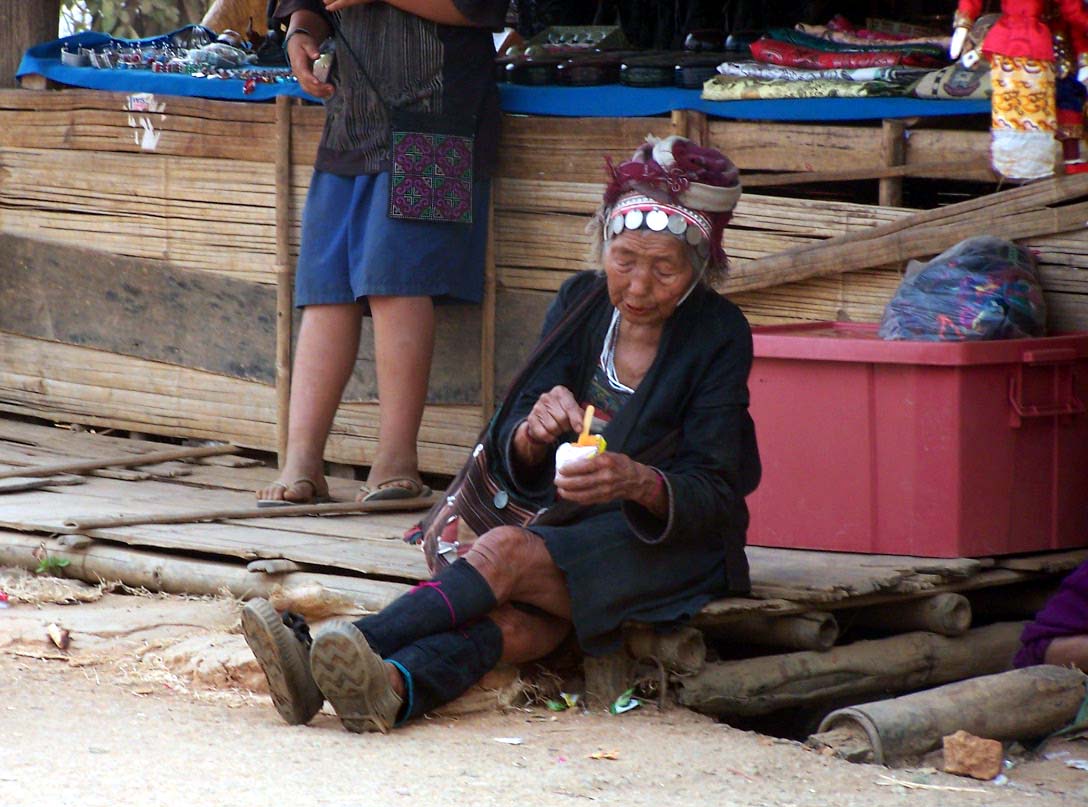
Mae Hong Son is in the trekking area–but quite a ways from Chiang Mai–drove there with several treks en route and spent one night in the town. There are many ethnic tribes–most renowned being the long necked ladies. When I was there not many tourists as it is hard to get to. We subsequently flew back to Chiang Mai–but that was included in the package. Did this on one of my early trips. On that trek we would walk for a day or two, spend nights in tribal villages and the van would pick us up at a designated site. Then onto the next trek–also did a little rafting but no rapids.

These peoples owe allegience to their ethnic group and national boundries are of no signifigance. They originally migrated from China and Tibet and now reside in southern China and in a geographic band across the north of Burma, Thailand, Laos and Vietnam.
100_3585.JPG

These tribes have taken taken advantage of the tourist influx and now offer their villages and homes as overnight lodging for trekkers. As they live in the hills there are no roads, autos and access is strictly by foot. So after a couple of days re-exploring Chiang Mai (its growing big time) I joined 5 other farangs (European and half my age) and a Thai guide for a 4-5 hr ride in the back of a pickup to the trailhead for a 3 day trek.

The walking is relatively easy but the heat/humidity combo is a killer. In 5 hrs we reach a Karen village, are given lodging in a bamboo slat hut and offered a “shower” from a barrel of cold water using a laddle to pour water on whichever body part is selected. A simple meal is offered–tasty but usually best not to ask what it is. Market comes to us as the local ladies show up with their handicrafts. The children run about and giggle at/with the strangers. During the night a pig was the victim of a noisy slaughter as the next day was a festival (new years).

On the previous trek along the Burmese border we had been invited to a wake for a child who had died that day (probably from congenital heart disease). But alcohol became the focus of the event and we made a hasty departure out a side door as belligerence unfortunately replaced festivity.

The next day of this trip offered many stream crossings over narrow logs and I was made suddenly aware that balance is one of the skills that diminishes with advancing youth. Oh well! But we made it to the waterfall for a rewarding swim and that night barbequed a suckling pig.

The last day offered a ride on a bamboo raft through several small rapids and the obligatory elephant ride (once is enough). My less than friendly elephant was named Toby with her cute baby following along behind. I kept thinking that I should have a seat belt. Toby, however, was sure footed, enjoyed the sugar cane and bananas that were sold at intervals along the route.

Mae Sai is just a border town in the far north I went to on another trip. Across the bridge is Burma. It is not a primary trekking destination. Used more for visa stamp-outs and Thais purchase stuff (primarily pornography I think that they cannot get in Thailand–or at any rate saw much of it being confiscated by Thai immigration.) From Chiang Mai it is part of a day trip –in a van–that also includes the Golden Triangle (people stand and have their picture taken under a Golden Triangle sign) and Mekong River/Laos border area. A boring trip.

Tip: The trips out of ChiangMai have become a bit too packaged and westernized–now include the obligatory elephant ride and a raft trip which is a token overcrowded experience. Ok if one has never done it but better if you are able to get off the beaten track like the trip to Mae Hong Son.

Keeping Body and Soul Together

In Bangkok we got a good deal for a month in a beautiful completely furnished apartment on a dead-end street in the upscale Saladaeng area…close to the Skytrain and the new subway that is running again after a recent accident.

Many delicious food vendors just outside the front door were well-placed for the two towers of business offices at the end of the street. After a week Bob took off for northern Thailand and I stayed in Bangkok…taxiing back and forth to my Tufts university-trained dentist who employs a group of specialists…all women…on Sukhumvit 24. With two new porcelain caps and a root planing, I will return in a month for prep work on two implants that will be completed in another 4 months…all for about a 7th of what it would cost with no dental insurance at home.

Doug and Luk took an overnight train from Krabi and stayed with me for a few days while a friend babysat their dog Ting-Tong at their house. They eat very small meals many times during the day…Thai food being what it is…so it seemed like we were eating constantly. One evening Doug took us up to the top of one of the tallest towers in Bangkok where we looked down from an outdoor bar/restaurant sitting on the very edge of the building…refreshing cool breezes blowing our hair…jaw-dropping night lights of the city down below. But mostly Doug and Luk just hung out in the air-con apartment with me…dreading the return to their “fan-cooled” (a uphemism if ever there was one) house in Krabi.

Bought a 20 hour wireless card I use with my Mac computer in any of the many Starbucks around town…handy for uploading blog notes and updating software…visiting with other computer users like the young guy from London who just moved here for a two-year tour with his company…paying as much for the freight on his furniture as it all cost in the first place. Our visit ended when a Thai-boy sat down at the Brit’s table…shooting me a look that could kill. Apparently I was interfering with their date.

Visited the six floors of Panthip Computer Shopping Mall several times where you can buy any high-tech item you could ever want. There are hundreds of stalls selling CD’s and DVD’s and at one I spoke to a rough-looking character standing next to me. “I come here often for R&R,” he says looking at the Thai girl standing next to him. (One in 30 Thai women have said to be working as prostitutes although they don’t call themselves that…they just want an ATM guy to exchange sex with.) “Most things are cheaper if you order over the net,” he says, apparently except for the handfulls of games and software he is buying for his employees in his computer center in Iraq.

Checked out the Foreign Correspondents Club, one of many around the world (I used the one in Phnom Penh Cambodia) that honor each other’s members. In the penthouse of a Bangkok tower you will find the club with a bar/restaurant that hosts speakers from around the world…recently the Dalai Lama spoke there…has a state of the art media center for journalists, jazz on Friday nights…and expats to speak English to! The night we were there ASEAN was hosting an open conference regarding Burma.