Aung San Suu Kyi

18016136-Dassk4.jpeg

In August of 2002, next door to a restaurant in the small village of Taunggy, Burma, I struck up a conversation with a young university student who was tending a small bookstore. “Can everyone speak (out) in America,” he asked. “Yes, we can,” I said, thinking I will not tell him about “politically correct” speech. He nodded sadly.

A few people, forbidden to talk about politics with foreigners, tried oblique approaches to the subject. One man with delicious donuts on a platter came up to me at the market and said to me in perfect English that he used to be an English teacher. Then he disappeared and returned a few minutes later with his wife who wanted to meet me. “She wants to go to America-so bad,” he said. I made several attempts to ask him to have tea and then dinner with us but was disappointed when he looked furtively around him and told me he couldn’t do that. The government has forbidden the people to talk to foreigners about politics but they are afraid to be seen talking to you (a foreigner) at all as it could mean trouble for them.

However, in Bagan our hired tour guide for a day to view the pagodas, told me that some Americans once told him that that there was a lot of fighting in Burma but that he reassured them there was no fighting in his country. I bit my tongue thinking of the BBC special the night before on satellite TV (that few in Burma can afford). It described the fighting between the ethnic minorities and the military near the Thai border where camps harbored thousands of refugees. American and European doctors regularly cross the border under cover of fire to care for the Karen and Shan tribal people who are suffering from a government policy of ethnic cleansing by burning their villages and killing the people outright or overworking them to death in forced labor groups. I’ll bet he is a government informer,” I said to Bob. “I think so too,” Bob said.

I have been watching the efforts of the international community to free Aung San Suu Kyi, the freely elected leader who has been under house arrest for 4 years and now for a 5th.

Suu Kyi’s Freedom Struggle
The Boston Globe
Published: May 21, 2007
Read More

Dual Pricing

Found a hilarious travel article on Bootnall today about the luxury tax…or dual pricing for foreigners as it is called:

The Luxury Tax – Asia, Europe, South America
By: Adam Jeffries Schwartz
The following is a guide to how the luxury tax is levied, worldwide.

ASIA
China has the highest tax in the region! Charging a hundred times the regular price is typical. If you negotiate at all, they will stand two inches in front of your face, and scream You PAY, you PAY NOW.

Note: Exactly!!!
Read More

Stamp-Out to Burma

1wXSp3CkNsDoJl3s0SgHmw-2006171164904627.gif

“Stamping out” consists of leaving Krabi Thailand at a border crossing…in the case of Ranong the border is with Burma…and then “stamping” back into Thailand. To do this they went to the Thai immigration office at the port in Ranong to officially exit the country called “stamping out.” Then they hired a boat ($12) for a 40 minutes ride across the estuary to Burma. They paid $5 US (had to be a US bill) at the Burmese immigration office for a stamp in their passports to enter Burma. They walked around the little dumpy Burmese border town trying to avoid the sellers (the big sales item was Viagra…probably from India) for 30 minutes and then took the boat back across to Thailand where they returned to the Thai immigration office to get stamped back into the country for another 30 days.

In my case I had purchased a 60 day Thai tourist visa in Kunming China so I had another couple weeks in my passport. While Bob and Doug were monkeying around with this, Luk and I found a nice air-con hotel that would accept their little Shimizu “Ting Tong” (the name means “crazy”) for the night…having take-out dinner purchased from the local night market and eating it in our room … one of the best meals we had in Thailand…all of us feasting for about $3.

The next day we drove east to Surat Thani on the east coast of the Thai peninsula …visiting a famous Buddhist meditation teaching center (in English) on the way. Had strong thoughts of being dropped off here for a month but there was no air-con or even fans in the rooms and that even I was not ready for. I just settled for my good old TM mantra in my comfortable air-con room in Krabi.

Volcanos in Tengchong

YUqE3FCf1Hd9CjfG1qqmt0-2006171132705308.gif

A young Chinese woman on the bus had struck up a conversation in English…telling us about the sights around Tengchong. We thought that maybe we could pay her to guide us to the nearby Hot Springs but the plan was aborted after her friend drove us around in a minivan…we paid for an expensive Bai minority lunch…we looked at a hotel we didn’t want…and after the driver took us to a hotel that we didn’t ask to go to…and we still don’t know the name of. The receptionists didn’t know a word of English but we managed to get a double room. The lights dimmed every time someone used the elevator, the dreaded evil kareoke bar was on the next floor down, the telephone rang at least twice a night with no one at the other end of the line. It was ok though because it had a WC and hot shower after 9pm and there was internet down the street a few meters, through some big iron doors and up some dark stairs to a huge room full of young boys playing computer games. There was a girl on each floor with hot water and towels. Supposed to have had dance hall. restaurant, beauty shop but nothing was operating except the dreaded evil kareoke bar and the parking lot inside the hotel compound.

The first day we just hung around the neighborhood and found great homemade dumpling soup made by a very friendly Chinese woman in the market. Bought a CD of a Chinese pop singer and a bag of fresh peas in the pod and delicious tomatoes to snack on…and after some looking Jana finally found an undershirt…in military green camaflage.

We had lunch at the Myanmar Tea House…asked a couple of English speaking Burmese men when they had come to Tengchong…1988 one said…everyone exclaiming at once…one: I fled my country…we saying, oh, since the military junta took over after the last election…told one I guessed he was a University professor in Rangoon and he said laughing…oh, about 30 years ago! I suspect these men may have figured in the opposition during the last election. That night we went back for dinner taking my laptop to treat the owners and their son and a couple young Burmese/Indian patrons with bleached crewcuts to a slideshow of our month in Burma last August.

The next day we struck out for the Tengshong Guest Hotel where there was a map that was promised at the reception desk…first I and then Jana trying to gesture our need for information…seeing the wheels turning in their heads…big pain in the arse Westerners that don’t speak Chinese…until one receptionist gave Jana a card for the T.C.C. backpacker cafe!

After walking a mile with me limping behind Jana, we practically hugged 25 year old Li Bing with his long ponytail and big smile. You saved our lives in Tengchong we wailed. For two hours were reveled in our conversation in English while he cooked us a great lunch…club sandwich for Jana and fried pork with french fries for me…a nice break from the noodle soup we were eating since leaving Lijiang. In his traveler tip book a couple from the Netherlands wrote that both Lonely Planet and Let’s Go guidebooks were useless in Tengshong, “need to put TCC Cafe in those books!!!”

There are over 90 volcanic cones in Tengchong county…22 of them with preserved craters. Jana and Li climbed one large nearby cone called Dakong Shan or “Big Empty Hill” (which pretty much sums it up) while I gave a verbal little three year old girl, Zhou Xiue Ping and her mother, Yang Yong Lai, an English lesson in the warm sun…fireworks, shoes, pants vs the English trousers, ice cream. When I pointed to a picture on my Magellan Point-to-Pictures International Translator and said “tomato” she looked perplexed…finally saying “oh, tomahto!” Jana, having climbed the ubiquitous Chinese steps all the way up to the crater of Big Empty Hill said that the view of the valley peppered with craters was stunning…thinking about what it must have been like millions of years ago…all erupting…

He Ho To Rangoon

Burma.gif

Flight to Rangoon From He Ho
Question: How do you know the Westerners standing behind you in the airport check-in line are not American? Answer: Their backpacks are pink, purple, yellow and orange. Probably French I say to Bob.

Then we take the shortest bus ride in history the 150 meters from the airport to the airplane! Waiting for the plane to take off we saw the ground crew standing at attention while the plane revved up…and then they all saluted briefly to the pilot before they walked off…waving…and we were off to Rangoon.

At the Rangoon airport we discover how a local gets a cheap taxi ride…jump into a car with a paying tourist! Images: on the way to the hotel we see half a dozen men sitting on top of a huge load of rice sacks having their lunch…tea cups and plates spread out-all. Some places not seen in Rangoon the first time: Beauty Saloons, Denney Fast Food Station, McBurger (complete with arches) and J’Donuts. Military trucks seem to be used to transport the citizens…or else they are government mandatory work parties. A “Drive Safely” sticker is on the back of every single vehicle…after awhile you don’t even notice them of course.

Talking Talking…Chinese guy in back of us on the plane…Indian guy on the train to Shimla…Moroccans on the ferry…the Italians…the Spanish…talking talking. It takes so many words? Where are the British and the Germans when I need them?

It occurs to me that my soul needs soothing…I am really hungry for some down and dirty American rock music…life-filled…defiant…power-filled…the personification of confidence…no wonder oppressed youth (and others) all over the world clamor for it. “I will not be broken!” Walking down the street a guy squatting at a tea stall yells out, “What is your country?” America, I yell back at him. “Springsteen!” he yells. “Born In the USA,” he sings again and again and we can hear him singing behind us all the way down the block. Later, walking around that afternoon I see a young guy coming toward me with a Sex Pistols T Shirt. “Where did you get your T Shirt,” I ask him…he answers with a thumbs up. That is how I feel too on this day.

In Rangoon we will take a flight back to Bangkok where we will rest and arrange for our visas to Viet Nam.

No Political Freedom

Today Burmese citizens are forbidden to talk to foreigners about politics and of course this makes the Burmese afraid to talk to you about anything. Government workers from mail carriers to university professors, must sign a pledge not to discuss the government among themselves, at risk of losing their jobs. Red and white signboards posted in public areas of all major cities carry slogans such as “Only when there is discipline will there be progress,” and “The strength of the nation lies only within.”

News Publications including the only English language newspaper called “The New Light” carry the following under the heading “People’s Desire: Oppose those trying to jaopardise stability of the State and progress of the nation” and “Crush all internal and external destructive elements as the common enemy.”

Myranmar TV is a hoot! TV Myranmar operates nightly and regular features include military songs and marching performances. A segment of national songs is performed by women dressed in ethnic costumes; when the songs are over the national flag is hoisted by the singer wearing Bamar dress.

Educated Burmese listen to shortwave BBC and VOA and the Burmese service of Radio Free Asia (RFA); state controlled Radio Myanmar broadcasts news three times a day.

Sr. Christine’s Orphanage

Burma.gif

While Bob was trekking I decided to walk a couple kilometers up the hill in Kalaw to Christ the King Church. Sr. Christine, a Burmese nun who was walking behind me caught up with me and introduced herself.

Sister.jpg

When we got to the church compound about 20 little girls in raggedy clothes came running out to greet us. These are our children, Sister says. They have no parents so they live with us. (The boys live with Father Paul in the rectory.) Then the children all lined up to sing some touching little songs about friendship for us…obviously having done this before.

How do you get money to support yourself, I asked…giving her an opening. By donations from tourists, she said honestly. Then she asked me to sit and have juice and little butter and bread sandwiches while we talked softly and quickly about the oppression of the military government which had confiscated most of the buildings belonging to the church. They lost their school and dormitories…everything except the rectory and one small building the four nuns share; the children sleep on cotton mats on the sidewalk out in front of the building at night.

I asked Sister if she had seen the BBC (British Broadcasting Corp) special on TV a few nights before about the war going on between the government and the ethnic groups. Oh no, she said, they didn’t get satellite TV. (About a year before she had visually seen the Pope for the first time in her life on a video.) When I described some of the atrocities that the BBC special showed, including a Karen village burned to the ground on Nov 11, 2001, she began to cry…remembering, she said…her father who had been tortured and killed by the army.

When the missionaries, mostly Catholic, arrived in the country, she explained, they immediately went into the outlying areas of the country where most of the ethnic minorities were located. So now, the people in central Burma are nearly all Buddhist and the minority areas are mostly Catholic and some Baptist. The ethnic groups therefore are not only culturally and linguistically different than the ethnic Berman people in central Burma but religiously different as well.

In the BBC special an American doctor from Louisiana said that burning the villages to the ground causes much more suffering for the people who are then forced to run into the jungle with whatever possessions they can carry…stopping to cook some food on little fires on the ground… than if they just shot the people. The most effective weapons, he said, are fear, poverty, hunger and disease. In addition, the army kidnaps young teenage boys from their families and forces them to be porters in the jungle. One who was interviewed by BBC said that they know if they run they will be shot and killed like others they have seen.

Though the doctor was in an area off-limits to foreigners, he said: “There are times when you have to take a stand and fight the evil…when we see people, their homes destroyed putting their belongings on their backs and slowly walking into the jungle to find someplace to hide, we know we have every right to be here because no one else will come to help.” By the time the world wakes up to the plight of the minorities it will be too late, he says, in spite of all the UN resolutions and efforts of governments who have put pressure on the country.

But our tour driver in Pagan (Bagan ) had denied that there was any fighting going on in Burma…

The highlight of the visit to mass at Christ The King Church the next day, Sunday, was the singing by the children. The entire back half of the church was filled with children singing with strong raised voices…singing with exhaltation if ever I heard it.

Trek to Pa-O Villages

Burma.gif

Bob was happy to get out and stretch his legs on a two day trek in the hills above Kalaw. His guide used to be a chemistry teacher and school principal who only made about $8.00 a month teaching school. So now he makes $15 for a two day trek in the hills.

teacherturnedguide.jpg

They visit several villages…the people know and love him and welcome the people he brings to their homes for a meal and overnight stay in exchange for the tips they receive.

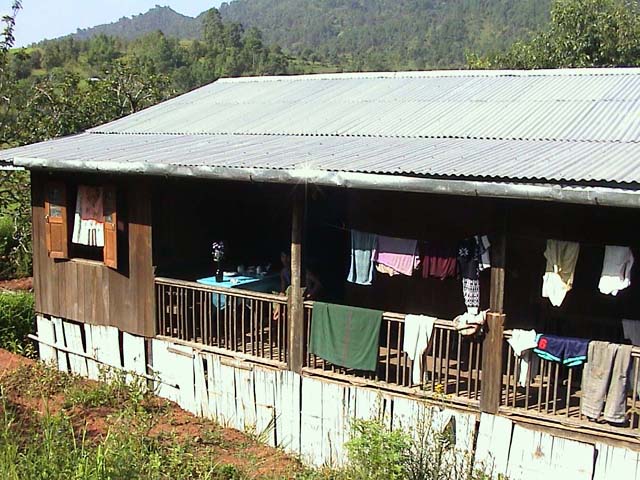
longhouselaundry.jpg

Bob was introduced to a young woman who had been his guide’s chemistry student. She quit studying chemistry in the local high school because she could make 10 times more money raising garlic. If the progress of the country depends on education, it is going to be a very long time before these humble people dig themselves out from under their oppressive military regime. Makes one wonder if this is by design.

Extended families live in a large building, usually on stilts, called a Longhouse. Over dinner in the longhouse that night, Bob, in his way, made one three month old baby giggle which delighted and impressed the family. When Bob offered to buy the baby they all laughed and said no….but the mother then offered to sell him the rambunctious 18 month old sitting next to her!

A UNICEF Advisor

Burma.gif

In Kalaw, at an outdoor tea house, I called out to a Western looking couple walking by…look…somebody from the West! The couple, from Israel, laughed and joined us at our low table for tea…all of us sitting on little stools with our knees around our ears again.

The woman had been in Rangoon for six months as a UNICEF advisor to the local education authorities. Families have about 10 children because about half die by the time they are teenagers she said. When the ethnic children go to school, she explained, they are confronted with both English and Bamar languages layered over their ethnic dialects and they have a very hard time learning. Old story I thought to myself thinking of the indiginous Indian children from Mexico who come with their migrant parents to the States.

Coincidentally, when I told her we were from Salem Oregon, she said a woman friend from Israel went to our city a couple years ago to live with a man friend but after six months of boredom she went back to Israel. What did she miss especially, I asked. Having fun, she said, dancing, having fun and street life. Yes, I know the feeling, I said!

Kalaw…British Hill Station

Burma.gif

In a monsoon rainstorm we climbed off the train in this cool wooded hill station built during the British occupation. The locals laughed (with me) at my little paper sun umbrella I carried that I had bought at the umbrella shop in Inle. Only transpo available was in a partially covered horse cart driven by a kind old man. Off went the horse clip-clopping with us along to the ironically named Dream Villa Hotel a few blocks away in the center of town. It was off season and we and a French couple were the only tenants in the second floor room in the very friendly hotel painted white with verandas and windows open on two sides.

I looked down into the street to see a common occurrence in Asia that we hardly see in the West…males touching each other…often holding hands while walking down the street. On this day three boys stood one behind the other looking out toward the street, each with hand and arms around the boy in front and finally the one in the back reaching to the boy in front, lovingly cradling the boy in the middle…it was done spontaneously and naturally and lasted only a few seconds. Refreshing I thought.

We explored the rotating market that happened to be in town the following Saturday…we have wonderful pictures of the goods that the colorful tribal hill people bring to town to sell; flowers, fish including eels, perfect looking leafy green vegetables of all kinds, cigars, prepared food of all unidentifiable kinds. Everyone wears flip flops; heels cracked and calloused. Babies in Burma are not diapered…the child is just held out in the air at the right time and whatever wants to come out comes out. One mother in the seat in front of us on the moving train to Kalaw held her baby with bare bottom out the window for this event.

We stop by a tea shop (patrons are almost always men and they all stare at me; women stay at home as they did in Morocco, Egypt, Africa, India, Greece and Thailand) to rest and watch the street scene. There was cheap clothing brought in from China…some of the tables piled with used plaid shirts, levi jackets and 501’s. So this is where the young Burmese university students get their levis I thought…you know those levi trucks you see in the supermarket parking lots at home?