Black Humor

 My two couchsurfers at the moment, bicyclers riding from Vancouver BC to Argentina, went out roaming around yesterday and came upon some street theater making fun of the panic over the flu. Last night they went out with a friend wearing a flu mask with “mieda” (fear in Spanish) written in big black letters on it.

Videos and spoofs are showing up all over the web including Daily Mash and Comedy Central.

From Oaxaca Study Action Group Forum: “In the zocalo about  one in ten are wearing face masks. All the servers in the restauants and cafes are wearing them. Doctora Bertha Muñoz was not wearing a mask. She says that viruses are too tiny to be obstructed by a piece of paper. But when she needed to sneeze, she pulled up the neck of her T shirt over her face to the eyes. The government bulletins recommend sneezing into your bent elbow.

Bertha’s opinion on the flu outbreak was that the gov is holding back info. A thought: does the government have info, or any way to gather it?”

Apparently, the Mexican authorities knew of the existence of this swine flu as early as mid-February but did nothing about it for two entire months. Government officials have been forced to acknowledge as much. Outrage over the Mexican government’s ineptitude has swept the country. On April 29, the Frente Sindical Mexicano (FSM) held a press conference during which it lambasted the Mexican government for its handling of the entire healthcare crisis.

7% of Mexico’s GDP comes from tourism. Tourists are leaving by the hundreds which will devastate the livlihoods of workers who depend on the tourist industry.

Turn Off The TV

My weekly newsletter from Casa de las Amigas, the Quaker guesthouse in Mexico City where I stayed in 2007, has this to say about the current flu going around:

You are invited to turn off the TV, especially those of you who remember Y2K and the Africanized killer bees, and look for news from some lower-gloss sources: The World Health Organization is the most official source for news, as is the Center for Disease Control and Prevention.  For news from here, check the main portal of the Government of Mexico City, La Jornada offers constant, critical updates en español from Mexico City.

Obrador Comes To Oaxaca

At the same time that Obama was in Mexico City promising to help Mexico militarize against the drug cartels, Andrés Manuel López Obrador (who ran against President Calderon in the last election as a member of the PRD) was in Oaxaca to protest the murder of a Oaxacan PRD woman activist.

Some Mexicans think that Obrador, who during the election was able to draw a million people to the Zocalo in Mexico City, would never be able to command that following now. Once, the popular mayor of Mexico City, it is said by some that he has managed to side-line himself somewhat by leaving the PRD and apparently switching positions on a number of political issues…therefore losing the ear of many in the middle class who once adored him. A Mexican musician (who is the partner of a friend of mine) who used to worship Obrador, now considers him a “clown.”

On the other hand, the party that Obrador ran for president on (PRD) has been coopted by the PRI and is now considered as corrupt as the PRI, suffering from in-fighting and is virtually dead.  So Obrador has dropped the PRD and seems to be running around supporting selected individuals for local elections in whatever party whether it be the PRD, the Workers Party or the Convergencia Party, and speaking out on issues of corruption and whatever is the crisis of the day. So it may be that, come the time for election of another President in four years (Mexico’s presidents may only serve one six-year term) Obrador could ride a tide of popular opinion on some issue.

Coming upon the 100th anniversary  of the 1910 revolution, in Oaxaca, Obrador said that “militarizing the country won’t resolve the problem of 27 years of no economic growth.” The big push is on to get the PRI out in the next election, which is in July of this year for congress. 2010 Oaxaca votes for new governor. Read More

What Mexico Needs From Obama

The LA Times has an opinion piece this morning entitled “What Mexico Really Needs From Obama” written by John M. Ackerman who is a professor at the Institute for Legal Research at the National Autonomous University of Mexico and a columnist for Proceso magazine and La Jornada newspaper.

From my observations of Mexico AND the U.S. he is right on on all accounts. In other words Obama should focus on helping Mexico reform it’s institutions and rule of law instead of supplying weapons to fight the drug cartels. “Only 15% of the funds in the $1.4-billion Merida Initiative signed by President Bush last year,” says Ackerman, “is earmarked for “institution building and rule of law.” If Obama hopes to contribute to long-term solutions, he should dramatically increase this percentage in future aid packages.”

“The Obama administration seems to be unaware of these deeper institutional issues. During her recent trip to Mexico, Secretary of State Hillary Rodham Clinton didn’t push Calderon on corruption control, human rights, freedom of the press, institutional reform or political reconciliation. She also went out of her way to cater to conservative constituencies. Her visit to Mexico’s principal basilica implied a nod to Calderon’s efforts to narrow the traditional separation between church and state. Her choice to travel to the city of Monterrey, home to the most powerful members of Mexico’s corporate oligarchy, also sent a clear signal about the priorities of the U.S. government.”

President Obama should not focus exclusively on short-term military goals during his visit to Mexico this week. The violence there, which has taken the lives of 10,000 Mexicans over the last two years, must be stopped. But the helicopters, weapons scanners and listening devices that have been the cornerstone of promised U.S. support will only go so far. The real solution lies in effective institution-building.

It does no good to capture drug kingpins if they don’t go to jail. During 2008, only one out of every 10 suspects arrested in Mexico for drug offenses was convicted, according to official statistics. In Chihuahua, one of the bloodiest states in the country, only 1,621 out of the 5,674 suspects arrested over the last 12 months have even had to stand trial, because of the weakness of the prosecutors’ cases.

RealTruth.org/Corruption_at_the_Top
Almost a decade ago, the U.N. special rapporteur on the independence of judges and lawyers, Param Cumaraswamy, discovered fundamental problems of inequality and inefficiency with Mexico’s system of criminal justice. Today, the grim picture he painted has changed little. Mexico’s jails remain full of petty thieves while serious criminals with money and connections roam the streets.

Last year, Mexico passed a major constitutional reform that would introduce oral trials — to replace trials conducted only through written documents — and transform the role of government prosecutors. The goals are to reduce case backlogs by speeding up trials, to prevent corruption by increasing transparency and to improve criminal investigations by dropping the requirement that prosecutors issue a preliminary judgment on the culpability of suspects. With this latter change, prosecutors would be able to dedicate themselves exclusively to investigating cases and avoid conflicts of interests. But the authorities have dragged their feet on implementation. Congress has delayed passing all of the necessary follow-up legislation, and the commission created by the reform, with representatives from the executive, judiciary and legislative branches, has not convened.

Corruption at the top all the way to the bottom.  Nothing will change until the institutions and rule of law are reformed. The problem is they are all on the take and no one wants to give that up.

U.S. Arms Flow Into Mexico

Homeland Security Secretary Janet Napolitano and Attorney General Eric Holder visit Mexico Thursday to meet with their counterparts.

The Christian Science Monitor has this story blaming gun shows and subsequent smuggling into Mexico for the proliferation of guns in Mexico…which are illegal and hard  to get for the ordinary citizen. I am sure illegal guns are coming across the border. But Narco News Bulletin has this disturbing story indicating:

“To be sure, some criminal actors in the U.S. are smuggling small arms across the border. But the drug war in Mexico is not being fought with Saturday night specials, hobby rifles and hunting shotguns. The drug trafficking organizations are now in possession of high-powered munitions in vast quantities that can’t be explained by the gun-show loophole.

At least one report in a mainstream media outlet deserves credit for recognizing that trend.

“[Mexican] traffickers have escalated their arms race, acquiring military-grade weapons, including hand grenades, grenade launchers, armor-piercing munitions and antitank rockets with firepower far beyond the assault rifles and pistols that have dominated their arsenals,” states a recent story in the Los Angeles Times. “The proliferation of heavier armaments points to a menacing new stage in the Mexican government’s 2-year-old war against drug organizations. …”

The Narco News report goes on to say:

“The deadliest of the weapons now in the hands of criminal groups in Mexico, particularly along the U.S. border, by any reasonable standard of an analysis of the facts, appear to be getting into that nation through perfectly legal private-sector arms exports, measured in the billions of dollars, and sanctioned by our own State Department. These deadly trade commodities — grenade launchers, explosives and “assault” weapons —are then, in quantities that can fill warehouses, being corruptly transferred to drug trafficking organizations via their reach into the Mexican military and law enforcement agencies, the evidence indicates.

“As in other criminal enterprises in Mexico, such as drug smuggling or kidnapping, it is not unusual to find police officers and military personnel involved in the illegal arms trade,” states an October 2007 report by the for-profit global intelligence group Stratfor, which Barron’s magazine once dubbed the Shadow CIA. “… Over the past few years, several Mexican government officials have been arrested on both sides of the border for participating in the arms trade.”

The U.S. State Department oversees a program that requires private companies in the United States to obtain an export license in order to sell defense hardware or services to foreign purchasers — which include both government units and private buyers in other countries. These arms deals are known as Direct Commercial Sales [DCS]. Each year, the State Department issues a report tallying the volume and dollar amount of DCS items approved for export.

The reports do not provide details on who the weapons or defense services were exported to specifically, but do provide an accounting of the destination countries. Although it is possible that some of the deals authorized under the DCS program were altered or even canceled after the export licenses were issued, the data compiled by State does provide a broad snapshot of the extensive volume of U.S. private-sector arms shipments to both Mexico and Latin America in general.

According to an analysis of the DCS reports, some $1 billion in defense hardware was approved for export to Mexico via private U.S. companies between fiscal year 2004 and fiscal year 2007 — the most recent year for which data was available. Overall, during the same period, a total of some $3.7 billion in weapons and other military hardware was approved for export under the DCS program to all of Latin America and the Caribbean.

In addition to the military hardware exports approved for Mexico, some $3.8 billion in defense-related “services” [technical assistance and training via private U.S. contractors] also were approved for “export” to Mexico over the same four-year period, according to the DCS reports.

That means the total value of defense-related hardware and service exports by private U.S. companies to Mexico tallied nearly $5 billion over the four-year window. And that figure doesn’t even count the $ 700 million in assistance already authorized under the Merida Initiative [Plan Mexico] or any new DCS exports approved for fiscal years 2008 and 2009 [which ends Sept. 30].”

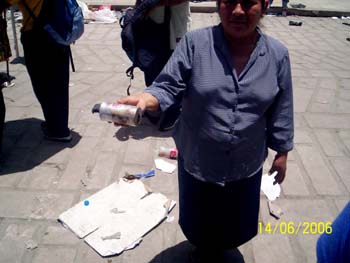
Maybe that’s why the tear gas canisters used against the demonstrators in 2006-7 in Oaxaca had “Made in the USA.” on them. [sarcasm]

100_0203.JPG

Couchsurfing Zoe

I joined Couchsurfing.com with a million members last year while I was traveling in Asia.  Couchsurfing is a world-wide social and cultural program run mostly by volunteers to foster cultural understanding…much like Hospitality Club (which I also belong to) or Servas.

For CS you are asked to set up a personal profile with your picture and fill in the answers to questions that explain your interests, personal philosophy of life, experiences with CS, travel experiences etc. You describe your guest facilities and whatever preferences you have such as preferred age groups or male, female or either etc. You are asked to verify your identity by giving a small donation by credit card and then they send a code number to your address which you then return to your profile and fill in. This verifies that you are who you say you are and that you live where you say you live. Then you can do a search for a particular city or country you want to visit and send a message through the secure CS messaging service to request a stay…or even just a request for a coffee or drink. At this time you can give your phone number and/or email address and discuss prospective visits. In addition, there are hundreds of forum discussion groups (I am a member of some of these like “International Politics”) and you end up getting to know and make friends with people there. Often these people will meet for a social evening in whatever city and country they are in and make their “couches” available to others from other cities/countries wanting to attend.

Then after being a guest or hosting or just “surfing” with (exchanging messages) you can leave a reference and/or a request to be a “friend” which will show up on the profiles of each party.

So when I returned to my home for a few months in Salem Oregon, I made my “couch” available but ended up not hosting anyone. However, now that I am living in Oaxaca I am getting requests almost daily…mostly from young women, although I did host a young French guy who has been living in Mexico City for three years. He is setting up a web-based Spanish-language radio program and is on the look-out for interesting stories. My first CSer was a young Iranian-American woman who had grown up in Berkeley. She was lovely and we had a great time together!  A couple nights ago I couldn’t host a woman from Oakland but she came to my apartment for a mescal…bringing a hand-full of lovely roses for me.  She appreciates that I make my “couch” available, she says.  A young Zoologist and his significant other from the Oregon State University faculty came one evening for fresh-squeezed orange juice and good conversation. In April I have two women from Estonia who are ecologists coming for a few days. And there are others.

In the meantime, I am hosting Belle and her young daughter, Yoli, from Austin Texas, who lived in my other apartment house with me in 2006-7. Belle has been to and lived in Oaxaca many times and tomorrow a Oaxaquena friend of hers is coming to my apartment to teach us how to make Chili Coloradito and get me back into learning Spanish.

Hillary Is Coming To Mexico Today

Articles about Mexico appeared at least twice in the LA Times this morning.

On her first official trip to Mexico beginning today, Secretary of State Hillary Rodham Clinton will confront a range of bilateral issues.  The LA Times this morning asked experts on both sides of the border to discuss issues that are likely to come up. Comments I found interesting:

Mayor of Rosarito, Mexico, and owner of the Rosarito Beach Hotel:

“People in Mexico love President Obama, even if he doesn’t know anything about Mexico. He’s never been in Mexico, even as a tourist. We also like Hillary, but she doesn’t really understand either. Mexico is going to be disappointed.

Certain elements in the U.S. government have reacted very quickly in telling people not to come to Mexico, talking only about the problems we have and that we have a lot of narcos. We do, but you have more over there. Our criminals sell the drugs wholesale, you distribute them retail, and the amount of money handled by U.S. distributors is probably 10 times as much.

For our city in particular, the travel warning is a big problem. We have had lots of killings. But 96% of the killings in our area were between traffickers. That also happens in New Orleans and Baltimore and other cities with high crime rates. But all of a sudden, there is a campaign to stay away from Mexico. We haven’t had any tourist or visitor caught in a crossfire in 20 years. We have 20 million visitors a year in Baja California, so really the risk is not there for a tourist. Yet in Rosarito, we have lost about 70% of tourists since the middle of last year”

Jose Reyes Ferriz Mayor of Ciudad Juarez, Mexico

“The problem right now is organized crime. The major problem we have is the sale of guns in the United States without regard to the fact that those guns are going to be illegally smuggled into Mexico. This needs to be investigated by the United States.

The second point that needs to be addressed is money. The activities by organized crime in Mexico are financed with drug money coming in from the United States. Money-laundering investigations need to be stepped up so the flow of money into those illegal activities stops”

These statements are all true but it is hilarious that they are coming from persons most probably on the cartel payroll! That or they would be dead by now!

“Gang-Rape of the American Dream”

Best article yet on the financial crisis.  Tells it like it all came down…in great detail.  I can see it all now.

Rollingstone.com

The Big Takeover

The global economic crisis isn’t about money – it’s about power. How Wall Street insiders are using the bailout to stage a revolution

MATT TAIBBI

Posted Mar 19, 2009 12:49 PM

“As complex as all the finances are, the politics aren’t hard to follow. By creating an urgent crisis that can only be solved by those fluent in a language too complex for ordinary people to understand, the Wall Street crowd has turned the vast majority of Americans into non-participants in their own political future.

There is a reason it used to be a crime in the Confederate states to teach a slave to read: Literacy is power. [Italics mine]

In the age of the CDS and CDO, most of us are financial illiterates. By making an already too-complex economy even more complex, Wall Street has used the crisis to effect a historic, revolutionary change in our political system — transforming a democracy into a two-tiered state, one with plugged-in financial bureaucrats above and clueless customers below.”

Read the rest of the article here.

I Used To Make Fun Of Rick Steves

 I used to make fun of Rick Steves.  No more!

Here are a few gems from a Salon.com interview just in case you don’t want to read to the end:

Salon: “Steves wants Americans to get over themselves. He wants us to please shed our geographic ego. Everybody should travel before they vote,” he has written.”

So if McCain and Palin had won, what would we have seen abroad?”

Steves: “More and more Americans wearing Canadian flags”

LOL.  During 7 years of near constant travel, I used to say I was from Canada.  My husband used to say he was from Iceland.  I always said I wanted a T-shirt that said in 6 languages: “I didn’t vote for Bush.”  Election night there were parties all over Mexico. Now they are watching us.

Steves: “As a travel writer, I get to be the provocateur, the medieval jester. I go out there and learn what it’s like and come home and tell people truth to their face. Sometimes they don’t like it. But it’s healthy and good for our country to have a better appreciation of what motivates other people. The flip side of fear is understanding. And you gain that through travel.”

What’s the most important thing people can learn from traveling?

Steves: “A broader perspective. They can see themselves as part of a family of humankind. It’s just quite an adjustment to find out that the people who sit on toilets on this planet are the odd ones. Most people squat. You’re raised thinking this is the civilized way to go to the bathroom. But it’s not. It’s the Western way to go to the bathroom. But it’s not more civilized than somebody who squats. A man in Afghanistan once told me that a third of this planet eats with spoons and forks, and a third of the planet eats with chopsticks, and a third eats with their fingers. And they’re all just as civilized as one another.”

The “ugly American” thing is associated with how big your country is. There are not just ugly Americans, there are ugly Germans, ugly Japanese, ugly Russians. Big countries tend to be ethnocentric. Americans say the British drive on the “wrong” side of the road. No, they just drive on the other side of the road. That’s indicative of somebody who’s ethnocentric. But it doesn’t stop with Americans. Certain people, if they don’t have the opportunity to travel, always think they’re the norm. I mean, you can’t be Bulgarian and think you’re the norm.

It’s interesting: A lot of Americans comfort themselves thinking, “Well, everybody wants to be in America because we’re the best.” But you find that’s not true in countries like Norway, Belgium or Bulgaria. I remember a long time ago, I was impressed that my friends in Bulgaria, who lived a bleak existence, wanted to stay there. They wanted their life to be better but they didn’t want to abandon their country. That’s a very powerful Eureka! moment when you’re traveling: to realize that people don’t have the American dream. They’ve got their own dream. And that’s not a bad thing. That’s a good thing.

That is certainly true of many people I have talked to around the world and most people I talk to in Mexico who have migrated to the north. The fruit seller speaks a little English. I ask if he has ever worked in the north. Yes, he and others say. Three years. Six years. Ten years, the guy in the tiny mountain village 7 hours from the nearest town in Guatemala says. The guy on the corner of my block whose wife sells tamales worked in the U.S. 30 years. But eventually they usually come back. If given an economic choice they would choose to stay in their own country where they can enjoy their own language, their own culture…and their families. One of my eureka moments. Read More