Meeting My Cervix

Well, this is probably going to mortify my three boys, men now, (well, maybe not the one who is a doctor) but when I went to the gynecologist here in Oaxaca last week, I saw, for the first time ever, at the age of 64, my cervix!  Don’t know if all my previous doctors had seen it either, but it only seems fitting that I get to see it. Too see that tiny place inside my body that miraculously allowed three fully-formed human bodies to stubbornly push through to the light of day. Just before Mother’s Day.  In Oaxaca! Read More

Black Humor

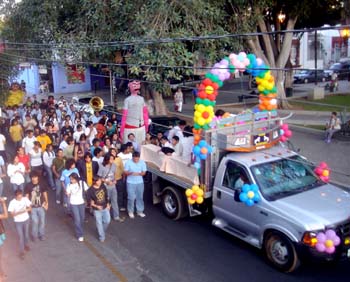
 My two couchsurfers at the moment, bicyclers riding from Vancouver BC to Argentina, went out roaming around yesterday and came upon some street theater making fun of the panic over the flu. Last night they went out with a friend wearing a flu mask with “mieda” (fear in Spanish) written in big black letters on it.

Videos and spoofs are showing up all over the web including Daily Mash and Comedy Central.

From Oaxaca Study Action Group Forum: “In the zocalo about  one in ten are wearing face masks. All the servers in the restauants and cafes are wearing them. Doctora Bertha Muñoz was not wearing a mask. She says that viruses are too tiny to be obstructed by a piece of paper. But when she needed to sneeze, she pulled up the neck of her T shirt over her face to the eyes. The government bulletins recommend sneezing into your bent elbow.

Bertha’s opinion on the flu outbreak was that the gov is holding back info. A thought: does the government have info, or any way to gather it?”

Apparently, the Mexican authorities knew of the existence of this swine flu as early as mid-February but did nothing about it for two entire months. Government officials have been forced to acknowledge as much. Outrage over the Mexican government’s ineptitude has swept the country. On April 29, the Frente Sindical Mexicano (FSM) held a press conference during which it lambasted the Mexican government for its handling of the entire healthcare crisis.

7% of Mexico’s GDP comes from tourism. Tourists are leaving by the hundreds which will devastate the livlihoods of workers who depend on the tourist industry.

Obrador Comes To Oaxaca

At the same time that Obama was in Mexico City promising to help Mexico militarize against the drug cartels, Andrés Manuel López Obrador (who ran against President Calderon in the last election as a member of the PRD) was in Oaxaca to protest the murder of a Oaxacan PRD woman activist.

Some Mexicans think that Obrador, who during the election was able to draw a million people to the Zocalo in Mexico City, would never be able to command that following now. Once, the popular mayor of Mexico City, it is said by some that he has managed to side-line himself somewhat by leaving the PRD and apparently switching positions on a number of political issues…therefore losing the ear of many in the middle class who once adored him. A Mexican musician (who is the partner of a friend of mine) who used to worship Obrador, now considers him a “clown.”

On the other hand, the party that Obrador ran for president on (PRD) has been coopted by the PRI and is now considered as corrupt as the PRI, suffering from in-fighting and is virtually dead.  So Obrador has dropped the PRD and seems to be running around supporting selected individuals for local elections in whatever party whether it be the PRD, the Workers Party or the Convergencia Party, and speaking out on issues of corruption and whatever is the crisis of the day. So it may be that, come the time for election of another President in four years (Mexico’s presidents may only serve one six-year term) Obrador could ride a tide of popular opinion on some issue.

Coming upon the 100th anniversary  of the 1910 revolution, in Oaxaca, Obrador said that “militarizing the country won’t resolve the problem of 27 years of no economic growth.” The big push is on to get the PRI out in the next election, which is in July of this year for congress. 2010 Oaxaca votes for new governor. Read More

Couchsurfing Zoe

I joined Couchsurfing.com with a million members last year while I was traveling in Asia.  Couchsurfing is a world-wide social and cultural program run mostly by volunteers to foster cultural understanding…much like Hospitality Club (which I also belong to) or Servas.

For CS you are asked to set up a personal profile with your picture and fill in the answers to questions that explain your interests, personal philosophy of life, experiences with CS, travel experiences etc. You describe your guest facilities and whatever preferences you have such as preferred age groups or male, female or either etc. You are asked to verify your identity by giving a small donation by credit card and then they send a code number to your address which you then return to your profile and fill in. This verifies that you are who you say you are and that you live where you say you live. Then you can do a search for a particular city or country you want to visit and send a message through the secure CS messaging service to request a stay…or even just a request for a coffee or drink. At this time you can give your phone number and/or email address and discuss prospective visits. In addition, there are hundreds of forum discussion groups (I am a member of some of these like “International Politics”) and you end up getting to know and make friends with people there. Often these people will meet for a social evening in whatever city and country they are in and make their “couches” available to others from other cities/countries wanting to attend.

Then after being a guest or hosting or just “surfing” with (exchanging messages) you can leave a reference and/or a request to be a “friend” which will show up on the profiles of each party.

So when I returned to my home for a few months in Salem Oregon, I made my “couch” available but ended up not hosting anyone. However, now that I am living in Oaxaca I am getting requests almost daily…mostly from young women, although I did host a young French guy who has been living in Mexico City for three years. He is setting up a web-based Spanish-language radio program and is on the look-out for interesting stories. My first CSer was a young Iranian-American woman who had grown up in Berkeley. She was lovely and we had a great time together!  A couple nights ago I couldn’t host a woman from Oakland but she came to my apartment for a mescal…bringing a hand-full of lovely roses for me.  She appreciates that I make my “couch” available, she says.  A young Zoologist and his significant other from the Oregon State University faculty came one evening for fresh-squeezed orange juice and good conversation. In April I have two women from Estonia who are ecologists coming for a few days. And there are others.

In the meantime, I am hosting Belle and her young daughter, Yoli, from Austin Texas, who lived in my other apartment house with me in 2006-7. Belle has been to and lived in Oaxaca many times and tomorrow a Oaxaquena friend of hers is coming to my apartment to teach us how to make Chili Coloradito and get me back into learning Spanish.

Every Day In Oaxaca A Different Day

My friends at home in the U.S. ask me “What do you do every day?” We expats find that a difficult question to answer.

Well, last week I walked all over town to find a rice cooker. I know, I’m spoiled. Wish I had the one that is packed away in my house in Salem…along with all the other stuff. I picked up my art pieces that I had framed and hung them. The apartment is really coming along. Everything is so nice…especially in the evening with Buddah Bar music coming from my iPod powered by the living room speakers and dimmers turned down on the recessed lights that provide a soft glow against the orange and yellow walls.  (Recessed lights are a luxury in Mexico…not to even mention dimmers! Most lights are just bare light bulbs hanging from the ceiling.)  Bright blue and purple pillows made from hand-woven Guatemalan huipiles (women’s tops) fill my white suede leather soiree couch. White woven Italian lawn chairs and a Mexican Rustica coffee table sit on big hand-woven earth-colored Guatemalan rugs in the middle of the living room facing the couch.  Against the opposite wall is my rustica brown leather covered round table for telephone with big comfy Mexican Rustica reading chair and light next to it.  On the end wall is a huge Rustica shelf unit with my metal Buddah head on the top shelf wisely overlooking all. Huge floor to ceiling windows face the veranda and park.  Found a huge ceramic flower vase with a big wide mouth for all the lovely flowers found in local markets. Being in a globalized world, it is made in Viet Nam. It is sitting in the middle of a beautiful dining room table that I found in a local woodworking cooperative waiting for flowers that I will buy in the Friday Market in Llano Park. Now I just have to find a small funky table for my long covered veranda overlooking Conzati Park. Conzati was an Italian botanist and teacher who contributed greatly to the city.  He catalogued the flora in the park that used to be much more forested than it is now and there is a monument to him there.

My friend Max is giving me, today, a rose bush and some other plants…and I will plant a local vegetable (the Chayote)  that will sprout into huge long vines and by the end of the summer will block the sun from the southern exposure.  And provide me with mucho chayotes that are good in soup.  So I will have to take a bus out to this gigantic earthen pot factory and bring home pots in a taxi. Max’s roommates, Budd and Sandy are back from the states and it will be fun to see them again. Budd worked on a documentary of the fall of the Soviet Union for the BBC and was the photographer who took the famous picture of Yeltsen on the tank in Russia during the coup. He has circled the globe on a motorcyle and they are in the business now of buying motorcyles instead of a car to get around on in Oaxaca. She is 70ish and he is in his 80’s…with 9 marriages between them! Expats can be an interesting lot.

One of the five “neighbors” in my apartment building, Carlos, showed me his new purchase yesterday. He is the curator of the Oaxaca Contemporary Art Museum so I was interested in seeing what he had…maybe something from one of the world-famous Oaxacan painters? No. To my surprise he showed me what looked like a huge antique Chinese urn…made by a Mexican artist up north…and found in an antique shop in Mexico City! I laughed! Serves the Chinese right, I said! In China today, I told him, you can see a pleasure park with all manner of copied Mayan, Zapotec and Aztec ruins and pyramids all jumbled up in one big mess! He sighed in dismay. Actually, I like it (the urn), I told him. It’s kind of funky…made by a Mexican and displayed in a art aficionado’s apartment in Oaxaca. “I like funky too,” he said as he smiled ironically. Then I trotted him over to my apartment where I showed him my big purchase that morning. A beautifully matted black and white lithograph made by a relatively unknown Zapotec artist that lives a block up from me…up a tiny cobbled alley-way. His stark but tasteful adobe one-room home/studio leads out the back to a huge garden with trees, plants and flowers. But he is very poor and I wanted to support his work. You know…the starving artist. The galleries take about half the money of an artist’s sale and makes the pieces unaffordable for me.  Now I will enjoy many hours trying to figure out the meaning of this really interesting  piece! Actually, there is a story to how I met him. When I was in Kunming several years ago, I met a lovely 35 year old British woman in an internet cafe at the Camellia Hotel and have kept in touch with her since. After leaving China she traveled up South and Central America and stopped in Oaxaca for a month. She is an artist and wanted to soak up the huge local art scene. She hung out here with a local guy, she said, and there on her web page was this gorgeous Zapotec guy…not too tall…about 50 plus…with the typical big Zapotec nose, long flowing black hair and dressed all in white. OMG, I told her…he is beautiful! Then a couple years later I was walking down a street in Oaxaca and passed by this guy. I stopped him and asked if he was Heather’s friend. Yes, he said. Small world, as they say. Sigh…if I were only 20 years younger…

Incidentally, my other apartment neighbors are: a high-priced prostitute who works in the Oaxaca judiciary,  keeps her co-workers happy and travels a lot. (This chisme… gossip… is from my funny gay apartment manager from NYC who lives downstairs with his young Mexican consort in a gorgeous apartment he remodeled at his own expense). She is very nice, he says. Then there is a young couple on one  side of me…a Mexican woman and her British boyfriend, and a divorced Mexican woman who lives with her daughter downstairs and whose ex-husband uses my unused parking spot with out telling me…much to the consternation of the manager.

I won’t even try describing the trip to the mountain Mescal factory with Max, my friend Paula who is here teaching English, and Francisco and his new consort…Joan.  Max, an old sot, got more than slightly inebriated, along with the driver, and Paula, Joan and I threatened to get out of the pick-up and hail down a collectivo taxi.  Anyway, Paula and I ended up leaving Max in Tlacalula with Francisco and Joan. It’s sad to see this very intelligent articulate witty man this way.  He is very ill and shouldn’t drink but he doesn’t care since he’s really on his way out anyway. Incidentally, the driver picked up a young Mexican along the way.  He had been going to high school in the states…illegally of course.  His English was perfect so he obviously had been living there most of his life.  The police picked him up off the street and threw him in jail for 6 months without charging him and then deported him.  I asked him how many others were there like him in jail in the states.  “Thousands,” he said.  I am furious that tax-payers are paying for jail time for immigrants who instead should just be deported.

All last week I hosted, through couchsurfing.com, a beautiful and gracious young Iranian-American woman who was born in Austria but raised in Berkeley. She speaks Farsi and Spanish (she majored in Spanish/linguistics) and and is now traveling after teaching Spanish in Guadalajara for the last 6 months. Her love is salsa dance and danzon…a beautiful dance from Cuba with choreographed steps…which she had a chance to enjoy in the lit-up zocalo the other night. Afterward, we ran into Willy…my Swiss friend…in a zocalo outdoor cafe and who I treated to beer and mescal…much to his dismay. Willy is such a gentleman and never lets me buy drinks…which he can ill-afford…living on the local economy. Nearby, the nightly marimba band accompanied a few dancers who just couldn’t keep still. One night we joined my friend Judie, who teaches English here in the Lending Library,  to listen to her Mexican boyfriend play a wailing sax with his great 3 piece band in a tiny smoke-filled venue. But we wished the rude Chilangos (from Mexico City) would have kept quiet. There is no love lost between the Oaxacans and the slumming Chilangos who are generally considered by the Oaxacan Indios to be rude, demanding and arrogant. But I had a great time with Sepi and miss her…but alas she is not mine to keep.

Yesterday I was supposed to host a French journalist who has lived in Spain many years and is now in Mexico City developing a Spanish language radio web site. But guess he found more interesting ground to till. And the two German girls didn’t show. Ended up in a hostel with other young travelers. Next wednesday my friend Belle, who lived in the last apartment with me in 2006-7 will visit me with her husband and adopted Guatemalan daughter. She recently found her daughter’s birth family by traveling in two buses and on a donkey up to a Guatemalan mountain village. It will be interesting to hear about the visit…her daughter is about eight now. Next month two women ecologists from Estonia will stay with me several days.

Week before last, on Ash Wednesday, found me with my Mexican friends, Mica and Bardo, in Huayapam at the annual Ash Wednesday Fair. Celebrants leaving church were greeted with miniature plastic cups of Mescal. Only in Mexico we often say. The whole town participates. The crowded food stands were great. Mica sold her roasted coffee beans and her mother served up the traditional frothy Zapotec Tajate drink.  I enjoyed three chili roja (red sauce) tomales…and the banda music and fireworks.

This is the Lenten season. Every day there have been processions and music all over town. Here is the best to come:

Friday, March 20th – Good Samaritan Day – businesses and homes set up booths and give free drinks to passers-by, thereby, becoming Good Samaritans. Question is…are these soft drinks or Mescal? My bet is on Mescal. 🙂

Thursday, April 9th – Day of Our Lady of the Sorrows – traditionally Oaxacans visit seven churches that day where altars are set up with chía seeds sprouting green out of clay animals (symbolizing the Resurrection) and flowers and Maguey plants. A beautiful one is constructed in the Privada de Alcalá on the Alcalá south of Niños Heroes de Chapultapec.

Good Friday, April 10th – Procession of Silence from the Church of the Sacred Blood of Christ up the Alcalá and returning to the church via García Vigil. Easter Week will find Oaxaca full of tourists enjoying the daily processions and music.

And that is not all…by a long shot. Yesterday my son, Greg, sent me, via UPS, a new iPod Touch for my birthday so now I have a new toy to play with.

Now you know…sort of…what I do every day in Oaxaca…when I am not reading, on my computer, sitting on the veranda…or taking a siesta.

Casa Raab Zapoteco Mescal Distillery

My friend Charlie and I visited Tony this week at his Casa Raab estate, about 30 minutes north of Oaxaca City, where he has built a traditional Zapoteco mescal distillery.

57bab57a7bb8a5a6f20a95eaf7110bed31ecdc4b9e1f9c0ea4cb789ccb243e01.jpg

From the Casa Raab website:

“Mezcal is the traditional local distilled liquor. It is made, like tequilla, from cooked agave hearts. Mezcal making in Oaxaca is still a rather primitive process, and the excellent quality illustrates the difference between a careful hand made product and an industrial one. Drinking mezcal in Oaxaca is a bit like drinking wine in France; the varieties are amazing, and the quality can’t be found anywhere else.”

Casa Raab has been collecting hand made mezcal directly from the remote stills in the mountains for over ten years. We also grow maguey (agave) plants by the thousands. We have a medium size pottery still on the property where we process hand picked “pinas” that come from our fields. Once or twice a year we do a “run”, and try to produce some of the best mezcal in the world. Visiting during a distilling period is great fun, and really educational.”

Tony is also growing the rare Tovala agave which makes a more flavorful mescal. I bought 1.5 liters which I will age in glass bottles. Charlie, however, loaded up with about 5 gallons of regular 2008 mescal which he will leave in Oaxaca to age until he returns from Canada next year…providing no one gets into it first! 🙂

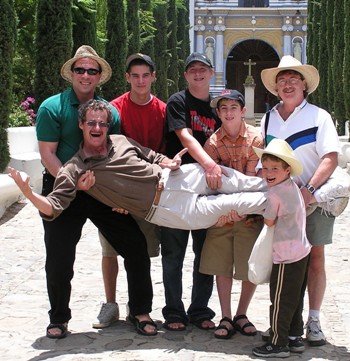
On the Casa Raab web site you will also see lovely pictures of Tony’s estate where they provide beautiful Zapoteco style lodging, tours and other activities. I guarantee Tony, levitating with help below, would show you a good time!
dab2b259c08b05fc1882db2d0b335e22e4b9821496a79d2a6e93b3cb9dfbda8f.jpg

Geo-Piracy In Oaxaca?

In Oaxaca, Geographers Deny Surveillance Charges

Narco News Bulletin
By Nancy Davies
Commentary from Oaxaca
February 21, 2009

Amid a storm of accusations, defenses, campus condemnation, public pronouncements and news articles, the Union of Organizations of the Sierra Juarez of Oaxaca (UNOSJO) has condemned the mapping project called Mexico Indigena, a sub-project of Bowman Expeditions. The founder and director of UNOSJO, Aldo Gonzalez, launched a campaign to alert indigenous communities of Mexico and the world to the risks involved in giving access to Bowman Expeditions under whatever name.

What is the true reason for a geographic survey of the Sierra Juarez paid for by both the US and Mexican governments? Many possible reasons come to mind, such as theft or purchase of forest timber, locating natural resources like minerals or water, narcotics activities, bio-piracy, counter-insurgency, geo-piracy, and preparing for privatization of communal land. UNOSJO’s press release discusses several possibilities.

The American Geographical Society (AGS) director, Jerome Dobson, asserts that academics commonly accept US Army funding, and hand over their results with no qualms. AGS sponsors Bowman Expeditions in places like Columbia and Jordan. Gonzalez advises other communities not to permit such mapping projects. “You’ll be sorry,” he asserts. It is not yet clear what the Mexico Indígena project sought in the Sierra Juarez.


Aldo Gonzalez showing map
D.R. 2009

In a formal press conference held on Thursday, February 19, Gonzalez disclosed UNOSJO’s charges against the Mexico Indígena Project, and Bowman Expeditions, claiming geo-piracy and lack of ethical conduct in the communities of the Sierra Juarez. Two communities among nine spread over a geographical mountain area of perhaps 10,000 hectares agreed to continue the project after UNOSJO objected, and cooperated by supplying investigators detailed information.

Gonzalez claims the investigation in the Sierra Juarez failed to inform the population regarding two aspects of its funding: the US military; and Radiance Technologies, a weapons business.

Although the Mexican government clearly participated and partially funded the project through its two agencies, Semarnat and PROCEDE, it has thus far made no statement in the face of accusations launched against the Mexico Indígena Project.

Gonzalez claims a possible violation of national sovereignty and violation of the autonomy of indigenous peoples. For all that, he has refrained from asserting as if it were proved, that the Mexico Indígena team was spying.

Spying? Bowman Expeditions has been in Iraq and Afghanistan with “embedded” sociologists, psychologists, and geographers. These teams gather terrain and cultural intelligence to make easier the task of the military, who can use information regarding the culture, family relations and psychology of the local people, as well as close details of streets and passages. According to Wikileaks, posted on December 11, 2008, a 122 page handbook dated September 2008 presents the US military’s controversial anthropology based counter-insurgency techniques. Formally titled “Human Terrain Team Handbook” the document comes out of the US Army’s $190 Million “Human Terrain System” [HTS] program. According to the handbook, Human Terrain Teams are 5-9 person intelligence teams made up of serving military, contractors and “academicians”. The teams are designed to assist a commander’s irregular warfare operations by using anthropological and intelligence techniques to exploit cultural, political and family relationships in a region. The material is unclassified, but has not been publicly released though official channels.

So is Mexico Indígena a Human Terrain System (HTS) project? Both use human participation. Geographers and academics are in the area to gather on-the-ground information with local input. Most important: they have the same parent origin and funding source. UNOSJO soon discovered that Mexico Indígena is a Bowman Expedition, like those carried out in San Luis Potosi, México; the Antilles; Colombia, and Jordan; all are sponsored and financed by the Foreign Military Studies Office (FMSO) of the US Army, among others. FMSO prepares a world data base which is an integral part of the HTS used for counterinsurgency by the US Army, and which could be used against indigenous pueblos or anyone else involved governments choose.

The history of the controversy: Read More

Valentine’s Day Story

On any day, in the park across from my apartment, young people, away from the prying eyes of parents and grandparents, can be seen  laughing and playing with each other affectionately…though the kissing never seems X rated. People walking past them pay them no attention…as if they weren’t there…giving silent assent.  I have seen this in other Mexican cities. This morning I came across this LA Times article describing an uproar in Guanajuato.

“A town famous for an Alley of the Kiss passes a law against public displays of affection, sparking a passionate outcry.

By Ken Ellingwood
February 14, 2009

Reporting from Guanajuato, Mexico — Once upon a time, there was a city where people came from far and wide to kiss.

The place was blessed with gold and silver, but its kissing legend, passed down like an heirloom, made it rich beyond measure. It tells of a fair maid named Ana who fell in love with Carlos, a poor miner who lived across a narrow alley. The young lovers met on their balconies, stretching across the tiny gap to kiss in the moonlight.

But their love was star-crossed: Ana’s father forbade the romance and threatened to kill his daughter if he discovered the lovers together again. The next night, he caught them and, true to his warning, stabbed Ana with a dagger. Dying, Ana reached out and Carlos kissed her hand — the couple’s final kiss.

The children of this city have learned this lovers’ saga by heart and told it over and over to the hopeless romantics who come to see the spot, known as the Alley of the Kiss, and to share a good-luck kiss there.

So it came as a terrible shock to people here last month when word spread that the city’s leaders had issued an edict: Kissing in public was forbidden. Violators would be punished.
The news set off a storm over smooching that, weeks later, still has tongues wagging in picturesque Guanajuato, a mining town in central Mexico — and reveals a lot about the ways of Mexico, where you don’t need to get a room to express your love for each other. Like any good Valentine’s Day story, this one ends with a kiss.

The affair blew up in January, when Guanajuato’s City Council, led by the socially conservative National Action Party, or PAN, approved an ordinance on public behavior to replace a 32-year-old law. The ordinance tackled problems such as unlicensed street vendors and jaywalking. But it also targeted offensive language and “obscene touching.”

The mayor, Eduardo Romero Hicks, was asked what sort of public act would be punishable. He said the law would ban agarrones de olimpiada, which translates roughly as “Olympic fondling.” (In an interview later, he explained that this meant “fondling far beyond the norm . . . extreme eroticism in public places.”)

Garden-variety kissing, the mayor said, was never the target.

But leftist opponents depicted Romero and his PAN colleagues as latter-day inquisitors bent on imposing strict morals on the rest of Guanajuato, a tranquil town with cobblestone streets and hillside homes painted in eye-popping hues of orange, pink and electric blue.

The outcry was swift. Protesters gathered in front of City Hall to kiss en masse. The news media got into the act, and pretty soon Romero and his city were at the center of an unflattering national controversy. A satirical video posted on YouTube played a familiar cumbiacumbia-style tune with reworked lyrics and depicted Romero in a priest’s collar. One editorial cartoon showed a couple kissing in a bird cage suspended by a fixture shaped to spell “PAN.”

It mattered little that the mayor announced within days that the measure would be suspended. All of Mexico seemed ready to take to the ramparts in defense of a treasured institution: the kiss.

“The attitude toward kissing is a good thermometer of the tolerance of a society,” columnist Federico Reyes Heroles wrote in the Reforma newspaper. He said trying to limit public kissing was like outlawing miniskirts — the stuff of totalitarian countries. “Eros is part of life,” he wrote.

In liberal Mexico City, officials have rallied to the cause of the kiss by summoning residents to a massive Valentine’s Day kiss-in on the main plaza. Organizers are hoping for thousands of kissers at today’s event, perhaps enough to land a spot in the Guinness World Records book.

In unveiling the kiss-athon, the city’s tourism secretary, Alejandro Rojas Diaz Duran, appeared to toss a dart in Guanajuato’s direction by pointing out that PAN members were welcome to join in. He said Mexico City “has always been the example of what Mexican society’s values should be.”

If so, public kissing would be high on the list. Compared with the United States, Mexico is a very smoochy place. Mexicans of all stripes kiss each other on the cheek when saying hello and goodbye. Children and parents slobber over each other with abandon. Even strangers merit a kiss; Americans might be taken aback by the Mexican custom of kissing someone on the cheek when being introduced.

Take a walk through many public parks in Mexico City and it can feel as though you’ve stumbled onto Lovers’ Lane, with couples in tight embrace on wrought-iron benches or entwined on the grass beneath shade trees. The capital’s vast and woodsy Chapultepec Park is so well known as a make-out zone that it has a racy nickname: Chapul-tetrepo, tetrepo, the last part of which can be translated as, “I climb you,” as one would a tree.

It’s not only teens locking lips on the street; middle-aged couples also are given to public displays, sometimes with surprising urgency. Making out in the park avoids the prying eyes of siblings, parents, grandparents, aunts and uncles who form the typical extended Mexican family. And there is an overall expressiveness that sets Mexicans apart from the northern neighbors.

“We’re more romantic. We show our feelings,” said Dulce Nancy Gonzalez, a 25-year-old doctor who on a recent day accompanied her boyfriend to the steps of the Alley of the Kiss for a lucky smooch. Tradition holds that kissing on the third step brings 15 years of good luck.

“It’s not hard for us to show our feelings,” Gonzalez said after she and her boyfriend of three weeks shared several kisses of the sort you’d never plant on grandma. “For us, it’s harder to hide them.”

In that spirit, Guanajuato’s leaders are adopting an “if you can’t beat ’em, join ’em” approach. Having shelved the controversial ordinance for more review, Romero has gone all the way, declaring his city the “Capital of the Kiss.”

Officials are hanging banners and printing postcards that celebrate various flavors of kissing (all G-rated and mostly showing family situations). Merchants are reportedly working on the recipe for a margarita-type drink that would be called the beso, Spanish for “kiss.”

Guanajuato’s residents have come to view the noisy affair as a cautionary tale about the futility of trying to lasso romance. Or the silliness of politicians. Or both.

On a recent day, Jorge Garcia and Vanessa Atzmuller, teens in matching white hoodies, stretched across the table of a sidewalk cafe near City Hall. They met halfway, touching lips softly, the way Ana and Carlos might have.

This time, they all lived happily ever after.”

I’ll bet you anything in the world it was complaints by norteno tourists who sparked the attempted shut-down of the kiss. LOL  For me, watching these playful carefree kids is much more uplifting than reading the daily headlines.

I Picked The Worst Day Ever To Travel

It was supposed to be a simple trip from Oaxaca to Portland Oregon on December 17th to get stuff for my apartment in Oaxaca.  In the first place the plane was an hour late out of Oaxaca.  So I missed the connection in Mexico City to Los Angeles. About a half hour into the flight we hear a message from the pilot: “This is an emergency! Take one of the oxygen maska and place it on your face!”  But no oxygen masks come down from the ceiling.  A few minutes later we get the same message.  Again nothing happens.  The stewardess is on the phone. Then an announcement in spanish from the stewardess,  that,  I gathered, was that all was a false alarm.  Tranquilo, she says.

Then in Mexico city they rerouted those of us who missed connections to LAX us through Las Vegas.  Three hours out of Mexico City (and almost to Las Vegas) the plane turned back and I ended up where I started…Mexico City.  No more planes out that night so I slept in the airport…the alternative was the Hilton Hotel at the airport for $200 a night!  Next morning finally took a plane out of Mex City to LAX where I waited for a 7:30pm flight.  A half hour wait on the tarmac because the plane door wouldn’t shut.  Finally slid into PDX about 8:30pm on the 18th.  Spent an hour filing a missing baggage report and narrowly got on the HUT for Salem after which I took a taxi to Lyn’s.  So here I am in Salem in the middle of the worst snow and ice in the last 30 years.  But the Toyota started right up and I spent the day today running errands.  Got a phone call late today that my bag turned up at PDX so they will deliver it to the house in Salem. Tomorrow I will pack some duffels full of kitchen and other stuff to take back to Oaxaca.

So for inquiring minds, this is how I got from Oaxaca, Mexico to Salem, Oregon.

On the way back to Oaxaca I’ll stop in Las Vegas to spend Christmas with Greg, my first-born son. Maybe.