Poor Oaxaca

Update wed:
Well, I hope the governor is good and embarrased after overstating the damage in Oaxaca and drawing intense international media attention. He has now issued a statement saying that 11 people are missing, no confirmed dead and 3-4 houses buried. Shhiishh!

Oaxaca has been inundated with two feet of rain in the last two weeks with record rainfalls for a month before that. The New York Times carried this report this morning:

A hillside collapsed onto a village in the southern Mexican state of Oaxaca early Tuesday, burying houses in mud and stones and trapping hundreds of people as they slept, state authorities said.

As many as 300 houses in the village of Santa Maria Tlahuitoltepec may have been buried in the landslide, said the state governor, Ulises Ruiz.

Rescue workers trying to reach the village with earth-moving equipment have been hampered by blocked roads in the remote area, which has been pounded by incessant rains. “We hope to reach in time to rescue those families who were buried by the hill,” Mr. Ruiz told Mexican television.

This is about 50 miles from Oaxaca City where I live. And the latest news report on CBC says they couldn’t even land one helicopter there today (!!)
People in Oaxaca are forming help centers and are asking for donations. This appeared in the Oaxaca group on couchsurfing:

Up to us a lot more responsibility now with the tragedy that has befallen the people of Tlahuitoltepec, Mixe. They can overcome this sadness is in large part on all of us! Let’s help these people with great history, traditions and poverty.

In my facebook profile for me, Rodrigo Guzman, I have the account number to which they can make donations, so you can donate nonperishable food, bottled water, beans, rice, sugar, canned goods, can opener, antiviral drugs, clothes in good condition, covers and mattresses in any of the collection centers that are opening throughout the state.

The other tragedy of the moment has to do with the Trique indigenous communities in the Mixteca region north of Oaxaca City.

Three years ago, the indigenous Trique municipality of San Juan Copala, in the southern Mexican state of Oaxaca, declared itself autonomous from the government. Since that time they have faced severe repression, with community members being kidnapped, raped and assassinated by two state-backed paramilitary groups in an attempt to destroy the autonomous project. Two caravans bringing food and water to the town were driven back with several people murdered…one a Finnish human rights worker. The people have been driven out of their town and taken over by Oaxaca government allies.

Join Friends of Brad Will along with guests from Movement for Justice in El Barrio, to learn more about San Juan Copala, including a short documentary and video-message from residents of the autonomous municipality.

Friends of Brad Will is a national network working for justice for Brad Will, an American independent journalist murdered by state paramilitaries in Oaxaca in 2006.

As if all that wasn’t bad enough, a bridge to the Oaxaca airport has collapsed caused people to have to walk in and out.

Wish me luck driving down in mid-October.

El Grito 2010

EVERY 100 years, Mexico seems to have a rendezvous with violence as again the country gathered on Wednesday night for the ceremony of the “grito” — the anniversary of the Revolution…the call to arms that began the war for independence from Spain in 1910.

As they have on every Sept. 15 for 200 years, Mexicans gathered together in the central squares of our cities and towns, even in the smallest and most remote villages. At midnight, they heard a local governing official re-enact the grito uttered by Miguel Hidalgo, the “father of the fatherland.” They shouted, jubilantly, with genuine feeling: “Viva México!”

Euphoric cries were mixed with a flashy Mexico City military parade, a counter-bicentennial gathering, fresh outbreaks of narco-violence in different parts of the country and goads of symbolism that embodied the past, present and future of a nation of more than 100 million people. As the historic day faded, Hurricane Karl bore down on the state of Veracruz, already battered by this summer’s torrential rains.

At a ceremony in the town of Dolores Hidalgo, Guanajuato, the unassuming place where Father Miguel Hidalgo y Costilla launched the 1810 rebellion that resulted in Mexican independence 11 years later, President Felipe Calderon was greeted with a sprinkling of obscenities and unusual shouts. Some members of the audience reportedly yelled out “Viva El Chapo,” or “Long Live El Chapo,” in apparent reference to fugitive drug lord Joaquin Guzman Loera. “Death to the Bad Government!” also was heard.

Later, Calderon presided over a Mexico City military parade of about 23,000 Mexican army and navy personnel, including members of elite anti-narco units. While air force jets flew overhead, military delegations from 17 countries were on hand for the historic commemoration.

What’s that all about?!!!

The participation of a Federal Police contingent was an unusual feature of this year’s parade. As the emerging front-line force in the so-called drug war, the Federal Police headed by Genaro Garcia Luna is the institution favored by Mexico City and Washington to take over combat of organized crime from the army and the navy.

Meanwhile in Oaxaca more than 2,000 police and military personnel are guarding entry to the Zocalo as a security measure. Wed night was the Grito, and Thursday was the parade.

Against whom are they guarding? All we know is the ambulant vendors, the unions and protesters.

In Oaxaca El Grito belies a different kind of violence…one instigated by the PRI (the powerful party in control for the last 80 years) to pit one group of Trique indigenous people against another group seeking autonomy as the government had promised years ago. Read More

Why I Am An Expat In Oaxaca Mexico

As for me, the best kind of traveling for Pico Iyer, the travel writer, is when he is searching for something he never finds. “The physical aspect of travel is for me,” he says “the least interesting…what really draws me is the prospect of stepping out of the daylight of everything I know, into the shadows of what I don’t know and may never will. We travel, some of us, to slip through the curtain of the ordinary, and into the presence of whatever lies just outside our apprehension…” he goes on to say. “I fall through the gratings of the conscious mind and into a place that observes a different kind of logic.”

Being a wanderer, says Alain de Botton in “The Art of Travel”, crossing different lands among people who speak languages strange to one’s ear…meditating dreamily to the rhythm of train wheels, allowing the sounds of the world to be one’s mantra, enables one to grow…to transcend one’s known life. The silence of being alone (much like being on retreat in a monastery) without the ease of familiarity allows one to stand outside oneself… large sublime views and new smells revealing new thoughts and emotions…thrilling or disappointing aspects of oneself…here-to-for hidden from one’s awareness.

If we find poetry in tattered old men weaving home on bicycles, a grateful charm in smiling young country girls… and a shared intimacy in the look of recognition in the eyes of kindred travelers we have found “an alternative to the ease, habits and confinement of the ordinary rooted world.”

Introspective reflections revealed by  new places and people much different than us may reveal hidden thrilling or disappointing aspects of ourselves.  Thrilled by finally learning the geopolitics of another people and learning that there are many valid ways of living in the world other than ours.  Disappointed at discovering we have limits to our tolerance for what we judge as inefficient or unsanitary.  So as another travel writer says “it is not necessarily [only] at home that we encounter our true selves. “The furniture insists that we cannot change because it does not; the domestic setting keeps us tethered to the person we [think] we are in ordinary life…who may not be who we essentially are,” says the author.

I love to travel alone. Traveling companions can keep us tethered to our predefined idea of ourselves. They may expect certain reactions from us that obligates us…underneath our awareness…forces us to accommodate in a way that feels unnatural. Or in our companion’s desire to have their own experiences, they may not have the patience to reciprocate and share. In traveling alone we are free to connect with what and whom comes our way.  We are more approachable.

Robert Young Pelton nailed it for me though when he said in his “World’s Most Dangerous Places” “living is (partly) about adventure and adventure is about elegantly surfing the tenuous space between lobotomized serenity and splattered-bug terror and still being in enough pieces to share the lessons learned with your grandkids. Adventure is about using your brain, body and intellect to weave a few bright colors in the world’s dull, gray fabric…”

The purpose of his book, he says, “is to get your head screwed on straight, your sphincter unpuckered and your nose pointed in the right direction.”

I retired in 2002, rented out the house long term and “went on the road.” I traveled for the next four years but then got sick of piling on and off buses, trains, planes, taxis, boats and all other manner of transportation…and packing and unpacking.

I returned to the states and for 4 months went from the computer to the TV and back again. One day, I thought, I could just die in this chair. Go for a walk? Where? Around the neighborhood block? Have to get in your car…and then go where? A coffee shop? I was bored to death. Not that there are not a jillion activities I could have participated in. But why? I felt I had done all I wanted to do there. Bored by a country I had spent 60 years in and bored by a town I spent 40 years in. I am not attached to the place and the culture….although I do miss incredibly sweet raspberries and strawberries in the spring and cherries and peaches in the fall…picked by migrants from here and sold cheaply in the US due to their cheap labor.

One son is in Hong Kong, one in Thailand and one in Las Vegas. No grandchildren. My grandparents immigrated from Poland and Ireland but died before or just after I was born…no extended family to speak of and the ones I have are all ranchers in Montana…a physical and intellectual world away.

My friends and former co-workers are scattered from “hell to breakfast” as we say.   Generally speaking, with only one or two weeks of vacation a year,  Americans don’t frequently travel outside the country.  So, “Oh,” you say, “in Thailand…” And then the veil comes down over the eyes and that is the end of that!

Many of my friends that I have now, I met on the road and keep in frequent contact through skype, email and Facebook. I have learned that “community” doesn’t have to be a physical place. It can be virtual. Guess I have, as Pico Iyer puts it…a “global soul.”

No roots to speak of…in a physical sense. I HAVE learned, however, after witnessing incredible poverty and injustice in the world, to value much more all those things (my roots) we as Americans take for granted…but they are internalized and remain with me wherever I live…independence, self-sufficiency, efficiency, innovation, freedom of thought and speech, an appreciation for the rule of law and government with relative separation of powers and relative lack of collusion and corruption. I said “relative.”

So…long story short…what I realized I wanted now, was a daily life that was interesting and full of small enjoyments. And to search for an understanding of a culture I will never find. So I moved to Oaxaca. I chose Oaxaca because it is in the mountains which I love and the weather is temperate year round. I also chose Oaxaca because I had worked with many farmworkers in Oregon who were from here and I found the people to be real.

Music everywhere. Rockets, fireworks going off. Church bells to wake you up in the morning. Processions, Fiestas. Protest marches, daily walks around the Centro…(I have arthritis so I need to walk) always discovering new little cafes and other places of business. And am trying to understand that when my Mexican friend says “I will see you manana he may mean tomorrow, next week or next month or never! Ha!)

I am learning to cook “Oaxacan” so going to a different little market for specialty items…mole and rare chilis at the Merced, Friday market tienges in Llano Park for meat and vegetables is a joy. A hundred small vendors selling everything you can imagine…and great chivo (BBQ goat) with consumme or tacos with hand-made tortillas.  I love to feed my friends and couchsurfers and watch them delight over estofado or mole.

Five blocks to the tree-filled Zocalo (plaza) where I can sit for hours in one of the little sidewalk cafes surrounding it over coffee or beer with friends who wonder by…both local and expat. There are 16 different indigenous groups from small mountain villages that are easily accessible whether 1 hour or 7 hours away. Or I just sit on my veranda overlooking a lovely park to read. Or the news junkie that I am, peruse the internet for the latest via my WiFi…amid wafts of dance music coming from the nearby cultural center.  Or visit with a friend over Pechuga Mescal. On Saturday and Sunday mornings I watch people practicing Tai Chi in the park below. Or video-skype one of my sons.

And then there is learning and practicing the language…a challenge to keep the brain from totally disintegrating.

Of course my social security and pension goes farther here. But it’s not the reason I am here.  Friends in the U.S. say” but why do you want to live in Mexico?  It is so poor!”  You don’t know poor until you’ve gone to India or black Africa.  Or they worry that I will get kidnapped or shot.  The narcos leave the tourists alone…they only kill each other or people who get in the way. And that is mainly in the border areas.  I feel very safe here.

I don’t know how long I will be here.  Much of it depends on my health. A debilitating or chronic condition would require me to go back to the states in order to be covered by medicare.  But for now, I enjoy the daily small things.  I still do travel periodically…mostly to Asia. In fact I just returned from 8 months away….6 of it in Thailand and Hong Kong.  But I live in a culture I will probably never understand.  It’s rewarding and enlivening to push my boundaries and try.
Oaxaca: Who is Permitted to Earn Money, and Where?

Taken from NarcoNews:

The Real Battle for Oaxaca: Who is Permitted to Earn Money, and Where?
“The lesser officials manage the street scene, but also the professionals, vendor bosses, who run a crew of ten or a dozen”

By Nancy Davies
Commentary from Oaxaca

August 17, 2009

A plague of ambulatory vendors annoy the tourists sipping cappuccinos in the Oaxaca zócalo. Beneath the cafe umbrellas vacationers, often with their families, don’t want to be pestered. They have disposable money; smart vendors head for the “whities”. The peddlers, here called ambulantes, have changed. A decade ago I could greet the same few — a family who sells homemade candy, Jorge who sells rebozos, AltaGracia who sells place-mats and table runners—all “inherited” their peddler’s licenses from parents, or so they tell me. During 2006, they suffered —no tourists, no sales. AltaGracia, a vital woman with a nice smile, lost almost all her teeth in the past two years.

waiting-for-permissi.jpg
Vendors waiting for permission

D.R. 2009 – Photos Nancy Davies
Who are the new ambulantes? Women from Chiapas, recognizable in wool wrap skirts and braided hair, selling beads and Chinese rubber chickens. Children follow behind, or if they’re nursing, nuzzle a breast and lunch on the go, like busy business-people must. Children vend by themselves if they are over eight or nine, thin-legged, endlessly circling in their plastic shoes. Others Oaxaqueños sell handmade wooden toys, or canes, or plastic necklaces.

On the corners the sellers of raspas station their ice-carts, and the popsicle vendors and soda vendors criss-cross the square.

Stationary vendors descend for any and all fiestas, to set up on the sidewalks their blouses and “hand-made” tourist goods, tortillas and comals for cooking food, oil cloth covered tables and iron benches or stools -a carnival atmosphere. In the background the blaring music. The permanent puestos (the booths which might or might not be taken down at night) smothered Bustamante Street, supplemented by sidewalk vendors with lettuce and radishes and fruits in season. Las Casas Street has been jammed for so long that I think of it as my favorite street, for its “true to life” confusion. The shopkeepers complain, probably with good reason —there’s hardly space to enter.

Welcome to hard times. The slippage of the Oaxaca (and Mexican) economy can be calculated by the numbers of vendors multiplied by the number of fiestas. Read More

Police Kick Vendors Out of Oaxaca Zocalo

Wondering around in the Zocolo (plaza) Monday, my friend Paula, who has lived here before, was approached by some young girls with a questionaire for tourists and asked if she had been to the Guelaguetza…or if she had been to see the reenactment of the Princess Donaji legend or any other official  related event of which she had attended none.

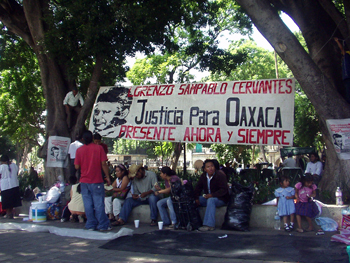
But she announced that she HAD been in the Zocolo that morning when the Municipal Police ignominiously strutted in with their flak jackets, shields and rifles to throw the street vendors out, releasing tear gas,  injuring four, detaining eight (mostly local hippie looking jewelry-makers who were standing up for the rest of the vendors who are mostly indigenous people from the mountains)  and sending tourists and locals alike into a frightened flurry to get out of the way.

It is not clear whether the vendors had a permiso to be in the zocalo but this is not the first time they have been thrown out over the years.  Maybe they didn’t pay their mordida (bribe to the city)?  This happened at the same time that the out-going Governor was giving his welcoming speech at the Guelaguetza so I guess he figured most of the tourists wouldn’t witness what was happening in the zocalo.

Read More

Guelaguetza Time Again

oaxacaoaxacaguelaguetza1.jpg

OMG narrow colonial streets are overrun with buses bringing dancers down from the mountains and by cars full of Mexican tourists. Calendas plug up what the cars don’t. Calendas are processions with a band with huge dancing 20 foot tall dressed figures with boys on stilts hidden inside leading a parade of costumed people. Got to be careful not to get hit by the flapping arms.

A bus ripped a hole in it’s fiberglass bumper turning the corner by my apartment the other day…and the night before a car hit another car and flipped over and slid down the sidewalk in front of the Arabia Cafe on the same corner…waking my house guest in the bedroom on that side of the apartment at 1am. A party of about 20 young men in the park from midnight until 5am kept her awake a few nights before that. I think she might be glad to leave next week. :))

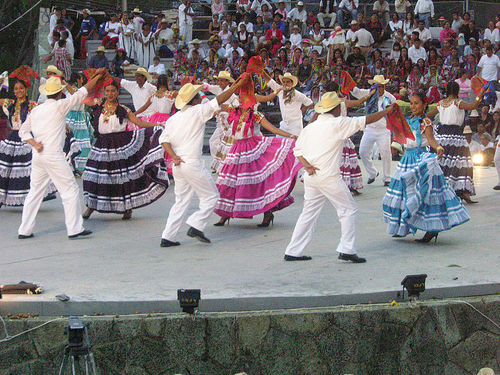
Popular Guelaguetza (free), Governor’s Guelaguetza ($40US). The word Guelaguetza comes from the Zapotec language and is usually interpreted as the “reciprocal exchanges of gifts and service.” Communities from within the state of Oaxaca gather to present their regional culture in the form of dance, music, costumes and food.

Local indigenous groups traditionally perform these dances to fulfill their obligations to their Uses Y Costumbres organized communities which is called doing your “tequio.”

Oaxaca has a large indigenous population, 40 percent, compared to 15 percent for Mexico as a whole. Indigenous culture in the state remains strong in its own right, with over 300,000 people in the state who are monolingual in indigenous languages. The celebration dates back to before the arrival of the Spanish and remains a defining characteristic of Oaxacan culture. Its origins come from celebrations related to the worship of corn as Oaxaca is considered it’s birthplace.

As the festival became a bigger tourist attraction, there was an inevitable backlash from purists that saw the ancient traditions being used for commercial purposes. The 2005 decision by the PRI Governor to conduct two performances a day for each of the two Mondays, was perceived by many traditionalists as a blatant attempt accommodate more ticket purchasing tourists. So the “popular” Guelaguetza, or a return to the more spontaneous celebrations of the pre-Columbian era, was organized.

In Oaxaca, where there is conflict between some groups and the state, the festival can become a focal point of contention.

Due to protests in 2006 against the state government calling for the fraudulently elected Governor to step down, the state-sponsored Guelaguetza was not held up on the hill at the Cerro del Fortín as planned. The protests were led by the Asamblea Popular del Pueblo de Oaxaca, an umbrella organization of teachers, human rights groups, political organizations, unions and others, which were met with state violence. Instead a free, “Popular Guelaguetza” was held by APPO.

The 2007 Governor’s celebration was again boycotted by APPO, and attempts to hold a Popular Guelaguetza were thwarted by government police repression. APPO members had barricaded the entrance to the Governor’s outdoor auditorium which resulted in the police killing of at least one and the disappearance of many others.

This year, the Governor attempted to build a protective cover over the stage of the state sponsored outdoor auditorium but it was not completed in time due to another boycott but also probably more by poor planning. Instead it will be held in an old baseball stadium. The Popular Guelaguetza is being held at an outdoor venue at the Technological University.

Well, that’s probably all you want to know about the Guelaguetza. Of more interest to many is the the annual Mescal Fair in Llano Park. $1.50 entrance fee and free samples from about 50 vendors. Whew!

Futbol Around The World

Futbol, as Spanish speaking countries call it, is the national game in Mexico and all Latin American countries and Oaxaca is no exception.  Americans call it soccer, I think mostly to distinguish the game played with a round ball from the game played with an oblong pointy one that refuses to roll on the ground in a straight line. Apparently the word “soccer” was the original name for the game in England where it was invented but that’s another story you can find on the web.

My kids played soccer in grade school and my oldest banned me from the games for being too loud and embarrassing the heck out of him. So here in Oaxaca even I have found it difficult to avoid the mania.  But the audio of the vuvuzela I downloaded onto my iPhone was pretty sick.  I watched Serbia and Ghana…then expecting to see the Americans play (a game they won) SKY TV immediately replayed the Serbians!  What was that all about?!! I won’t even attempt to speculate.

The restaurants in the zocalo (plaza) have TV monitors facing the sidewalk cafes where mostly young people huddle together…those who don’t go to the bars to watch anyway or depending on the time of day or night the game occurs…and many of them are European language students.  Yesterday Uruguay played Germany. The Europeans were in the minority and rendered pretty mute by the locals urging on Uruguay…the underdog. A table of young French girls were oblivious…tentatively tasting the black mole with barely a drop on the tips of their knives.  It was fun watching the looks on their faces. Either they were famished or they loved it because afterward not a bit was left on the plates.

My son, the chef at the American Club in Hong Kong, is napping.  Tonight (or rather tomorrow) the final between Spain and Holland will air at 2am.  He will open the restaurant…featuring free hot dogs and hamburgers…for those intrepid souls who will stay up.  No fun watching by yourself on the couch in front of your home TV…side-line coaching with friends and a little testosterone thrown in adds much to the pleasure.

Read More

4th of July in Oaxaca

Ironically the 4th of July was also the day of Mexican state elections. Exit polls last night showed that the PRI, the corrupt party that has ruled Mexican politics for over 70 years, was voted out nearly all over Mexico and even in Oaxaca. Well. We’ll see if the actual vote counts are commensurate. If the PRI contests the vote results this will end up in the courts…if not also in the streets.

Death To Criollo Corn In Oaxaca

Criollo corn is under attack in Oaxaca.  Hand made criollo corn tortillas are the prize find for any foreign foodie and for all local Oaxacans.  Industrial corn tortillas taste like sandpaper.  This reads like a detective novel in which Monsanto’s Washington-based communications company uses “phantom” or fake sources to derail a biologist’s career because he was demonstrating that genetically modified corn has indeed infested criollo corn fields.  In other words, the industrialists are fighting natural corn from within in order to make farmers dependent upon their products.

Phantoms in the machine: GM corn spreads to Mexico
MARIE-MONIQUE ROBIN
July 3, 2010

I LANDED in Oaxaca, Mexico, in October 2006. Nestled in the heart of a lush landscape of green mountains, the city is considered one of the jewels of the country’s tourist industry. I was here, however, to investigate contaminated corn.

On November 29, 2001, the scientific journal Nature had published a study that created a stir and drew heavy fire from the St Louis headquarters of North American multinational agricultural corporation Monsanto – manufacturer of the world’s best-selling herbicide, Roundup, and the world’s leading producer of GMOs (genetically modified organisms). Signed by David Quist and Ignacio Chapela, two biologists at the University of California, Berkeley, it found that criollo (traditional) corn in Oaxaca had been contaminated by Roundup Ready and Bt genes. (Bacillus thuringiensis is a bacterium that produces a protein toxic to some insects. The gene inside the bacterium – the Bt gene – is added to seeds such as corn to create genetically modified crops.)

The news was particularly surprising because in 1998 Mexico had declared a moratorium on transgenic corn crops in order to preserve the extraordinary biodiversity of the plant, whose genetic cradle was Mexico. Grown since at least 5000BC, corn was the basic food for the Maya and Aztec peoples, who worshiped it as a sacred plant.

Travelling around the indigenous communities of Oaxaca, I encountered everywhere women drying magnificent ears of corn coloured pale yellow, white, red, violet, black, or an astonishing midnight blue. ”In the Oaxaca region alone, we have more than 150 local varieties,” said Secundino, a Zapotec Indian who was harvesting white corn by hand. ”This variety, for example, is excellent for making tortillas. Look at this ear: it has a very good size and fine kernels, so I’ll save it to plant next year.”

”You never buy seeds from outside?”

”No. When I have a problem, I exchange with a neighbour: I give him ears for him to eat and he gives me seeds. It’s old-fashioned barter.”

”Do you always make tortillas with local corn?”

”Yes, always,” he said with a smile. ”It’s more nourishing, because it’s of much better quality than industrial corn. Besides, it’s healthier, because we farm without chemical products.”

”Industrial corn” means the 6 million tonnes of corn that flood in every year from the United States, 40 per cent of which is transgenic (modified by the introduction of genetic material from another species).

”Look,” said Secundino, holding out in his hand like a gift a magnificent violet ear. ”This corn was my ancestors’ favourite.”

”It existed before the Spanish conquest?”

”Yes, and now there is another conquest.”

”What’s the new conquest?”

”The transgenic conquest, which wants to destroy our traditional corn so industrial corn can dominate. If that happens, we will become dependent on multinational corporations for our seeds. And we will be forced to buy their fertilisers and their insecticides, because otherwise their corn won’t grow. Unlike ours, which grows very well without chemical products.”

IGNACIO Chapela, one of the authors of the Nature study, agreed to meet me at Sproul Plaza on the Berkeley campus. ”Small Mexican farmers,” he said ”are very conscious of the stakes raised by transgenic contamination, because corn is not just their basic food but a cultural symbol.”

It was an October Sunday in 2006, and the huge campus was deserted. Only a police car drifted by like a damned soul. ”That’s for me,” said Chapela. ”I’ve been closely watched since this affair started, especially when there’s a camera.” When I looked incredulous, he went on: ”You want proof? Come with me.” We drove to the top of a hill overlooking San Francisco Bay. As we walked towards the lookout point, we saw the same police car, parked conspicuously at the side of the road.

”How did you find out that Mexican corn was contaminated?” I asked, rather disturbed. Read More

6.2 Earthquake in Oaxaca

About 20 minutes after 2am last night, my friend Paula and I felt a pretty strong but momentary earthquake that woke us both up.

Reuters already had an article posted by 5:30 this morning in the NY Times.

The U.S. Geological Survey said the quake struck near the town of Pinotepa Nacional around 80 miles (125 km) southwest of the colonial city of Oaxaca, but police patrols checking surrounding towns did not report problems.

The USGS reported the quake as strong as magnitude 6.5 but later revised the figure to 6.2, also moving the epicentre slightly.

I have felt several of these here before but so far so good.