Jinghong China

jWLtBzsBGHTUmbHjYHypj0-2006185073225366.gif

Photos

While I was in Guizhou Province, Bob headed off for Putuashan Island and then circled back to Shanghai via Hangzhou…then flew to Jinghong to meet me at the Banna Hotel. We picked up Sarah, a trek leader at the Forest Cafe, who led us by bus into the surrounding mountains to visit some Hani, Dai and Jinguo ethnic minority villages.

In one village I ran into a Frenchman I had met in Guizhou Province (a thousand miles away) who had enlisted the services of a car and driver so Sarah took off trekking with Bob and I joined Marco (French-Italian) on a visit to several Dai village homes on the way back to Jinghong where I met Bob at the hotel that night.

Bob was to fly to Bangkok and I to Hanoi from Jinghong but planes were full so we flew the 40 minutes north to Kunming to catch planes…Bob to Bangkok and me to Hanoi.

Camellia Hotel In Kunming China

jWLtBzsBGHTUmbHjYHypj0-2006185073225366.gif

Video

Was really fun to spend time in the Camellia Hotel compound in Kunming, familiar from our 2002 visit to China, and fraternize with all the Western travelers and trade street-stories at the Mieli cafe/bar and Camel Bar up the street.

I picked up a Vietnamese visa at the Camellia. I nearly lost my temper with the hard-headed Chinese clerk who gave me the visa. When I filled out the application I put the date I would be entering Viet Nam-after having gone to Thailand first for two months. In no uncertain terms she kept ordering me to put the current date. In the face of her demand I finally gave in. Then when I went back to pick up the visa I discovered I would only have one month in Viet Nam because the 90 days started now! I told her I wasn’t entering Viet Nam for 2 months. Oh, she said. I could have killed her. But she knew better than I! Typical Chinese, I thought!

Also picked up a three month Thai visa at the Thai Consolate so I wouldn’t have to go out of the country and back in after 30 days. But even there, when I asked about the stamp-out process he insisted there was no legal process…which I found out later is the truth. But they let it happen because it’s brings in revenue. Then flew to Jinghong to meet Bob.

In the Camellia Internet Cafe and Bar I met a wonderful 30ish English woman, Hester, who was also traveling alone. We connected instantly. An artist, she had just broken off a ten year relationship and sold her home. She was on her way back to Lijiang where she was thinking of partnering with some local artists on an art project.

Far East Youth Hostel

East China.gif

The last time I was in China it was freezing cold in January 2003. The weather is fantastic this October day in 2004.

After slogging it out across Russia and Mongolia, we soak up creature comforts at the friendly Far East Youth Hostel located among the back alleyways of one of Beijing’s ancient hutongs where young backpackers pick the cheap dorm rooms next to the self-catering kitchen and laundry room in the basement and we, of course, choose a double room upstairs with all the Chinese tourists for about $25.

Downstairs is a “coffee bar” featuring a wide screen TV for viewing one of scores of dvd movies, three high speed internet terminals and a book case full of tattered novels and old travel guides.

Several tables of travelers share experiences and information…one with an Israeli guy trying to explain his country’s posture regarding Palestine to a couple of doubting Norwegians (Europe is generally pro-Palestine which is one reason the Europeans have trouble with the U.S.)

The compound includes a courtyard across the alley with a budget restaurant where I tried to order soy sauce in Mandarin (chiang yo) and got rice instead because of the tone I used.

On the back end of the courtyard are even cheaper dorms housing mostly young male West Europeans. After setting up the tiny computer speakers and coffee pot we step outside the doors of the cozy hostel and find ourselves dodging old men on bicycles between humming dumpling shops and cheap clothing stores blasting Chinese hip-hop and techno. At dinner we laugh at the English menu…among the choices are “Hot Pot of Old Duck With Chinese Medicine” and “Soup Of The Ox Reproductive Organs.” This is as good as it gets. If home is where the soul likes to be…I am there…at least for now.

And then…Bob packed up…and left.

Life in a Mongolian Ger

GyTjn0QZP9l6Qu21TubskM-2006198062551304.gif

Video
Terelgj National Park, an hour by car outside of Ulaan Baatar, is a spectacular valley surrounded by high eroded rock formations, pine covered mountains and steppes carpeted with sheep, Mongolian horses and perennial wild flowers. We are immediately taken by the tour company van to the ger (the word “yurt” is of Turkic origin that the Russians use) of an older Mongolian man who welcomes us with delicious yak butter on thin hard bread, two kinds of dried cheese and milk tea. We are told his wife is in Ulaan Baatar visiting a daughter who works for a mining company.

We walk behind a yak pulling a cart with our luggage up the side of a small valley to our ger which will be our home for three days. A ger is a round structure with a wooden lattice framework with long poles extending up toward the apex of the ceiling…all covered with layers of felt. Our ger sits on a cement platform covered with linoleum and carpeting. At the center is a hearth where the fire is considered sacred. The door faces south, men traditionally enter and walk to the west of the fire and the women to the east. At the north, opposite the door is the Khoima where valued objects like an altar for the Buddah and family pictures are kept. We have two beds with regular mattresses, one on each side of the hearth, a candle and small table. The mattresses and camel cloth blankets…”Gold Sheep Brand Wool En Bl Anket” all made in China.

It has snowed the day before and a young woman lights our fire in the evening and again, silently, about five in the morning. Our meals, are beautifully served in a large nearby ger.

Five Hours to Olkhon Island

7yBXvp82X2gVlMeZe25DiM-2006198051115673.gif

The next morning we are picked up at our homestay in Irkutsk by a sullen driver who drives us five hours over pot-holes, through the taiga and across a bay of the beautiful blue Lake Baikal to the small Buryat fishing village of Khuzhir on Olkholn Island with a population of 1500 (half are Buryat). Urr0g6ZfQ7ttYL19duYJfg-2006170133924757.gif

We stay at Nikita’s Guest House (Siberia’s only real traveler’s hangout) for five days. Nikita, we are told by some of the guests, was at one time Russia’s table tennis champion. Two multi-lingual Russian girls seem to keep things hanging together and they serve us great garlic-charged meals in a communal dining area. The guests are all European…no Americans…and the conversation is spirited…two Swedes quickly challenge a comment I made that they interpreted as being critical of Socialism.

We enjoy the banya (bathhouse) with wood-heated hot water we can pour over ourselves…although the first time we signed up we were the first on the list and the water was still cold.

Ancestral Village In Poland

Ancestral Poland.gif

We take local electric trains three hours north from Warsaw to Ostroda where we book into the Park Hotel on a lovely lake that caters to German-speaking tourists many of whom are coming to the former East Prussia to revisit lost homes and distant relatives. In fact while there we get a glimpse of a crackly BBC news report of an organization of older Germans who are demanding recompense from Russia for lost land and money during WWII…comparing themselves to the victims of the holocaust! President Shroeder, of course, refuses to intervene on their behalf, reminding them that the whole mess was due to their own country in the first place.

We luck out and find a pretty English speaking taxi driver in the line-up outside the Ostroda train station who agrees to take us the next day on a 20 minute drive (with liberal European speed limits amounting to no limits at all) to my ancestral village of Szczepankowo. And by village I mean village. Besides three or four homes with cobble stone lanes leading away from the main road, there is one tiny market. The village and the surrounding lush farmland looks like an 18th century pastoral painting.

While I walk around taking pictures of cobbles and pigs, the driver notices what appears to be the remains of a compound-like rock wall in the trees and overgrown grass across from the market. When she asks the old man in the market who lived there the response came: “Oh a rich man used to live there a long time ago.” Since my great grandparents sold their land in order to bring their 10 children to America and since anyone in 1890 who owned land would have been considered rich, and since my ancestors lived in this village as far back as the early 1700’s, I’d like to think I found their home…even if it wasn’t.

Five minutes away is Pratnica, a small town where we visited the church that my ancestors attended. Two priests, one 82 years old and a younger one originally from Gdansk, came to the door to the well-maintained quite large rectory and welcomed us in…offering candy and a viewing of copies of church records since the original were sent to Germany during the war )and since have been photographed by the LDS Library).

They let us into the church, which burned down twice in the last century…with one huge original rock cemented in near the foundation. But a rector’s chair was dated 1602 and we are told that a large hollowed out stone standing just inside the front doors is the original baptismal font. A Polish descendent like myself from Wisconsin donated nice new church pews in the 1970’s. The older priest remembers that one old Mroczynski lived nearby but has been dead several years. We drive to the home nearest his old one to visit an old woman who might remember him but there is a big lock on the door and no one is at home except the chickens and ducks.

Before leaving Pratnica, we stop for a bowl of soup at noon and our driver is happy to see Duck Blood Soup on the menu-a dish my grandparents always reserved for special occasions. We order our favorite made with rich dark smoky mushrooms from the forest.

On the way back to Ostroda our driver, in her early 30’s with two young daughters, tells us that there are few jobs in Poland and that her husband went to Ireland two years ago for work. She visited once, she says, but “things were not the same anymore so we must get a divorce.” (Skeptical Bob thinks there is more to the story.) But by this time we have made friends and she invites us to her parent’s home where she lives with her two girls on the top story. Her mother is in the hospital getting radiation and chemotherapy for breast cancer that she says is very common in Eastern Poland…due, everyone here thinks, to the Chernobl nuclear disaster in Russia about 25 years ago. We pick plums and apples from their backyard orchard. On the way out her father offers us Polish beer but we have already had coffee and cake in his daughter’s apartment and I feel bad turning him down.

My great grandmother was born in Radom…another visit to Poland some day.

Before leaving Poland we tank up one last time on pierogis..little savory pockets of noodle dough stuffed with mushrooms or other vegetables, meat or cottage cheese or sweet ones filled with blueberries or other fruit…just like my grandmother used to make at home. Oh, and I buy a CD that is popular in Poland right now…romantic songs sung by a thrilling Polish Zucchero. “I like very much,” says the young little blond in the music store. Read More

Krakow Poland

EHcDvLBEX5UlHHY96lAFi0-2006185062720933.gif

We are out of the unusually hot and humid Czech Republic. After an all night train we are in cool Krakow Poland. We accept an offer by a young English speaking man at the train depot and end up in a hostel…six flight up…”old building…no lift!”

The historic centre of Cracow, the former capital of Poland, is situated at the foot of the Royal Wawel Castle. The 13th-century merchants’ town has Europe’s largest market square and numerous historical houses, palaces and churches with their magnificent interiors. Further evidence of the town’s fascinating history is provided by the remnants of the 14th-century fortifications and the medieval site of Kazimierz with its ancient synagogues in the southern part of town, Jagellonian University and the Gothic cathedral where the kings of Poland were buried. It is a UNESCO World Heritage Site.

The first night out we look for Polish food and find ourselves in a Hungarian restaurant instead!

The next night we move to a nice little Jewish neighborhood-Kamimierz-with little cafes and jazz music up and down the street…and Internet hot spots to boot! There are fewer than 150 Jews in Krakow now. Most of the hotels in this neighborhood are full of young people from Israel visiting Auschwitz and Bzerzenka…surrounded by big burly bodyguards…

By the way In Poland, if you’re invited to dinner at someone’s house and you’ve had enough to eat, DO NOT clear your plate! This means that you want more, and your hosts will really get their feelings hurt if you refuse another helping. Same for drinking–always leave a little bit in the glass.

Zhangziajie

YUqE3FCf1Hd9CjfG1qqmt0-2006171132705308.gif

Bob and I said goodbye to Jana who would leave later in the day on a train to Shanghai and then home from Hong Kong. The next day we took a train to Zhangjiajie in Hunan Province.

Zhangjiajie
At the Dragon International Hotel Coffee shop…Little Santas and Christmas trees hanging everywhere…like Cinco de Mayo at home…no one knows what the day really celebrates but it is an excuse for a party…Kenny G on the stereo as usual…Old Lang Syne and Winter Wonderland. Our waitress, Liu Wen Qin, is a smiling friendly 19 year old…”excuse me, can I ask you some questions?”…absolutely we say…where are you from…where is your tour group…you are by yourselves? And we quickly become friends. She is from Hubei Province near Yichang…has two sisters one of whom she lives with in a room costing 120 yuan a month ($15) with the husband of her sister and five year old child…the child having a heart condition, she said. When she gets off work at 11am she leads us to the bus that will take us to Zhangjiajie Village in the Wulingjuan Scenic Park about 40 minutes away…by ourselves we never would have found the bus, one of many that all look alike.

Zhangjiajie Village

w020060814618397491283.jpg
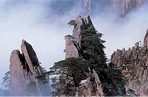
The Park is truly stunning with craggy cliffs and columns rising out of sub-tropical growth…the winter fog sitting low in the narrow canyons-a place that would be wonderful for hiking in the summer. Lonely Planet said the best hotel in the village was Minzu Shanzhuang, a thatched, Tujia-run (a Chinese minority group) hotel…but this was winter and it had snowed the night before. We buried ourselves under blankets and hot water bottles because the heater was lousy…and quit altogether during the night…

Back in Zhangjiajie City early the next morning we stumbled off the bus to the welcome-warm smile of Liu Wen Qin at the Dragon International Hotel Coffee Shop…glad for a place to park ourselves for the day until the train for Guangzhou at 6pm. We walked the streets awhile…a bookstore…Diary of Johann D. Rockefeller sitting right next to a book about Mao Tse Tung….in the window Bill Gates” Theories of Management and “How To Win Friends And Influence People.”

Since it was winter and hardly anyone was in the hotel, we spent most of the afternoon speaking English with Liu Wen Qin…Bob teasing her and loving it when, laughing delightedly, she finally catches on. He’s good at flirting with Asian girls 😉 When it was time to leave we paid the bill and by the time we had our backpacks on she had disappeared…the rumor that the Chinese hate to say goodbye apparently true…my throat getting a catch as I write this.

We settled in for what Lonely Planet said was a 24 hour train ride south back toward Hong Kong in a hard sleeper. But 6am the next morning, after only 12 hrs, we were awakened by the train attendant…we are here, she said…Guangzhou…Guangzhou!

After a night in Hong Kong we flew to the Philippines to warm up on a beach. Then we flew back to Hong Kong to catch our flight back to the States.

This is the end of our first year of travel around the world.

Panda Research Base

YUqE3FCf1Hd9CjfG1qqmt0-2006171132705308.gif

An early morning one-hour ride on Sam’s Guesthouse bus took us south of Chengdu to the Panda Research Base where China is trying to keep the Giant Pandas from disappearing into extinction. It was fun, even though the air was freezing, to watch the adolescents play…tumbling…climbing…scrapping with each other. It was interesting to watch these toy-like herbivores sit up on their haunches selecting and eating the leaves given them by the park attendents. But the newborns in the nursery window absolutely stole your heart away…delighted chattering Japanese children watching the babies adding to the magic.

You can see the pandas two thirds of the way through one of my China’s videos here.

New Years in Chengdu

YUqE3FCf1Hd9CjfG1qqmt0-2006171132705308.gif

The sleeper train from Kunming to Chengdu takes about 18 hours and passes through more than 200 tunnels. It took 10 years to build the railroad…mostly by political prisoners…and looking through the train windows many of their graves can be seen high on the hillsides.

New Year’s Eve
This is not cold compared to Omaha Nebraska in the winter…but it’s damn cold! We were in a triple in Sam’s Guesthouse…and it was damn cold!

After a good Western dinner at “Granmas,” giving homage to the Western New Year, (Chinese New Year, or Spring Festival, is on January 28 this year) Jana and I curled up in bed in our comforters and hot water bottles…no we weren’t in our hot water bottles but we would have been if we could have been…

Bob went out in search of the New Year in China and found himself the only reveler 20 minutes before midnight at a “party” in an empty room at the Holiday Inn complete with appetizers and favors. He didn�t stay long, lamenting “It’s hard to party by yourself.” But the evening quickly picked up as he walked into Mao Square to find several thousand Chinese counting down the New Year (in English) while watching the Square clock hanging on the side of a building just to the right of Mao’s head…then giving a short cheer and dispersing unsentimentally 30 seconds afterward…which, hating to say goodbye, is what the Chinese do after any social occasion. Bob was back home…yes, hotels have become home…twenty minutes after midnight.