Trek to Pa-O Villages

Burma.gif

Bob was happy to get out and stretch his legs on a two day trek in the hills above Kalaw. His guide used to be a chemistry teacher and school principal who only made about $8.00 a month teaching school. So now he makes $15 for a two day trek in the hills.

teacherturnedguide.jpg

They visit several villages…the people know and love him and welcome the people he brings to their homes for a meal and overnight stay in exchange for the tips they receive.

longhouselaundry.jpg

Bob was introduced to a young woman who had been his guide’s chemistry student. She quit studying chemistry in the local high school because she could make 10 times more money raising garlic. If the progress of the country depends on education, it is going to be a very long time before these humble people dig themselves out from under their oppressive military regime. Makes one wonder if this is by design.

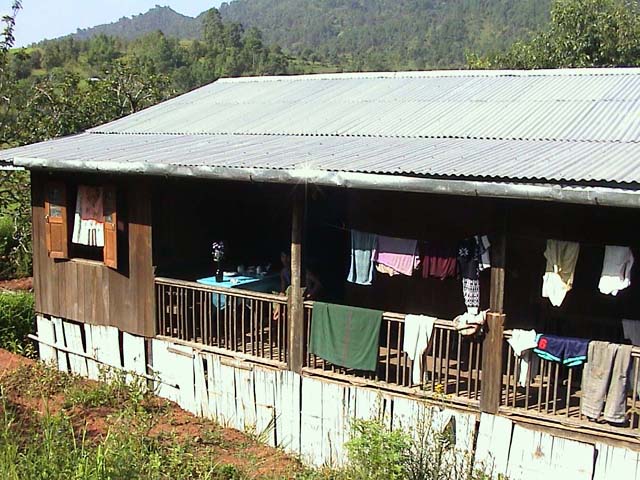
Extended families live in a large building, usually on stilts, called a Longhouse. Over dinner in the longhouse that night, Bob, in his way, made one three month old baby giggle which delighted and impressed the family. When Bob offered to buy the baby they all laughed and said no….but the mother then offered to sell him the rambunctious 18 month old sitting next to her!

Repression & The People

Burma.gif

Next door to the restaurant in Taunggyi I struck up a conversation with a young university student who was tending a a small bookstore. “Can everyone speak (out) in America,” he asked. “Yes, we can,” I said, thinking I will not tell him about “politically correct” speech that I consider just as fascist as the rules perpetrated by his government.

A few people, forbidden to talk about politics with foreigners, tried oblique approaches to the subject. One man with delicious donuts on a platter came up to me at the market and said to me in perfect English that he used to be a teacher. Then he disappeared and returned a few minutes later with his wife who wanted to meet me. “She wants to go to America-so bad,” he said. I made several attempts to ask him to have tea and then dinner with us but was disappointed when he looked furtively around him and told me he couldn’t do that. The government has forbidden the people to talk to foreigners about politics but they are afraid to be seen talking to you at all as it could mean trouble for them.

However, in Bagan our hired tour guide for a day to view the pagodas, told me that some Americans once told him that that there was a lot of fighting in Burma but that he reassured them there was no fighting in his country. I bit my tongue thinking of the BBC special the night before that described the fighting between the ethnic minorities and the military near the Thai border where camps harbored thousands of refugees. American and European doctors regularly cross the border under cover of fire to care for the Karen tribal people who are suffering from a government policy of ethnic cleansing by burning their villages and killing the people outright or overworking them to death in forced labor groups. “I’ll bet he is a government informer,” I said to Bob. “I think so too,” Bob said.

The next morning as I am waiting for my breakfast in the top floor restaurant I watch as two monks enter the alley below on their early morning rounds. They stand outside the gate of a house and wait for the owner to come out. After a few minutes a woman does and immediately drops to her knees and bows with her head down to the ground. The older monk appears to give her a blessing and a few words. She stays on her knees as they walk to the next house where a man comes out with some food but he doesn’t get on his knees.

The People
Everyone assumes you are well intentioned. If you give them a smile you will immediately get one back-without guile or expectation. Waiters in restaurants wait on you with respect like altar boys at mass-putting the plate down slowly and respectfully in front of you.

Talad Nam Lam-Paya Floating Market

Our friend, Jiraporn, who lived in the U.S. ten years and has a doctorate from Oregon State University in Fisheries and is now a lecurer in the Department of Fishery Management of Kasetsart University, generously drove us to the weekend Talad Nam Lam-Paya Floating Market about an hour north of Bangkok. No tourist would ever find this market unless they knew exactly where to make the various turns and even Jiraporn got off the track a couple times. Only the locals go to this market that sells food and useful household items.

After choosing more food than we could eat in two meals, we feasted on a cruising ferry while it meandered down a river to a Buddhist temple. Then Jiraporn and I had a Thai massage in an open air pavilion…this day…one of the most pleasurable I have spent in Thailand.

Expatriates

There are many expats in Bangkok who love this city and it’s people for many reasons. One day I struck up a conversation with a Brit woman sitting next to me on the SkyTrain who worked for an international finance company. When I told her we had been traveling for several months she noted that Thailand is addictive…people don’t go back to Singapore or Hong Kong she said…but they always come back to Thailand. “Write a book,” she says to me and then disappears out an exit.

After pleasuring sorrowfully to Mozart’s Requiem on September 11 at 8:46 am at St. Joseph’s Convent, we were invited to join a couple of retired expats from New York City to a breakfast of pastry and a huge bowl of caffe latte at La Boulange across the street. “What brought you to Thailand?” I asked one. “I came for a two week vacation and have been here 20 years now,” he says with a smile. How much longer do you think you’ll stay? They both quickly exclaim: “this is it!” “Do you have many Thai friends?” we ask. “No,” they say, “being retired we have no status. Regardless of how much money we have or what we have done with our lives or how much education we have, we have no status among the Thais… and status is everything here. “But so what?” they said.

Extremes In India

Back in Delhi the next day Bob and I are walking in the middle of the street as usual to a shopping area from the hotel when I noticed that one of the men lying on the sidewalk was dead…large open white emaciated eyes with flies in them…still body…like the dead sheep I used to see on my father’s farm growing up…none of the sellers or other pedestrians seemed to notice…just the western tourist…

The next day on the way to the airport we see miles of male walkers in orange and maroon carrying large triangular forms decorated in shiny fringe on their shoulders. They are making a 270 mile pilgrimage from Hardiwar, through Delhi to a Hindu temple on the border of Rajasthan. They started July 26 and they will reach the temple on August 12. Along the way charities have set up rest and food stations for the pilgrims many of whom are limping with bandaged feet.

For an hour I look through the taxi window and feel tremendous affection for these sincere, earnest and well-meaning people that don’t have a cynical bone in their bodies but probably have every reason to…If we had not visited India we would not have known a land like no other.

Shimla India

July 31-August 4 2002
The last few days I have been fighting some sort of strange malady…raging sore throat, red spots on the tops of my feet and the underside pads of my fingers red, sore and sensitive. Want to risk a diagnosis? But symptoms seem to be residing after a few doses of antibiotic. So feeling a bit lethargic I am contented to sit for the five hour train ride that will take us up most of the 300km to Shimla on the Himalayan Express.

We change to a toy train (narrow gauge) in Kalka and jump out to buy a dahl and rice meal in a tin foil tray and some bananas before another five hours climbing switchbacks the last 60 km into the mountains. I look out the window and see a huge sign hanging above the train platform: “World’s Number one. The Times of India.” Reminds me of the presumptuous title of those annual baseball games played in the US only by US teams called the World Series.

From the train we watch India fly by…people in tattered clothing lying asleep by the side of the tracks…naked babies sprawled out flat on their backs…a sign says “Do Not Pluck Flowers.” Another sign: “The Allah of Islam is the same as the God of Christianity and the Iswar of the Hindu.” Children with white nylon sacks pick through the garbage selecting plastic-India’s system of recycling…ads for Bob Cards-the Indian credit card…men with hair dyed a bright henna color.

I smile to myself at the young Indian across the aisle reading “Autobiography of a Yogi” (many of us were inspired by it in the 60’s). The leak in the roof of the toy train above my head stops once the train gets up some speed…the German girl across from me and her male Indian companion share their feelings of culture shock…she has been volunteering in a school for blind children for six months in a small village in the south of India…quiet…clean…traditional customs…no touts…she and her companion have never been in the north…now I wish we had gone south instead. A few seats back a group of 20 something Indian guys finds hilariously funny a Lonely Planet given them by the Swedish couple in the seat across-but I notice they are taking notes. We have noticed people everywhere throwing garbage on the ground…Bob feels guilty throwing the banana peels out the train window.

As the train pulls into Shimla about 20 Muslim touts in long red shirts crowd against the windows yelling at us to let them carry our luggage the two kilometers up the hill to the hotel in the center of town. (Shimla is a lovely 8,000 feet above sea level.) Bob takes to one lively man, Bob guesses rightly 34 years old, and he takes my small daypack. (We left the large packs in Delhi.) Bob carries his own pack…”macho” I say…”yes, yes”, he laughs…and then a large monkey threatens to take off my leg as he grabs the banana in a plastic bag I am carrying in my hand.

The Town
Shimla is at an altitude of 7000 feet-a quiet pleasant town of 120,000 sprawled across the U-shaped valley of the steep Himalayan foothills with narrow winding terrace-like streets connected at intervals by stairs. The town feels authentic; virtually all of the tourists this time of year are Indians escaping the heat of Delhi and the lowlands. It is a luxury to stroll through the streets unhindered by hordes of touts and beggars.

Shimla was once part of the Nepalese kingdom called Shyamala. The British discovered the area in 1819; many of the buildings were erected by them and is reflected in some of the architecture. In 1864 it became the summer capital of India and after the railway line was constructed in 1903 Shimla became first the capital of Punjab and then of Himachal Pradesh in 1966.

Eating in Shimla
I take back our assessment of where we are in the culture shock process…we (or I should say I) are (am) desperate for an alternative to the spicy Indian food we have been eating for a month. It takes two hours walking the winding streets to find a restaurant that just might have something without curry spices…in the meantime to stave off my dizzying hunger I stop at a fast food stall and buy an order of tooth-breaking french fries that are sprinkled with masala powder…then to get the taste out of my mouth I buy six cookies…finally we find a rather upscale restaurant that claims continental food on a sign above the door. Chicken Hawaiian Salad was described by the waiter as chicken, capsicum (green peppers) and white sauce…turns out white sauce is mayonaise. Bob’s thin French onion soup sports a raw egg yolk floating in the middle which he carefully extracts from the bowl. If the waiters in India don’t understand you they pretend you haven’t ordered anything. The lifesaving Chinese eggroll is delicious but I leave unconsumed the vanilla milkshake made with what I don’t know.

The next day we find a Chinese restaurant, Chung Fa, with a real live chinese cook and we founder on chow mein, spring rolls and the best won ton noodle soup ever. The owner was born in Canton, lived in Athens Greece 20 years, in Arabia 8 years and now Shimla for the past 12-and speaks many languages. When we told him we were from the US he said “San Francisco-best Chinese food. But New York the Chinese food terrible!” Bob concurs-having eaten in wonderful restaurants in SF while in college in the SF area and also having had a horrible experience in a Chinese restaurant in Manhattan where he mortified son Josh by leaving without tipping.

Town Plaza
As evening approaches we walk around the town plaza and appear to be the curiosity of the Indians…we sit down on a concrete “bench” ringing the large plaza and Bob takes a picture of two Sikh men and a woman…they smile and move over to sit closer by us. The older one has just retired as a banker and is now a consultant for multi-national organizations-he says his daughter is a well-known pediatric heart surgeon in New Orleans. He is very proud of his shy nephew who is an accomplished traditional tabla player and the girl, who is a traditional devotional singer. The older one had noticed us walking the plaza and had been explaining to his companions, he said, that as Americans we had probably worked very hard and were now enjoying our lives. “People don’t realize that Americans work very hard for what they have, “he  said as he went on to describe his daughter�s lifestyle in Louisiana. Thinking of the people we had seen in the Sikh temple in Udaipur, I told him that I had noticed that many Sikhs seemed to be very successful people. “Oh, yes,” he said, “we are very industrious and make a very big effort…instead of like many people in India.”

You can tell which Indians are Sikhs because they never cut their hair and they wear turbans. They practise tolerance and love of others and their belief in hospitality extends to offering food and shelter to anyone who comes to their spiritual centers.

Then we had a brief exchange of words about the Eastern and Western approaches to religion. “As Sikhs we are very practical and take a very simple approach to spirituality,” he said. “Sikhs don’t believe in caste distinctions or idol worship,” he continued, “and we believe in one God that is the same in you as is in me.” As he talked I thought to myself that I have heard Catholic mystics like Thomas Merton use almost his same words to describe their contemplative experiences. We talk about meditation; we understand each other. I get goose bumps and feel blessed by this man as I float back to the hotel in the cool evening air.

Rickshaw Driving Lesson

After dinner, Bob entertains the nearby date sellers by dickering with another rickshaw driver who makes the mistake of saying to Bob “You are rich man-why can’t you give me few extra rupees?” Bob shot back that “I have traveled all the way to India and now you guys have all my rupees!” He laughs. They think you are stupid if you don’t bargain hard.

They settle on a price and on the way home Bob is full of questions about the auto-rickshaw which is a three-wheeled device powered by a two-stroke motorcycle engine with a driver up front and seats for two or more behind. There are no doors and it has just a canvas top. They are generally about half the price of a taxi and because of their size they are often faster for short trips. And if you are a thrillseeker you will love it because their drivers are nutty–heading straight through the mass of cars and pedestrians wielding hair-raising near-misses! When stopped at traffic lights, the height you are sitting is the same as most bus and truck exhaust pipes so many riders wear kerchiefs over nose and mouth looking ridiculously like movie-western cowboys. Bob wheedles a chance to drive our rickshaw a short distance. Bob and the driver end up friends and the guy gets a tip for the driving lesson.

At 5am the next morning an auto-rickshaw driver offers to drive us 3 blocks to the train station for 20 rupees. After we are seated he says “20 rupees each!” Should have seen how fast Bob jumped out of the rickshaw! We don’t feel like cheapskates anymore as this style of bargaining is the norm in India and many other countries-the locals see you as ridiculous or naive if you do not bargain.

The internal struggle is over for me. The guilt is gone. I don’t even notice the beggar lady pulling on my arm. We are finally getting the hang of India and learning how to play their game. And I think we’re entering the last stages of culture shock. But haven’t had the courage to taste a “bhang lassi” yet! (A bhang lassi is a yogurt drink spiked with marijuana…)

Bargaining for a Rickshaw

Our last night in Delhi before taking the train to a cooler Shimla in the mountains for a few days, we strike out in the worst part of the day for traffic to have dinner in Old Delhi. Bob is bargaining on the price-which is always about double or triple for the big westerners-when a policeman comes down the street whacking all the drivers across their backs with a big stick to get them to move on. I hate what I see but it works to our advantage-the driver is anxious to move on and takes Bob’s last offer.

The streets are full of people, animals and various mechanical transporters and the auto-rickshaw comes to a stop in traffic for half an hour. It has cooled off a few degrees and there is a slight breeze. No problem! We surprise ourselves by just watching the show go on around us despite being enveloped in exhaust fumes.

The restaurant was interesting-several venues surrounded a central open air “kitchen” where one area was devoted to tandoori, in another small area three men were sitting on a raised floor making chapatis and puris and baking them in an oven in a hole in the floor and another area displayed half a dozen huge round metal jars sitting at an angle with small openings into which the waiter dipped out servings of stewed vegetables, chicken, and mutton. The mutton stew was superb.

Traveling India Bob-Style

The Indians have a wonderful sense of humor so Bob takes advantage of it and manages to turn everything upside down wherever we go.

In addition to an auto-rickshaw, India has bicycle rickshaws-a three-wheeler bicycle with a seat for two behind the rider-and is the basic means of transport especially in small towns and villages. We take a bicycle rickshaw ride in New Delhi from an old man and entertain the entire street of people when Bob insists on doing the pedaling with the old white haired guy Indian sitting beside me in the back…”slowly, slowly,” the rickshaw owner keeps repeating nervously as we weave through traffic……..

Later, when the umpteenth little girl comes begging from Bob as we are sitting in an auto-rickshaw he turns the begging routine on it’s head and asks her for a rupee…she obliges and gives him a coin…then he rewards her for her good-natured response by giving her several rupees to finish off the joke. When the sellers ask Bob what he is looking for and Bob answers that he wants rupees or nirvana or something just as ridiculously nebulous (silly) they just stop and look at him funny and then laugh—successfully diverted from their begging. “Yes everyone has their own way of getting money,” one says. It’s Bob’s turn to stop and think.

Suffering cabin fever Bob takes off on another afternoon to explore and get lost again. While walking, his attention is diverted by a beggar woman and her scantily clothed children but as he gets away from them a boy insists on shining Bob’s shoes. “Look” the shoeshine boy says, “you need shine!” Bob looks down and there is a huge glob of what was probably human shit on his sandle…he kicks his shoe and the shit toward the boy growling his sentiments… realizing he has been had by an accomplice. This is not so funny. The boy–startled and taken aback–retreats. This scam is described in several guidebooks as a maneuver to generate business for the shoeshine mafia. On the way back to the hotel Bob snarls at every Indian tout that approaches him and they immediately back off…I think this is called the disintegration stage of culture shock.

On a better note, in the mountain town of Shimla, people are sitting around the edges of a town plaza watching people watching people and Bob takes a picture of four local hip 20-something young men and then asks them for dollars in
exchange for their photo. They laughed heartily and Bob sensed they appreciated both the irony and the joke.

But if Bob doesn’t stop telling everyone we are from Iceland (“Where you come from?”) I am going to kill him…makes me feel like a complete fraud!

New Delhi

July 27-30
The hotel arranged to have us taken to the railway station in their car for the 6am train to Delhi, so at 5am the streets are full already and workers are queued up at the tea stalls for breakfast. In Africa the pace was slow and men sat around doing nothing. Here, sure, some are lying on just a small dirty piece of cloth on the sidewalks asleep but most men are up and about-energetic and eager for the day’s work-meager as it will be. Interestingly you seldom see women on the sidewalks. As the train pulled into the station I looked at it dubiously, but it turned out to be ok. It was not the cleanest train ever but had air conditioning-the most important thing in this heat.

On the outskirts of Delhi I sleepily watch the plastic and cloth shacks and the naked children whiz by but come alert when I catch a glimpse of a young man seemingly out of place in his nice new yellow shirt and new-looking grey slacks sitting on a stool and leaning on his arms high on a bank above the railroad tracks…maybe he is dreaming…maybe he’ll be going to school…or to work in the new hotel in New Delhi this new day…

Four hours later we stumble out of the train station behind the only two other young but tired looking white tourists who keep glancing back at us…I guessed French or Italian…and probably wondering who else from the west besides them is nuts enough to be in India in the summer. It is 106 degrees on this day. We have not seen one American in India.

The taxi ride to the hotel and subsequent auto-rickshaw rides in the insane traffic looking at alternative hotels all afternoon does me in. We finally choose the Ajante Hotel primarily because it has a restaurant and high speed internet downstairs. For two days I refuse to leave my air conditioned room except for brief forays into the internet cafe. Bob braves the heat, noise and traffic to explore the city by himself, getting lost of course and having to take a rickshaw back to the hotel.