Bob Climbs Kilomanjaro

HF0m0NezqDnitkljwNP8lg-2006188095850902.gif
Kilomajaro.jpg

Marengo Route.jpg
BobatKilomajaro.jpg

Bob’s Report:

Curious how one thing leads to another. It all started at the local fitness club. In the bravado of a post-workout discussion we proposed adventures that would be a goal to keep our workouts both frequent and intense. The suggestion that appealed to us was to climb Mt. Rainier in Washngton State. We decided to do it and six months later realized that the effort was similar to running a marathon with risk, thrill, and danger elements thrown in.

Subsequent to the climb, I found myself on the mailing list of a prominent climb leader. His brochures detailed the many climbs he had scheduled for the next year. I skimmed one pamphlet that described plans for a Mt. Kilomanjaro climb in Kenya and filed it in a corner of my desk pile as being impossible. But as I reread the brochure several times over the ensuing weeks I began to think, “why not?” “What am I waiting for?” Eventually I sent in a deposit and had another goal for which I needed to maintain regular workouts.

A Dacha In Samarkand

7Z3XBdt3hLmJjqkmk2I6k0-2006190121351559.gif

After coming off the Kyrgyzstan trek, Peter, our trip leader, had arranged for us to go to Samarkand in Uzbekistan before continuing on up to Tashkent for the flight home via a week in Istanbul Turkey.

Beautiful…magical Samarkand…with more history than you can imagine. The population (412,300 in 2005) is the third-largest city in Uzbekistan and the capital of Samarkand Province. The city is most noted for it’s central position on the Asian Silk Road between China and the west.

We stayed at an old Russian “dacha” (summer home) used by Communist party members before the break-up of the Soviet Union.

Everyone was excited about a real shower, a real sit-down toilet and real beds. You line up there for toilet paper…someone said…pointing to a heavy babushka (old woman) sitting officiously behind a small table in the entry way. “No! No! Not tonight,” she grumbled loudly. “Tomorrow morning…toilet paper!” We were incredulous! But the sit-down toilets have no paper….we groaned. “No, No, Not tonight” she repeated. Someone else’s room didn’t have electric lights so an old guy was sent off to investigate…never did find out if light was discovered. Some rooms had tv’s with snowy reception of Russian programs…we were hoping to get some news but there was nothing we could decipher.

So gratefully, we all sat down on real sit-down benches at a real table in the garden outside the dacha for a feast after 18 days and nights eating on the ground. There was a smattering of Russians who joined us that were not on the trek…police…Peter said. One, who had too much too drink, bragged menacingly about how much power he used to have and now he was nobody. “Don’t answer him,” Peter advises.

Despite its status as the second city of Uzbekistan, the majority of the city’s inhabitants are Tajik-speaking. In 2001, after several abortive attempts, UNESCO inscribed the 2700-year-old city on the World Heritage List as Samarkand – Crossroads of Cultures.

Trekking in Kyrgyzstan

7Z3XBdt3hLmJjqkmk2I6k0-2006190120654814.gif

The fall of 1995 Bob and I joined an REI adventure tour company based in Seattle Washington on an 18 day trek in the highest and most dramatic part of the central Tian Shan mountain range of south Kyrgyzstan in Central Asia.

Uzbekistan Airways, flying in from New York, landed in Tashkent Uzbekistan where we visited a couple from our home town of Salem Oregon who happened to be there as volunteers for USAID. We had told our friends via email where we would be staying, but upon failure of the phone system, they simply slipped a note under our door, a local custom in lieu of telephones, letting us know where and when to meet them.

When we arrived at a restaurant parking lot to board the bus, to our dismay, we found several Uzbekis hovered over many and myriad motor parts lying on the ground. “Have some tea,” they said as they pointed toward a nearby tea house, “and we will be ready soon!” Riiight…we thought. To our relief, after watching them reassemble the inner workings of the motor for an hour, we were motioned back to the bus by Peter, our trip guide.

To reach the trekking area in Kyrgyzstan it was necessary to cross a small oddly carved out thumb of Tajikistan from Uzbekistan. However, the two countries don’t get along and when we arrived at the Tajik border the guard held up the bus…apparently wanting baksheesh to let us pass. Peter was adamant about not wanting to set a precedent of paying them off so there we sat in the hot sun, eating the best melon we have ever had in our lives to quench our thirst. Finally, Peter had the driver take a roundabout road across the Fergana Valley to reach our staging area in Kyrgyzstan where the driver had to pull some very crooked logs over a stream to get the bus across…we chose to wobble across on our feet.

Aksu.jpg

The trek included walks up breath-taking beautiful stream-filled and flowered valleys and over high ridges to more valleys. Shepherds from their permanent homes in the lowlands summer their sheep and horses on the grassy mountain-sides. Sheer glossy Ak-Suu peak, one of the world’s best extreme rock-climbing destinations that had just before opened up to climbers since the fall of the Soviet Union glinted at the head of the glacial valleys. The first sobering day saw a climb team carry out a dead British compatriot that had fallen off the peak.

nomads.jpg

As we leisurely meandered up the trails, children of the local nomads would come running, sometimes with a kettle of tea or chay in their hands, yelling “pen!” “pen!” Have pen? Pens and paper are the most prized gifts, although Peter discouraged us from giving the kids anything…preferring to have them see us as friends rather than a rich Western source of material goods.

Alaska.jpg

Peter’s favorite “gift” was to bring photos of the locals that he had taken on previous treks in the area. The amazed smiles and giggles of the nomads that had never seen themselves in a picture was tear-jerking.

twoincentralasia.jpg

Every couple days, locally hired shepherds carried our gear on horses over narrow mountain trails to succeeding camps…the trek trip just before ours losing a horse hundreds of yards to a river below. We would set up our own tents. The potty was a hole dug out behind some rocks. In the mornings chay (tea) was brought to our tents to get us awake. In the evenings, Victor, our Russian cook, would wok up a delicious dinner like stew of spicy laghman (noodles) with cabbage and lamb bought from the locals. Dumplings (chuchvara) fresh yogurt (ayran) and home-made bread with raspberry jam and butter (sary may) kept us filled up.

After dinner at night, Peter, in real life a young non-practicing attorney from Colorado, would regale us with his rock climbing and trekking stories. One day he stumbled across a friend on the trail, a professional climber from Idaho who was checking out the newly opened climb area. A motivational speaker in the states, he mezmerized us that evening with a story of an Annapurna climb in Nepal during which a Russian climbing partner became disoriented and insisted on going up the line instead of down during a storm. The Russian was never seen again. Right at the climax, before we could find out what happened to the poor climber, we saw a huge lingering flash of red hot color fill the western sky! Only later, reading an English language paper in Istanbul Turkey on our way home, did we find out that it was the Russian manned space flight returning to earth in Kyrgyzstan.

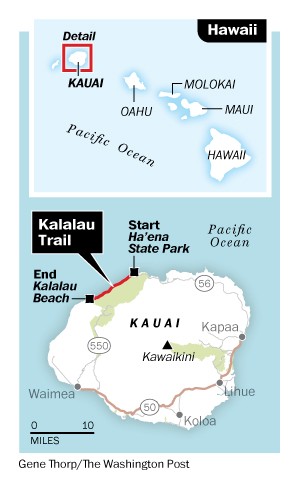
Na Pali Trail Kauai Hawaii

After our son Josh graduated from Whitman College, he joined his former roommate and friend, Phil, in Kauai where they were to spend a couple years working and repairing some cottages that belonged to Phil’s dad near Poipu Beach that were damaged in a hurricane September 1992.

Hurricane Iniki caused more damage than any other hurricane to affect Hawaiʻi since records began. It hit the island of Kauai as a Category 4 on September 11. Iniki caused almost $2 billion in damage, mainly to Kauai. It remains the second costliest East/Central Pacific hurricane on record, only behind Hurricane Paul in 1982. Six died as a result. Iniki brought winds of 140 miles per hour (230 km/hr).

Phil’s dad’s house, closer to the beach, was lifted clear off the concrete pad. For weeks afterward people were finding papers and objects they knew belonged to him because he was a well-known Methodist minister on the island.

Bob and I took the opportunity visit Josh while he lived on the island. We hiked the Na Pali Trail, which, in retrospect probably wasn’t a good idea. But what did we know was up ahead. Namely a trail along side the mountain…very very narrow trail…with a vertical drop of 300+ feet to the ocean rocks below. At times all we had to hang onto were branches of bushes and trees. Alas we turned back before we got to the hippie beach.

When the work on the cottages was done, Josh worked for a restaurant in the nearby Hyatt Hotel. He was offered a promotion but opted to quit and go to culinary school. Phil, who had been an art major is an artist and stay at home dad while married with two children in Seattle. For Josh the rest is history.

Rafting The Grand Canyon

After two years on a waiting list my husband and I were finally able to spend 18 days paddle rafting the Grand Canyon…putting in above Flagstaff Arizona. We went with a company called “Azra”…not a cadillac company…but with knowledgeable and entertaining river guides who have been running the river for years. Highly recommended. We went in September…the best time to go because all the motorized boats are off the river and it is quiet.

Each morning the trip leader, who had worked as a park ranger for years, would gather us round the morning breakfast fire…his maps spread out so he could explain the geological formations we would see that day. Every few days we would take a hike up a side canyon to view Indian ruins or swim in ice cold streams…or just canyoneer the narrow gorges.

During the day, while on the river, if anyone had to go potty it was just projected over the side of the boat…or bare asses hung over the boat in the case of the females. “The solution to pollution is dilution” the trip leader advised us!

Interestingly, some of the most memorable moments were when the boats were tied together and we just floated lazily down stretches of the river that were not filled with white-knuckling number 5 rapids…listening to Irish fiddle tunes and gazing up at the configurations of the canyon walls.

In the evenings the trip leaders would set up the “honey buckets” (everything that goes onto the river comes back out except for the pee) and cook dinner while we selected a site and put up our tents. Then out came the musical instruments, the beer and interesting conversations with people like the young Chinese guy who had been in Tianamen Square when China brutally put down the student demonstrations.  The students were so sure that change was imminent, he said, and when it didn’t happen he was so disappointed he just left China and his educator parents behind. He is now a banker in San Francisco.

One night it was warm so we all slept out under the stars on the beach. However about 1am it started to rain and a strong wind came up. We all jumped up to put up our tents but Bob and I weren’t careful to throw something heavy into the tent to hold it down and the wind took it as we were trying to pound in the stakes. There went the tent rolling miles a minute toward the river! I ran after it…not catching it until it was half way across the river…Bob watching it all from the beach!

A trip of a lifetime with unforgotten river companions!