Hanging Out On Olkhon Island

Urr0g6ZfQ7ttYL19duYJfg-2006170133924757.gif
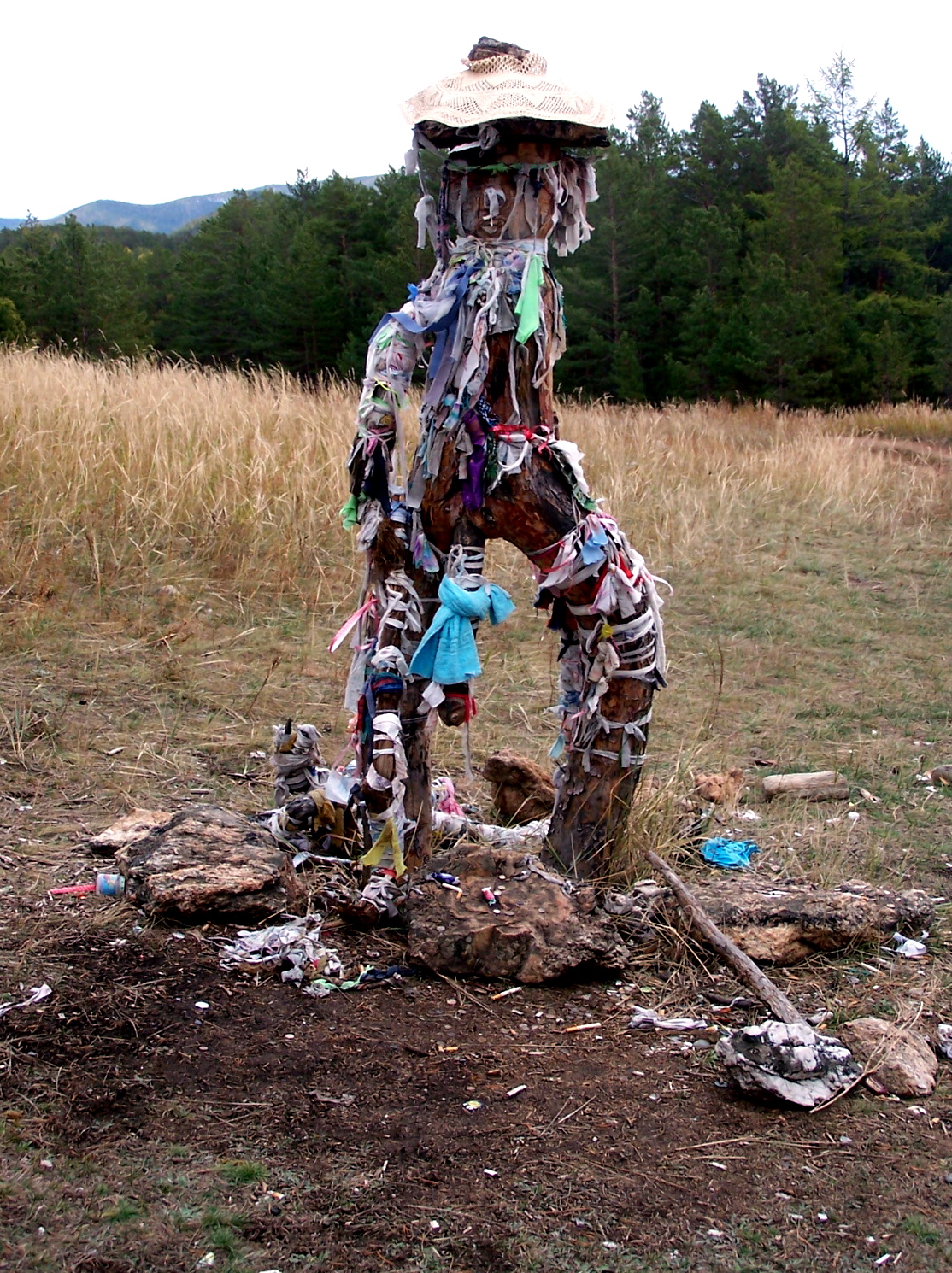
After hanging out a couple days…glad to be off the train…Gregory, a former University teacher of German, drove Bob and I, three Germans and a Pole on a half-day excursion to the north of the 70km long island to visit various geological sites and views of the lake but most especially to see a world renowned Shaman ceremonial circle called Three Brothers that is sacred to two faiths practiced here, Buddhism and Shamanism. Two years ago almost 300 Shamans from the world-over came together here. We lay a one rouble coin at the foot of the prayer flag pole while the “Sarma” or east wind blows fiercely over us.

The Buryats are of Mongolian descent…nomads who spent time herding their flocks between the southern shores of the lake and what is now northern Mongolia. They lived in felt-covered yurts and practised a mixture of Buddhism and Shamanism.

Gregory is driving Nikita’s four wheel drive van…a Russian vehicle designed 30 years ago and that was so successful they used it as an ambulance. “There is only one reason Russians sent the first man into space,” says Gregory the Kamikazi driver thumping over mud hole roads at least 90km per hour…”is because of the roads!” Later he says “we at the moment are using two wheels…if it gets really complicated we will use four!” “Normally we sacrifice two persons…usually 50% survive this trip!” Any of our U.S. vehicles would have rolled over at the first turn but this one mysteriously keeps it’s four wheels on the ground.

We pass through beautiful valleys with sheep and cattle farms…two of which are rich and have beautiful houses “because they don’t drink,” Gregory says. We pass by one small house of an old woman who lives alone with her cow…the rest of the houses in the area appear empty. We are shown an area that was a gulag during the Stalin era and whose inmates produced cans of caviar from the lake sturgeon that was then sent to the Kremlin for the enjoyment of the party bigwigs). I see a straggly triangular three wooden stick affair on the top of a hill and ask Gregory what it used to be. “Local KGB headquarters,” he says throwing his head back in laughter. I ask if the Russians and Buryats intermarry. “Seldom,” he says.

Five Hours to Olkhon Island

7yBXvp82X2gVlMeZe25DiM-2006198051115673.gif

The next morning we are picked up at our homestay in Irkutsk by a sullen driver who drives us five hours over pot-holes, through the taiga and across a bay of the beautiful blue Lake Baikal to the small Buryat fishing village of Khuzhir on Olkholn Island with a population of 1500 (half are Buryat). Urr0g6ZfQ7ttYL19duYJfg-2006170133924757.gif

We stay at Nikita’s Guest House (Siberia’s only real traveler’s hangout) for five days. Nikita, we are told by some of the guests, was at one time Russia’s table tennis champion. Two multi-lingual Russian girls seem to keep things hanging together and they serve us great garlic-charged meals in a communal dining area. The guests are all European…no Americans…and the conversation is spirited…two Swedes quickly challenge a comment I made that they interpreted as being critical of Socialism.

We enjoy the banya (bathhouse) with wood-heated hot water we can pour over ourselves…although the first time we signed up we were the first on the list and the water was still cold.

Yekaterinburg

7yBXvp82X2gVlMeZe25DiM-2006198051115673.gif

Yekaterinburg is most famous, however, as the place where Tsar Nicholas II and his wife and five children were murdered by the Bolsheviks in July 1918. Having seen where the bodies were interred in the family vault in the Hermitage Museum in St. Petersburg, we now traveled a few miles outside the city to view the site surrounded by a quiet forest of lodge pines and birches where the bodies were found and to see the beautiful Orthodox monastery and seven churches newly built in honor of each of the Romanoff “saints.”

We stop at the exact point where European Russia meets Asia and have our pictures taken wit one foot on each continent.

At Shirokorenchinskaya Cemetery we see monumental graves…one a life-size engraving in marble of a 35 year old gangster, with Mercedes keys dangling from his hand. I asked Shasha, our young English-speaking guide if the mafia was all gone in Russia today since these guys had finished each other off. “Yes,” he said, “now they are all in the government.” No fooling this young educated generation soon to take over the reins of this beleagued country where across the street you can see a vast memorial dedicated to the 20 million victims of Stalin’s Gulags many of which were in this Region. The bodies of 25,000 people from Yekanterinburg alone were found buried here.

A Day With Sasha

7yBXvp82X2gVlMeZe25DiM-2006198051115673.gif

I had watched “Russian Ark,” a movie about the history of the Hermitage before I left home so I was excited when we found Sasha, a university educated art historian, to take us through the museum (actually 5 linked buildings) set in a magnificent palace from which the tsars ruled Russia for one and a half centuries. Sasha had an unusually sophisticated command of the English language and an ironic sense of humor and made sure we knew the history and context of each painting we viewed…until we were absolutely exhausted.

We managed to keep up with him, however, when afterward he says “da da, you must experience a few more places” so off we trudged to see babushkas selling a few possessions…knick knacks, flowers and little piles of vegetables on the street, to buy historical propagada posters designed by Soviet-era Futurist artists in a little hidden art supply shop, to see the little Dostoevsky Museum which unfortunately was closed and finally by 10pm to view thirty-somethings drinking beer in a modern upscale bar right out of the Village in Manhattan…we were even instructed to go upstairs to see the industrial design bathrooms which had fixtures that looked like they were designed by Siemens and purchased from the KaDeWa Department store in Berlin.

Sasha was obviously very proud of this new Russia. Only we already knew that about 1% of the people, who buy everything they own on the black market, can afford a place like this where a beer will cost the equivalent of 20% of their monthly wage.

Traki, Karaites & Kibini Pastry

Trakai, on the outskirts of Vilnius, Lithuania, is a small settlement placed in the middle of five large lakes that is home to about 350 members of the Keraites, a minority community originally from Mesopotamia (modern day Iraq) who later migrated to Turkey. Keraite literally means “reader”. Their religion is a form of early Judaism mixed with reading of the Koran. (Imagine that !!—maybe we should inquire whether they have insights for current situations.)

Traki used to be one of Lithuania’s many capitals and the Keraites served as guards to the palace/castle…which Bob wanted to buy and occupy. We tasted the Karaites’ traditional dish called Kibinine, a small piping hot pastry stuffed full of delicious chopped meat and onions…juice squirting down one’s arms with each bite.

In an area selling crafts I met a woman who was exclaiming over two drunk locals…I asked her what country she was from and she said “San Francicsco.” She went on to say she was enjoying herself “but they won’t take our dollars here!” Speechless, I decided against asking if she had thought of visiting a money exchange window.

Young Czech Prime Minister

NikaFEAe66TwIiJDaeZZ7w-2006198180634090.gif

The Prime Minister of the Czech Republic, Stanislav Gross, is 32 years old and looks 20! We are realizing how little information we have gotten in the US in the last 15 years about the dynamics in and among Europe and the former communist satellites! “Our new Czech Prime Minister is very clever,” the young waitress says. “He and I went to the same school and we all liked his ideas and his speaking ability.” But I made the catastaphic mistake of calling her country “Czechoslovakia!” “You have made a big mistake, she says,” because we have been the Czech Republic since 1992!”

I have to quote a description out of “History Of The Present” by Timothy Garton Ash…written in the 1994: “The sleeping beauty of Central Europe has not merely been awakened by a prince’s velvet kiss. She has put on black tights and gone off to the disco. While Budapest developed gradually into a modern consumer city starting in the 1970’s, Prague has emerged from its time warp suddenly and explosively. Instead of the magical museum, lovely but decaying, there is color, noise, action: street performers, traffic jams, building works, thousands of young Americans…would-be Hemingways or Scott Fitzgeralds…millions of German tourists, betting shops, reserved parking places for France Telecom and Mitsubishi Corporation, beggars, junkies, Skpenritter of all countries, car alarms, trendy bars, gangsteers, whores galore, Bierstuben, litter, graffiti, video shops and Franz Kafka T-shirts.” We didn’t notice any American kids in this year of 2004…maybe they have moved on to other frontiers…the son of a friend brought one back to the US to marry a few years ago.

Built between the 11th and 18th centuries, the Old Town, the Lesser Town and the New Town speak of the great architectural and cultural influence enjoyed by this city since the Middle Ages. The many magnificent monuments, such as Hradcani Castle, St Vitus Cathedral, Charles Bridge and numerous churches and palaces, built mostly in the 14th century under the Holy Roman Emperor, Charles IV. The historic center of Prague is an UNESCO World Heritage Site.

We took a city walking tour and when I commented to our leader that she knew a lot about the city’s architecture and architecture in general, she shared that yes, she was a civil engineer…but that it wasn’t her first choice because when the new government vetted the former communist members, of which her father was one, she said she was kept, by association, from choosing what she wanted to study in school. (It was common for people to belong to the communist party in order to get a good job, but not believe in it.) She said she would have preferred social science and psychology but she was told she had a choice of civil engineering. Bob thinks there is more to this story but it is a fact that the Czech parliament voted in a “lustration”law, that Vaclav Havel reluctantly signed, to vet all former Communist members. In any case, her husband is an artist and she showed us little noticed public art and memorials…like the small burial plot of a student shot by police in an early resistance demonstration and who is now honored as a hero on each anniversary. We get the feeling there are cautious watchers of this new democracy.
Read More

Yichang & Yangtse Dam

YUqE3FCf1Hd9CjfG1qqmt0-2006171132705308.gif

As we were checking into our hotel, Joe Peng, 30-something young entrepreneur that was with us on our trip up the little gorges showed up with four of his travelling friends: “Most young people like me are in business. I am in charge of sales for a Christmas tree company and I also own my own business. Our sales keep going up…we can’t figure out how so many people could want so many fiber optic trees!” Nine foot trees go to distributors for $80 who then sell them to hotels and other businesses all over the world for $900. His boss for 8 years was Canadian and now his English is great so we jumped at the chance to go with Joe and his friends in a van back to the construction site.

The Construction Site
In 1995, when Winchester wrote his book, the journey from Yichang to the construction site took four hours. The road vanished after five miles and was replaced by a track clogged with every kind of construction vehicle, van, bus, taxi, tractor, crane, backhoe, bulldozer, motorcycle and ricksha imaginable, he says. The giant expressway that carried our bus for the 40 minute journey to the site was just being built halfway up the mountainside. Winchester was able to walk unescorted among the giant bulldozers and excavators, to talk to workers who slept in tents near their work sites. Some 20,000 workers toiled on the site and by the end of 1996 there was 35,000 many of whom were soldiers…some said to be prisoners, laboring on the project at no cost.

When we decided to visit the site this is what I had pictured. But all that is available to the traveller now is a viewing site on Zhongbao Island between the dam and the locks…China requiring each Yichang city Number 8 bus load, or “tour group,” to be accompanied by a “tour leader” that does nothing except ride along. The concrete has been poured and the locks are nearly finished and will be in operation by June of this year although the entire reservoir behind the dam won’t be completely filled until 2009.

The Controversy
The dam has it’s detractors…Dai Qing, a journalist trained as an engineer, earned herself a 10 month spell in prison for her outspoken book “Chang Jiang, Chang Jiang” that was published just a few months before the student uprising that culminated in the Tiananmen Square tragedy in Beijing. Dai was appalled at the risky business of building the dam and throughout the late eighties she carefully collected a series of academic papers by well-respected engineers and hydrologists, each of whom had competent, well-argued and sound reasons for opposing the dam.

Within months, according to Simon Winchester in his “The River At The Centre Of The World,” all of China’s elite and intelligentsia knew of the risks of the monster project. In 1992 nearly 180 men and women from what was called the Democratic Youth Party in Kaixian country were reportedly taken away by police and charged with sabotage and counter-revolutionary activity relating to their opposition to the dam. According to Winchester they have not been heard of since.

Friends of the Earth has said the dam will create a 480km long septic tank backing up clear to Chongquin. The rising water will cover countless cultural artefacts at over 8000 archaeological sites, many of which have not yet been properly studied. But almost all the criticism of the dam is based on on the assumption that it will not last for a franction of the anticipated time, that its effects will be minimally beneficial and possibly an environmental disaster and that it may turn out to be a catastrophe waiting to happen.

Dams break, and it is now known that at least two have broken with disastrous results because of either substandard construction or poor design. For example, The Banqiao, an earthen dam on a tributary of the Lower Yangtse in Henan province was long regarded as an iron dam-one that can never fail. But a rainstorm associated with a typhoon in August 1975 forced the reservoir behind the dam to rise nearly seven feet overnight and the heavy siltation at the base of the structure prevented the water from flowing away even when the sluice gates were wide open. The water finally overtopped the dam and the vast structure burst resulting in a lake that stretched for thirty miles downstream and whole villages were inundated in seconds. Various human rights groups have suggested that almost a quarter of a million people died. The Chinese said nothing about the catastrophe and news finally seeped out of the country only in 1994, nearly 20 years after the event…something not possible if the Yangtse dam were to go.

Down The Yangtze

YUqE3FCf1Hd9CjfG1qqmt0-2006171132705308.gif

Side Trips on The Way
At 6:05am a tour guide knocked at the door…follow me, follow me now, he says! We saw the ghosts…a series of temples in the dark of morning called the Abode of Ghosts or Fengdu Ghost City…also called the Nether World which is said to be the place of devils…Disneyland, Bob says…a series of temples combined with a hokey carnival-type ride.

After looking at the lunch food provided in the small cafe on the boat we munched on our bag of snacks…oranges, dried apricots, boiled eggs, crackers, dried plumbs and tamarind…chocolate kisses…

The lady came back in to try to get us to pay for the whole compartment…they think we don’t understand the way things work and they are right, Jana says. We gestured to the lady that a compartment mate was welcome but he/she couldnít smoke. But money…no more, no more…I said as I sliced my hand sideways through the air…ok, ok, ok she muttered as she left. The funny part is that a fourth person was never put into our compartment…my guess is that no Chinese would have wanted to be in there with us. But still trying to fool a foreigner.

Another knock at the door in the afternoon…follow me, follow me now, the tour guide said again as the boat pulled into the dock. So up the ubiquitous Chinese wooden steps Bob and Jana went to the 12 storey wooden temple called the Stone Treasure Stockade built next to a huge rock bluff which is supposed to look something like a stone seal. It was built in the 17th century during the Qing dynasty. It will become an island when the water level reaches its full height.

For the rest of the day we played house, tried to stay warm in our comforters and with our hot water bottles in the heaterless cabin, and watched the mountainous left side of the Yangtse go by through the big windows of our compartment…banks full of vacation apartments for the Communist Party cadres we think…factories…huge Mandarin characters telling the locals not to cut the newly planted second growth of trees. Jana sang Old Lang Syne along with Kenny G…Bob read and I worked on this story. We never saw any wildlife…no birds…the Chinese ate them all Bob says. Look at those big white buildings up there on the hill I asked idly…they look like prisons…they sell insurance up there Bob says…they sell insurance? Itís probably a good thing this trip is almost over…

Massive Relocation
About 6pm we passed a ghost city…one of many…huge empty factory buildings hanging on the mountainside in the fog like a fantasy city drawn in a childrenís book…no people or roads or cars in view. Whole cities are being vacated and taken apart…to be reassembled higher up the mountain out of reach of the water or moved elsewhere…people cutting and collecting bricks from the rubble and carrying them away on their backs.

Panda Research Base

YUqE3FCf1Hd9CjfG1qqmt0-2006171132705308.gif

An early morning one-hour ride on Sam’s Guesthouse bus took us south of Chengdu to the Panda Research Base where China is trying to keep the Giant Pandas from disappearing into extinction. It was fun, even though the air was freezing, to watch the adolescents play…tumbling…climbing…scrapping with each other. It was interesting to watch these toy-like herbivores sit up on their haunches selecting and eating the leaves given them by the park attendents. But the newborns in the nursery window absolutely stole your heart away…delighted chattering Japanese children watching the babies adding to the magic.

You can see the pandas two thirds of the way through one of my China’s videos here.

Volcanos in Tengchong

YUqE3FCf1Hd9CjfG1qqmt0-2006171132705308.gif

A young Chinese woman on the bus had struck up a conversation in English…telling us about the sights around Tengchong. We thought that maybe we could pay her to guide us to the nearby Hot Springs but the plan was aborted after her friend drove us around in a minivan…we paid for an expensive Bai minority lunch…we looked at a hotel we didn’t want…and after the driver took us to a hotel that we didn’t ask to go to…and we still don’t know the name of. The receptionists didn’t know a word of English but we managed to get a double room. The lights dimmed every time someone used the elevator, the dreaded evil kareoke bar was on the next floor down, the telephone rang at least twice a night with no one at the other end of the line. It was ok though because it had a WC and hot shower after 9pm and there was internet down the street a few meters, through some big iron doors and up some dark stairs to a huge room full of young boys playing computer games. There was a girl on each floor with hot water and towels. Supposed to have had dance hall. restaurant, beauty shop but nothing was operating except the dreaded evil kareoke bar and the parking lot inside the hotel compound.

The first day we just hung around the neighborhood and found great homemade dumpling soup made by a very friendly Chinese woman in the market. Bought a CD of a Chinese pop singer and a bag of fresh peas in the pod and delicious tomatoes to snack on…and after some looking Jana finally found an undershirt…in military green camaflage.

We had lunch at the Myanmar Tea House…asked a couple of English speaking Burmese men when they had come to Tengchong…1988 one said…everyone exclaiming at once…one: I fled my country…we saying, oh, since the military junta took over after the last election…told one I guessed he was a University professor in Rangoon and he said laughing…oh, about 30 years ago! I suspect these men may have figured in the opposition during the last election. That night we went back for dinner taking my laptop to treat the owners and their son and a couple young Burmese/Indian patrons with bleached crewcuts to a slideshow of our month in Burma last August.

The next day we struck out for the Tengshong Guest Hotel where there was a map that was promised at the reception desk…first I and then Jana trying to gesture our need for information…seeing the wheels turning in their heads…big pain in the arse Westerners that don’t speak Chinese…until one receptionist gave Jana a card for the T.C.C. backpacker cafe!

After walking a mile with me limping behind Jana, we practically hugged 25 year old Li Bing with his long ponytail and big smile. You saved our lives in Tengchong we wailed. For two hours were reveled in our conversation in English while he cooked us a great lunch…club sandwich for Jana and fried pork with french fries for me…a nice break from the noodle soup we were eating since leaving Lijiang. In his traveler tip book a couple from the Netherlands wrote that both Lonely Planet and Let’s Go guidebooks were useless in Tengshong, “need to put TCC Cafe in those books!!!”

There are over 90 volcanic cones in Tengchong county…22 of them with preserved craters. Jana and Li climbed one large nearby cone called Dakong Shan or “Big Empty Hill” (which pretty much sums it up) while I gave a verbal little three year old girl, Zhou Xiue Ping and her mother, Yang Yong Lai, an English lesson in the warm sun…fireworks, shoes, pants vs the English trousers, ice cream. When I pointed to a picture on my Magellan Point-to-Pictures International Translator and said “tomato” she looked perplexed…finally saying “oh, tomahto!” Jana, having climbed the ubiquitous Chinese steps all the way up to the crater of Big Empty Hill said that the view of the valley peppered with craters was stunning…thinking about what it must have been like millions of years ago…all erupting…