Message from Ulaan Bataar

GyTjn0QZP9l6Qu21TubskM-2006198062551304.gif

Greetings-
Have been in Mongolia for the past week–initial few days in a ger bordering on a national park–lazy, relaxing days with hiking and Mongolian pony riding (when on the horse my feet nearly reach the ground). Then had only 2 days for Ulaan Bataar, the capital. Weather was so pleasant and culture such a change of pace following Russia that we decided to stay longer. However train only passes through town once a week, more time here than what we need but that’s ok.

First couple of days we did the home-stay thing but the hostess spoke no English and was a bit shy to interact so moved to a hotel. Lodging too expensive but all else cheaper–can take a taxi from one end of town to the other for less than a buck.

Yesterday went to a huge local market. Guidebooks said to take care re thievery (advice in the realm of one’s mother saying to wear a coat). But while there my packback received a gash and a similar long slash across my pant leg in the general area where someone saw me depositing change. I was aware of the contacts so nothing lost but do have a superficial cut on my thigh. That sort of action leaves an uncomfortable feeling. I was told that the local Mongolians are equally at risk but for some reason I stick out in a crowd (boyish good looks perhaps).

This city (Ulaan Bataar) has a bit of a cowboy feel–most roads not paved and well pot-holed, horse carts compete for space with autos who obey some sense of order only peripherally, older folks still wear their long brightly colored coats (deels) with and an orange sash, everyone under 40 in jeans, black leather jackets and constantly fiddling with their cell phones (same-same at all latitudes and longitudes). Tiz too bad as all interesting ethnic features/diversities will soon be lost–well on our way to a homogenized worldwide culture.

The Mongolians have features that are different than other Asians. They seem to universally dislike the Chinese but respond favorably when asked about Russians–surprising as the country was part of the Soviet Union until 1990. All that I have talked to however are much happier with independence. Too many soviet style buildings remain in the city and many of the people within the city still live in gers (50% by one guide book estimate).

Our next move is to Beijing; then no agenda. Probably will work our way down the east coast of China to Shanghai, then either inland or to Hainan Island in So. China Sea off the coast of Vietnam. Our fixed and booked trans-siberian itinerary ends in Beijing so then the fun begins with winging it again, buying train tickets in Mandarin, etc.-Chinese characters even harder for these poor foreigners than Cyrillic. Many Chinese find it difficult to believe that someone does not speak their language. And therein is the adventure.

Hope all are well. Please send money.
RLG

Hanging Out On Olkhon Island

Urr0g6ZfQ7ttYL19duYJfg-2006170133924757.gif
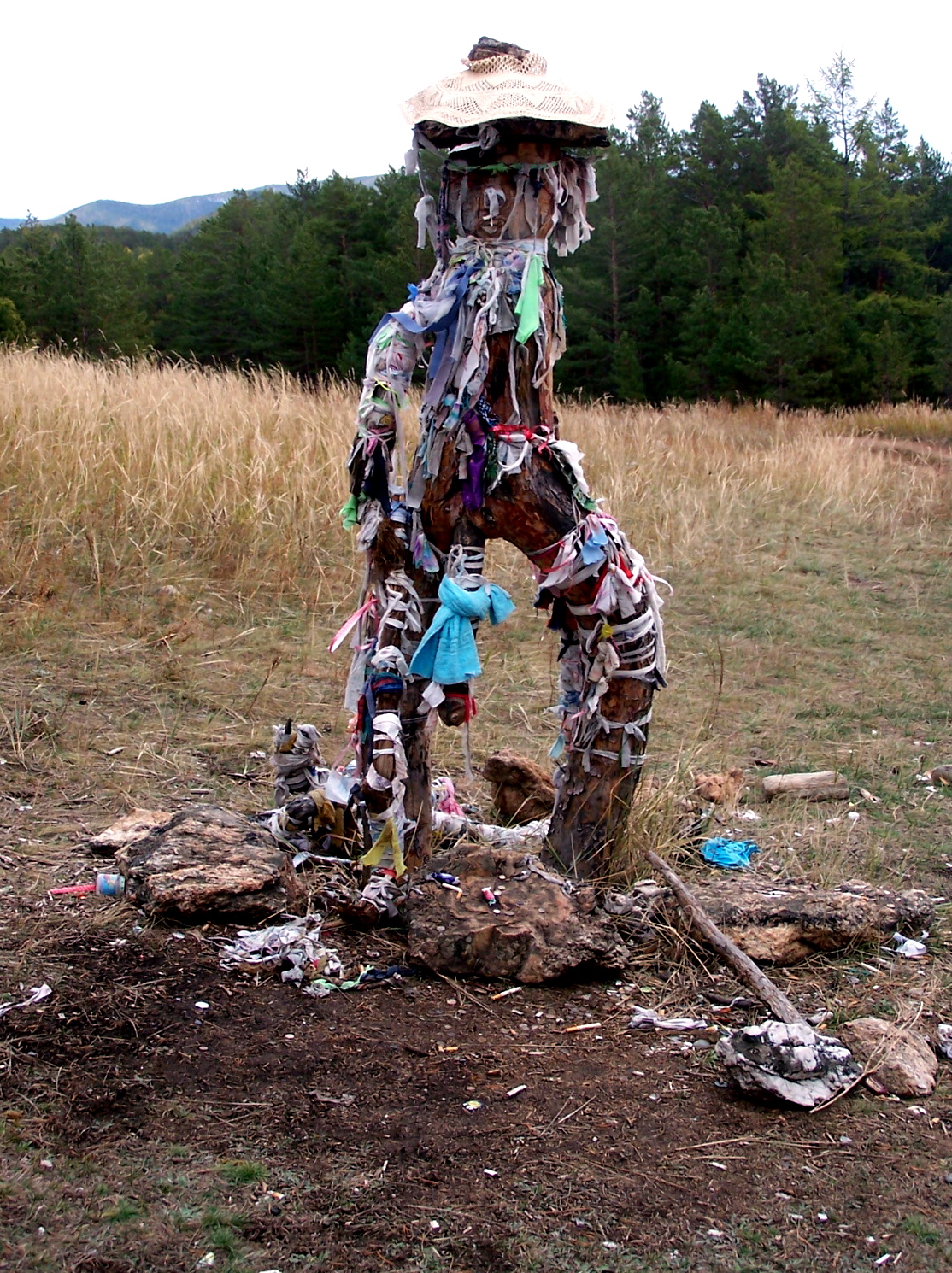
After hanging out a couple days…glad to be off the train…Gregory, a former University teacher of German, drove Bob and I, three Germans and a Pole on a half-day excursion to the north of the 70km long island to visit various geological sites and views of the lake but most especially to see a world renowned Shaman ceremonial circle called Three Brothers that is sacred to two faiths practiced here, Buddhism and Shamanism. Two years ago almost 300 Shamans from the world-over came together here. We lay a one rouble coin at the foot of the prayer flag pole while the “Sarma” or east wind blows fiercely over us.

The Buryats are of Mongolian descent…nomads who spent time herding their flocks between the southern shores of the lake and what is now northern Mongolia. They lived in felt-covered yurts and practised a mixture of Buddhism and Shamanism.

Gregory is driving Nikita’s four wheel drive van…a Russian vehicle designed 30 years ago and that was so successful they used it as an ambulance. “There is only one reason Russians sent the first man into space,” says Gregory the Kamikazi driver thumping over mud hole roads at least 90km per hour…”is because of the roads!” Later he says “we at the moment are using two wheels…if it gets really complicated we will use four!” “Normally we sacrifice two persons…usually 50% survive this trip!” Any of our U.S. vehicles would have rolled over at the first turn but this one mysteriously keeps it’s four wheels on the ground.

We pass through beautiful valleys with sheep and cattle farms…two of which are rich and have beautiful houses “because they don’t drink,” Gregory says. We pass by one small house of an old woman who lives alone with her cow…the rest of the houses in the area appear empty. We are shown an area that was a gulag during the Stalin era and whose inmates produced cans of caviar from the lake sturgeon that was then sent to the Kremlin for the enjoyment of the party bigwigs). I see a straggly triangular three wooden stick affair on the top of a hill and ask Gregory what it used to be. “Local KGB headquarters,” he says throwing his head back in laughter. I ask if the Russians and Buryats intermarry. “Seldom,” he says.

Traki, Karaites & Kibini Pastry

Trakai, on the outskirts of Vilnius, Lithuania, is a small settlement placed in the middle of five large lakes that is home to about 350 members of the Keraites, a minority community originally from Mesopotamia (modern day Iraq) who later migrated to Turkey. Keraite literally means “reader”. Their religion is a form of early Judaism mixed with reading of the Koran. (Imagine that !!—maybe we should inquire whether they have insights for current situations.)

Traki used to be one of Lithuania’s many capitals and the Keraites served as guards to the palace/castle…which Bob wanted to buy and occupy. We tasted the Karaites’ traditional dish called Kibinine, a small piping hot pastry stuffed full of delicious chopped meat and onions…juice squirting down one’s arms with each bite.

In an area selling crafts I met a woman who was exclaiming over two drunk locals…I asked her what country she was from and she said “San Francicsco.” She went on to say she was enjoying herself “but they won’t take our dollars here!” Speechless, I decided against asking if she had thought of visiting a money exchange window.

I’m A Gypsy?

NikaFEAe66TwIiJDaeZZ7w-2006198180634090.gif

Back in Prague, doors open…a gypsy girl sits down beside me at a bus stop…flirting…wanting me to listen to lively music in her cell phone. I smile and she is encouraged…she smiles widely…waving back at me through the windows of her departing bus.

Later after many bad looks from faces peering at me through narrow eyes, I finally realize I am being taken for Romany…in this country not a good thing for me…it is jarring…who am I…how do I look to these people? In this country, Gypsies are regarded with hostility and open discrimination and on a train to Krakow I experience part of the why when a gypsy family corners me in the hallway… aggressively yelling into my face…demanding money…no way…I am determined.

Later at Oswiecim Poland, called Auschwitz by the Germans, I find out that half a million gypsies were incinerated during World War II by the Nazis.

No Chinese Visa In Germany

Today we try to get our China visa in Berlin, but were refused because we weren’t Germans. It was suggested by the Chinese embassy that we could get a visa in Hong Kong, but since our trans siberian tickets had us entering China from Mongolia, this presented a dilemma: without the visa the alternative would be to take a plane from Ulaan Baator Mongolia to Hong Kong and then back into mainland China. We decide to wait and see if we can get the visa en route…maybe Prague.

Zhangziajie

YUqE3FCf1Hd9CjfG1qqmt0-2006171132705308.gif

Bob and I said goodbye to Jana who would leave later in the day on a train to Shanghai and then home from Hong Kong. The next day we took a train to Zhangjiajie in Hunan Province.

Zhangjiajie
At the Dragon International Hotel Coffee shop…Little Santas and Christmas trees hanging everywhere…like Cinco de Mayo at home…no one knows what the day really celebrates but it is an excuse for a party…Kenny G on the stereo as usual…Old Lang Syne and Winter Wonderland. Our waitress, Liu Wen Qin, is a smiling friendly 19 year old…”excuse me, can I ask you some questions?”…absolutely we say…where are you from…where is your tour group…you are by yourselves? And we quickly become friends. She is from Hubei Province near Yichang…has two sisters one of whom she lives with in a room costing 120 yuan a month ($15) with the husband of her sister and five year old child…the child having a heart condition, she said. When she gets off work at 11am she leads us to the bus that will take us to Zhangjiajie Village in the Wulingjuan Scenic Park about 40 minutes away…by ourselves we never would have found the bus, one of many that all look alike.

Zhangjiajie Village

w020060814618397491283.jpg
The Park is truly stunning with craggy cliffs and columns rising out of sub-tropical growth…the winter fog sitting low in the narrow canyons-a place that would be wonderful for hiking in the summer. Lonely Planet said the best hotel in the village was Minzu Shanzhuang, a thatched, Tujia-run (a Chinese minority group) hotel…but this was winter and it had snowed the night before. We buried ourselves under blankets and hot water bottles because the heater was lousy…and quit altogether during the night…

Back in Zhangjiajie City early the next morning we stumbled off the bus to the welcome-warm smile of Liu Wen Qin at the Dragon International Hotel Coffee Shop…glad for a place to park ourselves for the day until the train for Guangzhou at 6pm. We walked the streets awhile…a bookstore…Diary of Johann D. Rockefeller sitting right next to a book about Mao Tse Tung….in the window Bill Gates” Theories of Management and “How To Win Friends And Influence People.”

Since it was winter and hardly anyone was in the hotel, we spent most of the afternoon speaking English with Liu Wen Qin…Bob teasing her and loving it when, laughing delightedly, she finally catches on. He’s good at flirting with Asian girls 😉 When it was time to leave we paid the bill and by the time we had our backpacks on she had disappeared…the rumor that the Chinese hate to say goodbye apparently true…my throat getting a catch as I write this.

We settled in for what Lonely Planet said was a 24 hour train ride south back toward Hong Kong in a hard sleeper. But 6am the next morning, after only 12 hrs, we were awakened by the train attendant…we are here, she said…Guangzhou…Guangzhou!

After a night in Hong Kong we flew to the Philippines to warm up on a beach. Then we flew back to Hong Kong to catch our flight back to the States.

This is the end of our first year of travel around the world.

Yichang & Yangtse Dam

YUqE3FCf1Hd9CjfG1qqmt0-2006171132705308.gif

As we were checking into our hotel, Joe Peng, 30-something young entrepreneur that was with us on our trip up the little gorges showed up with four of his travelling friends: “Most young people like me are in business. I am in charge of sales for a Christmas tree company and I also own my own business. Our sales keep going up…we can’t figure out how so many people could want so many fiber optic trees!” Nine foot trees go to distributors for $80 who then sell them to hotels and other businesses all over the world for $900. His boss for 8 years was Canadian and now his English is great so we jumped at the chance to go with Joe and his friends in a van back to the construction site.

The Construction Site
In 1995, when Winchester wrote his book, the journey from Yichang to the construction site took four hours. The road vanished after five miles and was replaced by a track clogged with every kind of construction vehicle, van, bus, taxi, tractor, crane, backhoe, bulldozer, motorcycle and ricksha imaginable, he says. The giant expressway that carried our bus for the 40 minute journey to the site was just being built halfway up the mountainside. Winchester was able to walk unescorted among the giant bulldozers and excavators, to talk to workers who slept in tents near their work sites. Some 20,000 workers toiled on the site and by the end of 1996 there was 35,000 many of whom were soldiers…some said to be prisoners, laboring on the project at no cost.

When we decided to visit the site this is what I had pictured. But all that is available to the traveller now is a viewing site on Zhongbao Island between the dam and the locks…China requiring each Yichang city Number 8 bus load, or “tour group,” to be accompanied by a “tour leader” that does nothing except ride along. The concrete has been poured and the locks are nearly finished and will be in operation by June of this year although the entire reservoir behind the dam won’t be completely filled until 2009.

The Controversy
The dam has it’s detractors…Dai Qing, a journalist trained as an engineer, earned herself a 10 month spell in prison for her outspoken book “Chang Jiang, Chang Jiang” that was published just a few months before the student uprising that culminated in the Tiananmen Square tragedy in Beijing. Dai was appalled at the risky business of building the dam and throughout the late eighties she carefully collected a series of academic papers by well-respected engineers and hydrologists, each of whom had competent, well-argued and sound reasons for opposing the dam.

Within months, according to Simon Winchester in his “The River At The Centre Of The World,” all of China’s elite and intelligentsia knew of the risks of the monster project. In 1992 nearly 180 men and women from what was called the Democratic Youth Party in Kaixian country were reportedly taken away by police and charged with sabotage and counter-revolutionary activity relating to their opposition to the dam. According to Winchester they have not been heard of since.

Friends of the Earth has said the dam will create a 480km long septic tank backing up clear to Chongquin. The rising water will cover countless cultural artefacts at over 8000 archaeological sites, many of which have not yet been properly studied. But almost all the criticism of the dam is based on on the assumption that it will not last for a franction of the anticipated time, that its effects will be minimally beneficial and possibly an environmental disaster and that it may turn out to be a catastrophe waiting to happen.

Dams break, and it is now known that at least two have broken with disastrous results because of either substandard construction or poor design. For example, The Banqiao, an earthen dam on a tributary of the Lower Yangtse in Henan province was long regarded as an iron dam-one that can never fail. But a rainstorm associated with a typhoon in August 1975 forced the reservoir behind the dam to rise nearly seven feet overnight and the heavy siltation at the base of the structure prevented the water from flowing away even when the sluice gates were wide open. The water finally overtopped the dam and the vast structure burst resulting in a lake that stretched for thirty miles downstream and whole villages were inundated in seconds. Various human rights groups have suggested that almost a quarter of a million people died. The Chinese said nothing about the catastrophe and news finally seeped out of the country only in 1994, nearly 20 years after the event…something not possible if the Yangtse dam were to go.

Off The Boat…Where?

YUqE3FCf1Hd9CjfG1qqmt0-2006171132705308.gif

Back on the boat from the little gorges tour, a woman appears at our cabin door…in her little English she says “I have a hotel for you…a bus will pick you up and take you to the hotel…Yichang is small…it might be hard to find a hotel room at 11pm.” Later, Jana reads in Lonely Planet that the city has nearly 4 million people! We think she may have meant that the city isn’t as developed for tourists as other cities are…or she is just touting. We would get to Yichang, our ticket destination, by 11:00pm she said.

At 8:30pm we received a knock at the door…”quickly, quickly”…as we frantically packed our things, not expecting to be off the boat until 11pm…and then stood at the exit with our backpacks on for 20 minutes. Finally out the doors and up the ramp, we were led to a waiting bus where about 15 Chinese were frantically elbowing each other to get on. I have never seen anything like it in my life. The company apparently overbooked the bus-we think probably with the last minute addition of the three foreigners! To make room for everyone two poor Chinese guys were forced off the bus by the driver and tour operator after much sustained yelling and waving of arms…controlled rage, Jana called it.

We did not know for sure where the boat had let us off until we passed the lights that covered the construction site of the dam and the locks. It would be another couple hours to Yichang where the bus let us off at our hotel…no third bed as promised…this time the foreigners were fooled.

Down The Yangtze

YUqE3FCf1Hd9CjfG1qqmt0-2006171132705308.gif

Side Trips on The Way
At 6:05am a tour guide knocked at the door…follow me, follow me now, he says! We saw the ghosts…a series of temples in the dark of morning called the Abode of Ghosts or Fengdu Ghost City…also called the Nether World which is said to be the place of devils…Disneyland, Bob says…a series of temples combined with a hokey carnival-type ride.

After looking at the lunch food provided in the small cafe on the boat we munched on our bag of snacks…oranges, dried apricots, boiled eggs, crackers, dried plumbs and tamarind…chocolate kisses…

The lady came back in to try to get us to pay for the whole compartment…they think we don’t understand the way things work and they are right, Jana says. We gestured to the lady that a compartment mate was welcome but he/she couldnít smoke. But money…no more, no more…I said as I sliced my hand sideways through the air…ok, ok, ok she muttered as she left. The funny part is that a fourth person was never put into our compartment…my guess is that no Chinese would have wanted to be in there with us. But still trying to fool a foreigner.

Another knock at the door in the afternoon…follow me, follow me now, the tour guide said again as the boat pulled into the dock. So up the ubiquitous Chinese wooden steps Bob and Jana went to the 12 storey wooden temple called the Stone Treasure Stockade built next to a huge rock bluff which is supposed to look something like a stone seal. It was built in the 17th century during the Qing dynasty. It will become an island when the water level reaches its full height.

For the rest of the day we played house, tried to stay warm in our comforters and with our hot water bottles in the heaterless cabin, and watched the mountainous left side of the Yangtse go by through the big windows of our compartment…banks full of vacation apartments for the Communist Party cadres we think…factories…huge Mandarin characters telling the locals not to cut the newly planted second growth of trees. Jana sang Old Lang Syne along with Kenny G…Bob read and I worked on this story. We never saw any wildlife…no birds…the Chinese ate them all Bob says. Look at those big white buildings up there on the hill I asked idly…they look like prisons…they sell insurance up there Bob says…they sell insurance? Itís probably a good thing this trip is almost over…

Massive Relocation
About 6pm we passed a ghost city…one of many…huge empty factory buildings hanging on the mountainside in the fog like a fantasy city drawn in a childrenís book…no people or roads or cars in view. Whole cities are being vacated and taken apart…to be reassembled higher up the mountain out of reach of the water or moved elsewhere…people cutting and collecting bricks from the rubble and carrying them away on their backs.

You Can Always Fool a Foreigner

YUqE3FCf1Hd9CjfG1qqmt0-2006171132705308.gif

Down the Yangze River
From it’s origins in Tibet through Tiger Leaping Gorge to Chonqing every Chinese calls China’s longest river Chang Jiang and at 6300km is the third longest in the world. From Chongqing to the North China Sea just north of Shanghai, this river is known as the Yangze by Westerners. Along the way lie the three gorges, regarded by many as one of the great scenic attractions of China…at least for now.

By 2009 when the mega Three Gorges Dam is completed, the gorges will become part of history…nearly 2 million people will have been dislocated…the water will back up for 550km and flood an area the size of Singapore. The dam is five times as wide as the huge Hoover dam. The wall swallows up 26 million tons of concrete and 250,000 tons of steel. It will yield the equivalent of 18 nuclear power plants…four times more than an power station in Europe and eight times the capacity of the Nile’s Aswan Dam and half as much again as the world’s current largest river dam, the Itaipu Dam in Paraguay. and it is said that it will prevent flooding and relieve the region’s environmentally damaging dependency on fossil fuels. It will cost as much as $36 billion generating electricity that will have cost $2000 for every kilowatt of capacity.

The dam will be an epic show, Lonely Planet says, of the new 21st century Communist might and definitive proof of man’s dominance of nature. Li Peng needed a project of this magnitude, and stature says Simon Winchester in his “The River At The Centre of The World,” to revive his image and the morale of the Party, still shaken by the aftermath of Tiananmen Square tragedy.

Chinese Saying: You Can Always Fool a Foreigner
Foregoing the expensive luxury boats for foreigners, we managed to negotiate a ticket for a local Chinese boat down the Yangtze…paying two guys a dollar each to carry our luggage and lead us down the dock to the right boat which we never would have found by ourselves…although we later had our doubts about whether we were on the right boat anyway…doubts nurtured by other travellers’ stories about scams designed by smaller boats to cash in on the more expensive tickets.

Our tickets were for a four passenger compartment…so small all four people had difficulty all standing up at the same time…our fourth compartment mate being an older well-dressed Chinese man.

Waiting on the boat for an 8pm departure, we were immediately offered the entire compartment to ourselves for an additional 200 yuan (about $25) which we declined. When the older gentleman lit up a cigarette in violation of compartment rules we had our suspicion that he was a pawn in an effort…assuming we wouldn’t want a smoking partner…to extort extra money from us. But they can always fool a foreigner.

Then they came around again and wanted an extra $40 each for three side trips…only one we knew for sure we wanted…the trip down the three little gorges which is said to make it all worthwhile. The first trip was at 6:00am the next morning so we crawled into our bunks early. Waiting for sleep amid the constant noise and activity on the boat I thought about “The Gorge,” the music amphitheater in central Washington that sits absolutely on the edge of the Columbia Gorge. I really didn’t think anything I would see here could beat that. But you can always try to fool a foreigner.

A Chinese Adventure With Three Foreign Devils
Then at 2:30am…we hear banging on the door which swings open and the lights go on…a lady engages in lively conversation with our Chinese roommate of which we understand not a word. The Chinese man pulls out his ticket…it wasn’t clear who wasn’t where they were supposed to be.

The three of us responded typically the way we usually have on the whole China trip: Jana groans, oh it can’t be 6am yet as she pulls out her ticket and tries to figure it all out. I’m not moving, I said. Bob lay motionless with eyes closed…waiting for it all to sort itself out.

The lady leaves. Amid our confusion…and explanations to us in Chinese…our roommate suddenly says “bye bye” and flicks the light out as he leaves…but we had just gotten back to sleep when he came back and pointing to his nose delivered more explanations in Chinese. I couldn’t figure out what was wrong with his nose. Then he pointed to his watch…oh, I thought…he points to his nose to indicate himself! Then he points to the door. He was to go at 7am. But you can always try to fool a foreigner.

On top of all this, during the night my heavy rubber slippers provided by the boat had fallen off the end of my upper bunk and hit the Chinese gentleman below me on the head…so before he left in the morning our Chinese friend pointed to my slippers and then to his head…sorry, sorry, sorry I begged him…later-peels of giddy laughter. Next time he sees Westerners on a tour he’ll probably get as far away from them as possible! Couldn’t fool a foreigner on this night.