Deep Into Mao & China

It’s cold and snowy outside and right now I am deep into the recently published biography of Mao Tse Tung by Jung Chang who also some years ago wrote the respected three-generation epic “Wild Swans.” Jung, born in China, was a Red Guard for a time during the Cultural Revolution and witnessed first-hand the devastation wrought by Mao. She soon after fled to Britain where she was educated. She and her British husband spent 12 years researching the Russian archives and interviewing many of the principal actors of the Cultural Revolution who are still alive.

The book answers my question about why most mainland Chinese still revere Mao after all the devastation he wrought. Apparently, it is because in the absence of a free press he manufactured his persona and made up the whole myth about the Long March (which he fed to the American journalist Edgar Snow who disseminated Mao’s lies in his book “Red Star Over China”) that most people in China still believe in today!

Mao began with no official party status and conscripted local “bandits” that he called an “army.” Then he basically stole a small army from a military commander through blackmail, manipulation and by taking advantage of a technologically ineffective communication system between Shanghai and the rest of China and Moscow where Stalin was pulling the strings. It was by creating an army and by that he was then able to gain credibility and ascend to party leadership. All the while he was carried over snow-covered mountains on a litter by mostly barefoot carriers so he could comfortably read his books.

Meanwhile, Stalin’s top agenda was China’s defeat of the Japanese. Mao’s modus operandi was to lead Stalin into thinking he was following the Soviet line but all the while outmaneuvering Chiang Kai Khek and the Nationalist Army and all other Red factions who were competing for power…no small feat! Moscow bought into Mao’s deception and protected Mao.

Chiang Kai Khek’s nationalist forces had been “chasing” Mao from the south (his wife raised millions of dollars in the U.S. for this war) but let Mao and his “army” go because Stalin was holding Chiang’s son hostage in Moscow. Ironically, for Chiang, the Reds took over China and it took Chiang 11 years to get his son back. As we know, Chiang eventually fled to Taiwan.

Another eye-opening book is the biography of Mao written by his personal physician of 25 years. After Mao died, his physician moved to Chicago near his two sons who had been university educated there. The biography was published just before his death around 1995.

When I was in Bangkok this summer, I gave the biography to a young Chinese woman in her early 20’s who was “visiting her boyfriend.” “He is very fat,” she said laughing, “but he is a very rich Texan!” She was by herself sitting next to me at a sushi bar. Her English was perfect and she was reading a Bangkok travel book in English! Since it is very unusual for mainland Chinese to get out of China alone, I suspect she was there to observe and report back. “Is it true, she asked, “that blacks have group sex?” Astounded, I answered that some may, but people are individuals and you can never say “all” people of an ethnic or racial group do anything! She looked puzzled. We talked for several hours the next morning in a busy coffee shop. I told her I thought Mao was worse than Hitler and she flew off the handle. “My mother (who is a university professor) loves Mao,” she yelled. She also embarrassed me to death in front of the Thais that were present: “I hate Buddah!” she yelled when I asked about Buddhism in China.

Meeting her reminded me of a young mainland Chinese “spy” in Australia who went public about a mainland Chinese spy network that apparently reports on overseas Chinese and asked for asylum when he realized that he had been duped by the Party leadership. Australia, trying to get along with China hesitated but finally gave him temporary asylum (the US refused). He said that if he returned to China he would probably be killed or at least jailed and tortured, a claim that China refuted.

It would have a profound consequence if these books became available to the mainland Chinese. Even better, the Chang book would make an incredible epic movie…and with all the pirated movies in China…it would spread like wildfire among the youth.

“11 Minutes” Outranks Mao

On my way to my BTS Skytrain station, I stop for lunch at The Emporium, an upscale indoor shopping mall where there is a variety of restaurants on the 5th floor. A young Asian woman sitting next to me at a sushi counter is reading an English language travel guide. I wonder if she is from Singapore but to my surprise she is from Beijing. She is here with her “fat” Texas boyfriend, but “he is rich,” she says. I am impressed by the command of spoken and written English by this 26 year old woman.

Fascinated to find a mainland Chinese traveling outside the country, I said that I was told by many Chinese that the only way to get a passport was via an organized holiday tour or a business trip with associates. Her business card reads that she is manager of the contacting department of a cultural communications company but I never did understand what her job is.

We met the next morning for coffee…talking intensely for four hours. One of my questions related to the fact that even after everything that happened during the cultural revolution, I still see statues and big portraits of Mao everywhere in China. She said her mother thought Mao was a hero for China. I told her I thought Mao was worse than Hitler. She bristled and said that that wasn’t true. I told her that I thought that many people in China don’t really know what happened for the ten years of Mao’s campaigns in the countrysides where it is estimated that anywhere from 30 to 80 million people died.

Then we visited an English language bookstore where I recommended the shocking biography of Mao written after Mao’s death by his personal physician of 25 years, “Wild Swans,” a story of three generations of a Chinese family, “11 Minutes” by Paulo Coelho-a book that I think is being read by every traveler from Europe to Asia, and “Soul Mountain” by Chinese author Gao Xingjian who was the first Chinese to win the Nobel prize for literature. I have since received an email from her telling me she was moved down to her soul by “11 Minutes,” the true story of a prostitute who discovers love.

Trekking Northern Thailand

gatQye8keZlS3vpnwrOvxg-2006186163905868.gif
As soon as we returned to Bangkok from Bali Bob took a train to Chiang Mai for a trek in northern Thailand near Mae Son Hong. I stayed in Bangkok to have some dental work done. This entry was written by Bob.

Chiang Mai is Thailand’s second city and the jump-off point for experiencing the northern hill tribes.
100_3454.JPG

Mae Hong Son is in the trekking area–but quite a ways from Chiang Mai–drove there with several treks en route and spent one night in the town. There are many ethnic tribes–most renowned being the long necked ladies. When I was there not many tourists as it is hard to get to. We subsequently flew back to Chiang Mai–but that was included in the package. Did this on one of my early trips. On that trek we would walk for a day or two, spend nights in tribal villages and the van would pick us up at a designated site. Then onto the next trek–also did a little rafting but no rapids.

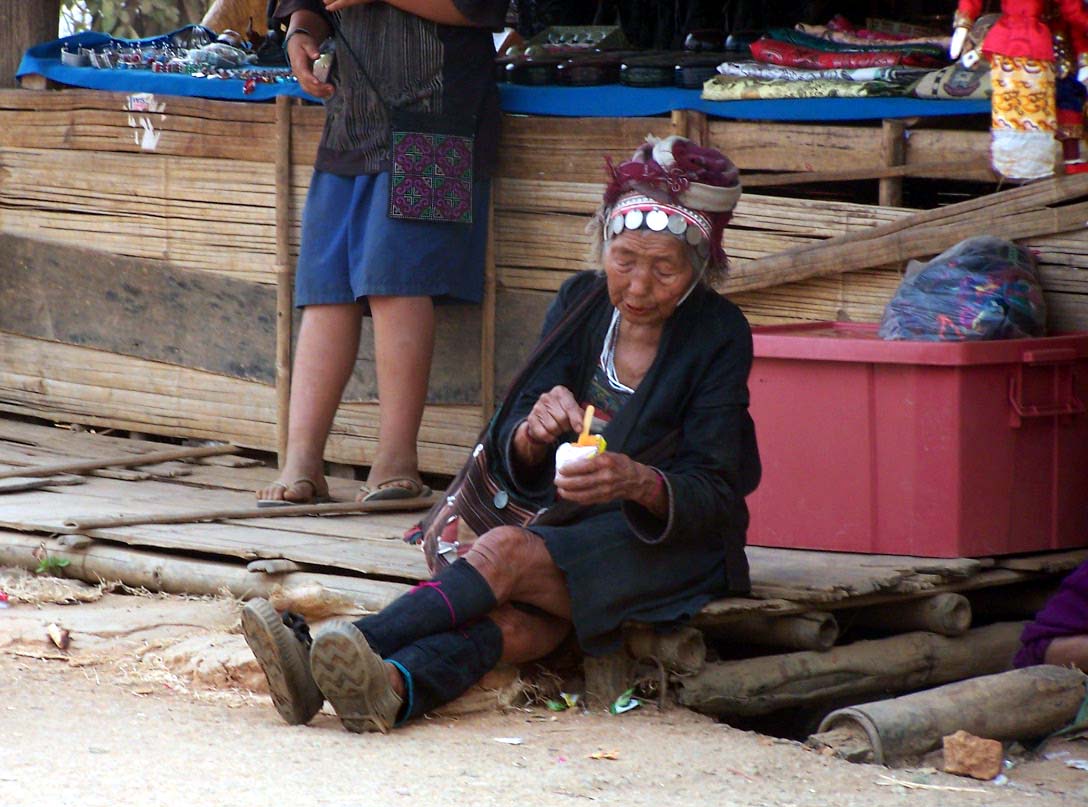
These peoples owe allegience to their ethnic group and national boundries are of no signifigance. They originally migrated from China and Tibet and now reside in southern China and in a geographic band across the north of Burma, Thailand, Laos and Vietnam.
100_3585.JPG

These tribes have taken taken advantage of the tourist influx and now offer their villages and homes as overnight lodging for trekkers. As they live in the hills there are no roads, autos and access is strictly by foot. So after a couple of days re-exploring Chiang Mai (its growing big time) I joined 5 other farangs (European and half my age) and a Thai guide for a 4-5 hr ride in the back of a pickup to the trailhead for a 3 day trek.

The walking is relatively easy but the heat/humidity combo is a killer. In 5 hrs we reach a Karen village, are given lodging in a bamboo slat hut and offered a “shower” from a barrel of cold water using a laddle to pour water on whichever body part is selected. A simple meal is offered–tasty but usually best not to ask what it is. Market comes to us as the local ladies show up with their handicrafts. The children run about and giggle at/with the strangers. During the night a pig was the victim of a noisy slaughter as the next day was a festival (new years).

On the previous trek along the Burmese border we had been invited to a wake for a child who had died that day (probably from congenital heart disease). But alcohol became the focus of the event and we made a hasty departure out a side door as belligerence unfortunately replaced festivity.

The next day of this trip offered many stream crossings over narrow logs and I was made suddenly aware that balance is one of the skills that diminishes with advancing youth. Oh well! But we made it to the waterfall for a rewarding swim and that night barbequed a suckling pig.

The last day offered a ride on a bamboo raft through several small rapids and the obligatory elephant ride (once is enough). My less than friendly elephant was named Toby with her cute baby following along behind. I kept thinking that I should have a seat belt. Toby, however, was sure footed, enjoyed the sugar cane and bananas that were sold at intervals along the route.

Mae Sai is just a border town in the far north I went to on another trip. Across the bridge is Burma. It is not a primary trekking destination. Used more for visa stamp-outs and Thais purchase stuff (primarily pornography I think that they cannot get in Thailand–or at any rate saw much of it being confiscated by Thai immigration.) From Chiang Mai it is part of a day trip –in a van–that also includes the Golden Triangle (people stand and have their picture taken under a Golden Triangle sign) and Mekong River/Laos border area. A boring trip.

Tip: The trips out of ChiangMai have become a bit too packaged and westernized–now include the obligatory elephant ride and a raft trip which is a token overcrowded experience. Ok if one has never done it but better if you are able to get off the beaten track like the trip to Mae Hong Son.

Jinghong China

jWLtBzsBGHTUmbHjYHypj0-2006185073225366.gif

Photos

While I was in Guizhou Province, Bob headed off for Putuashan Island and then circled back to Shanghai via Hangzhou…then flew to Jinghong to meet me at the Banna Hotel. We picked up Sarah, a trek leader at the Forest Cafe, who led us by bus into the surrounding mountains to visit some Hani, Dai and Jinguo ethnic minority villages.

In one village I ran into a Frenchman I had met in Guizhou Province (a thousand miles away) who had enlisted the services of a car and driver so Sarah took off trekking with Bob and I joined Marco (French-Italian) on a visit to several Dai village homes on the way back to Jinghong where I met Bob at the hotel that night.

Bob was to fly to Bangkok and I to Hanoi from Jinghong but planes were full so we flew the 40 minutes north to Kunming to catch planes…Bob to Bangkok and me to Hanoi.

Camellia Hotel In Kunming China

jWLtBzsBGHTUmbHjYHypj0-2006185073225366.gif

Video

Was really fun to spend time in the Camellia Hotel compound in Kunming, familiar from our 2002 visit to China, and fraternize with all the Western travelers and trade street-stories at the Mieli cafe/bar and Camel Bar up the street.

I picked up a Vietnamese visa at the Camellia. I nearly lost my temper with the hard-headed Chinese clerk who gave me the visa. When I filled out the application I put the date I would be entering Viet Nam-after having gone to Thailand first for two months. In no uncertain terms she kept ordering me to put the current date. In the face of her demand I finally gave in. Then when I went back to pick up the visa I discovered I would only have one month in Viet Nam because the 90 days started now! I told her I wasn’t entering Viet Nam for 2 months. Oh, she said. I could have killed her. But she knew better than I! Typical Chinese, I thought!

Also picked up a three month Thai visa at the Thai Consolate so I wouldn’t have to go out of the country and back in after 30 days. But even there, when I asked about the stamp-out process he insisted there was no legal process…which I found out later is the truth. But they let it happen because it’s brings in revenue. Then flew to Jinghong to meet Bob.

In the Camellia Internet Cafe and Bar I met a wonderful 30ish English woman, Hester, who was also traveling alone. We connected instantly. An artist, she had just broken off a ten year relationship and sold her home. She was on her way back to Lijiang where she was thinking of partnering with some local artists on an art project.

Miao Village In Guizhou

1wXSp3CkNsDoJl3s0SgHmw-2006171171225701.gif

In Shanghai, exploring the Lonely Planet Thorn Tree web site, I noticed a query from a young woman from Kaili in Guizhou Province who was offering to arrange a homestay in a Miao minority village in the mountains. We exchanged emails and I was excited to meet her. But then I received an email saying she was in Shanghai and could we meet for the train ride to Guizhou in a couple days. I returned that I couldn’t leave that soon but I could meet her in Kaili…then I never heard from her again. A mystery…or maybe she got an offer from someone to pay her fare back to Kaili…who knows. But I knew where I was going next! From Shanghai I flew to Guiyang, capital of Guizhou Province and stored my baggage at a hotel there before boarding a bus for the three hour ride to the city of Kaili.

When I got off the bus there, I was directed to another station around the corner with several rickety old buses waiting for passengers to various villages. I had no idea which bus would take me to Xiuang, the village I had been told by the English-speaking receptionist in Guiyang that would be celebrating their New Year’s holiday. Then I saw a smiling family waiting near one half-full bus. “Xiuang,” I asked. Yes, they nodded. But while we were waiting to board, a couple of men outside a nearby fence a few feet from us motioned us to approach them. It gradually became clear they were taxi drivers that wanted to take us to Xiuang. Between my motions and their language we all agreed to share the cost of the taxi so we piled in and were off…on a harrowing short-cut along steep mountain dirt roads with thousand foot drop-offs…to our village!

The people in the mountains in this southeastern Chinese province are not Han Chinese. Eighteen different minorities live within Guizou province and I was here to visit the Miao people in this gulley-like valley with identical hand-hewn wooden houses climbing the hills on all sides.

209915718_a429a4e0bb.jpg

209926509_dec6fd2f3f.jpg

The wooden houses are built on foundations of stone and constructed with wooden pegs…no nails or cement. Steep paths meander among the houses.

After some initial quandry as to where a hotel might be, if there was one, I came across a woman who led me to a small building…who would have thunk it was a hotel…for about $2.00 for the night. I was invited to join the family around their hotpot dinner downstairs…had no idea what I was eating but I was starved and it tasted delicious with smiling faces all around. No extra charge! There was no heat in the freezing room that night so I took the bedding off the other twin bed and added it to mine.

There are at least 130 different types of Miao people living in villages among the mountains and they have different dialects, headdress, and traditions. Yet, they all belong to one Miao minority. Their language is endangered as it has no written form and is used less and less among the younger generation who is often eager to learn English.

The next morning, walking along the main cobblestone path through the village I came across a young French couple…the only Westerners in the town…who were delighted to speak English with someone after hiking all over the mountains from village to village without a guidebook. “Just knock on a door” they said, and show the sign for sleep and eat and show money and you will be invited in,” they said. They were in their second year of travel before returning home to start a family. They had been traveling in the province two months and it was they who took me to Mr. Hou. Mr. Hou was the English teacher in the middle school there that drew students from villages all over the mountains. “By foot,” he said.

210633704_1745d7eb1b.jpg

210633628_6db0e86236.jpg

Mr. Hou invited me to stay for two days for $4 a day in his home, generously sharing three banquet meals a day around “hotpot” and dozens of small dishes of whatevers with him and his extended family of which there were many coming and going during each meal! While the men and women prepared the food, the guests all sang a local folk song. Then they asked me to sing a song…and I’ll be darned if my mind didn’t go panicky blank…all I could think of was Row Row Your Boat and I think that is really a French song! So I told them we had rock music and I couldn’t sing rock. They all nodded in agreement…to my relief I was off the hook!

The family and I joined round on 8 inch high stools and watched Mr. Hue chop the meat up on a thick round wood cutting block on the floor. Then slowly bowls of food appeared from another cooking room that the women had prepared and were set out on the floor around a “hotpot”or wok full of boiling broth sitting on a foot high round stand full of lit charcoal. Mr. Hue would chopstick some of the food he considered the best onto my small bowl of rice. The bones and small rejected bits were spit onto the floor. After every few bites the local hooch was poured round and after a song and a whoop everyone would gulp down the fiery fruit-flavored alcohol made by the grandmothers. It didn’t take long for the whoops and songs to exceed the eating. Humorously, I was given “just a small amount” each time..the villagers having experienced past catastrophes with drunk foreigners!

Finally the day came when the New Year’s biggest day would be celebrated…music, dancing…the women in wonderful traditional dress.

210851901_ed09870d37.jpg

210885497_88f1e95a8d-2.jpg

211284526_99c82f9754.jpg

During the daytimes I wandered through the small cobbled lanes leading through the houses and shops…trying my best to avoid the firecrackers thrown at the visitors by the small boys.

Although the New Years ethnic dances in costumes were delightful and the people warm-hearted and friendly, I was happy to leave the village. The small boys thought it was great fun to make the “foreigner” jump when they threw firecrackers at her feet…one landing on top of my backpack…nearly scaring me out of my wits. And on top of that Mr. Hou felt he had to direct my every move in the home…was terribly worried I would fall off the narrow log ladder to the upper level where he had cleared out a cozy room with a rock-hard bed. After all, I was “old.” 62! So by the third day I had had enough fireworks and directing!

While I was waiting for the bus back to Kaili, (there was no schedule…you just waited for the bus to show up) a newly-arrived young man from Amsterdam and I made friends with some Chinese English-speaking students from Hunan province who were there with their photography teacher and we nearly went to Langde village with them if there had been room in their van. I was sorry not to be able to go with these cheery young people who were so anxious to try out their English…some of the words inappropriately big and ostentatious…and some I didn’t even know the meaning of! Be sure to correct our English, they said! Well, we don’t use that word in normal conversation I would say and they would look so disappointed. We exchanged email “to practice English.”

“Kaili, Kaili, bystanders yelled at me as a small bus appeared…barely missing the food-vendors on either side of the dirt road leading up to the village. Then just as I was waiting to board, a Russian-American in his 80’s from NYC with a false leg nearly toppled off the bus with his bag into the street. We quickly traded some travel stories…he had been backpacking for years all over the world…refusing to give it up…very inspiring…and touching…

I headed back to Kaili, a comfortable and colorful Miao urban city with great food down small alleys, and was pleasantly surprised to find that my hotel room harbored a broadband high speed internet connection! This was not only Asia, but it was China after all and the appetite here for technology and communication devices is insatiable.

213543317_e1daf65c6e_m.jpg

213492238_197f89aa47.jpg

213563973_0e7b423433_m.jpg

213492164_3ac8d92d2e.jpg

After another bus back to Guiyang I spent the evening walking along the river than runs through the city, meandering up and down streets…getting lost and finding my way again…checking email at a large internet cafe with at least a hundred young kids all noisily playing video games. And eating wonderful street food!

The next night I headed off to Kunming on an overnight train…middle bed in a 6-bed compartment this time…but not without exploring the new Wal-Mart around the corner from the train station to replenish my battery supply!

Shanghai

East China.gif

Spent about 3 weeks in Shanghai in a lovely small hotel behind the Shanghai Library on a tree-lined street of the former French Concession. The US Embassy was next door to the Library but we never did figure out where the entrance was.

Had some interesting conversations at breakfast in the hotel with two men from Manhattan New York…both fluent in Mandarin. They collect Chinese art and furniture and are proficient in Chinese calligraphy. Made me wonder where I have been all my life. They are gay with a long relationship together…separated now…but still travel together and share their Chinese interests. I wish I could explore this further with them…after all relatonships are relationships…whether gay or straight.

Shanghai is a surprisingly user-friendly city for a Westerner. Just felt good to get off the road and cool out. Spent a whole day at the Shanghai Museum Of Modern Art during a tech-friendly exposition of world renowned artists…mostly video exhibits…very inspiring for a video freak. Even Yoko Ono sponsored a Wishing Tree which will provide the basis of some future work of hers.

Yangshau

East China.gif

Currently in a delightful city (Yangshau) that is on the Yangtze River about 100 miles north of Shanghai.

China’s autumn has been fantastic, the people interesting (and challanging) and the food tasty (most of the time) even if we do not always know what we are eating.

Spent 3 days north of Beijing trekking the Great Wall (I waved to the folks in space so hopefully they were able to see me) and then did a couple of climbs on China’s sacred mountains (Tai Shan and Lao Shan).

The climbs were more like our day hikes in Oregon but still a good workout–spent one night on the summit and got up with several hundred Chinese to view the sunrise–magical and mystical as an orange globe emerging from a cloud bank. The Chinese, however, take a tram to the summit and were quite surprised that a foreigner of my age would want to walk up the mountain. “Singjingbing” (“crazy”) is the frequently heard comment.

China is a very dynamic country and going through rapid metamorphoses–in 10 yrs it will be quite different and maybe not for the better–they aim for modernization and construction is booming. However on the lanes, streets and freeways autos compete with pedestrians, bikes, and hand drawn/animal drawn carts. The expression “Chinese fire drill” prevails. Crossing a street is an adventure.

Market economy is obvious and pervasive–Karl Marx can only be shaking his head.

Tiz OK to laugh with the Chinese but not at them (have made a couple of social/cultural guffaws).

Off the tourist track we foreigners are still an oddity and draw many long stares. Younger children say “hello” and then giggle. I say “neehow” (hello) and they giggle even more. The smaller kids are cute as can be; as they get older (teens) jeans and cell phones prevail and there is the loss of cultural diversity.

Air pollution, autos, hacking & spitting, littering (everything: restaurant bones, trash, spit goes on the floor–at an internet cafe I was admonished by the propriator for putting my backpack on the floor–did not appreciate her concern until I realized what all else is on the floor and had the insight that she was trying to prevent backpack contamination.)

Then the Chinese sweep–everywhere things are swept with grass brooms but that is as deep as the cleaning process goes. But as always the fun is in observing and appreciating cultural differences (a two way street as they laugh at me)
later. B

Yangshau & Shanghai

1wXSp3CkNsDoJl3s0SgHmw-2006171171225701.gif

To Bob
When I sent e-mail had not seen your messages. Your place sounds great–will spend a couple more days here before moving on–would like to access your place. gonna run back to hotel to see more of election results.

B
Well, last night I went to Hilton to find CNN..no luck so I circled back to Huaihai via Huanshan. By the time I had turned a few corners I got turned around and then turned the wrong way on Huaihai. Turns out that the hotel is off a section of Huaihai called Central Huaihai…further west it becomes West Huaihai…I walked until I got to the very end of Huaihai…but at least the street was varied and interesting. Walking any of these streets is fun unlike around the other hotel. The Brasil Steak House serving meat like the restaurant in Nairobi is recommended by Lonely Planet is right across the street from the Library…
E

hi again–
Am still in Yangshau and am enjoying it–many canals, shady streets, and less hussle/bussle. Will stay another couple of days then will probably make a short hop to Nanjing for a couple of days–anticipate Shanghai probably Monday–depends on train schedule but suspect there are many–or may take a bus.

We can look into flying to your next stop–do not think we will miss too much unless there is some stop you have in mind en route. I would like to do +/- 5 days in Shanghai if you are up to that much more. Gonna mail another package tomorrow–not much accumulated but I am near a post office and have no room to spare–all this luggage is getting tiring–in BKK I will store much of it. My camcorder screen is almost a total goner- -difficult to take shots–and I cannot review to edit –so less pics– hope you have many. Will check in again manana.
b

B
I don’t have any pics…just enjoyed my stay in Quindao without being Ms. tourist. And second day here my little camera got picked out of my jacket pocket…I know because my pen and reading glasses were in same pocket and they all came up missing later…it happened late at night…was walking all around the area of the Hilton Hotel looking for that little country inn I saw advertised in the China newspaper…never did find it. Guess I better get out the video camera…

Have you heard from Josh…I have emailed him but haven’t heard from him for weeks…

I now have hi speed internet in my room…was worthwhile asking…4 yuan an hour.
E

E
Sat Nov 6
good morning
Last night while doing my email chores was hit with an overwhelming feeling of fatigue–then chills and sweats thru the night–had diarrhea much of yesterday so suspect GI is the focus–not doing too well–diarrhea about every third day with cramps–had a couple of close calls while on buses–such are the battles!!! At any rate had planned on leaving here (yangshou) today but have apprehension about getting on a bus for 3-4 hrs–so will hang out here today and see how things are tomorrow–always feel there is some sort of a deadline but that is due to years of conditioning–have to stop and readjust to fact that there is no hurry getting anywhere. Better to smell the roses…

Sorry about your camera–it also was insured but may not be worth hassle of police reports etc–you decide. Room rate at Admiral in BKK must be for one of the more upscale rooms– cheaper not available? Also at this time of year rates go up in Thailand. At http://www.asiatravel.com there are many serviced apartments but I never know re location–but take a look. I will be knocking on your door sometime Mon. afternoon unless catastrophe strikes–may not have email access between now and then…
see ya soon
B

Tai Shan Sacred Mountain

East China.gif

Located midway between Beijing and Shanghai, “Tai Shan” is probably the most famous of the five sacred mountains of China. According to legend Tai Shan represents the head of Pan Gu, who after creating heaven and earth, dies from exhaustion and his limbs and head fall to earth as the five mountains. Subsequent emperors were required to climb the mountain in order to be considered an appropropriate ruler. Both Confucius and Mao felt obliged to scale the summit (5068 feet).

The sacred Mount Tai (‘shan’ means ‘mountain’) was the object of an imperial cult for nearly 2,000 years, and the artistic masterpieces found there are in perfect harmony with the natural landscape. It has always been a source of inspiration for Chinese artists and scholars and symbolizes ancient Chinese civilizations and beliefs. It is an UNESCO World Heritage Site.

I had no idea what to expect but planned on spending a night on the summit so packed my pack with multiple contingencies to include extra clothing, rain gear, food, water etc. All unnecessary, of course, as vendors and shops lined the route from bottom to top altho prices became proportionately more expensive with elevation.

The majority of the route is along carved and/or constructed stone steps which are several centuries old. Multiple temples and shrines line the way. These have cultural and spiritual significance for the Chinese but without English explanation went over my head and remain largely unappreciated. Trees, under which various emperors rested, are noted and enshrined.

Along the route the Chinese would often give me the thumbs up sign–perhaps because of being a foreigner (“laowai”–the word has a derogatory connotation like farong or gringo or honkie) or perhaps my age, perhaps both. Frequently they would request (demand) to carry my backpack (I sweat easily) and were dismayed and occasionally argumentative when I communicated that I preferred to carry my own pack. My interpretation was that they felt they should be “taking care of” the foreigner.

Photos of ancient sites & scenery were encouraged but attempts to photograph poverty, filth or anything less than ideal were met with negative feedback or at least wonderment on why anyone would want to take such a picture. The Chinese have elevated posing to an art form and always include themselves in the scene.

I reached the summit about 5pm and found it to be crowded with all shapes and sizes of Chinese who had taken a bus to the half way point and then a tram the remainder of the way to the summit. As the sun set it became increasingly cold and vendors rented out Chinese military overcoats. The laowai (foreigner) had difficulty finding one that would fit–precipitating smiles to giggles to gaffaws. The lodging was somewhere on the negative side of adequate and without heat the night was cold enough to interfere with sleep.

After a knock on the door at 5 a.m. I joined a huge entourage of Chinese for a hike to a lookout where we sat and waited for the sunrise. It was spectacular with an orange globe rising from a white bank of clouds…this coupled with a lone pine tree next to a pagoda…represented my interpretation of the quintessential and mystical China.
the summit.JPG