One East On Third

On the e-hotelier.com web site a friend found this description of son Josh’s restaurant in the Hilton Hotel in Beijing where he is the Chef de Cuisine:

Hilton Beijing stars as Lord of The 3rd Ring
Jul 31, 06 | 1:57 am
Catch Hilton Beijing this month as it shines at the premiere of The 3rd Ring. The critics and glitterati alike have been eagerly awaiting the opening of this new, multi-outlet dining and entertainment concept. If sneak previews are anything to go by, it�s clear that The 3rd Ring will consistently perform to sell out crowds – keen to catch a glimpse of the stunningly made-over restaurants and bars that line the tri-level ringed atrium at Hilton Beijing on the Third Ring Road.

A hush falls over the crowd. The music starts up � this tune definitely has a toe-tapping ring to it. Saucy Ring Masters hit the screen first, leading the way to fresh and innovative cuisine as well as signature cocktails and superlative wines. An award winning performance from all of the new restaurants, bars and cafes. The excitement builds to the tantalizing grand finale, with dancers, musicians and DJs and stealing the limelight. There�s no doubt about it, Hilton Beijing truly is Lord of The 3rd Ring.

“One East On Third: Without a doubt the luminary of the show, it�s hard to fault The 3rd Ring�s signature Western restaurant. The a la carte menu offers modern American cuisine, with a twist. Order individual dishes, or opt for the tantalizing six and eight course Tasting Menus � delicious creations complemented by exquisite wines.

Showcased in the glass encased �Vintage Bank,� replete with an area for private tastings, One East on Third features an extensive list of new and old world wines, including the largest selection of US varieties in town, which you can enjoy at the restaurant�s bar before or after your meal.

But despite all the attention and praise, One East on Third remains remarkably down to earth, with an inviting southern mansion interior not dissimilar to the original Louisiana Restaurant. A difficult act to follow.”

Enough to make a mother proud.

Serendipity

When I was in China a couple years ago, I met a lovely British woman in her 30’s using an internet next to me in the bar at the Camellia Hotel in Kunming. We have kept in touch while we each have traveled our separate ways…she spending the last year in South America and Mexico.

She is back home now…an artist printmaker by profession. But she had told me about Alejandro, a long-haired artist who dresses all in white that she spent time with in Oaxaca City. And I had seen his picture she had posted on a photo web site. One day as I was sitting in a cafe on Alcala St. near the Zocalo, I swore I saw Alejandro walk past. I emailed Hester who told me to go up to him next time I saw him and tell him hi for her…which I did yesterday! I emailed her again, saying that he is beautiful, and this was her description of him:

Dear Eunice,
That’s funny about Alejandro. He is beautiful. He is also very interesting to talk to. He is really insightful and we used to just sit and tell each other stories. Good for my spanish….good for his patience! His artwork is really interesting too. I kind of felt we had a teacher and muse thing going on. He liked the fact I was lively and emotional and flitting around (geographically and mentally) and I loved his insights, wisdom and his peaceful self-fulfilled nature.

I am still hoping to make it to Oaxaca round Christmas time. Will keep you posted. Wouldn’t it be great to meet up again after all this time. I really did enjoy our short time getting to know each other in Kunming.

Are you enjoying living in mexico? How do you find life in Oaxaca? Your blogs have been great. It has been so nice for me to keep up to date on everything that is happening there politically and socially and also to hear about the people you meet and friends you’ve made. I felt sort of homesick even though it isn’t my home.

Serendipty friends!

Update on Living In Oaxaca

I have almost finished my application for a Mexican FM3 year-long visa. Forms have to be filled out exactly right…with copies…and money paid to a bank. About $200 for the visa and another $40 for them to examine the forms. I have to show an income of $1000 a month. Four pictures, side and front. Two Mexican references, a letter of invitation (I’ll use my landlord) and a copy of his “credential” which is usually the voting card. And a copy of my rental contract. All this monkey business has taken a lot of time but my initial 90 day tourist visa I got at the airport upon arrival expires the end of August so I have some time.

At the CREATE alternative education program in Hillsboro/Forest Grove, I worked with two Mixtec indigenous cousins (see “One Oaxacan Family” entry). The parents are back in their village here.

Catalina says in yesterday’s email: “I wanted to talk to you on exactly where you are located. The reason why is because maybe you can visit my parents in Juxlataxca, Oaxaca. My mom and my dad are there now as we speak and I am not sure how far away you are from them. I know they would love to have you visit them. I know that there is hardly any tourist where they are at and my mom was saying that a few years ago they had a lot of asian tourist which was suprising.”

I am excited about the prospect of visiting the parents in their village, but can’t find it on my Oaxacan map. I will call Catalina, who is like the daughter I never had, on Saturday. She is working, going to school at Portland Community College, living with her significant other and has a little 2 year old that I haven’t seen yet. If I go back to Oregon to pick up my car as I am hoping to do I will definitely see her and her family.

Then I will be returning again to Oregon in January or February to attend to the sale of the farm in Salem.

Last night I talked to my son Doug and his wife Luk who are living in an isolated beach area of Koh Samui Thailand. They are planning on moving to the small town of Lamai. It will be better for them there…closer to things to do and they won’t have to ride his motorcycle so far in the wind and rain during the monsoon season to get to the market. A week ago, a palm tree fell on some electrical lines and shorted out their electronics and fans so hopefully they can get it all repaired.

Josh has been busy opening the “One East On Third” restaurant in the Hilton Hotel in Beijing China so don’t expect to hear much from him for awhile. Josh and Amy will be in China for at least three years so when my year is up here in Mexico I will return to Asia for a year…traveling back and forth between Thailand and China…taking an apartment somewhere as a base.

I found a great mail service in Oaxaca. Mailboxes Etc. has arranged to have U.S. postal mail go to an address in Miami and then to Oaxaca…bypassing the lousy Mexican postal service.

Update 12/2016: Mailboxes is no longer in Oaxaca

University Contacts In Beijing?

My son Josh Goetz, 33, who has been a chef in Manhattan New York for the last five years has accepted a position opening a new restaurant in the Hilton Hotel in Beijing China. He starts the third week of June 2006…in one week. His wife Amy is currently teaching history at Rutgers University in New Jersey. At the end of the term she will join Josh in Beijing. She would like to know if anyone has any university contacts in Beijing that would be useful to her in either getting employment or just making friends.

Thank you

Tha Ton Thailand

gatQye8keZlS3vpnwrOvxg-2006186163905868.gif
Supuat drove me to Tha Tan…right on the Thai-Burma border directly north of Chiang Mai to see several minority groups, Lisu, Lahu, Akha and Longnecks, that live there.

Last year in southern Yunnan China, I visited Lahu, Lisu and Mien mountain people many of whom had migrated into Thailand years ago. The Karen and Shan and Longneck people in and near Tha Ton have been forced out of Burma by the junta who took over the Burmese government in the early 90’s. They do not speak Thai and they have their own languages, but Supoat, my guide, being from the area, speaks the local Chiang Rai dialect that is common to all the people.

About seven years ago Thailand launched a program to pave the roads into the mountains, so instead of trekking dirt trails we are able to drive into the villages. We visit the Lahu first.

DSC00517.JPG

DSC00481.JPG

DSC00514.JPG
Akha Woman

DSC00489.JPG

DSC00490.JPG

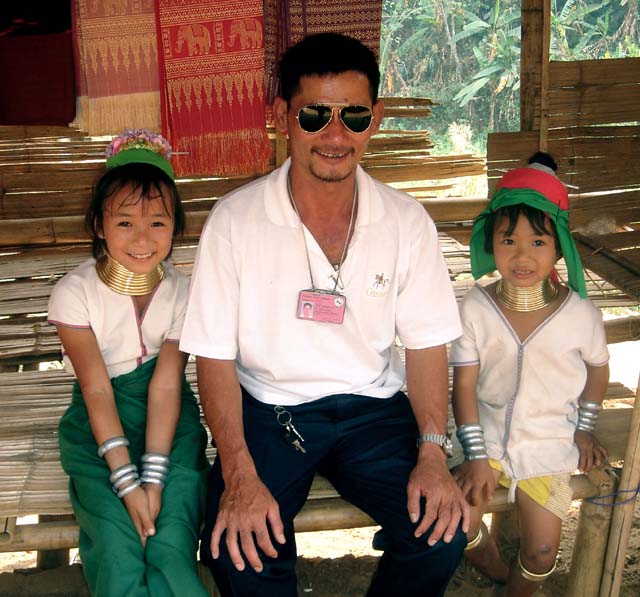
The Longnecks are refugees from Burma and do not have Thai citizenship so they are confined to small areas where the women weave items in small thatched shelters to sell to the tourists and the men grow rice on the mountainsides. The Longnecks wear gold-colored metal coils around their necks that actually does not elongate the neck but they look long because over time the shoulders slope down. I buy some lovely woven scarves for $1 each.

DSC00505.JPG

DSC00504.JPG

DSC00512.JPG
My driver with two smiling Longneck girls.

The last village is Lisu. We park in the schoolyard. Supoat knows the family we visit. The yard, with children, pigs and chicken running free is well-swept.

DSC00522.JPG

I notice a chubby woman sitting in a nearby chair…looking miserable. Questioning her we decide she is passing a gallstone. Her husband is out looking for their pig he can butcher to sell to their neighbors so he can have money to take her to the doctor in Chiang Mai. I commiserate with her…I know how painful gallstones are. She kindly invites me to stay and eat with the family but Supoat carefully refuses…we don’t want to trouble the family at this time and we need to be on our way back to Chiang Mai.

DSC00518.JPG
Slicing Palm for cooking

DSC00526.JPG

Leaving the village we pass under a colorful arch…past small piles of old clothing that used to belong to villagers who have passed on. The clothes are there for spirits who might need them when they come back, I ask. Yes, he says. In the background you can see smoke from “slash & burn” fires that take place this time of year when the locals burn harvested fields.

DSC00529.JPG

Faithful Tuk Tuk Driver

eWCBF9KYWi73omUCUHRffw-2006185115650300.gif

Nice to have someone faithful to me. I trust Supoat, in his 50’s, with soft face and warm bright eyes. I call him when I need him to drive me somewhere in his Tuk Tuk.

Most of the people living outside of the moat that surrounds the center of town are illegal Shan refugees from the border between Thailand and Burma. Today, he took me to the Chiang Mai Shan temple where very young Shan boy- children are being initiated into monkhood. They are carried in a musical procession through the streets and around the temple on the shoulders of young men. They are dressed in sparkling tribal ceremonial dress and their faces are made up like girls with lipstick and rouge. Nearby drummers are making rhythmic music. I am the only farang in the crowd and draw curious looks.

My masseuse suggested today I eat a northern Thai soup called Kang Cae for my health, a soup with many different vegetables including two different kinds of eggplant and 15 different herbs. Supoat joined me tonight at the “Huenphen,” a lovely upscale restaurant specializing in northern Thai cuisine. Learning spoken and written English in school as a small boy he got the best grades in his class he says proudly. A Chinese couple next to our table says not a word to one another during their dinner…listening to our conversation in English…seeming to be deeply disturbed at seeing us together. I do not have a good feeling about them. They leave in a huff.

Supoat suggests taking me two hours north to his home town, Fang, early tomorrow in his new (used) Peugeot car purchased with money down given him by his niece’s husband who is a mechanic in Texas. We will visit his mother and father in Fang. He will drive me another hour on up to Tha Tan, a tiny village at the Burma border, drop me off and return to Fang to spend the night with his parents and rake the leaves in their yard. As the youngest of his siblings he is responsible for taking care of his mother, he says. He will return to Tha Tan at noon the next day and pick me up to go further on to visit tribal villages before returning to Chiang Mai. I am looking forward to being out of the hot noisy city and getting into the cool mountains.

“Letters From Thailand”

“Letters From Thailand” is a lovely novel wrtten in 1969 by “Botan”, a pseudonym of the Chinese-born Thai female writer, Supa Sirisingh, and recently translated into English by Susan Fulop Kepner, an academic on Southeast Asian studies from UCLA.

The book is written in the form of self-revealing letters to the beloved mother of a young man who leaves rural China to make his fortune in Thailand at the close of World War II. In Tan Suang U’s starkly honest account of his daily life in Bangkok’s bustling Chinatown, deeper themes emerge: his determination to succeed at business before all else; his hopes for his children in this strange new culture that sickens him by what he sees as it’s drunkeness, laziness, gambling and sexual depravity and his resentment at how easily his children embrace urban Thai culture that is becoming increasingly Westernized at the expense of their Chinese heritage that he holds dear.

Westerners will recognize the cross-cultural themes that emerge… the desire to hold on to cultural heritage in the midst of an alien land, the stereotypes that keep groups separated one from another and the struggle of oppressed women to transcend their own culture and live life on their own terms.

“Not to eat another man’s rice but to hate him” is something to be ashamed of, Suang U learns. “I was of the opinion that a good heart was not money in the bank,” Suang U says toward the end of the book. But he learns that “two baht worth of rice with love at the supper table is a feast.” Finally, a lonely old man, after he has passed his business on to the ungrateful son that he himself mentored, he discovers that “to be alone is terrible, but it is not so terrible as to be a guest in a son’s house.”

The strongest survival instinct is self deception. After a long sorrowful road to self-discovery he is astounded to learn two things: one is that money is not the most important thing in life; the other is that what we believe does not necessarily reflect what and who we are.

“Letters From Thailand”
1969 by Supa Sirisingh
Susan F. Kepner English Translation 2002
Silkworm Books Chiang Mai
http://www.silkwormbooks.info

More On Mao

We are grounded by the subway strike so have been reading more of the biography of Mao by authors Jung Chang, the author of the wonderful three-generation epic “Wild Swans,” and her British husband Jon Halliday.

What is especially interesting so far, is that this biography reveals much heretofor unknown information about Mao Tse Tung and the Cultural Revolution in China. Mao, for decades, held absolute power over the lives of one-quarter of the world’s population and was responsible for “well over 60 million deaths in peacetime,” more than any other twentieth-century leader. He used terrorism to try to establish China as a world-wide military nuclear power and to seat himself as it’s leader. To do this he wanted to draw draw Russia and America into a world war. Russia, hoping to appease Mao, allowed him to start the Korean War…Korea’s Kim even taking his orders from Mao. Mao sent thousands and thousands of troops into Korea thinking the Americans would never know the difference between Chinese and Koreans…and he was ready to sacrifice untold millions of people. He knew the Americans wouldn’t tolerate the body bags. Stalin (“The Master”) held the line, but when Stalin died, Khrushchev pulled the plug.

The detail illustrates Mao’s premeditated cruelty unprecidented in modern history. The authors had access to the Russian archives, interviewed hundreds of key people that are still alive…Russians, Chinese, Americans and anyone else who had a role during this time.

Values in China are carried forward by the culture…not by any ethical or civic standard. I could feel reverberations of China’s past during our several months in the country.

Human Rights In China

Yesterday, as Bob and I stepped out the door of the Thai Consolate on E 52nd St. where we were applying for our visas to Thailand, we were met by about 50 Chinese people holding up banners condemning the beating of Falun Gong practitioners by police in Thailand last week. As I reported in an earlier blog, China is sending out agents to other countries to monitor the activities of not only mainland Chinese but also Chinese citizens of other countries. But we were surprised that Thailand of all countries would apparently support China in this horrendous persecution of such an innocuous activity.

Falun Gong claims it is a form of meditation with gentle exercises that cultivates inner balance by teaching truthfulness, compassion and tolerance. Falun Gong is becoming wildly popular in China and in over 60 countries worldwide. Practitioners claim that Communist Party head Jiang Zemin, fearing that Falun Gong’s widespread popularity will overshadow his own legacy, has ordered the traditional Chinese practice “eradicated.” This means that 100 million citizens are apparently cast as criminals. In the past five years, up to one million people, practitioners claim, have been illegally detained, with many tortured in slave-labor camps, psychiatric hospitals and prisons. More than 1,060 are confirmed dead with the actual number estimated to be more than 10,000. Practitioners are fined, fired from jobs, denied graduation, forced to divorce and flee their homes.

All Chinese press is state-controlled and people are told that the meditation is evil and drives people crazy. A couple years ago, Bob and I ran across a young girl who was waiting on us in a restaurant in a small southern town who was horrified that I thought Falun Gong was not dangerous!

Dr. Charles Lee, an American citizen was sentenced in March 2003 to three years in prison for planning to broadcast information on state-run TV about the persecution of Falun Gong. Dr. Lee has been subjected to force-feeding, brainwashing, beatings and slave labor, and denied contact with friends, family and U.S. consular officials. (http://rescuecharles.org).

US businesses and government officials supportive of Falun Gong have also been pressured and intimated to the extent that on Oct 4 2004, in response to the many cases of harrassment and violence by Chinese agents on U.S. soil, The U.S. House of Representatives unanimously passed House Resolution 304 that said “The Government of the People’s Republic of China should immediately stop interfering in the exercise of religious and political freedoms within the U.S. such as the right to practice Falun Gong, that are guaranteed by the US constitution.

The NY Times runs stories, many front-page, almost daily about human rights abuses in China. Today, we read about one lawyer, Gao Zhang, who travels the country filing lawsuits over corruption, land seizures, police abuses and religious freedom. His opponent is usually the same: the ruling Communist Party. As a result of his successes, he has had his license revoked and has finally fled to the hills of Shanxi where he is persuing another case against the party on behalf of Falun Gong practitioners.

Yesterday on the front page was an article about the sleepy fishing village of Dongzhou, just 125 miles north of Hong Kong, the scene of a deadly face-off between protesters hurling homemade bombs and the police gunning them down in the streets. The article says “many facts remain unclear about the police crackdown” on a Dongzhou demonstration on Dec 6 protesting against the construction of a coal-fired power plant that the villagers knew was not approved by the central government. Residents say police fired into the crowd of demonstrators killing 20 or more people. But one thing is certain: The government is doing everything possible to prevent witnesses accounts of what happened from emerging by offering people money to keep quiet.

“Rural confrontations are increasing in China as local authorities confiscate land for construction of factories, power plants and other projects,” says the NY Times.

Museum Of Natural History

When we were in southern China last year we spent some time hiking and driving through parts of mountainous Yunnan Province that are populated primarily with, not Han Chinese, but with “minorities.” (Their word.) So when I saw that the museum was offering a special photo exposition of the Yi and Naxi peoples, we were off…walking on a gorgeous sunny day through Central Park to the museum on the west side.

A non-profit organization had given cheap point and shoot cameras to over 200 locals who were asked to take pictures of their surroundings and daily life…a project intended to be empowering for them. The project included a first exposition of the photos in their own towns…the Yi in their big black tri-tipped hats and the Naxi in their blue and white…and it was tear-jerking to see pictures of absolutely delighted people looking at photos of themselves…for many a first experience.

Minorities in China have always been brutally discriminated against by a country that has considered them to be subhuman. But now that the government has discovered that the colorful minorities have become a tourist attraction and can bring money into these areas…all of a sudden they are being given special status. High in the mountains of Guizhou Province, in a tiny Miao town during their New Years celebration, I was told by a young urban Han Chinese college student from Fujian Province that it was his “duty” to volunteer in the local school without pay because he had so much and the farming people here had so little opportunity.