Last Days In Jinghong

Joe, a gregarious Dai tour guide who hangs out at the tourist haunts looking for business invited me to join him and his family and friends, including a young French couple, at the new BBQ restaurants on the road along the river…the ones we couldn’t find before. His English was great and we shared many ideas. “My heart is breaking with the pollution in the environment,” he said. I told him about Amy’s International School and it’s mission to bring east and west together. Not against each other, he asked? No I said, entwining my fingers. Together. He liked that, as he entwined his own fingers. I told him he had one foot in each culture. He liked that too. Then he wrote a C on one shoe and a W on the other shoe as we laughed.

It is the Spring Festival here and fireworks are going off everywhere. Over 20-40 small dishes (river snails, cow’s skin, river moss and the like) we raised small glasses of beer too many times to shouted toasts…first among ourselves (we women toasted to our beauty…!) and then with a group of about 20 Anhi teachers sitting at the next table.

The next day a German woman and her son, who is getting an advanced degree in business in Hangzhou (SW of Shanghai), invited me to go with them to a small village on the other side of the Mekong River by ferry and then tuk tuk. She is here, like me, visiting her progeny. Her son has been here three years and is fluent in Mandarin…as are many of the Westerners I’ve met here. A group of American high school girls here in Jinghong on break from on a one year exchange program in Beijing to learn Mandarin amazed me with their ability to speak the language…their futures will be bright with opportunities.

I will be glad to leave the An Ya Jiu Dian Hotel, however. It is newer…clean and very nice with satellite TV and a hot and cold water cooler for about $7…and friendly owners. It’s just up the street from the western-oriented Mei Mei Restaurant on Man Lan Lu. But there is a restaurant down an ally behind the hotel…outside my window…that starts up about midnight…with many shouted toasts…and finally subsides about 3am. Ear plugs only take the edge off.

No lack of internet cafes on this street!

And I won’t miss the Asian toilet, if you know what I mean. The shower head is above the open-hole toilet in the floor so one must be very careful where one steps.

Just Hanging Out

Yesterday an older woman from Ireland and I tried to find the Night Market at the end of the bridge over the Mekong River where you used to be able to get great BBQ meat cooked over coal fires. Not found.

Of the many uninterested Chinese we stopped along the way to get information, a young strolling couple with a few words of English helped us. The man called his old English teacher from school on his cell phone so we could explain what we were looking for. But after my simplified request, she kept asking “what do you want” obviously not understanding me. And she was his English teacher, I thought!

Finally we gave up the idea of the Night Market when they said “follow us.” They took us to an open-air shack near the new beautifully lit bridge. In the “kitchen” we pointed to a few vegetables and some pork. In a matter of seconds we were feasting…on delicious food so full of flavor but probably loaded with MSG. Turns out the woman is a doctor at the local hospital but her husband said he “lost his job” at the same hospital. I was curious as to why he “lost” his job but didn’t want to pry. She was six months pregnant. “I want a boy,” her husband said. Knowing the Chinese can pay a fine for a second child I asked how many children they intended to have. “I only need one,” she said with finality!

Later, back at the Mei Mei Cafe where foreigners hang out, a 45 year old good-looking adventure-hooked guy from Belgium who has lived here several years regaled us with stories…many of them dealing with corruption. For example, a few years ago he, through his girlfriend, rented a building to remodel for a cafe. He signed a contract for the rental for five years. But after two years he was informed by the police they were tearing down the building for a big high-rise. So he lost his investment. A contract in China means nothing, he said.

The Night Market is no longer, he says. The Chinese are glad to be rid of it…having been full of prostitution and the drugs coming in from nearby Burma.

Then we discussed the latest biography simply entitled “Mao” that is banned in China. “Yes,” he said, I have it locked up in my room!” “My god,” he said, “if only 5% of it is true…!” We talked about “The Coming Collapse of China” written by a Chinese Professor at an American university which I had mischievously passed on to a Swiss girl studying Chinese economics in Shanghai on my last trip to China a couple years ago. Steven agreed with the tenuous situation in China where the dangerous rate of growth of the GDP can’t continue indefinitely. But the book was written when Deng (who said it was “glorious to be rich”) was President. President Hu, Steven says, is trying to help China avoid a crisis.

Steven, the Belgian, is planning on taking his Dai girlfriend of three years to Belgium for a 12 week visit. He said he could hardly wait to see her eyes! Getting her a tourist visa will be very tedious because so many Chinese try to get into Europe using falsely filled out papers. “They all lie because all Chinese want out of China,” he said. Besides the bureaucratic red tape, they will have to travel to Guangzhou for an interview at the Belgian Embassy. She will only be able to visit with a “Schengen” visa while there. (If you don’t know, the Schengen countries are the ones in Europe (I think there are four) who no longer recognize borders.

Then we talked about the attitude of the dominant Han Chinese toward the ethnic “minorities” as the ethnic groups are called. About one third of the 800,000 people of this region are Dai. Another third are Han Chinese and the rest includes the Hani, Lisu and Yao as well as lesser-known hill tribes such as the Aini, Jinuo, Bulang, Lahu and Wa. These beautiful friendly self-sufficient intelligent people, who live in the mountains with views that Californians would kill for, have historically been viciously discriminated against and the attitude of the Han is that they are dirty and stupid. Consequently the minorities are turning against their own cultures…so Steven has been teaching his Dai girlfriend, Orchid, about her Dai history and origins including that fact that many years ago the huge Dai army once defeated the encroaching Han dynasties. Ironic that it takes a western foreigner to counsel his culturally bifurcated girlfriend. The 37 year old Orchid, who owns and manages the Mei Mei Cafe, is certainly not stupid. Also ironic that since China has discovered that Western tourists are interested in seeing the minorities, it is starting to help promote their welfare as a source of tourism.

With my Irish friend off to Dali, I had breakfast this morning with a lovely woman from Holland who has traveled all over Indonesia. Hmmm. Think Sumatra may be next after Thailand. This is a good time to visit there, she said, as it is not the rainy season. Good! We had a long discussion about China. We agreed that one does not “like” China so much as one finds it incredibly interesting!

Other travelers can be just as enlightening as the country one is visiting…

Update on Living In Oaxaca

I have almost finished my application for a Mexican FM3 year-long visa. Forms have to be filled out exactly right…with copies…and money paid to a bank. About $200 for the visa and another $40 for them to examine the forms. I have to show an income of $1000 a month. Four pictures, side and front. Two Mexican references, a letter of invitation (I’ll use my landlord) and a copy of his “credential” which is usually the voting card. And a copy of my rental contract. All this monkey business has taken a lot of time but my initial 90 day tourist visa I got at the airport upon arrival expires the end of August so I have some time.

At the CREATE alternative education program in Hillsboro/Forest Grove, I worked with two Mixtec indigenous cousins (see “One Oaxacan Family” entry). The parents are back in their village here.

Catalina says in yesterday’s email: “I wanted to talk to you on exactly where you are located. The reason why is because maybe you can visit my parents in Juxlataxca, Oaxaca. My mom and my dad are there now as we speak and I am not sure how far away you are from them. I know they would love to have you visit them. I know that there is hardly any tourist where they are at and my mom was saying that a few years ago they had a lot of asian tourist which was suprising.”

I am excited about the prospect of visiting the parents in their village, but can’t find it on my Oaxacan map. I will call Catalina, who is like the daughter I never had, on Saturday. She is working, going to school at Portland Community College, living with her significant other and has a little 2 year old that I haven’t seen yet. If I go back to Oregon to pick up my car as I am hoping to do I will definitely see her and her family.

Then I will be returning again to Oregon in January or February to attend to the sale of the farm in Salem.

Last night I talked to my son Doug and his wife Luk who are living in an isolated beach area of Koh Samui Thailand. They are planning on moving to the small town of Lamai. It will be better for them there…closer to things to do and they won’t have to ride his motorcycle so far in the wind and rain during the monsoon season to get to the market. A week ago, a palm tree fell on some electrical lines and shorted out their electronics and fans so hopefully they can get it all repaired.

Josh has been busy opening the “One East On Third” restaurant in the Hilton Hotel in Beijing China so don’t expect to hear much from him for awhile. Josh and Amy will be in China for at least three years so when my year is up here in Mexico I will return to Asia for a year…traveling back and forth between Thailand and China…taking an apartment somewhere as a base.

I found a great mail service in Oaxaca. Mailboxes Etc. has arranged to have U.S. postal mail go to an address in Miami and then to Oaxaca…bypassing the lousy Mexican postal service.

Update 12/2016: Mailboxes is no longer in Oaxaca

Tha Ton Thailand

gatQye8keZlS3vpnwrOvxg-2006186163905868.gif
Supuat drove me to Tha Tan…right on the Thai-Burma border directly north of Chiang Mai to see several minority groups, Lisu, Lahu, Akha and Longnecks, that live there.

Last year in southern Yunnan China, I visited Lahu, Lisu and Mien mountain people many of whom had migrated into Thailand years ago. The Karen and Shan and Longneck people in and near Tha Ton have been forced out of Burma by the junta who took over the Burmese government in the early 90’s. They do not speak Thai and they have their own languages, but Supoat, my guide, being from the area, speaks the local Chiang Rai dialect that is common to all the people.

About seven years ago Thailand launched a program to pave the roads into the mountains, so instead of trekking dirt trails we are able to drive into the villages. We visit the Lahu first.

DSC00517.JPG

DSC00481.JPG

DSC00514.JPG
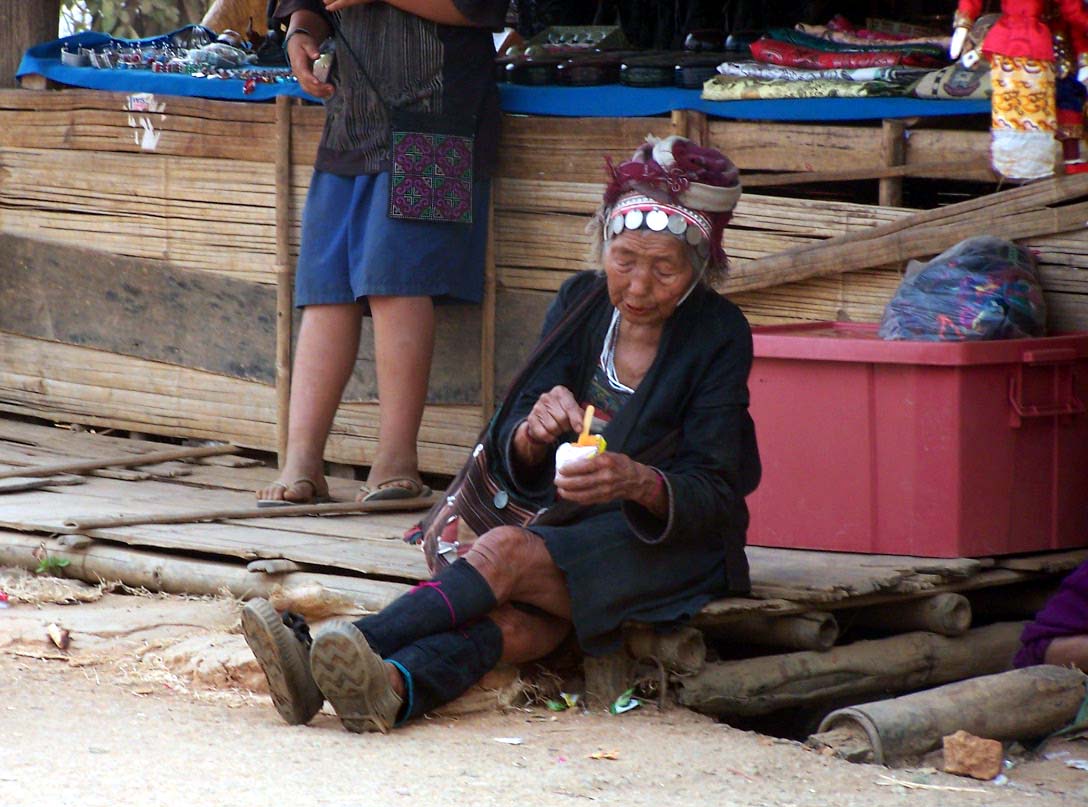
Akha Woman

DSC00489.JPG

DSC00490.JPG

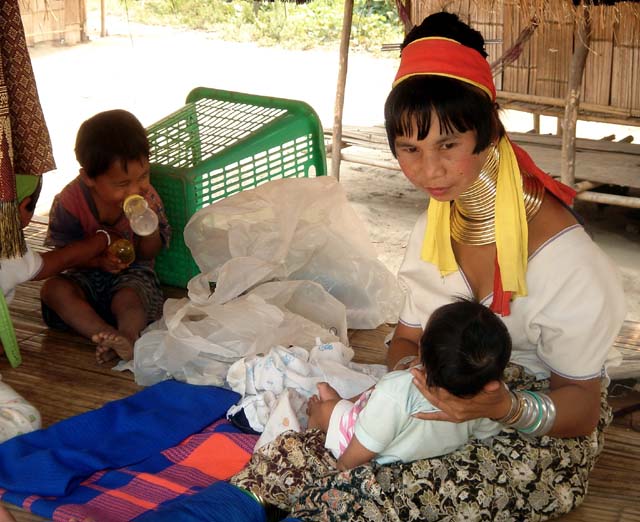
The Longnecks are refugees from Burma and do not have Thai citizenship so they are confined to small areas where the women weave items in small thatched shelters to sell to the tourists and the men grow rice on the mountainsides. The Longnecks wear gold-colored metal coils around their necks that actually does not elongate the neck but they look long because over time the shoulders slope down. I buy some lovely woven scarves for $1 each.

DSC00505.JPG

DSC00504.JPG

DSC00512.JPG
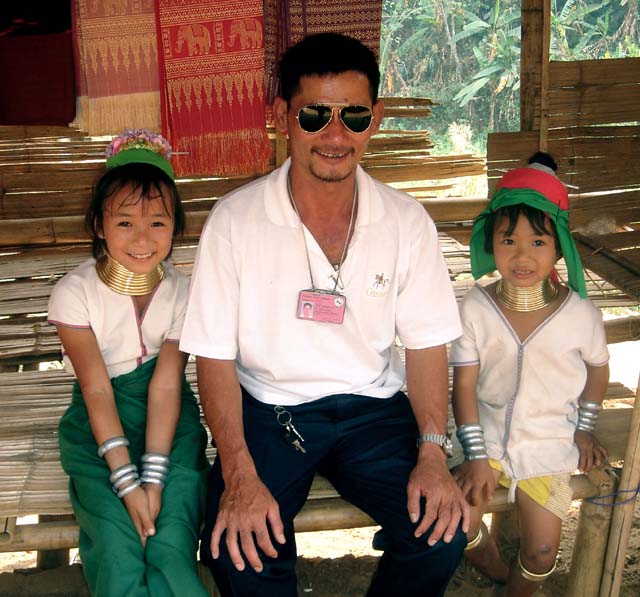
My driver with two smiling Longneck girls.

The last village is Lisu. We park in the schoolyard. Supoat knows the family we visit. The yard, with children, pigs and chicken running free is well-swept.

DSC00522.JPG

I notice a chubby woman sitting in a nearby chair…looking miserable. Questioning her we decide she is passing a gallstone. Her husband is out looking for their pig he can butcher to sell to their neighbors so he can have money to take her to the doctor in Chiang Mai. I commiserate with her…I know how painful gallstones are. She kindly invites me to stay and eat with the family but Supoat carefully refuses…we don’t want to trouble the family at this time and we need to be on our way back to Chiang Mai.

DSC00518.JPG
Slicing Palm for cooking

DSC00526.JPG

Leaving the village we pass under a colorful arch…past small piles of old clothing that used to belong to villagers who have passed on. The clothes are there for spirits who might need them when they come back, I ask. Yes, he says. In the background you can see smoke from “slash & burn” fires that take place this time of year when the locals burn harvested fields.

DSC00529.JPG

Faithful Tuk Tuk Driver

eWCBF9KYWi73omUCUHRffw-2006185115650300.gif

Nice to have someone faithful to me. I trust Supoat, in his 50’s, with soft face and warm bright eyes. I call him when I need him to drive me somewhere in his Tuk Tuk.

Most of the people living outside of the moat that surrounds the center of town are illegal Shan refugees from the border between Thailand and Burma. Today, he took me to the Chiang Mai Shan temple where very young Shan boy- children are being initiated into monkhood. They are carried in a musical procession through the streets and around the temple on the shoulders of young men. They are dressed in sparkling tribal ceremonial dress and their faces are made up like girls with lipstick and rouge. Nearby drummers are making rhythmic music. I am the only farang in the crowd and draw curious looks.

My masseuse suggested today I eat a northern Thai soup called Kang Cae for my health, a soup with many different vegetables including two different kinds of eggplant and 15 different herbs. Supoat joined me tonight at the “Huenphen,” a lovely upscale restaurant specializing in northern Thai cuisine. Learning spoken and written English in school as a small boy he got the best grades in his class he says proudly. A Chinese couple next to our table says not a word to one another during their dinner…listening to our conversation in English…seeming to be deeply disturbed at seeing us together. I do not have a good feeling about them. They leave in a huff.

Supoat suggests taking me two hours north to his home town, Fang, early tomorrow in his new (used) Peugeot car purchased with money down given him by his niece’s husband who is a mechanic in Texas. We will visit his mother and father in Fang. He will drive me another hour on up to Tha Tan, a tiny village at the Burma border, drop me off and return to Fang to spend the night with his parents and rake the leaves in their yard. As the youngest of his siblings he is responsible for taking care of his mother, he says. He will return to Tha Tan at noon the next day and pick me up to go further on to visit tribal villages before returning to Chiang Mai. I am looking forward to being out of the hot noisy city and getting into the cool mountains.

Museum Of Natural History

When we were in southern China last year we spent some time hiking and driving through parts of mountainous Yunnan Province that are populated primarily with, not Han Chinese, but with “minorities.” (Their word.) So when I saw that the museum was offering a special photo exposition of the Yi and Naxi peoples, we were off…walking on a gorgeous sunny day through Central Park to the museum on the west side.

A non-profit organization had given cheap point and shoot cameras to over 200 locals who were asked to take pictures of their surroundings and daily life…a project intended to be empowering for them. The project included a first exposition of the photos in their own towns…the Yi in their big black tri-tipped hats and the Naxi in their blue and white…and it was tear-jerking to see pictures of absolutely delighted people looking at photos of themselves…for many a first experience.

Minorities in China have always been brutally discriminated against by a country that has considered them to be subhuman. But now that the government has discovered that the colorful minorities have become a tourist attraction and can bring money into these areas…all of a sudden they are being given special status. High in the mountains of Guizhou Province, in a tiny Miao town during their New Years celebration, I was told by a young urban Han Chinese college student from Fujian Province that it was his “duty” to volunteer in the local school without pay because he had so much and the farming people here had so little opportunity.

Trekking Northern Thailand

gatQye8keZlS3vpnwrOvxg-2006186163905868.gif
As soon as we returned to Bangkok from Bali Bob took a train to Chiang Mai for a trek in northern Thailand near Mae Son Hong. I stayed in Bangkok to have some dental work done. This entry was written by Bob.

Chiang Mai is Thailand’s second city and the jump-off point for experiencing the northern hill tribes.
100_3454.JPG

Mae Hong Son is in the trekking area–but quite a ways from Chiang Mai–drove there with several treks en route and spent one night in the town. There are many ethnic tribes–most renowned being the long necked ladies. When I was there not many tourists as it is hard to get to. We subsequently flew back to Chiang Mai–but that was included in the package. Did this on one of my early trips. On that trek we would walk for a day or two, spend nights in tribal villages and the van would pick us up at a designated site. Then onto the next trek–also did a little rafting but no rapids.

These peoples owe allegience to their ethnic group and national boundries are of no signifigance. They originally migrated from China and Tibet and now reside in southern China and in a geographic band across the north of Burma, Thailand, Laos and Vietnam.
100_3585.JPG

These tribes have taken taken advantage of the tourist influx and now offer their villages and homes as overnight lodging for trekkers. As they live in the hills there are no roads, autos and access is strictly by foot. So after a couple of days re-exploring Chiang Mai (its growing big time) I joined 5 other farangs (European and half my age) and a Thai guide for a 4-5 hr ride in the back of a pickup to the trailhead for a 3 day trek.

The walking is relatively easy but the heat/humidity combo is a killer. In 5 hrs we reach a Karen village, are given lodging in a bamboo slat hut and offered a “shower” from a barrel of cold water using a laddle to pour water on whichever body part is selected. A simple meal is offered–tasty but usually best not to ask what it is. Market comes to us as the local ladies show up with their handicrafts. The children run about and giggle at/with the strangers. During the night a pig was the victim of a noisy slaughter as the next day was a festival (new years).

On the previous trek along the Burmese border we had been invited to a wake for a child who had died that day (probably from congenital heart disease). But alcohol became the focus of the event and we made a hasty departure out a side door as belligerence unfortunately replaced festivity.

The next day of this trip offered many stream crossings over narrow logs and I was made suddenly aware that balance is one of the skills that diminishes with advancing youth. Oh well! But we made it to the waterfall for a rewarding swim and that night barbequed a suckling pig.

The last day offered a ride on a bamboo raft through several small rapids and the obligatory elephant ride (once is enough). My less than friendly elephant was named Toby with her cute baby following along behind. I kept thinking that I should have a seat belt. Toby, however, was sure footed, enjoyed the sugar cane and bananas that were sold at intervals along the route.

Mae Sai is just a border town in the far north I went to on another trip. Across the bridge is Burma. It is not a primary trekking destination. Used more for visa stamp-outs and Thais purchase stuff (primarily pornography I think that they cannot get in Thailand–or at any rate saw much of it being confiscated by Thai immigration.) From Chiang Mai it is part of a day trip –in a van–that also includes the Golden Triangle (people stand and have their picture taken under a Golden Triangle sign) and Mekong River/Laos border area. A boring trip.

Tip: The trips out of ChiangMai have become a bit too packaged and westernized–now include the obligatory elephant ride and a raft trip which is a token overcrowded experience. Ok if one has never done it but better if you are able to get off the beaten track like the trip to Mae Hong Son.

Miao Village In Guizhou

1wXSp3CkNsDoJl3s0SgHmw-2006171171225701.gif

In Shanghai, exploring the Lonely Planet Thorn Tree web site, I noticed a query from a young woman from Kaili in Guizhou Province who was offering to arrange a homestay in a Miao minority village in the mountains. We exchanged emails and I was excited to meet her. But then I received an email saying she was in Shanghai and could we meet for the train ride to Guizhou in a couple days. I returned that I couldn’t leave that soon but I could meet her in Kaili…then I never heard from her again. A mystery…or maybe she got an offer from someone to pay her fare back to Kaili…who knows. But I knew where I was going next! From Shanghai I flew to Guiyang, capital of Guizhou Province and stored my baggage at a hotel there before boarding a bus for the three hour ride to the city of Kaili.

When I got off the bus there, I was directed to another station around the corner with several rickety old buses waiting for passengers to various villages. I had no idea which bus would take me to Xiuang, the village I had been told by the English-speaking receptionist in Guiyang that would be celebrating their New Year’s holiday. Then I saw a smiling family waiting near one half-full bus. “Xiuang,” I asked. Yes, they nodded. But while we were waiting to board, a couple of men outside a nearby fence a few feet from us motioned us to approach them. It gradually became clear they were taxi drivers that wanted to take us to Xiuang. Between my motions and their language we all agreed to share the cost of the taxi so we piled in and were off…on a harrowing short-cut along steep mountain dirt roads with thousand foot drop-offs…to our village!

The people in the mountains in this southeastern Chinese province are not Han Chinese. Eighteen different minorities live within Guizou province and I was here to visit the Miao people in this gulley-like valley with identical hand-hewn wooden houses climbing the hills on all sides.

209915718_a429a4e0bb.jpg

209926509_dec6fd2f3f.jpg

The wooden houses are built on foundations of stone and constructed with wooden pegs…no nails or cement. Steep paths meander among the houses.

After some initial quandry as to where a hotel might be, if there was one, I came across a woman who led me to a small building…who would have thunk it was a hotel…for about $2.00 for the night. I was invited to join the family around their hotpot dinner downstairs…had no idea what I was eating but I was starved and it tasted delicious with smiling faces all around. No extra charge! There was no heat in the freezing room that night so I took the bedding off the other twin bed and added it to mine.

There are at least 130 different types of Miao people living in villages among the mountains and they have different dialects, headdress, and traditions. Yet, they all belong to one Miao minority. Their language is endangered as it has no written form and is used less and less among the younger generation who is often eager to learn English.

The next morning, walking along the main cobblestone path through the village I came across a young French couple…the only Westerners in the town…who were delighted to speak English with someone after hiking all over the mountains from village to village without a guidebook. “Just knock on a door” they said, and show the sign for sleep and eat and show money and you will be invited in,” they said. They were in their second year of travel before returning home to start a family. They had been traveling in the province two months and it was they who took me to Mr. Hou. Mr. Hou was the English teacher in the middle school there that drew students from villages all over the mountains. “By foot,” he said.

210633704_1745d7eb1b.jpg

210633628_6db0e86236.jpg

Mr. Hou invited me to stay for two days for $4 a day in his home, generously sharing three banquet meals a day around “hotpot” and dozens of small dishes of whatevers with him and his extended family of which there were many coming and going during each meal! While the men and women prepared the food, the guests all sang a local folk song. Then they asked me to sing a song…and I’ll be darned if my mind didn’t go panicky blank…all I could think of was Row Row Your Boat and I think that is really a French song! So I told them we had rock music and I couldn’t sing rock. They all nodded in agreement…to my relief I was off the hook!

The family and I joined round on 8 inch high stools and watched Mr. Hue chop the meat up on a thick round wood cutting block on the floor. Then slowly bowls of food appeared from another cooking room that the women had prepared and were set out on the floor around a “hotpot”or wok full of boiling broth sitting on a foot high round stand full of lit charcoal. Mr. Hue would chopstick some of the food he considered the best onto my small bowl of rice. The bones and small rejected bits were spit onto the floor. After every few bites the local hooch was poured round and after a song and a whoop everyone would gulp down the fiery fruit-flavored alcohol made by the grandmothers. It didn’t take long for the whoops and songs to exceed the eating. Humorously, I was given “just a small amount” each time..the villagers having experienced past catastrophes with drunk foreigners!

Finally the day came when the New Year’s biggest day would be celebrated…music, dancing…the women in wonderful traditional dress.

210851901_ed09870d37.jpg

210885497_88f1e95a8d-2.jpg

211284526_99c82f9754.jpg

During the daytimes I wandered through the small cobbled lanes leading through the houses and shops…trying my best to avoid the firecrackers thrown at the visitors by the small boys.

Although the New Years ethnic dances in costumes were delightful and the people warm-hearted and friendly, I was happy to leave the village. The small boys thought it was great fun to make the “foreigner” jump when they threw firecrackers at her feet…one landing on top of my backpack…nearly scaring me out of my wits. And on top of that Mr. Hou felt he had to direct my every move in the home…was terribly worried I would fall off the narrow log ladder to the upper level where he had cleared out a cozy room with a rock-hard bed. After all, I was “old.” 62! So by the third day I had had enough fireworks and directing!

While I was waiting for the bus back to Kaili, (there was no schedule…you just waited for the bus to show up) a newly-arrived young man from Amsterdam and I made friends with some Chinese English-speaking students from Hunan province who were there with their photography teacher and we nearly went to Langde village with them if there had been room in their van. I was sorry not to be able to go with these cheery young people who were so anxious to try out their English…some of the words inappropriately big and ostentatious…and some I didn’t even know the meaning of! Be sure to correct our English, they said! Well, we don’t use that word in normal conversation I would say and they would look so disappointed. We exchanged email “to practice English.”

“Kaili, Kaili, bystanders yelled at me as a small bus appeared…barely missing the food-vendors on either side of the dirt road leading up to the village. Then just as I was waiting to board, a Russian-American in his 80’s from NYC with a false leg nearly toppled off the bus with his bag into the street. We quickly traded some travel stories…he had been backpacking for years all over the world…refusing to give it up…very inspiring…and touching…

I headed back to Kaili, a comfortable and colorful Miao urban city with great food down small alleys, and was pleasantly surprised to find that my hotel room harbored a broadband high speed internet connection! This was not only Asia, but it was China after all and the appetite here for technology and communication devices is insatiable.

213543317_e1daf65c6e_m.jpg

213492238_197f89aa47.jpg

213563973_0e7b423433_m.jpg

213492164_3ac8d92d2e.jpg

After another bus back to Guiyang I spent the evening walking along the river than runs through the city, meandering up and down streets…getting lost and finding my way again…checking email at a large internet cafe with at least a hundred young kids all noisily playing video games. And eating wonderful street food!

The next night I headed off to Kunming on an overnight train…middle bed in a 6-bed compartment this time…but not without exploring the new Wal-Mart around the corner from the train station to replenish my battery supply!

Hanging Out On Olkhon Island

Urr0g6ZfQ7ttYL19duYJfg-2006170133924757.gif
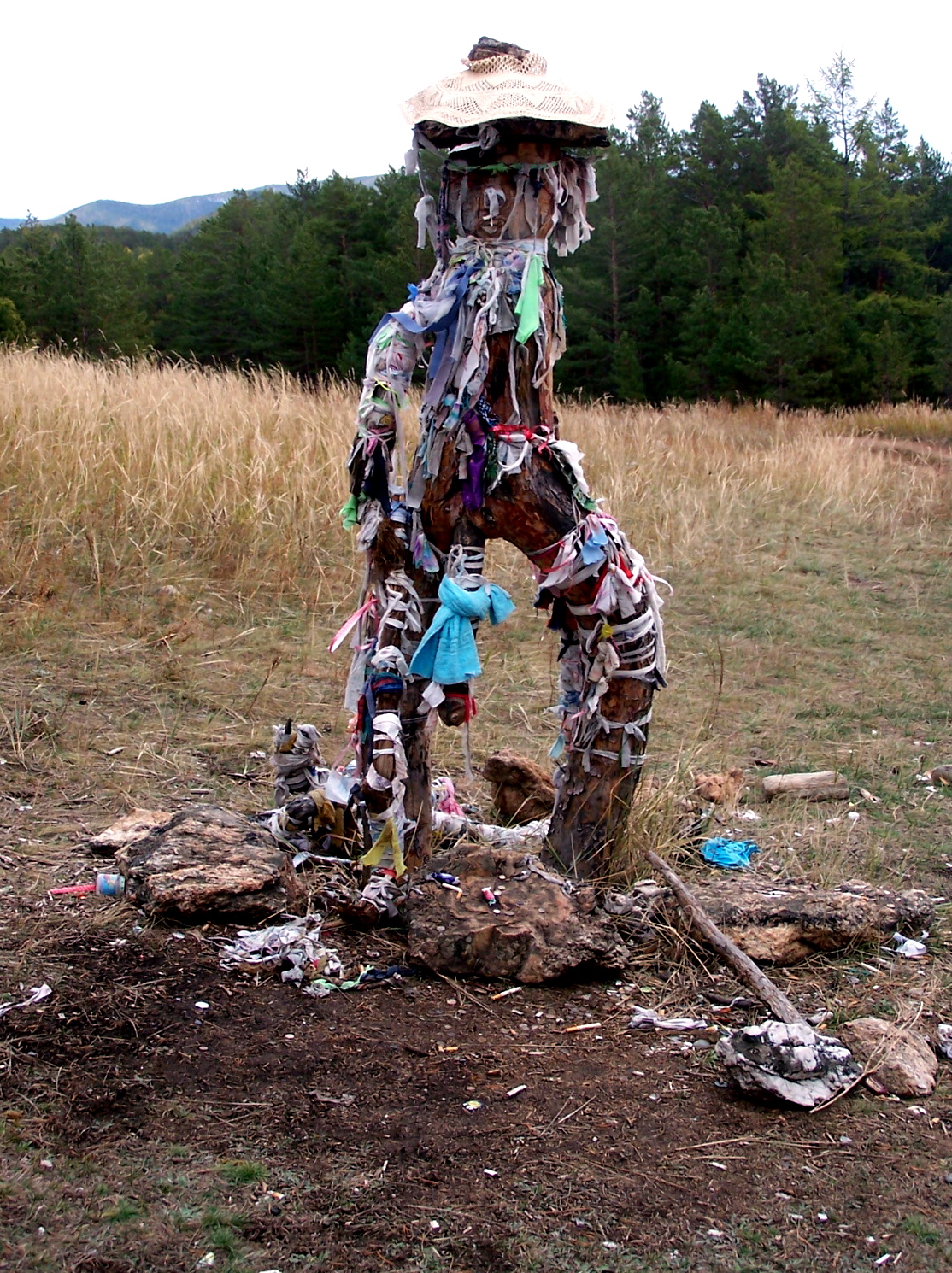
After hanging out a couple days…glad to be off the train…Gregory, a former University teacher of German, drove Bob and I, three Germans and a Pole on a half-day excursion to the north of the 70km long island to visit various geological sites and views of the lake but most especially to see a world renowned Shaman ceremonial circle called Three Brothers that is sacred to two faiths practiced here, Buddhism and Shamanism. Two years ago almost 300 Shamans from the world-over came together here. We lay a one rouble coin at the foot of the prayer flag pole while the “Sarma” or east wind blows fiercely over us.

The Buryats are of Mongolian descent…nomads who spent time herding their flocks between the southern shores of the lake and what is now northern Mongolia. They lived in felt-covered yurts and practised a mixture of Buddhism and Shamanism.

Gregory is driving Nikita’s four wheel drive van…a Russian vehicle designed 30 years ago and that was so successful they used it as an ambulance. “There is only one reason Russians sent the first man into space,” says Gregory the Kamikazi driver thumping over mud hole roads at least 90km per hour…”is because of the roads!” Later he says “we at the moment are using two wheels…if it gets really complicated we will use four!” “Normally we sacrifice two persons…usually 50% survive this trip!” Any of our U.S. vehicles would have rolled over at the first turn but this one mysteriously keeps it’s four wheels on the ground.

We pass through beautiful valleys with sheep and cattle farms…two of which are rich and have beautiful houses “because they don’t drink,” Gregory says. We pass by one small house of an old woman who lives alone with her cow…the rest of the houses in the area appear empty. We are shown an area that was a gulag during the Stalin era and whose inmates produced cans of caviar from the lake sturgeon that was then sent to the Kremlin for the enjoyment of the party bigwigs). I see a straggly triangular three wooden stick affair on the top of a hill and ask Gregory what it used to be. “Local KGB headquarters,” he says throwing his head back in laughter. I ask if the Russians and Buryats intermarry. “Seldom,” he says.

Traki, Karaites & Kibini Pastry

Trakai, on the outskirts of Vilnius, Lithuania, is a small settlement placed in the middle of five large lakes that is home to about 350 members of the Keraites, a minority community originally from Mesopotamia (modern day Iraq) who later migrated to Turkey. Keraite literally means “reader”. Their religion is a form of early Judaism mixed with reading of the Koran. (Imagine that !!—maybe we should inquire whether they have insights for current situations.)

Traki used to be one of Lithuania’s many capitals and the Keraites served as guards to the palace/castle…which Bob wanted to buy and occupy. We tasted the Karaites’ traditional dish called Kibinine, a small piping hot pastry stuffed full of delicious chopped meat and onions…juice squirting down one’s arms with each bite.

In an area selling crafts I met a woman who was exclaiming over two drunk locals…I asked her what country she was from and she said “San Francicsco.” She went on to say she was enjoying herself “but they won’t take our dollars here!” Speechless, I decided against asking if she had thought of visiting a money exchange window.