The Unseen During The Olympics

Watching the Olympics in Beijing has got me to thinking about China again.  I’d like to make a point about the legacy of the damage done in the last 50 years.

You might like to read “The Corpse Walker: Real-Life Stories, China from the Bottom Up” by Liao Yiwu.

Master Deng Kuan, abbot of the Gu Temple, established in the Sui Dynasty sometime around the turn of the sixth century, was 103 when the writer Liao Yiwu met him while mountain climbing in Sichuan Province, in 2003, and Yiwu’s oral histories begin with him.

This is from a review of the book by Howard W. French, a former career foreign correspondent for the New York Times, who covered China from 2003 to 2008 and who teaches at the Columbia University Graduate School of Journalism:

We know the Anti-Rightist Campaign of the late 1950s, the party went on a nationwide witch hunt for supposed liberals, reactionaries and capitalist roaders. Relating the Chinese experience amounts to a way of averting one’s eyes from something that may seem too hard to comprehend. It also encourages a kind of blurry forgetting, a storing away of things on a high, musty shelf that has been officially encouraged by China’s leaders, who are most keen to manage this story because they have the most to lose from a more vigorous and thorough telling. Thus the famous posthumous verdict by Deng Xiaoping, who judged that Mao had been 70 percent “correct” and 30 percent wrong. Yes, Mao’s errors, like the 30 million or more deaths from starvation caused by the crash industrialization of the Great Leap Forward, were doozies, but by and large he kept the country on the right path, avers Deng Xiaoping. Deng’s past has also benefited from studious airbrushing to avoid mussing up the standard portrait of him as a kindly, strong and nearly infallible second father to the nation. His enthusiastic role in violently suppressing “rightists” in the late 1950s has been placed out of bounds by the gatekeepers who determine which subjects can be researched and which cannot.

Master Deng’s life, and almost every other oral history in Liao Yiwu’s new book, appropriately subtitled Real-Life Stories, China From the Bottom Up , gives the lie to this entire vision, making this a deeply subversive book. I do not mean the reader should expect a tract or treatise on Chinese politics. Instead, Liao casts aside the official “facts” of events and replaces them with “memories”–with the resulting contrast between the censored record and interior consciousness revealing a post-1949 China that has never stopped being a traumatic place. At their root, all of Liao’s “real-life” stories share something fundamental: a fantastic, dreamy and nightmarish quality. Each story provokes a moment’s thought about its relationship to the truth.
Read More
China’s Opening

With an unlimited budget, China’s most illustrious film director has achieved a lush multimedia feast that I cannot imagine will be surpassed anytime soon. As expected it was embedded with the political…for local consumption as much as for the world.

Images…visions…symbols…and then…mirage…illusion, the ideal…and then…if you pay attention: signs.

In Tai Chi, movement in one direction often begins with a movement in the opposite direction… perfect alignment is created as hundreds and thousands of actors move as one when they have perfect awareness of where their neighbors are…water moves gracefully away from resistance and conflict…but then soldiers march to drumming rumble…

Soldiers? At an Olympics opening?

Great propaganda, China!

19th Anniversary of Tiananmen Massacre

The world must not forget.

China’s Grief, Unearthed

NYTimes.com
June 4, 2008

By Ma Jian

FOR three days last month, China’s national flag flew at half-staff in Tiananmen Square to honor the victims of the devastating earthquake in Sichuan. It was the first time in memory that China has publicly commemorated the deaths of ordinary civilians.

Crowds were allowed to gather in the square to express sympathy for their compatriots. Despite a death toll that has risen to nearly 70,000, the earthquake has shaken the nation back to life. The Chinese people have rushed to donate blood and money and join the rescue efforts. They have rediscovered their civic responsibility and compassion.
Read More

2008 Chef Olympics

My son the chef!

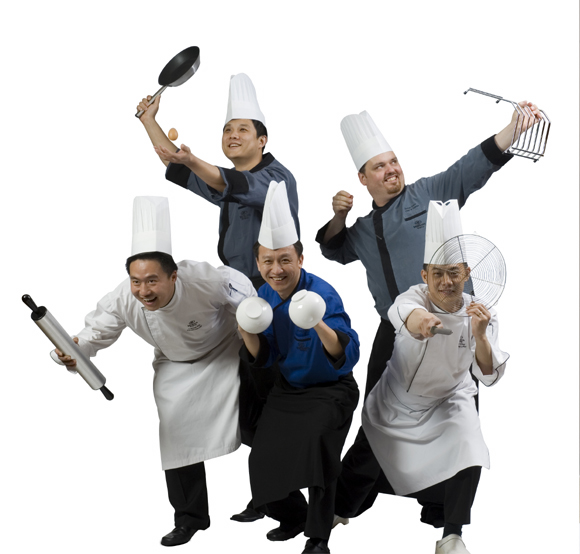
abp_5253.jpgHere is a picture of me and my chefs!!

Josh says: “The two in the grey are myself on the right, chef de cuisine of “One East On Third” Restaurant in the Hilton Hotel in Beijing, and Ivan, on the left is chef de cuisine of “Elements,” another restaurant in the Hilton. In the blue in the front is Boris my pastry chef, the guy in white on the left is William, the exec sous chef, and the guy in white on the right is Jason Ong the exec chef.”

Can you guess the sports??
Enjoy
Josh

A Blog For China Watchers

An excellent site in English for people wanting to understand China is “The China Beat…Blogging How The East Is Read.”

One of the writers is Peter Hessler Peter Hessler (b. June 14, 1968) who is an American writer and journalist. He is currently the Beijing correspondent for The New Yorker and a contributor to National Geographic. He has previously written for the Atlantic Monthly, the New York Times, the Boston Globe, the Wall Street Journal, and other American newspapers and magazines. He is best known for his two books on China: River Town: Two Years on the Yangtze (2001), a Kiriyama Prize-winning book about his experiences in two years as a Peace Corps volunteer teaching English in China, and Oracle Bones: A Journey Between China’s Past and Present (2006), a collection of journalistic stories he wrote living in Beijing. His stories are about ordinary people’s lives in China and are not politically themed.

In 1996, he joined the Peace Corps and spent the next two years teaching English at a local college in Fuling, China. Since 1999, he has lived in Beijing as a freelance writer.

Chinese Students Fight View Of Their Home

New York Times Article

By SHAILA DEWAN

Published: April 29, 2008

LOS ANGELES — When the time came for the smiling Tibetan monk at the front of the University of Southern California lecture hall to answer questions, the Chinese students who packed the audience for the talk last Tuesday had plenty to lob at their guest:

…….

As the monk tried to rebut the students, they grew more hostile. They brandished photographs and statistics to support their claims. “Stop lying! Stop lying!” one young man said. A plastic bottle of water hit the wall behind the monk, and campus police officers hustled the person who threw it out of the room.

Scenes like this, ranging from civil to aggressive, have played out at colleges across the country over the past month, as Chinese students in the United States have been forced to confront an image of their homeland that they neither recognize nor appreciate. Since the riots last month in Tibet, the disrupted Olympic torch relays and calls to boycott the opening ceremony of the Games in Beijing, Chinese students, traditionally silent on political issues, have begun to lash out at what they perceive as a pervasive anti-Chinese bias.

Last year, there were more than 42,000 students from mainland China studying in the United States, an increase from fewer than 20,000 in 2003, according to the State Department.

……..

As the U.S.C. session wound to a close, the organizer, Lisa Leeman, a documentary film instructor, pleaded for a change in tone. “My hope for this event, which I don’t totally see happening here, is for people on both, quote, sides to really hear each other and maybe learn from each other,” Ms. Leeman said. “Are there any genuine questions that don’t stem from a political point of view, that are really not here to be on a soap box?”

At that moment, the bottle hit the wall

Read the full article here.

A Question I Asked Myself

How did China learn how to spin Tibet?

From Salon.com

By Andrew Sullivan

“Trust a public relations professional living in Beijing to write by far the best analysis I’ve seen of the Olympic-size mess that China has created for itself through its actions in Tibet. Writing in his blog Image Thief, William Moss provides detail and perspective that significantly outclass How the World Works’ own effort to make sense of recent events.

It’s a must-read for China watchers. The entire piece is great, but one section jumps out. Here, Moss is summarizing the ways in which China has effectively managed perceptions of the riots for a domestic audience.

For a good overview of the Chinese approach to all of this, see Mark Magnier’s interesting article on China’s P.R. efforts around the Tibet riots. It includes this damning quote from Chinese blogger and journalist Michael Anti:

“The [Chinese] government is showing more confidence and learning more about spin,” said Michael Anti, a well-known Chinese blogger on a Nieman fellowship this year at Harvard. “They’ve learned more PR tactics from Western people. They see the way the White House and the Pentagon do it.”

Yet another legacy for the current administration to be proud of: teaching the Chinese Communist Party how to spin.”

Last Days In Jinghong

Joe, a gregarious Dai tour guide who hangs out at the tourist haunts looking for business invited me to join him and his family and friends, including a young French couple, at the new BBQ restaurants on the road along the river…the ones we couldn’t find before. His English was great and we shared many ideas. “My heart is breaking with the pollution in the environment,” he said. I told him about Amy’s International School and it’s mission to bring east and west together. Not against each other, he asked? No I said, entwining my fingers. Together. He liked that, as he entwined his own fingers. I told him he had one foot in each culture. He liked that too. Then he wrote a C on one shoe and a W on the other shoe as we laughed.

It is the Spring Festival here and fireworks are going off everywhere. Over 20-40 small dishes (river snails, cow’s skin, river moss and the like) we raised small glasses of beer too many times to shouted toasts…first among ourselves (we women toasted to our beauty…!) and then with a group of about 20 Anhi teachers sitting at the next table.

The next day a German woman and her son, who is getting an advanced degree in business in Hangzhou (SW of Shanghai), invited me to go with them to a small village on the other side of the Mekong River by ferry and then tuk tuk. She is here, like me, visiting her progeny. Her son has been here three years and is fluent in Mandarin…as are many of the Westerners I’ve met here. A group of American high school girls here in Jinghong on break from on a one year exchange program in Beijing to learn Mandarin amazed me with their ability to speak the language…their futures will be bright with opportunities.

I will be glad to leave the An Ya Jiu Dian Hotel, however. It is newer…clean and very nice with satellite TV and a hot and cold water cooler for about $7…and friendly owners. It’s just up the street from the western-oriented Mei Mei Restaurant on Man Lan Lu. But there is a restaurant down an ally behind the hotel…outside my window…that starts up about midnight…with many shouted toasts…and finally subsides about 3am. Ear plugs only take the edge off.

No lack of internet cafes on this street!

And I won’t miss the Asian toilet, if you know what I mean. The shower head is above the open-hole toilet in the floor so one must be very careful where one steps.

This And That In China

If there is anything a foreigner knows about China, it is that he or she knows that she knows nothing.

Today an American woman went to the Blind Massage School for accupuncture…but they don’t do accupuncture on foreigners. She doesn’t know why. Two different internet cafes refused me today even though I had been going to them before. I don’t know why. Meo! (No!) The price boards in the hotels show 680 Yuan but when they offer you a room it is lowered to 50 Yuan. Who gets to pay 680? No one knows. Some hotels won’t take foreigners at all. No one knows why.

Many Chinese are adamant about getting rid of that extra fluid in their throats. So they hack and spit…wherever they might be…trains…restaurants…on the floor next to their chairs in the internet cafes…

A Canadian wanted to go to Shanghai from Beijing a few weeks ago during the worst of the storm in China. A small boy with some English was willing to help him find the right window at the train station. But the vendor said she knew English and sent the boy away. The Canadian and his wife spent 30 hours on the train. When the train reached it’s destination they climbed off the train. But only when they looked at a menu in a restaurant they realized that they had gone to Xian instead of Shanghai. The ticket seller at the train station hadn’t understood them at all. So they looked at the unearthed soldiers or whatever they are called in Xian while they waited three days to get train tickets to Shanghai.

Whatever…

Chinese Logic

Already, one-third of China’s land mass is desert and it is losing 1500 square acres more a year to overgrazing, deforestation, urban sprawl and draught. Looking out the window of my plane from Beijing to Kunming, for the first half-hour I thought I was seeing snow. But then I realized the white was primarily in the valleys…and in what used to be terraced rice paddys. Didn’t make sense. I didn’t see a stick of wood or anything green. My god, I suddenly thought…this has all become desert! Don’t know how the few villages that could be seen below manage to grow anything to eat! Gave me the chills…like the ones you get when watching futuristic science fiction movies. As we approached Kunming for landing you could see thousands of acres of covered hothouses growing vegetables. So this is how much of China eats.

In Beijing the air seemed to be much improved this year from what I saw two years ago. But one night I woke up about 3am and looked out the window and you couldn’t see the buildings in the next block so I don’t know if China is manipulating the pollution.

Yet, President Hu goes on television to say that it is unfair for the developed countries to expect the developing “victim” countries to reduce their emissions at the same rate. China has four times more people, he says, and the developed countries have been contributing to the world’s pollution far far longer.

Don’t get the logic. My mother used to say “don’t cut off your nose to spite your face.”